Chapter 1: Fundamentals of Human Resource Management
 Call Kai
 Learn
Learn Practice Test
 Spaced Repetition
 Match
Match Flashcards
 Knowt Play
1/114

There's no tags or description
Looks like no tags are added yet.
Name | Mastery | Learn | Test | Matching | Spaced | Call with Kai |
|---|
No analytics yet
Send a link to your students to track their progress
115 Terms
Human resource management
is about the management of people in order to achieve desired results.
It simply refers to any system of people management.
People management
The term _____ is increasingly used as an alternative to HRM.
Senior Managers
Have an ultimate responsibility for how an organization manages people.
Responsible for good-governance.
Set the tone and make policy decisions.
Line Managers
They bring policies to life.
HR or People Management Professionals
Provide the advice, support, and services that both managers need.
HR architecture
is a comprehensive representation of all that is involved in HRM.
It incorporates the HR system of policies and practices, the roles and behaviour of managers and employees generally and the contribution made by members of the HR function
Distinctiveness, Consistency, Consensus
The HRM System should be:
High in ____
High in ____
High in ____
Strong HRM System
_____ → Powerful Organizational Cultures → Structured Employee Behavior → Desired Organizational Goals
HR Strategies
Direction of the HRM.
_____ and Corporate Strategies should be integrated.
HR Policies
Provide the specific guidelines on how the aspects of HR should be applied and implemented.
HR Practices
Involved in managing and developing people and in managing the employment relationship.
Provide the core of the system.
Affected by the stakeholder interests, corporate social responsibility, and HR Values
Stakeholder
is a person or body that has a legit interests in an organization.
Internal and external stakeholders
The system needs to satisfy the interests of ____ and ___.
____: owners of the company, senior management, and employees
____: customers, suppliers, clients, community
Stakeholder Interests
Stakeholder is a person or body that has a legit interests in an organization.
The system needs to satisfy the interests of internal and external stakeholders.
Internal: owners of the company, senior management, and employees
External: customers, suppliers, clients, community
Corporate Social Responsibility
Ethically conducting the business, taking account of the social, environmental, and economic impact.
Examples:
Scholarships of SM Foundation
Farmer Entrepreneurship Program (FEP) of Jollibee
Values for Managing People
”The customer is the boss.”
People are valuable.
Provide what is believed to be appropriate behavior and action
Strategic Human Resource Management (SHRM)
aligning people management with business goals, now and in the future.
Human Capital Management (HCM)
treating employees as valuable assets and investing in them to gain competitive advantage.
Knowledge Management
collecting, sharing, and using organizational knowledge effectively
HR Analytics
using data and statistics to make better HR decisions
Digital HRM
using digital technology and online tools to deliver HR services.
HR Procedures
step-by-step rules for handling employee-related actions and issues
Employment Law Compliance
making sure the organization follows labor and employment laws.
Organization
designing structures, jobs, and work systems so the organization runs effectively
Resourcing
planning for, attracting, selecting, and managing the people the organization needs.
Workforce planning
identifying how many people and what skills the organization needs now and in the future
Recruitment and selection
attracting applicants and choosing the best person for the job.
Talent management
attracting, developing, and retaining high-potential employees to achieve organizational goals.
Learning and Development
building employees’ skills, knowledge, and potential to meet organizational goals.
Performance Management
continuously setting, monitoring, and improving individual and team performance
Reward Management
recognizing and motivating employees through fair pay, benefits, and nonfinancial rewards.
Employment Relations (Employee Relations)
managing relationships between employees and management and giving employees a voice.
Employee Wellbeing
supporting employees’ physical, mental, financial, and work–life wellbeing.
International HRM
managing people across different countries in multinational organizations.
HR Processes and Procedures
the steps used to implement HR strategies, policies, and practices.
1980s
HRM emerged in the ____ as a new approach to managing people, based on theories from behavioral sciences, strategic management, human capital management, and industrial relations.
Normative
Early HRM was ___, meaning it identified problems in traditional personnel management and proposed solutions to improve it (Hendry & Pettigrew, 1990).
HRM aimed to address weaknesses in earlier personnel management, such as limited scope, poor coherence, weak direction, and outdated attitudes.
Harvard and Michigan/Matching Model
Two major US models shaped early HRM thinking:
Harvard Framework
(Beer et al., 1984):
HRM includes all management decisions affecting employee–organization relationships.
Emphasizes strategic alignment, viewing employees as assets, and assigning HR responsibility to senior management.
Michigan Framework / Matching Model
(Fombrun et al., 1984):
Focuses on aligning HR systems and organizational structure with business strategy.
Guest and Legge
In the UK, scholars and practitioners further developed and debated HRM:
____ (1987) highlighted HRM’s reliance on commitment, motivation, and organizational behavior theories.
_____ (2005) noted HRM’s adoption by both UK managers and academics
Storey
____ (1989) distinguished between two forms of HRM:
Hard HRM – focuses on strategic, quantitative, and business-driven management of people.
Soft HRM – emphasizes communication, motivation, leadership, and employee relations.
Later research suggested that hard and soft HRM are not opposites but complementary approaches (Keenoy, 1997; Truss et al., 1997).
Hard HRM
focuses on strategic, quantitative, and business-driven management of people.
Soft HRM
emphasizes communication, motivation, leadership, and employee relations
Optimistic view
HRM can improve employee wellbeing and performance through supportive HR practices, leading to mutual gains for employees and organizations
Pessimistic view
HRM primarily benefits employers by intensifying work and exploiting employees (profits before people).
Exploitative but disguised as humanistic
Early critics argued that HRM promotes employee involvement on management’s terms, with power remaining firmly with employers (Fowler, 1987).
HRM has been described as ______, such as:
“Wolf in sheep’s clothing” (Keenoy, 1990)
“Macho-management dressed up as benevolent paternalism” (Legge, 1998)
Capitalist system
The radical critique of HRM views workers as commodities within a ____, where employee wellbeing is secondary to business needs (Guest, 1999).
Philosophy of people management
Treating employees as stakeholders
Treating employees as people rather than exploitable resource
HRM (Traditional Version)
Concept / Philosophy: Focus on control, order, and efficiency; employees seen through performance and competition
Ownership and Priority: Shareholder- and senior management–driven; employees seen as factors of production
Approach: Trend-driven and reactive
Employment Relationship: Unitary view; legal contracts; compliance-focused; limited employee voice
Work Design: Work intensification; mechanistic jobs
Analytics: Descriptive data; annual engagement surveys
Digital HR: HR information systems (HRIS)
Learning and Development: Formal, systematic training; elearning
Talent Management: Buy top talent; exclusive and elitist approach
Performance Emphasis: Financial outcomes; individual performance
Rewards and Incentives: Pay-focused; individual bonuses; highly differentiated rewards
Performance Management: Formal, annual, results- and payfocused system
People Management
Concept / Philosophy: Focus on collaboration, ethics, and treating people as valued individuals
Ownership and Priority: Multi-stakeholder focus; employees seen as key contributors; wellbeing prioritized
Approach: Evidence-based and research-driven
Employment Relationship: Pluralist view; psychological contracts; partnership and mutual gains; strong employee voice
Work Design: Emphasis on job quality; flexible working arrangements
Analytics: Predictive analytics; frequent pulse surveys
Digital HR: Web-based tools, social media, cloud systems, chatbots, smartphones
Learning and Development: Experiential, self-managed, social, and blended learning
Talent Management: Develop everyone’s talent; inclusive and “grow your own” approach
Performance Emphasis: Balanced scorecard; collective and team performance
Rewards and Incentives: Total rewards; recognition; profit sharing; addressing low pay
Performance Management: Continuous feedback; developmentfocused; line managers as performance leaders
Human Capital Management
Focuses on employees’ knowledge, skills, abilities, and capacity to innovate.
Employees are treated as valuable assets to be invested in through resourcing, talent management, and learning and development.
The goal is to increase the value of human capital to support short- and long-term performance and gain competitive advantage.
Human capital
refers to the knowledge, skills, abilities, education, experience, and health of employees in an organization
Human capital theory
views people as assets and argues that investing in employees generates valuable returns for organizations.
Intellectual capital
The knowledge and skills within an organization that create value.
Social capital
The value of relationships and networks that enable knowledge sharing.
Organizational capital
The institutionalized knowledge embedded in systems, processes, and routines
Absolute measures
single rater, multiple rater, and aggregation of individual measures
Specific measures
workforce composition, recruitment and retention, skills, qualifications, and competencies, performance management, employee relations and voice, pay and benefits, regulatory compliance, organization development and design
Internal Environment
Environmental Factors:
The combination of an organization’s social and technical systems, workforce characteristics, union presence, and financial conditions that shape how work and HR activities are carried out.
External Environment
The economic, competitive, technological, and regulatory forces outside the organization that shape its operations and HR practices.
Labour Market
The system where workers offer their skills and employers demand labor in exchange for wages and employment conditions.
In the Philippines:
The unemployment rate has generally been low and stable, around ~3.8 – 4.3 % in 2025, indicating most working-age Filipinos who want jobs are finding them.
Underemployment (workers wanting more hours or additional work) remains a significant concern, ranging around 10 % – 14 % in 2025.
Labour Process Theory
Developed by Karl Marx (translated 1976).
Capitalists extract surplus value by paying labour less than the value it produces.
Work processes are designed to maximize surplus extraction.
Workers’ productive capacities are subordinated to capitalist control, leading to alienation and reduced human potential.
Braverman
____’s contribution (1974)
Labour processes theory
Modern management techniques, mechanization, and automation intensify managerial control.
Work becomes de-skilled in both offices and factories.
Management aims to remove worker control over the labour process.
Reflects Taylorism (scientific management): task specialization, measurement, and treating workers like efficient machines.
Criticisms of Braverman’s view
Seen as overly simplistic (Littler & Salaman, 1982).
Labour processes are shaped by multiple factors, not just technology.
Neglects varied and adaptive forms of managerial control (Friedman, 1977).
Storey (1995) argued the theory has become fragmented and weakened.
Newton and Findlay
Contemporary perspective
____ (1996) argue labour process theory still explains managerial control.
Job performance measurement and assessment are central control mechanisms.
Management continually refines control to ensure compliance and maximize surplus value.
This perspective is relevant in many, though not all, organizational contexts.
Agency Theory
Focuses on the relationship between principals (owners/managers) and agents (employees).
Assumes agents may not always act in the best interests of principals.
Emphasizes the need for monitoring, control, and supervision of employee activities.
Management Implications
Agency Theory
______:
Principals must reduce ambiguity by clearly setting objectives.
Performance monitoring and evaluation are used to ensure goals are achieved.
Control mechanisms are designed to align employee behavior with organizational interests.
Managerialist
Criticisms of Agency Theory:
Described as “_____” by Gomez-Mejia and Balkin (1992).
Criticized for adopting a management-centered perspective.
Views employees as objects to be controlled through rewards and punishments.
Armstrong (1996) argues it assumes employees cannot be trusted, portraying a negative view of human motivation
Exchange Theory
Explains organizational behaviour in terms of the rewards and costs incurred in the interaction between employers and employees.
Rewards
payouts that satisfy needs emerging from the interactions between individuals and their organizations.
Costs
fatigue, stress, anxiety, punishments and the value of the reward that people have lost because of the lack of opportunity.
Outcomes
rewards minus costs. If positive, the interaction yields a ‘profit’ and this is satisfactory as long as it exceeds the minimum level of expectations.
Level of comparisons
people evaluate the outcome of an interaction against profit they are foregoing elsewhere
Unitary Perspective
HRM seeks to increase employee engagement and commitment.
Encourages employees to share organizational values and align personal goals with organizational objectives.
Based on a unitary frame of reference, assuming harmony and shared goals.
Organizations are viewed as integrated teams working toward common objectives (Gennard & Judge, 2005).
Pluralist perspective
Views organizations as coalitions of different interest groups.
Accepts the legitimacy of diverse values, interests, and goals.
Considered more realistic than the unitary approach.
Emphasizes respect for the interests of various stakeholders, not just management
Job demands resources model
Developed from research by Demerouti et al. (2001) and Crawford et al. (2010).
Categorizes job characteristics into job demands and job resources.
Challenging demands
Job demands
Complexity, responsibility, and workload that can stimulate growth and learning.
Hindrance demands
Job demands
Role ambiguity, conflict, and overload that obstruct performance and well-being.
Job Resources
Include autonomy, supervisory support, feedback, access to information, and development opportunities.
Relationship to Engagement (JD & JR)
Challenging demands and job resources are positively related to employee engagement.
Hindrance demands are negatively related to engagement.
Attitudes to work
People differ in how they perceive work.
Some view work mainly as a means to an end (e.g., income).
Others see work as a source of fulfillment and satisfaction.
Individuals who derive pleasure and status from work tend to be the highest-paid workers.
What is happening to work
Shift toward organic structures with lateral processes, networking, and flat/lattice hierarchies.
Decline in large-scale industrial/manufacturing jobs.
Rise in service work and knowledge work (e.g., professional services, R&D).
More women, increased ethnic diversity, higher education levels, and an ageing workforce.
Employees increasingly work for multiple employers over their careers.
Growth of part-time work and flexible arrangements.
Persistence of low-skill, low-wage “bad jobs” limiting career progression
Significant increase in home working/remote work due to COVID-19 pandemic.
Impact of emerging technologies
Emerging technologies focus on artificial intelligence (AI), machine learning, and robotics.
OECD (2019) predicted 14% of jobs may disappear in 15–20 years due to automation; another 32% will change significantly.
Taylor Review (2017) and Deloitte (2015) highlight job creation alongside substitution, emphasizing augmentation of human work.
Technology-driven change has already created more jobs than lost but may involve a time lag between losses and gains.
Mundane tasks are automated, allowing employees to focus on higher-value work.
AI/Automation can be deskilling and disempowering, but more likely to enable higher-skilled tasks.
Work Intensification
The process of increasing employees’ workload by adding more tasks or reducing the time to complete them.
Cardiff University (2012) study: _____ rose from 31.5% in 1992 to 45.3% in 2012 of the workforce.
Contributing Factors
Introduction of new computerized equipment or ICT.
Increased competitiveness in the market.
Pressure on employers to cut costs.
Shift in power dynamics between employers and employees.
Other Observation
High work intensity was not directly linked to downsizing or reductions in workforce size.
Volatility, Uncertainty, Complexity, Ambiguity
VUCA World
Vision, Understanding, Clarity, Agility
VUCA Prime
Gig Economy
A labour market dominated by short-term contracts or freelance work instead of permanent employment.
Workers are treated as independent contractors with no guaranteed pay or employment rights.
Work schedules are often last-minute, creating a perceived flexibility that may be limited in practice.
Critics argue that gig workers face pressure or incentives to work when employers need them
Named after “gigs,” referring to individual, brief performances.
Dependent contractor
Gig Economy
Policy Suggestion
The Taylor Review recommended a new category: “_____”, providing some employment benefits and wage protection between full employment and freelance contracting.
Demographics
Age: Nearly 40% are 18–29 years old, compared to 21% of other workers.
Gender: Slightly more likely to be male (56%).
Zero-hours contract
An agreement where an individual may be asked to work, but there is no guaranteed minimum number of hours.
Specifies pay for hours worked and conditions for offering or declining work.
Most common in retail and hospitality or roles with fluctuating work demand.
Home and Hybrid working
____: Working full-time or part-time from home.
____: Splitting the workweek between home and the normal workplace.
TUC (2022) survey: regular home working tripled during the Covid-19 pandemic
PwC (2021) survey: 77% of respondents prefer a hybrid model
Fire and rehire
_____: Redundancy followed by reengagement on worse terms, showing pursuit of profit over employee welfare.
By 2025, half of work tasks may be automated.
Over 75 million jobs displaced, but an equal or greater number of new jobs created.
Addressing social justice and inclusion of marginalized groups is essential for a fair future of work
AMO Model
Employee performance depends on Ability, Motivation, and Opportunity.
Provides guidance on the HR practices needed in a High-Performance Work System (HPWS).
Linked to improved financial performance.
Despite disagreement on specific practices, most HPWPs:
Enhance ability/skills
Enhance motivation
Enhance opportunity/empowerment
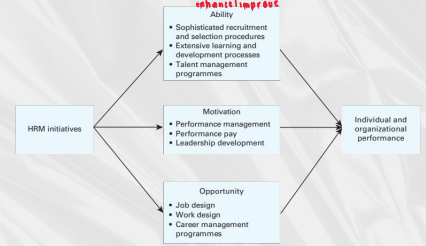
Organizational performance
Five ways HR improves ____:
Creating a climate for performance
Promoting high-performance working through HPWS
Enhancing motivation and engagement
Developing resourcing and learning & development practices
Strengthening performance management processes
Fairness
The consistent, unbiased, and just treatment of individuals with due consideration of their needs and in ways that employees perceive as procedurally just.
Equity Theory
reflecting perceived fairness based on deserved differences rather than equal treatment for all.
Justice
process of treating people in a way that is inherently fair, right and proper
Procedural Justice
employees’ perceptions that organizational procedures and decision-making processes are fair, consistent, transparent, and take their views and needs into proper account.
Distributive Justice
ensuring that people are rewarded equitably in comparison with others in the organization and in accordance with their contribution.
Social Justice
the principle that organizations must respect employees’ inherent human rights by treating them justly, equitably, and with dignity, regardless of broader organizational gains.