Exam 3 Competitive Effectiveness
 Call Kai
 Learn
Learn Practice Test
 Spaced Repetition
 Match
Match Flashcards
 Knowt Play
1/170

There's no tags or description
Looks like no tags are added yet.
Name | Mastery | Learn | Test | Matching | Spaced | Call with Kai |
|---|
No analytics yet
Send a link to your students to track their progress
171 Terms
Motivation
Internal and External factors that stimulate desire and energy in people to be continually interested and committed to a job; to make an effort to attain a goal
Process Theories (How Motivation Occurs)
Emphasize how individuals are motivated
Focus on steps occurring when individual is motivated
Content Theories (Understand Human Needs)
Emphasize individual’s internal characteristics
Focus on understanding what needs individuals have and how to satisfy those needs
Four Important Theories of Motivation (How motivation occurs)
Needs-Goal Theory
Vroom Expectancy Theory
Porter-Lawler Theory
Equity Theory
Needs-Goal Theory
Motivation begins with individual feeling a need
Need transforms into behavior that supports the goal of performance behavior
Individuals who set goals have an easier time focusing on relevant activities
Examples, Sports - Draft Picks, Changing Academic Majors, Internships
Goal-Setting Theory
Setting ambitious but attainable goals can motivate workers and improve the performance if the goals are accepted, accompanied by feedback, and facilitated
Vroom Expectancy Theory of Motivation
A bit more sophisticated than Needs-Goal Theory
Vroom is based on the premise that ‘felt needs’ drives human behavior
Introduces Motivational Strength:
An individual’s desire to perform a behavior
Their motivation fluctuates as individual’s desire increases or decreases
Formula:
Motivation Strength = Perceived value of the result of performing behavior x Perceived probability that the result will materialize
Porter Lawler Theory of Motivation
Comprehensive Theory - Builds upon Needs-Goal And Vroom
Amount of effort is determined by value of rewards and the probability of reward being recieved
Task accomplishment is determined by ability to do a task and perception of task required
Value of reward is determined by intrinsic and extrinsic factors
Perceived fairness of rewards influences amount of satisfaction produced by rewards
Intrinsic Rewards
Come from directly performing the task
Extrinsic Rewards
Extraneous to the task, compensation
Equity Theory of Motivation
Employee’s perception and/or view of reality of their inputs in comparison to others in similar situation
Inputs = what I put into my job
Outputs = what I get from my job
Employees will respond in different ways
Perceptions of equity or inequity
Work Assignments, Promotions, Compensation, Rating Reports, Office Assignments
All of these situations are emotionally charged as they relate to perceptions of self-worth
Content Theories of Motivation (Employee Internal Characteristics)
Maslow’s Hierarchy of Needs
Alderfer’s ERG Theory
Argyri’s Maturity-Immaturity Continuum
McClelland’s Acquired Needs Theory
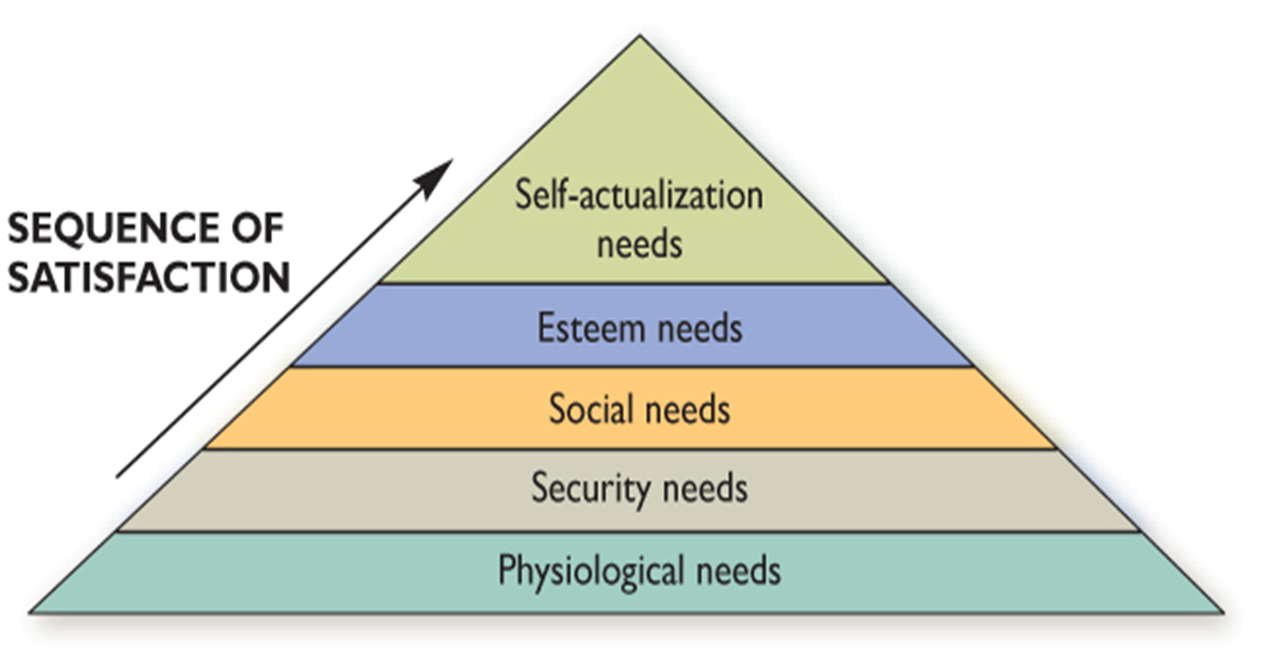
Maslow’s Hierarchy - Management Perspective
People have a range & hierarchy of needs which they seek to satisfy
Higher level needs could only be met once the foundation ones have been satisfied
Analogous to priority setting in the business world
Alderfer’s ERG Theory of Motivation
E = Existence Need
Need for physical well-being
R = Relatedness Need
Need for satisfying interpersonal relationships
G = Growth Need
Need for continuing personal growth and development
Differs from Maslow’s in that the levels can be activated differentially at different times, depending upon the situation
Example: work for income, though look elsewhere for fulfillment … community service
Argyris’s Maturity-Immaturity Continuum
Human needs progress along a continuum focusing on the personal and natural development of people
People naturally progress from immaturity to maturity … more awareness and control over their own destinies
Maturity-Immaturity Progression (Argyri’s Maturity-Immaturity Continuum)
State of passivity - age related
State of dependence - decreases generally
Capable of behaving in many different ways - situational
Deeper, more lasting interests - know what is more important
Long-time perspective - knowledge to wisdom
Control over self actions and reactions
Acquired Three Needs Theory - McClelland
Achievement - challenges, risks, responsibilities
Has a strong need to set and accomplish challenging goals
Affiliation - Team centered management style
Favors collaboration over competition
Power - Decision Making
Wants to control and influence others
Suggests the dominant motivator depends upon life experiences and culture
Strategies for Motivating Employees (with the process and content theories as a backdrop)
Managerial Communications
Theory X & Theory Y
Effective Job Design
Monetary Incentives
Nonmonetary Incentives
Managerial Communications
Most basic motivation strategy for managers
Verbal, nonverbal, written … communicate often!
Communicating is a basic tool for satisfying human needs of organization members
McGregor’s Factor X/Y Theory
Managers have 2 beliefs about employees:
Theory X - Majority of employees need to be closely managed as they generally dislike work
Theory Y - Majority of employees seek responsibility, do not need much supervision
Can unlock value, strong performance
Importance of Job Design and Characteristics
Job Design = Design of organizational members’ roles
Four Elements - balance general vs. specialized roles
Job Rotation - engagement, reduces absenteeism
Job Enlargement - leverage, satisfaction
Job Productivity and Enrichment
Flextime/Flexibility
Herzberg’s Two-Factor Theory
Hygiene, Maintenance Factors - relate to workplace
When these factors are undesirable, the individual becomes dissatisfied
Examples: Supervision, Relationship with Peers, Salary
Motivating Factors - relate to the work itself
When these factors are compelling, the individual is satisfied and motivated to perform tasks
Examples: Opportunity for Recognition, Responsibility, Personal Growth
Fundamentally, a combination of the two factors both increase job satisfaction and enhance the job performance!
*All falls into point 3, Job Productivity and Enrichment
Flextime (Advantages vs. Disadvantages)
Advantages:
Improved employee attitude and morale
Accommodation of working parents
Decreased Absenteeism (the practice of regularly staying away from work or school without good reason.)
Disadvantages:
Leadership capable of adjusting?
Difficulty in planning work schedules
Collaboration - Spotaneously
Monetary Incentives (Extrinsic)
Base Competition
401 (k)’s, ESOPs - Employee Stock Ownership Plans
Profits Sharing & Bonuses
Paid ‘Leaves’
Nonmonetary Incentives (Intrinsic)
Promoting from within policy
Emphasis on Quality
Recognition!!
Autonomy
Freedom to make decisions, take ownership of work, fosters a sense of personal responsibility
the capacity to make informed, uncoerced decisions and act according to one's own values, rather than external control
Leaders
Those able to influence others and possess managerial authority and responsibility
The process of directing the behavior of others toward the accomplishment of an objective; getting things accomplished through people
Directing
Causing individuals to act in a certain way or to follow a particular course of action
Leadership vs. Managment
Leadership:
Subset of management
Emphasizes vision; relationships; strategy
Cares about and focuses on people doing the job
Management:
Organization processes; execution
Emphasizes behavioral and nonbehavioral issues
Makes sure the job gets done
Leaders focus on vision, innovation, and empowering people, while managers focus on processes, structure, and executing tasks
Social Influence Conecept
The leader’s ability to effect a change in the motivation, attitudes, and behaviors of others
Evolution (components) of leadership development:
Traits, behaviors, situational, transformative
Trait Theories of Leadership
Isolate characteristics that differentiate leaders from non-leaders
Assumed leaders are born and not made (the great person theory of leadership)
Described leaders based on a set of characteristics
Ohio State Behavioral Studies Highlights
Structure Behavior
Consideration Behavior
Structure Behavior (more task focused/job centered)
Extent to which a leader defines and structures his or her role and the roles of employees to attain goals
Consideration Behavior (More relationship focused/people)
Extent to which a leader has job relationships characterized by mutual trust, respect for employees’ ideas and regard for their feelings
Situational Theories of Leadership
Leadership success and effectiveness depends on a combination of
SL = f(L,F,S): Leader, Follower; Situation
Life Cycle Theory Leadership
Leaders need to focus on the maturity and readiness of followers - be flexible
Leaders should adjust their leadership style in accordance with the readiness of their followers
Maturity
Ability of followers to perform their jobs independently, assume additional responsibilities, and desire to achieve success
Life Cycle Theory of Leadership
Leader Delegating
Low task, low relationship
Push down decisions - more routine, repetitive jobs
Life Cycle Theory of Leadership
Leader Directive
High task, low relationship
Needs to get done, more of an urgency
Fiedler’s Contingency Leadership Model
A bit more rigid and difficult to sustain proper match between the leader’s style of interacting with employees, the job at hand, and the leader’s degree of control over a situation
Change the organization situation to match the individual’s leadership style
Change leader-member relations - align with like minded employees, same backgrounds
Change leader to fit situation - (new dept. to be created existing dept. to be overhauled)
Change leaders position power - established team? new hires? maybe even give a higher rank?
Leadership: Path Goal Theory
Leaders’ style is flexible, can change to adapt to a situation
Leader outlines goals for followers
Leaders clears path that followers should take
Followers achieve goals and earn rewards contingent on doing so
Two classes of situations: Environmental and Employee variables
Assumes leader’s style is flexible and can be changed to adapt to the situations at hand
Path Goal Theory: Four Primary Types of Behavior
Directive Behavior
Supportive Behavior
Participative Behavior
Achievement Behavior
Directive Behavior
Telling followers what to do and how to do it
Supportive Behavior
Being friendly with followers and showing interest in them as human beings
Participative Behavior
Seek suggestions from followers regarding business operations to the extent followers are involved in making important organizational decisions
Achievement Behavior
Setting challenging goals for followers to reach and expressing/demonstrating confidence they measure up to the challenge
Employee oriented behavioral leader
Interpersonal relations, takes a personal interest in the needs of employees, and accepts individual differences
Job centered behavioral leader
Technical or task aspects of a job, is concerned mainly with accomplishing tasks, and regards group members as means to accomplishing goals
Tannenbaum and Schmidt Leadership Continuum
Continuum of Leadership that emphasizes decision-making processes, popular common refrenced
Leaders and Managers are successful decision makers only if the method they use to make decisions appropriately reflects the leader, the follower, and the situation
Depicts a range of how leaders make decisions
Boss-Centered Leadership
Use of authority by the manager
Subordinate-Centered Leadership
Area of freedom for subordinates
Tannenbaum and Schmidt Leadership Continuum; Three Primary Forces
Forces in Manager
Forces in Subordinates
Forces in Situations
Tannenbaum and Schmidt Leadership Continuum;
Forces in Manager
Values-Confidence in Subordinates- Personal Leadership Strengths - Tolerance for Ambiguity
Tannenbaum and Schmidt Leadership Continuum;
Forces in Subordinates
Need for Independence - Readiness - Interest - Knowledge - Experience - Expectations
Tannenbaum and Schmidt Leadership Continuum;
Forces in Situation
Organization Type - Group Effectiveness - Problem to Solve - Time Available
Laissez-Faire
Area of freedom for employees
Participative
A mix of Laissez-Faire and Autocratic
Autocratic
Use of authority by the manager
Transformational Leadership (Focus on outcomes and how you get there)
Acting like a leader - integrity with authenticity
Inspire organizational success by affecting follower’s beliefs
Create vision - Build Commitment - Facilitate organizational change
Know the people you are leading, coach and council them
Stimulate action, make others think and take responsibility
Inspire others to transcend their own interests for the benefit of the organization
Emotional Intelligence
Ability to manage ourselves and our relationships effectively through awareness of and effective response to our emotions
Strong Leadership = IQ + EQ
IQ - Knowledge, competencies, technical skills
EQ - Social skills, engagement, relationship building
Servant Leadership (A term on Transformational Leadership)
Servant Leaders: Good listeners, persuasive, aware of their surroundings, empathetic, stewards, consultative coaches
Places high value on service to others over self-interests
Leader’s primary role is to help followers in quests to satisfy personal needs, aspirations, and interests
Moral courage - strength to take actions consistent with moral beliefs
Defining DEI, Surface Level
generally immutable
almost immediately observable
measured in simple and valid way
Examples: Race, ethnicity, sex, age
Defining DEI, Deep Level
Subject to more interpretation
More mutable
Examples: attitudes, knowledge, value, skills
Diversity - Macro Level Factors
Population is growing more slowly
Workforce is getting older
Growing presence/impact of women in the workforce
Minorities will make up a larger share of new entrants, demographics changing
Immigration is increasing in general population and the workforce
Reverse Mentoring
Pairing a senior employee with a junior employee to transfer new knowledge
Ethnocentrism
Belief one’s group, culture, country, and customs are far superior to those of other groups
Prejudice
Preconceived judgment, opinion about an issue, behavior, or group of people
Stereotype
Positive or negative assessment of a group or their perceived attributes
Discrimination
Unjust/inequitable treatment based upon stereotypes or prejudice
Tokenism
Definition: The superficial or symbolic effort to promote equality and inclusion by hiring or featuring a small number of people from underrepresented groups to avoid accusations of discrimination.
Unacceptable reference to one of the few members of a group within an organization
Strategies for Promoting Diversity in Organizations
Hudson Institute Strategies
Equal Employment and Affirmative Action
Diversity Through Organizational Commitment
Promoting Diversity Through Pluralism
Hudson Institute Strategies (“think tank” take actions on)
The Hudson Institute is a prominent Washington, D.C.-based right-of-center think tank established in 1961, known for promoting American leadership, global security, and free-market economics. It focuses on interdisciplinary studies, particularly in defense, international relations, technology, and energy.
Reconcile the conflicting needs of women, work, and families, for equitable distributions
Erase the biases for a broader skilled and engaged workforce
Improve the education and skill of all workers, invest in greatest asset; HUMAN CAPITAL
Equal Employment Opportunity Commission (EEOC)
A federal agency that enforces laws prohibiting workplace discrimination, harassment, and retaliation based on race, color, religion, sex (including pregnancy and LGBTQ+ status), national origin, age (40+), disability, or genetic information
Affirmative Action (Positive Action)
Eliminate barriers and increase opportunities for underutilized and/or disadvantaged individuals
Reverse Discrimination
the alleged unfair treatment of members of a dominant or majority group (e.g., race, gender, age) in favor of historically disadvantaged minorities
Promoting Diversity in Organizational Commitment
Commitment to Diversity (continuum), a framework for organizations and managers
from
Broad based diversity programs and efforts
to
no diversity programs and efforts
Promoting Diversity Through Pluralism
Pluralism: Managers strive to create an environment where differences are acknowledged, accepted, and contributed
ChatGPT: an active, positive engagement with diversity rather than mere tolerance, where distinct religious, ethnic, or social groups coexist, interact, and contribute to a shared society
Five major categories and strategies to achieve pluralism
Golden Rule Approach
Assimilation Approach
Righting the Wrongs Approach
Culture-Specific Approach
Multicultural Approach
Golden Rule Approach
Be sure to understand others frame of reference … empathy!
Assimilation Approach
avoid! involves exerting undo pressure
Righting the Wrongs Approach
embrace policies to create a more equitable set of conditions
Culture-Specific Approach
Train on norms and practices of another culture (Example: cultural immersion training in multinational corporations)
Multicultural Approach
Build into the fabric of the organization!
Managing a Diverse Workforce; Donaldson/Scannell Four Stage Model
Stage 1: Unconscious Incompetence - managers unaware, development required
Stage 2: Conscious Incompetence - on the learning curve
Stage 3: Consciously Competent - much more deliberate and engaged
Stage 4: Unconscious Competence - most effective, part of a managers engagement style
Corporate Social Responsibility Skill
Ability to take action that protects & improves both the welfare of society and the interests of the organization
Environmental Protection Agency
Formulates and enforces environmental standards in such areas as water, air, and noise pollution
Consumer Product Safety Commission
Strives to reduce consumer misunderstanding of manufacturer’s product design, labeling, and so on, by promoting clarity of these messages
Occupational Safety and Health Administration
Regulates safety and health conditions in nongovernment workplaces
Approaching to Meeting Social Responsibilites
Continuum of managerial studies
Requirement: Firm only does what is required by law … the must do’s …
Recognition: Firm has obligations to pursue both profit and social goals
Believing: Firm has both profit and social goals
Management: The Philanthropy Challenge
Promote welfare of others through general monetary donations to social causes
Aim to increase the well-being of people and society
Managers should donate to causes that in some way benefit both the organization and the society
Sustainability
Degree to which a person or entity can meet its present needs without compromising the ability of others to meet their needs
Examples: conservating natural resources, reducing waste, recycling, environment/climate, carbon credits
Sustainable Organization
An organization that can meet their present needs without compromising future generation’s ability to meet theirs
The Triple Bottom Line
Management should work toward making their organizations sustainable in three areas: economy, environment, and society
People, Profit, Planet
Why companies should purse Sustainability?
Three reasons why managers should build sustainable organizations
Increased Profits
Increased Productivity and Engagement
Increased innovation
Other Considerations: Talent Attraction and Retention; Stakeholder Management
Ethical Management
The capacity to reflect on values in the corporate decision-making process
To determine how these values and decisions affect various stakeholder groups
Establish and reinforce how to use ethics in daily operations
Value
Heart of any organization; what is considered important for or against something
Values Statement
Formal document that summarizes the primary values within the culture of an organization
Norms
appropriate attitudes and behaviors in day-to-day work and interactions