Unit 8 - Key Terms to Remember
 Multiple Choice & FRQ
 Call Kai
1/101

Earn XP
Description and Tags
FInd this list on page 652 of "Environmental Science for the AP Course 4th edition, ANdrew Friedland & Rick Relyea"
102 Terms
Point Source + ie. ___, ___ ___, __
A distinct location from which pollution is directly produced + ie. factories, sewage plants, smokestacks
Nonpoint Source + ie. __ region, __ community, __ __ storm runoff
A more diffuse area that produces pollution + ie. farming region, suburban community, parking lot storm runoff
Homeostasis
The ability to experience relatively stable internal conditions within ones body
Polychlorinated biphenyls (PCB’s)
A group of carcinogenic industrial compounds that were once used to manufacture plastics and insulat electrical transformers.
Neurotoxin
A chemical that disrupts the nervous systems of animals.
Carcinogen
Chemicals that cause cancer through cell damage leading to uncontrolled growth.
Mutagen + ie. ___, ___, ___
Generally carcinogens that damage cell genetic material + ie. asbestos, radon, formaldehyde
Teratogen + ie. ___
Chemicals that interfere with normal fetus/embryo development + ie. thalidomide
Allergen
Chemicals that cause allergic reactions.
Endocrine disruptor
Chemicals that interfere with hormone functions
Wastewater
Water produced by livestock operations and human activities
Levee
An enlarged bank built upon each side of a river
Dikes
Structures built to prevent ocean water floods
Dam
A barrier that runs across a river or stream to control water flow
Reservoir
The water body created by damming a river or stream
Fish ladder
A stair-like structure wth water that allows migrating fish passage around dams
Desalination (Desalinization)
A process for obtaining fresh water by removing the salt from salt water
Distillation
A process of desalinization in which water is boiled and the resulting steam is captured and condensed to yield pure water
Reverse osmosis
A process of desalinization in which water is forced through a thin semipermeable membrane at high pressure, where salt cannot pass the membrane.
Brine
High salt concentration wastewater from reverse osmosis.
Eutrophication
Deadzones without oxygen caused by algae blooms which are triggered due to excess nutrients in waterbodies that alter food webs resulting in excessive algae which consumes said oxygen.
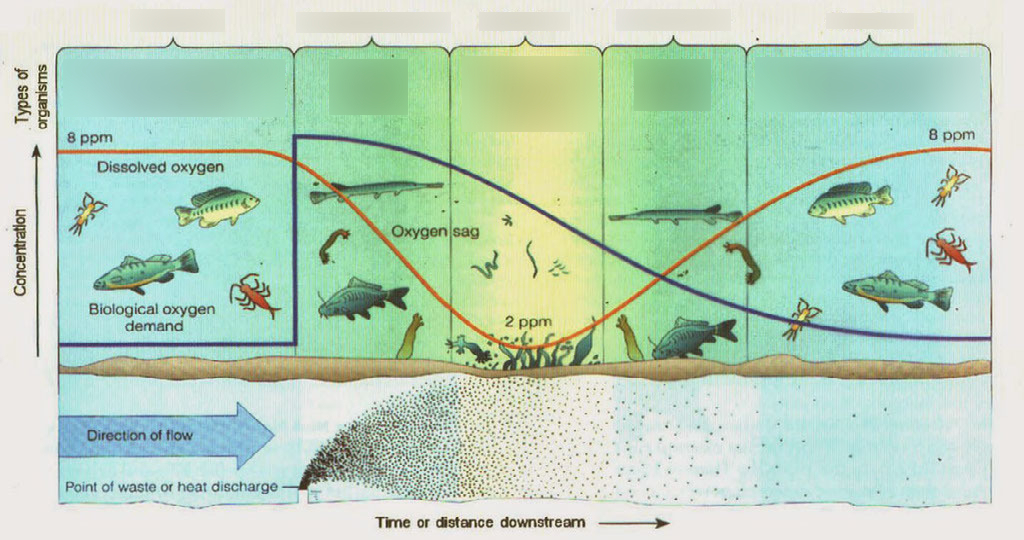
Oxygen sag curve
The relationship of oxygen concentrations to the distance from a point source of decomposing sewage or other pollutants.
Thermal pollution
Occurs when humans cause a substantial change in the temperature of a water body.
Thermal shock
A dramatic change in temperature that can kill many species.
Chemical Persistence
How long a chemical remains in the environment, impacted by factors like temperature, pH, environment, and method of degradation.
Persistent organic pollutants (POP’s)
Synthetic, carbon-based molecules that break down very slowly in the environment.
Route of exposure
The way in which an individual might ocme into contact with an environmental hazard, such as a chemical.
Solubility
How well a chemical dissolves in a liquid.
Bioaccumulation
The selective absorption and concentration of a chemical within an organism overtime, buildup.
Biomagnification
THe increase in chemical concentration in animal tissues as the chemical moves up the food chain.
Solid waste
The waste produced by humans as discarded materials in solid form that don’t pose a toxic hazard to humans or other organisms.
Municipal solid waste (MSW)
Solid waste colletcted by municipalities from households, small businesses, and institutions such as schools, prisons, municipal buildings, and hospitals.
Waste stream
THe flow of solid waste that is recycled, incinerated, placed in a solid waste landfill, or disposed of in another way.
Leachate
Liquid that can contain elevated levels of pollutants as a result of haiving passed through the solid waste of a landfill.
Sanitary landfill
An engineered ground facility designed to hold municipal solid waste (MSW) with as little contamination of the surrounding environment as possible.
Tipping fee
A fee chrged for trucks that deliver and tip solid waste into a landfill or incinerator.
Incineration
The process of burning waste materials to reduce volume and mass, and sometimes to generate electricity or heat.
Ash
The residual nonorganic material that does not combust during incineration.
Waste-to-energy
A system in which heat generated by incineration is used as an energy source rather than released into the surrounding environment.
Hazardous waste
Liquid, solid, gaseous, or sludge waste material that is harmful to humans, ecosystems, or materials.
Superfund Act (CERCLA (Comprehensive Environmental Response, Compensation, and Liability Act))
1980 U.S. federal act that taxes chemical and petroleum industries to cleanup hazardous waste sites. Authorizes federal government intervention in the release of substances threatening common good.
Brownfields
Contaminated industrial or commercial sites that may require environmental cleanup before they can be redeveloped or expanded.
The Three R’s (—, —, —: explanation)
Reduce, Reuse, Recycle: a phrase promoting diverting materials from the waste stream.
Source reduction
An approach to waste management that seeks to cut waste by reducign the use of potential waste materials in the early stages of design and manufacture.
Reuse
Using a product or material that would otherwise be discarded
Recycling
The process of collecting and converting potential MSW into raw materials.
Closed-loop recycling
Recycling a product into the same product.
Open-loop recycling
Recyclign one product into a different product.
Composting
The breakdown of organic materials into organic matter (humus).
Life-cycle analysis (Cradle-to-grave Analysis)
A systems tool that examines the materials ujsed and released throughout the lifetime of a product, including design, material procurement, use, and disposal.
Integrated waste managment
An approach to waste disposal that employs several waste reduction, management, and disposal strategies to reduce their costs and reduce the environmental impact of MSW.
Biochemical oxygen demand (BOD)
The amount of oxygen a quantity of water uses over a period of time at a specific temperature.
Cultural eutrophication
An increase in fertility in a body of water, the result of anthropogenic inputs of nutrients.
Fecal coliform bacteria
A group of microorganisms that live in the intestines of humans, other mammals, and birds, that serve as an indicator species for potentially harmful microorganisms associated with contaminated sewage.
Septic system
A relatively small and simple sewage treatment system made up of a septic tank and leach field, traditionally in rural area homes.
Septic tank
A large container that receives wastewater from a house as part of a septic system.
Sludge
Solid waste material from wastewater.
Septage
A layer of fairly clear water found in the middle of a septic tank.
Leach field
A component of a septic system, made up of underground pipes laid out below the surface of the ground.
Dose-response study
A study that exposes animals or plants to different amounts of a chemical and then looks for a variety of possible responses, including mortality or changes in behavior or reproduction.
Acute study
An experiment that exposes organisms to an environmental hazard for a short duration.
Chronic study
An experiment that exposes organisms to an environmental hazard for a long duration.
LD 50
The lethal dose of a chemical which’ll kill 50% of individuals in a dose-response study.
Sublethal effect
The effect of an environmental hazard that does not kill an organism but may impar an organisms behavior, pyhsiologoy, or reproduction.
ED 50
The effective dose of a chemical that causes 50% of individuals in a dose-response study to diplay a harmful, but nonlethal, effect.
No-observed-effect level (NOEL)
The highest concentration of a chemical that causes no lethal or sublethal effects.
Environmental hazard
Anything in the environment that can potentially cause harm in a risk assessment.
Innocent-until-proven-guilty Principal
Broadly American principle of belief that a potential hazard shouldn’t be considered an actual hazard until scientific data definitively demonstrates harm.
Precautionary Principle
Principle that if a hazard is plausible, even if it’s not yet certain, we should take actions to reduce or remove the potential hazard.
Stockholm Convention
2001 UN-ratified, legally binding international treaty aimed at mitigating the environmental hazards of POP’s. Initially targeted the “dirty dozen” of 12 chemicals.
REACH (Registration. Evaluation. Authorization. Restriction.)
A 2007 European agreement on chemical regulation, focusing on the precautionary principle.
Retrospective Study
A study looking at the past to monitor the effect of an environmental hazard on people already impacted.
Prospective Study
A study looking towards the future, monitoring people who may become exposed to an environmentla hazard in the future.
Synergistic interaction
A situation in which two risks together enhance each other to cause more harm than either individually.
Disease
Any impaired function of the body with a characteristic set of symptoms
Pathogen Types (there are six.)
Bacteria, Fungi, Viruses, Parasites, Yeast, Prions
Infectious disease + ie. —, —, —
A disease caused by a pathogen + ie. Cholera, STI, Malaria
Acute disease
A disease that rapidly impars the functioning of a person’s body
Chronic disease
A disease that slowly impairs the functioning of a person’s body
Epidemic
A situation in which a pathogen causes a rapid increase in disease
Pandemic
An epidemic that occurs over a large geographic region, such as an entire continent
Dysentery
An infection of the intestines that causes diarrhea, which results in dehydration and can cause death
Plague
An infectious disease caused by a bacterium (Yersinia pestis) that is carried by fleas
Malaria
An infectious disease caused by one of several species of protists in the genus Plasmodium
Tuberculosis
A highly contagious disease caused by the bacterium Mycobacterium tuberculosis that primarily infects the lungs
Emergent infectious disease
An infectious deisease that has not been previously described or has not been common for at least 20 years
AIDS (Acquired Immune Deficiency Syndrome)
An infectious disease caused by HIV, which weakens the immune system
HIV (Human Immunodeficiency Virus)
A type of virus that causes AIDS
Ebola hemorrhagic fever
An infectious disease with high death rates, caused by several species of Ebola viruses
Mad cow disease
A disease in which prions mutate into deadly pathogens and slowly damage a cow’s nervous system. Can be transmitted through meat regardless of cooking
Prion
A small, beneficial protein that occassionally mutates into a pathogen
Swine flu
A type of flu caused by the H1N1 virus
Bird flu
A type of flu caused by the H5N1 virus that jumped from birds to people
SARS (Severe acute respiratory syndrome)
An unusual form of pneumonia, a type of flu caused by a coronavirus
MERS-CoV
A coronavirus that causes the Middle Eastern Respiratory Syndrome disease
SARS-COV-2
A coronavirus that causes the disease Covid-19
West Nile virus
A virus that lives in hundreds of species of birds and is transmitted amongst birds by mosquitoes.
Lyme disease
A disease caused by a bacterium (Borrelia burgdorferi) that is transmitted by ticks.
Zika virus disease
A disease caused by a pathogen that causes fetuses to be born with unusually small heads and damaged brains.
Clean Water Act
Legislation protecting aquatic life and recreation through monitoring, maintaining, and restoring chemical, physical, and biological properties in surface waters.