MCB 2210 L26: Mitosis Part I - Prophase, Prometaphase, Metaphase
 Call Kai
 Learn
Learn Practice Test
 Spaced Repetition
 Match
Match Flashcards
 Knowt Play
1/19

There's no tags or description
Looks like no tags are added yet.
Name | Mastery | Learn | Test | Matching | Spaced | Call with Kai |
|---|
No analytics yet
Send a link to your students to track their progress
20 Terms
What kind of embryos exhibit coordinated mitosis?
Fly embryos
Describe the cell cycle
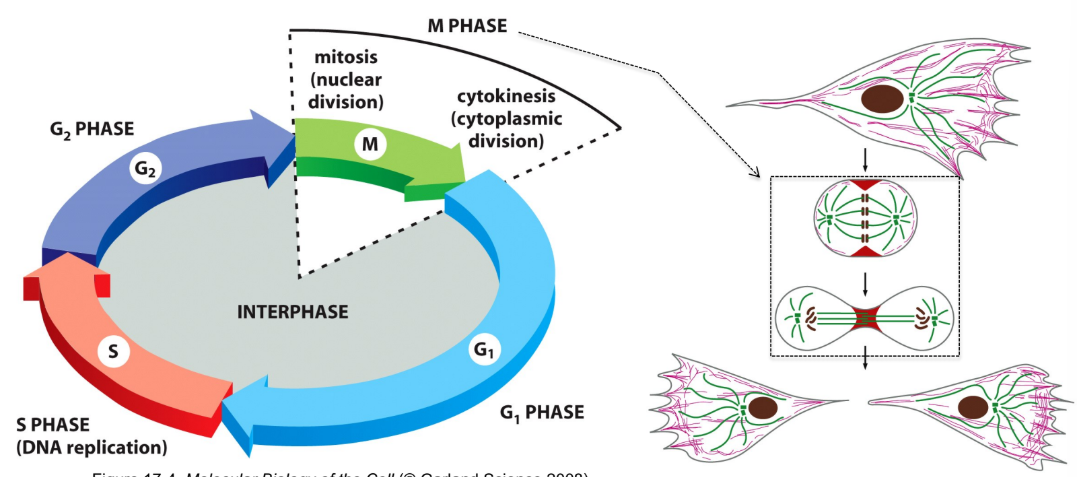
Interphase = G1 → S → G2
G1 = initiation of DNA synthesis
S = DNA synthesis
G2 = period b/w DNA synthesis
M phase = Mitosis + Cytokinesis
Mitosis = process of chromosome segregation
Name the 3 major subcellular changes of M phase
Chromosome condensation = organized into nucleosomes by histones
Condensin = protein that compact in M phase
Mitotic spindle assembly
Formation of the contractile ring = actin + myosin II
Ring contraction
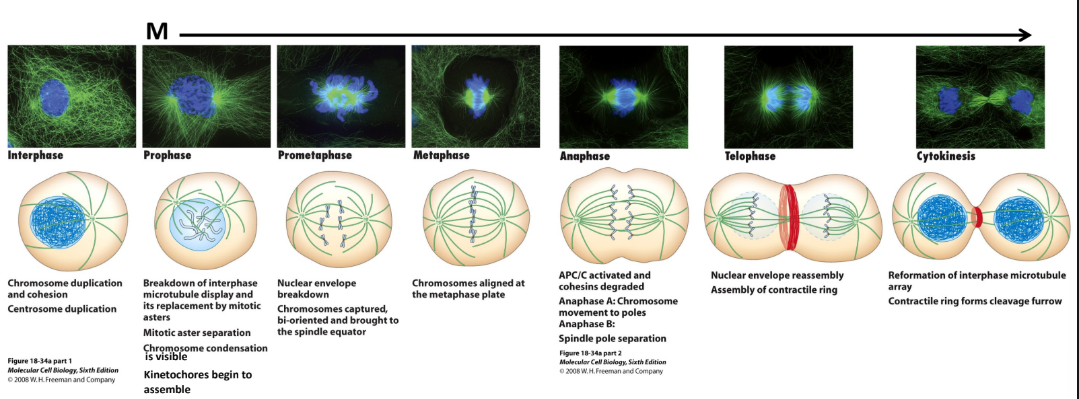
Overview of stages of mitosis
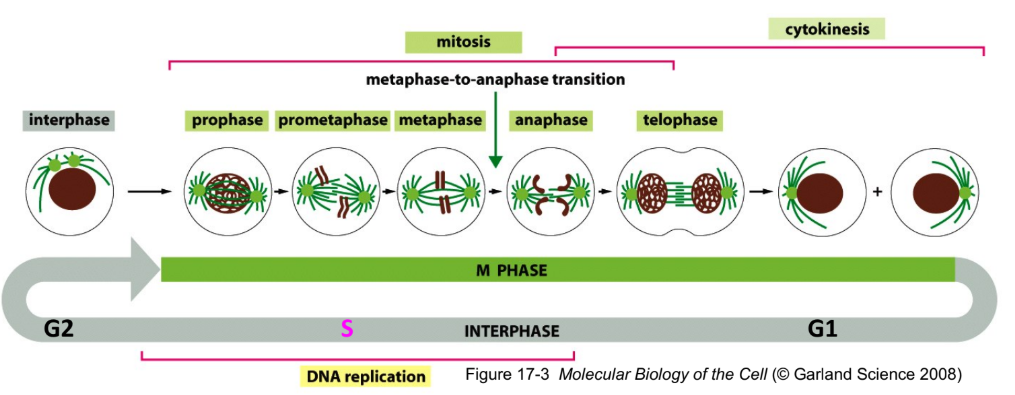
Interphase = chromosome duplication + cohesin + centrosome duplication
Prophase = Breakdown of interphase MT display + Mitotic aster separation + Chromosome condensation = visible + Kinetochores begin to assembly
Prometaphase = nuclear envelop breakdown, chromosomes
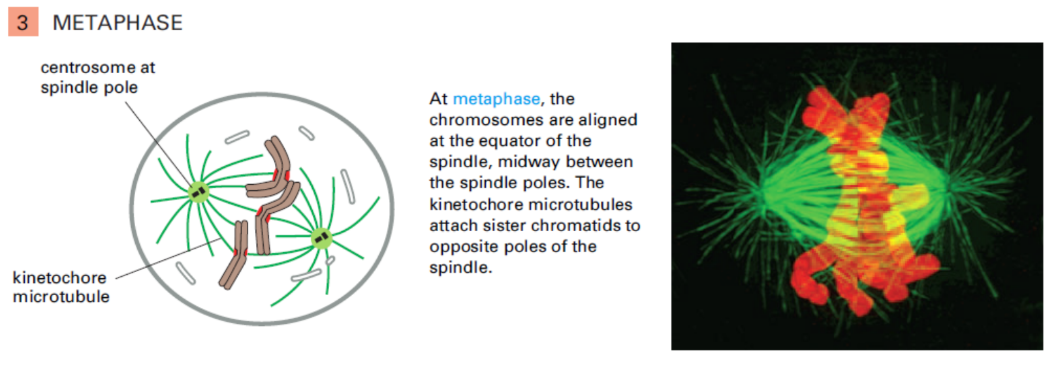
Metaphase = chromosome aligned @ metaphase plate
Anaphase = ACP/C activated + cohesin degraded
Anaphase A = chromosome movement to poles
Anaphase B = spindle pole separation
Telophase = Nuclear envelope reassembly + assembly contractile ring
Cytokinesis = interphase MT array reforms + contractile ring = cleavage furrow
Describe the role of S-phase and G2 on mitosis
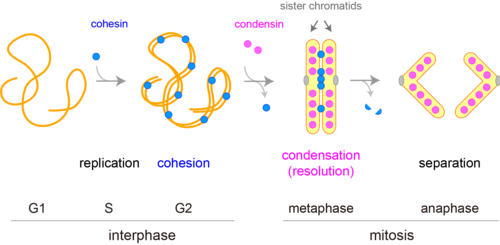
S phase = completed
1 duplicated chromosome = 2 sister chromatids
G2 phase
Chromosome condensation
Condensin = compact chromosomes
Describe how sister chromatids are attached
Centromere = region of chromosome where chromatids = constricted + attached
Cohesins = proteins that glue sister chromatids together
Kinetochores = specialized protein complexes that assemble on centromere of each sister chromatids
Describe transition through interphase
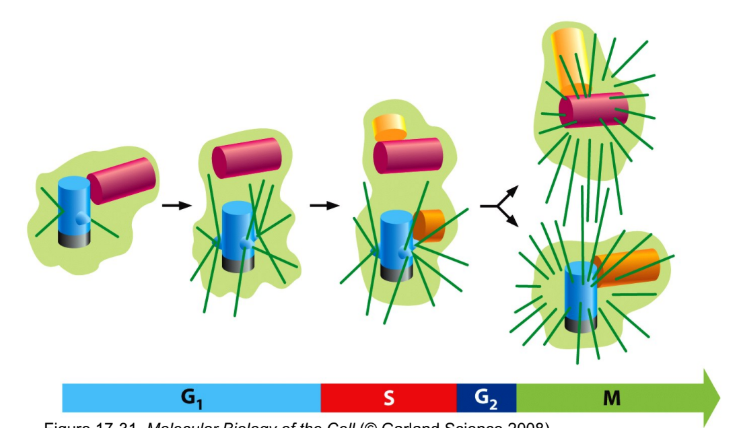
G1 = 1 centrosome
S + G2 → centrosome = duplicated but @ 1 side of nucleus
Describe what happens during prophase
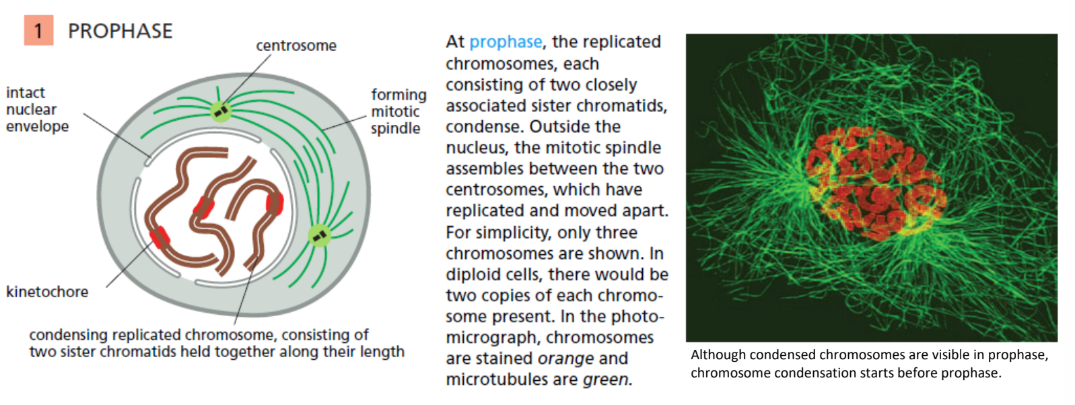
Prophase = condensed chromosomes = seen by light microscopy
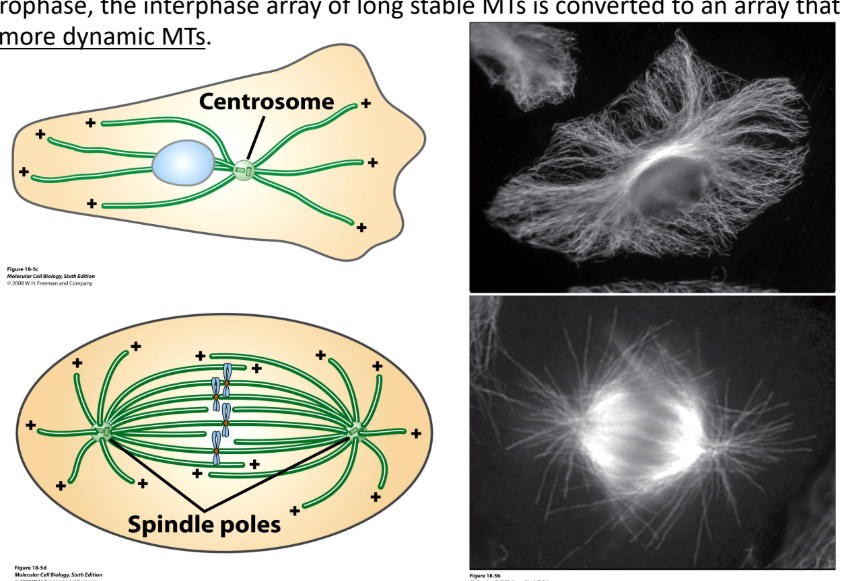
Interphase MTs = disassemble
2 centrosomes separate → each centrosome nucleates aster
Asters move apart to opposite sides of nucleus → begin forming mitotic spindle
What does mitotic spindle formation organizational activity involve?
Centrosomes
ChromosomesZ
What happens to MTs during prophase of mitosis?
Increase in # of MTs nucleated from centrosome
Interphase array of long stable MTs → prophase array of short, more dynamic MTs
Prometaphase
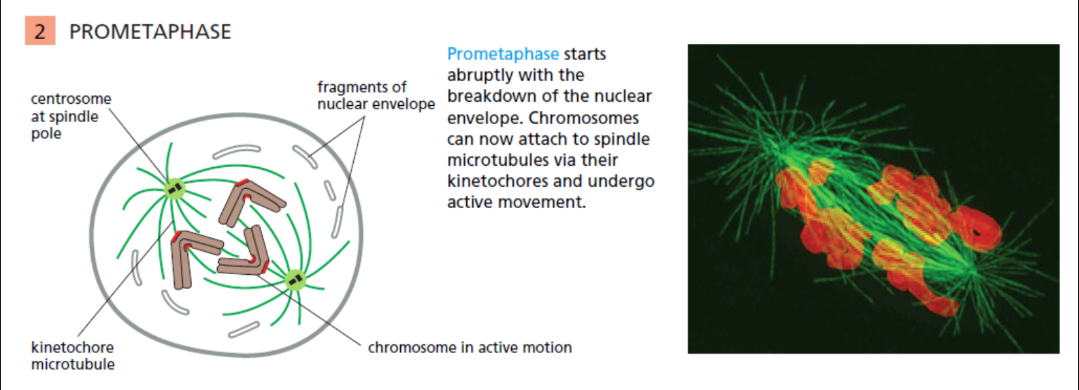
Nuclear envelope breakdown
Kinetochore MTs captured by kinetochores
Chromosomes move back + forth b/w poles
Purpose of nuclear envelope breakdown
2 mechanisms of nuclear envelope breakdown
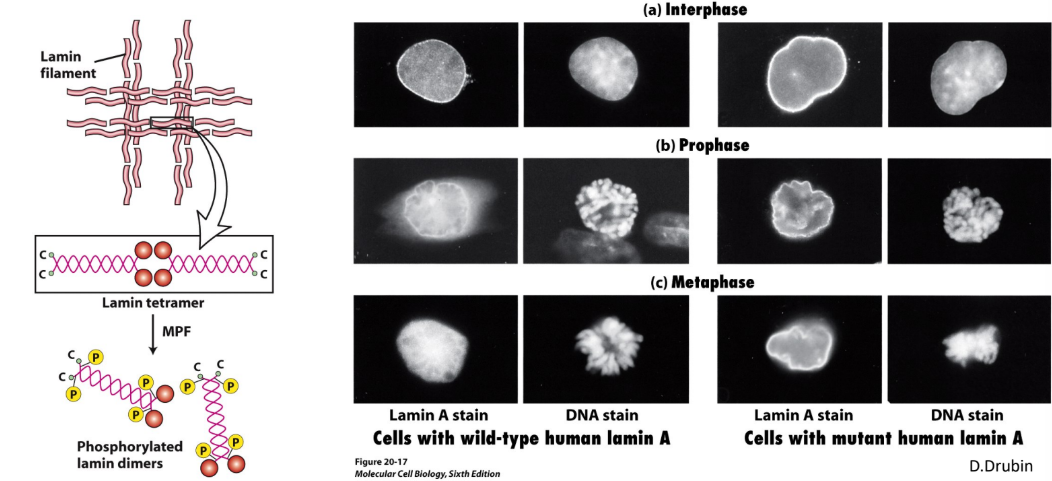
What happens to cells with mutant human lamin A?
Gives spindle MTs access to chromosome kinetochores
Cytoplasmic dynein = binds to proteins outside of nuclear envelope
Walk to (-) ends → rip hole in nucleus
Lamins of nuclear lamin cytoskeleton → nuclear envelope breakdown
Mutant lamin A → MTs cannot bind properly to chromosomes
What are the 3 types of motor proteins involved in spindle assembly?
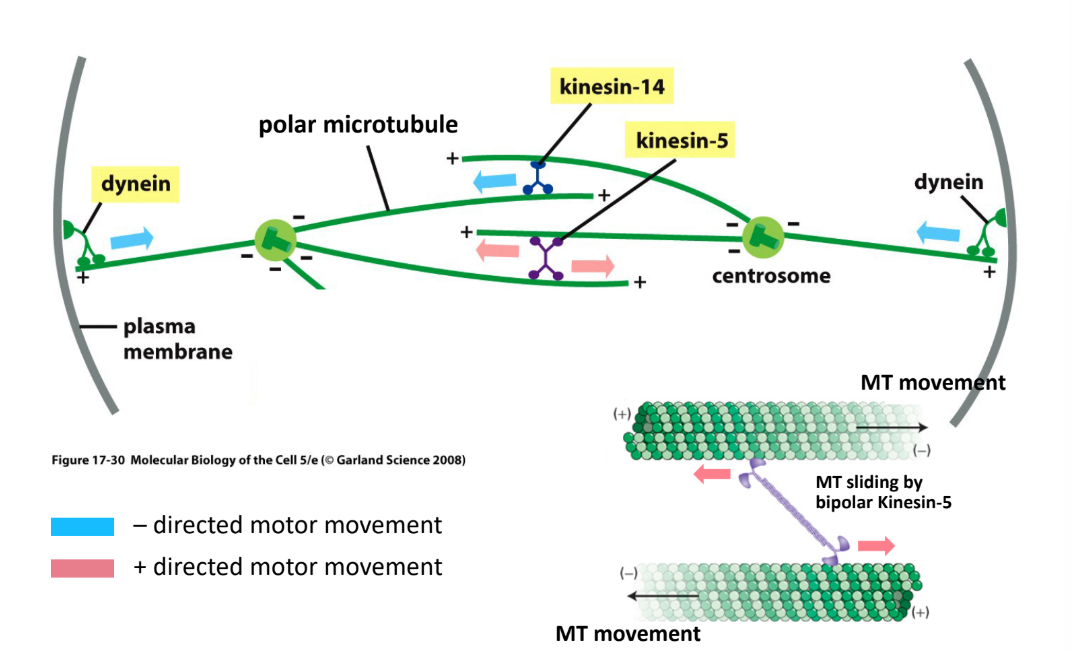
Kin-N Kinesin = Kinesin 5 → (+) end directed
Push 2 poles apart
Kin-C Kinesin = Kinesin-14 → (-) end directed
Pull 2 poles together
Dynein = anchored to cell cortex → (-) end directed
Walk toward astral MT (-) end
Pull poles apart
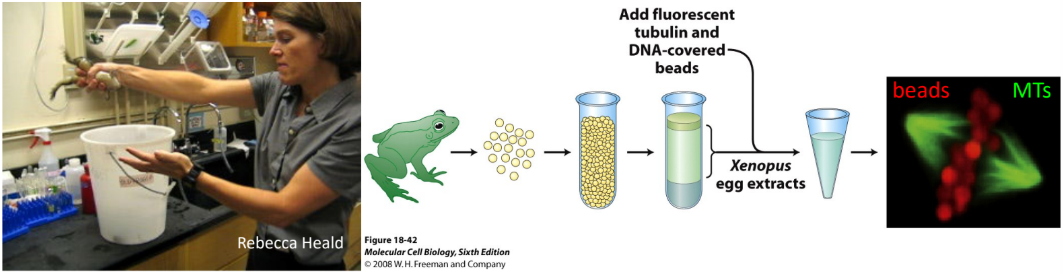
Explain how spindle organization can happen by chromosomes + the experiment that was conducted to prove this
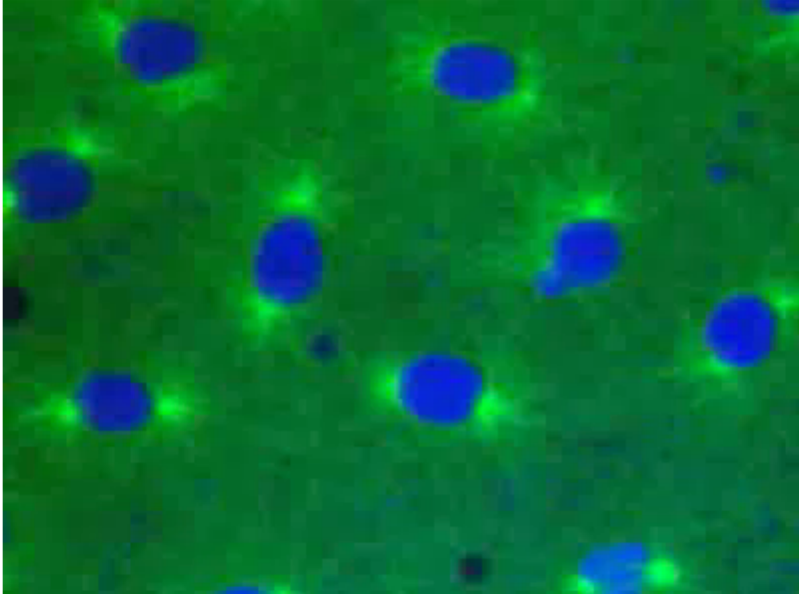
Mitotic spindle formation → absence of centrosomes
No centrosomes → spindle organized by chromatin
Cytoplasmic extracts w/o centrosomes → Xenopus frog egg extract w/o centrosomes
Beads coated w/ chromatin
Beads added to frog egg extract
Mitotic spindle formation around beads
Results = chromatin = sufficient to direct spindle assembly
Describe the mechanism behind chromatin-based spindle self-organization
Ran-GEF binds to chromatin (in nucleus)
Ran-GDP → Ran-GTP
Ran-GAP binds to cytoplasm
Ran-GTP → Ran-GDP
Importin cargo = MT nucleating proteins + MT stabilizing proteins
Importin binds to Ran-GTP → MT nucleating proteins = released → allow MT nucleation + polymerization near bead
Beat coated w/ Ran-GEF or Ran-GTP works as well
Identify the three motor proteins associated with kinetochores
Explain the name of the model and the mechanism of how MTs are bound to kinetochores
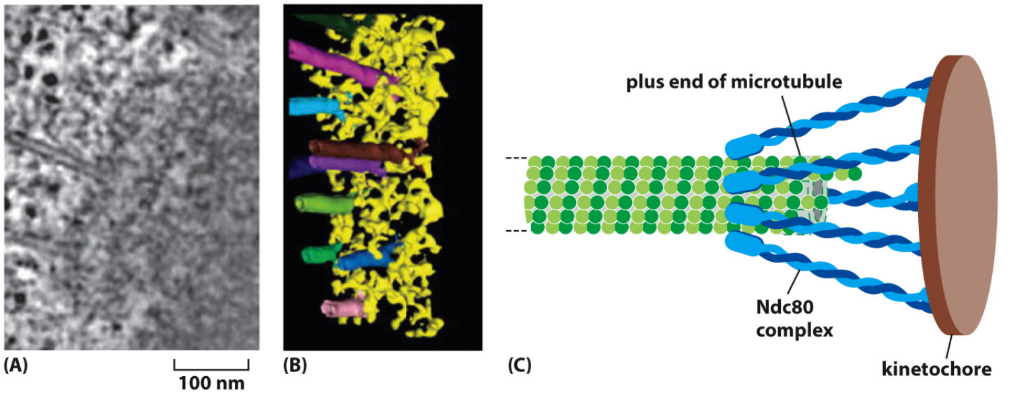
Kinetochores = Kin-N Kinesin (CENP-E) + Dynein + Kin-I Kinesin (Kin-13) + Ndc80 complex = mediate binding to MTs in spindle
Chromosomes = NO centrosomes → CANNOT interact w/ spindle MTs = CANNOT correctly separate during mitosis
Search-and-Capture Model
Search = prometaphase MTs = dynamic instability
Capture = some MTs encounter kinetochore + bind through motor proteins
Side of MT binds to kinetochore → Kin-N Kinesin motor move chromosome to (+) MT end
Sister chromatids = bi-oriented when both kinetochores are captured by MTs from opposite poles
Ndc80 complex = stabilizes attachment of kinetochore to MT (+) end
What phase does chromosome congression occur in?
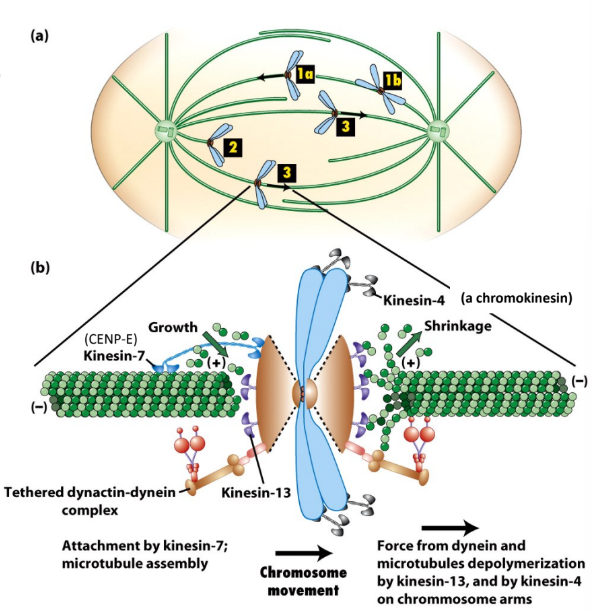
Chromosome congression = captured chromosomes → equator of spindle + back-and-forth movement of bi-oriented chromosomes near equator
Polymerization + depolymerization @ (+) ends of kinetochore MTs of bioriented chromosomes
Kin-13 = depolymerizing
Kin-7 = CENP-E = polymerizing
What are the 2 parts of chromosome congression during prometaphase?
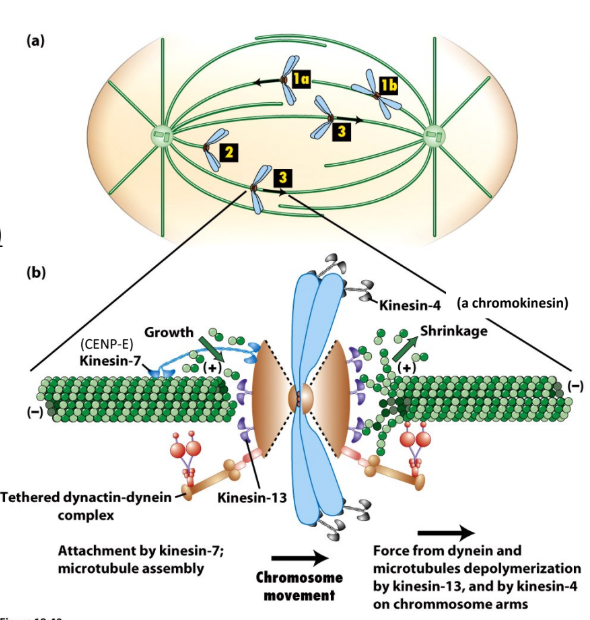
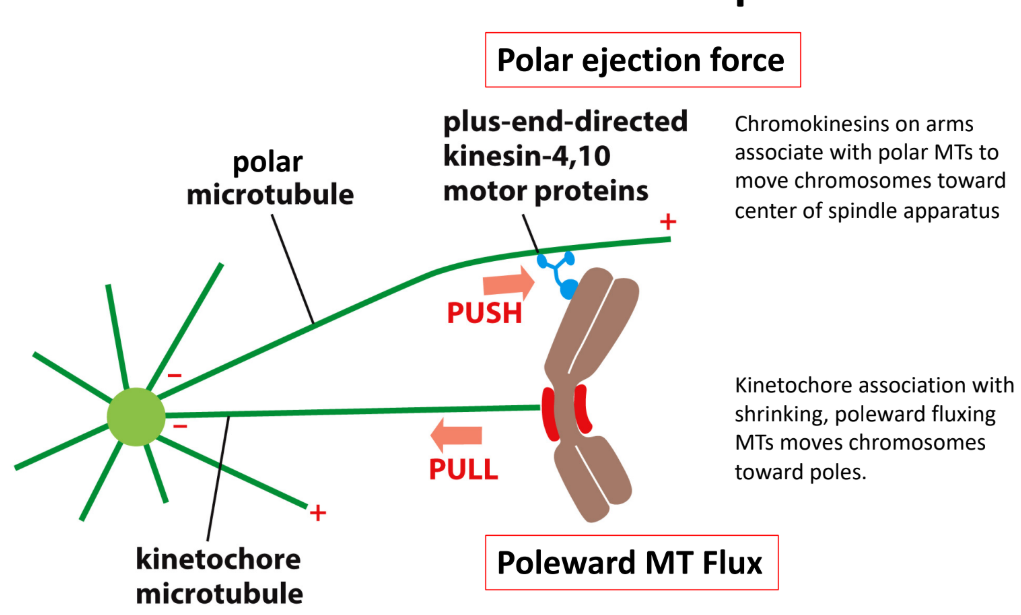
Poleward MT flux = treadmilling = addition to (+) ends of spindle MTs by Kin-7 + (-) ends depolymerized by Kin-13
Polar Ejection Force = move chromosomes away from spindle poles = Chromokinesins (Kin-N kinesins on chromosome arms)
Move to (+) ends of polar MTs
AWAY from spindle poles
Explain what happens dynamically during metaphase
Forces = balanced @ metaphase
(+) end polymerization = (-) end depolymerization
Constant spindle length
TREADMILLING
What happens during metaphase?
Metaphase = Point when chromosomes aligned in one plane halfway b/w 2 spindle poles
Chromosome held under tension @ metaphase plate
Metaphase plate = region where chromosomes align
Paired kinetochores + kinetochore MTs