P5 : Forces
 Call Kai
 Learn
Learn Practice Test
 Spaced Repetition
 Match
Match Flashcards
 Knowt Play
1/185

Earn XP
Description and Tags
Name | Mastery | Learn | Test | Matching | Spaced | Call with Kai | Chat |
|---|
No analytics yet
Send a link to your students to track their progress
186 Terms
What is a scalar quantity?
A quantity that has magnitude only
What is a vector quantity?
A quantity that has magnitude and a direction
What is magnitude?
Size
How can vector quantities be presented?
By using an arrow
What does the length + the direction of arrow represent?
Length of an arrow represents the magnitude
Direction of an arrow represents the direction
Give an example of a scalar quantity (any)
Speed
Distance
Mass
Temperature
Time
Give an example of a vector quantity (any)
Force
Velocity
Displacement
Acceleration
Momentum
What is a force?
A push or pull that acts on an object due to the interaction with another object
What are 2 main types of forces?
Contact forces
Non-contact forces
Give an example of a contact force (any)
Friction
Air resistance
Tension
Normal contact force
Give an example of a non-contact force (any)
Gravitational force
Electrostatic force
Magnetic force
Is force a scalar or a vector quantitity?
Vector
What is the unit for force?
Newton (N)
What is friction?
A force that opposes the motion of two surfaces that are in contact with each other
What is air resistance?
A force that opposes the motion of an object as it moves through the air
What is weight?
A force that pulls an object towards the centre of the Earth
What is upthrust?
A force that pushes up on an object in a fluid
What is tension?
A force that acts through a stretched object
What is electrostatic force?
A force that is acting between 2 charged particles
What is normal contact force?
The force when a surface pushes up on an object at a right angle to the surface
What is thrust?
A force that is generated from the engine of a motorised vehicle/movement
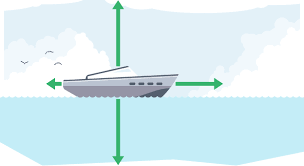
Label the forces (the boat is moving towards the right)
↑ = Upthrust
↓ = Weight
→ = Thrust
← = Friction
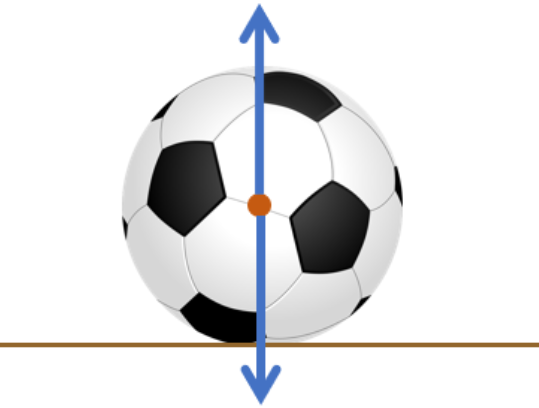
Label the forces (the ball is not moving)
↑ = Normal contact force
↓ = Weight
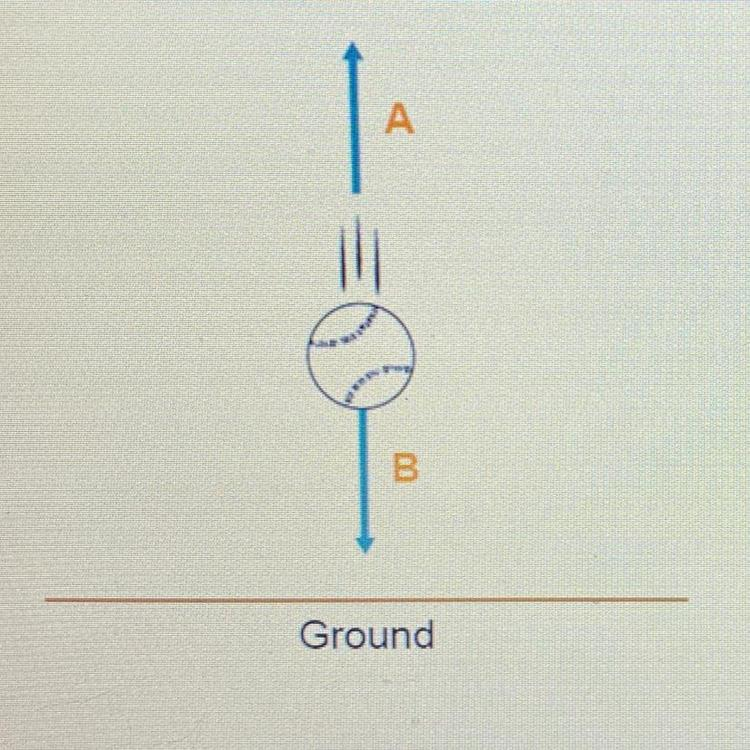
Label the forces (the ball is falling)
A = Air resistance
B = Weight
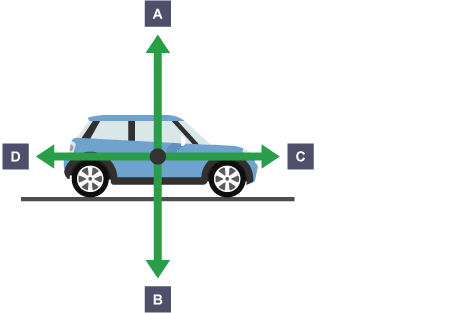
Label the forces (the car is moving to the right)
A → Normal contact force
B → Weight
C → Thrust
D → Friction
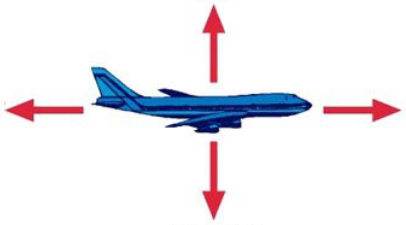
Label the forces (the aeroplane is moving to the right)
↑ = Lift
↓ = Weight
→ = Thrust
← = Air resistance
What does the size of the arrow determine?
How big a force is
Why is there a force close to the Earth?
Because of the gravitational field around the Earth
What does the weight of an object depend on?
The gravitational field strength at the point where the object is
What is the formula for weight?

What is referred to when the weight of an object is considered to act a single point?
The objects “centre of mass”
What is the relationship between the weight and mass of an object?
It is directly proportional
What is weight measured with? (2)
A calibrated spring-balance
A newton meter
What is the difference between mass and weight of an object?
The mass of an object is a definite value and always will be whereas the weight of an object changes due to an objects mass and the gravitational field strength of where the object is located
What is the resultant force?
The overall force acting on a point or an object
If the forces are acting along the same line how do you find the resultant force of
Forces going in the same direction
Forces going in opposite directions
Same direction → add the forces
Different direction → subtract the forces
What is a free body diagram?
A diagram which shows forces acting on an object
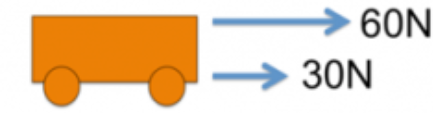
Calculate the resultant force
90N to the right
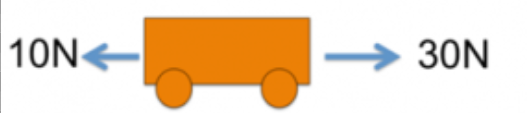
Calculate the resultant force
20N to the right

Calculate the resultant force
220N to the right
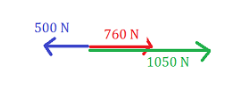
Calculate the resultant force
1310N to the right
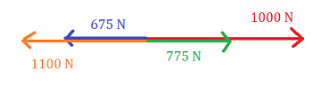
Calculate the resultant force
0N
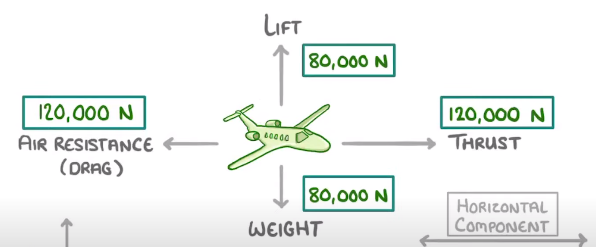
What does it mean if all the forces cancel each other out?
The object is at equilibrium
Explain how to find the resultant force using a vector diagram (7)
Draw the 2 sides given (line A at the top and line B at the bottom) making sure the angle given fits in the space between
Use a suitable scale (e.g. 100N = 1cm)
Then extend the top line using the measurement of line B making sure it corresponds with the angle give to create the third line of a parallelogram
Then join up the bottom line with the line just created
Then join the two furthest points of the parallelogram with a line
That is the resultant force
Measure the line and relate back to the scale
Explain how to resolve a single force into two forces using a vector diagram (7)
Draw a dot as a starting point
Then draw faint horizontal and vertical lines → these will act as the axis of the diagram
Then draw the angle, if it is to the horizontal then draw the angle using the x axis as the starting line, if it is to the vertical then do the same
Then use a ruler to draw the force and use a suitable scale (e.g. 100N = 1cm)
Then draw dotted lines from the tip of the line drawn to the faint axis
Where the lines touch the axis is the tip of the two other forces
Draw the two other forces and measure them using the scale
What is work done?
When a force causes an object to move through a distance
What causes a displacement of an object?
When a force does work on an object
What is the formula for work done?
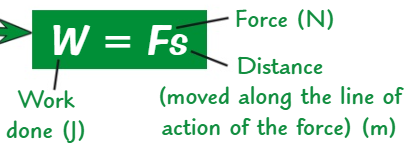
What happens in terms of energy when work is done on an object?
Energy is transferred
What is the relationship between joules and newton metres?
1J = 1Nm
What happens when work is done against the frictional forces acting on an object?
There is a rise in temperature of the object due to energy being transferred to the thermal energy store of the object
What forces are involved in stretching, bending or compressing an object?
Work done
Elastic potential energy
Why does more than one force have to be applied to change the shape of an elastic object?
Because if there was only one force the object would move in the direction of the applied force instead of changing shape
What types of object can be inelastically deformed?
Elastic objects
What are the 3 ways a spring can be manoeuvred?
Stretched
Compressed
Bent
What are the 2 types of deformation?
Elastic deformation
Inelastic deformation
What does it mean if an object is elastically deformed?
When an object can be bent, stretched or compressed, it will return to its original state
What does it mean if an object is inelastically deformed?
When an object can be bent, stretched or compressed, it will not return to its original state + the length doesn’t change after the force has been removed
What happens to an object if it is elastically deformed and has been stretched or compressed?
Energy is transferred to the elastic potential energy of the object
What is the relationship between the extension of an elastic object and the force applied?
It is directly proportional
What does limit of proportionality mean?
When the extension of an elastic object and the force applied are no longer directly proportional
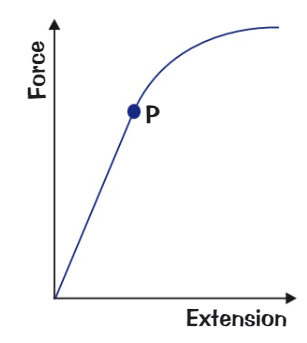
What is the equation for force?

What can the e in the force = spring constant x extension (F = K x e) also be applied to?
The compression of an object → difference between the natural and compressed lengths
Explain the energy transfer when a spring is stretched or compressed
Work is done to the spring and elastic potential energy is stored in the string
What does a graph look like when an object is inelastically deformed?
non-linear
What does a graph look like when an object is elastically deformed?
Linear
What is the formula for elastic potential energy?

What does a high spring constant show about the object?
Higher spring constant = stiffer the object
Explain how to investigate the relationship between force and extension for a spring (7)
Set up your equipment, ensuring the spring will return to its original dimensions if stretched within its elastic limit
Attach the pointer to the base of the spring, ensuring that it isn’t angled (parallel to the workbench) and perpendicular to the metre ruler. Align the top of the ruler with the top of the spring
Measure the initial length of the spring without any weights attached
Add a 10g mass to the base of the spring and record the length of the spring
Repeat and continue to add masses, ensuring that the spring doesn’t oscillate after each weight has been added
Calculate the extension of the spring for each mass by subtracting the initial length of the spring from each different length of the spring
Convert all masses to weights using the equation: Weight (N) = mass (kg) x 9.81 (N/kg) where 9.81N/kg is the gravitational field strength on Earth
Plot the graph of force (y-axis) against extension (x-axis). Calculate the gradient.
What does moment of a force mean?
Th turning effect of a force
What is the formula for moment of a force?

What would cause a larger moment? (2)
Larger force
Longer distance
What is a pivot?
The point around which the object can rotate or turn
If an object is balanced what does that mean in terms of pivoting?
The total clockwise moment about a pivot equals the total anticlockwise moment about that pivot
How is the maximum moment achieved?
Pushing at right angles to an object
Why are levers useful?
Because they increase the distance from the pivot at which the force is applied → make it easier to do work
Describe the structure of a gear
Circular discs with teeth around their edges
How do gears work?
Their teeth interlock so that turning one causes another to turn in the opposite direction
What are gears used for?
They are used to transmit the rotational effect of a force from one place to another
What is the benefit of using different sized gears?
They can change the moment of a force
How do different shaped gears change the moment of a force?
A force transmitted to a larger gear will cause a bigger moment, as the distance to the pivot is greater
Which gear would turn faster, the larger gear or the smaller gear?
The smaller gear
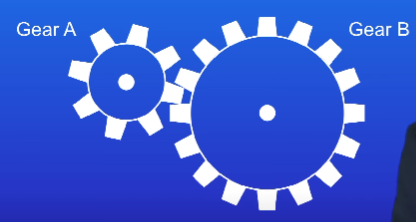
Why is the overall force of both gears the same?
Because gear A rotates twice for every time gear B rotates once
If a seesaw is balanced what does that mean in terms of moment?
(refer to moment = distance x force)
The clockwise moment (distance x force) must equal the anticlockwise moment (distance x force)
Why do objects topple?
The line of action of the weight of the object lies outside the base of the object which causes an unbalanced moment to act of the block
What states of matter can a fluid be? (2)
Liquid
Gas
What does the pressure in fluids cause?
A force normal at right angles to any surface
What is the formula for pressure at the surface of a fluid?
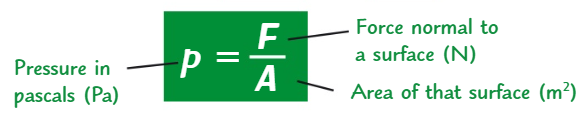
What is the formula for pressure at a certain depth due to the column of liquid ?

When is a liquid more dense?
When it has more particles in a given place
Why does the pressure of a liquid increase?
Because there are more particles which leads to more collisions
What happens to pressure as depth increases?
Pressure increases
Explain why, in a liquid, pressure at a point increases with the height of the column of liquid above that point and with the density of the liquid
As the depth of the liquid increases the number of particles above that point increases
The weight of these particles adds to the pressure felt at that point so the liquid increases with depth
What happens to an object when it is either partially or totally submerged in a fluid?
The pressure of the fluid exerts a force on it from every direction
In a fluid which force is larger, the force being exerted upwards or the force being exerted downwards + why?
The force being exerted upwards because pressure increases as depth increases
Where is the resultant force created on an object either partially or fully submerged in a fluid + what is this called?
There is a resultant force upwards
This is called upthrust
When would an object float? (in terms of forces)
When its upthrust is equal to its weight
When would an object float? (in terms of density) (3)
When an object that is less dense than the fluid it is placed in, weighs less than the equivalent volume of fluid
This means that it displaces a volume of fluid that is equal to its weight before it is completely submerged
Then the weight is equal to the upthrust
When will an object sink? (in terms of forces)
When its weight is larger than its upthrust
When will an object sink? (in terms of density) (2)
When an object is denser than the fluid it is placed in, it is unable to displace enough fluid to equal its weight
This means that its weight is always larger than the upthrust, so it sinks