Mills Exam 4
 Call Kai
 Learn
Learn Practice Test
 Spaced Repetition
 Match
Match Flashcards
 Knowt Play
1/47

There's no tags or description
Looks like no tags are added yet.
Name | Mastery | Learn | Test | Matching | Spaced | Call with Kai |
|---|
No analytics yet
Send a link to your students to track their progress
48 Terms
What are the main types of asexual reproduction?
: Fission (splitting into two), Budding (new individuals grow from the parent), Fragmentation followed by Regeneration (body parts regrow into clones), and Parthenogenesis ("virgin birth")
What is Parthenogenesis?
A form of asexual reproduction where a female gamete forms an embryo without fertilization, enabling reproduction in habitats without males
What is Hermaphroditism?
condition where an individual has both male and female reproductive organs, allowing every individual to produce both types of gametes and potentially mate with any other individual.
What is "Heterogamy"?
When a species alternates between asexual and sexual reproduction based on environmental conditions (e.g., Aphids)
What are the advantages of Asexual Reproduction?
Rapid population growth in resource-rich habitats, transmission of all beneficial mutations to offspring, and no need to find a mate (saves energy/time and avoids mating-related injuries/STDs)
What are the disadvantages of Asexual Reproduction?
Low probability of adapting to environmental changes (clones) and the transmission of all harmful mutations to offspring.
What are the advantages of Sexual Reproduction?
Increased genetic variation through DNA recombination, faster removal of harmful mutations, and emotional bonding/hormonal changes that improve parenting.
What are the disadvantages of Sexual Reproduction?
Slower reproduction rate, fewer offspring (only females produce them), risk of STDs, and potential injuries from mate-searching or male combat.
Which reproduction type is favored in stable vs. variable environments?
Stable environments (abundant food, ideal weather) favor Asexual reproduction. Variable or unstable environments (insufficient food, pathogens, predators) favor Sexual reproduction
How can a population continue sexual reproduction if one sex is eliminated?
Through Sex Reversal, where individuals (found in ~450 fish species) can change their sex within 1–2 weeks to restore the population's ability to reproduce.
What induces budding in sand dollar larvae?
Predator mucous, along with abundant food and ideal temperatures, can induce bud formation to increase reproductive output.
What is a "Perfect Flower"?
A flower that has both female and male organs (hermaphrodite), enabling it to perform both outcrossing and self-fertilization.
What is the difference between Monoecious and Dioecious species?
individuals produce both female and male organs (either in one perfect flower or distinct flowers on the same plant). Dioecious individuals are strictly female or male and must outcross
What are the main reproductive structures of a flower?
The Stamen (male part, includes anther and filament) and the Carpel/Pistil (female part, includes stigma, style, and ovary).
How does Pollination differ from Fertilization?
Pollination is the physical transfer of pollen from the anther to the stigma. Fertilization is the biological process occurring 3–24 hours later when the pollen tube delivers male gametes to the ovule to form a zygote
What are the roles of the two nuclei in a pollen grain?
The Generative Nucleus divides to form two male gametes, while the Vegetative Nucleus guides the development of the pollen tube
What is "Double Fertilization"
One sperm fertilizes the egg to form a diploid zygote, while the other sperm fertilizes two polar nuclei to form triploid endosperm (a food source for the embryo)
How is wind-pollinated pollen different from animal-pollinated pollen?
Wind-pollinated species produce many aerodynamic, lightweight pollen grains. Animal-pollinated plants often have traits to attract pollinators (color, scent) and reward them (nectar, pollen, or shelter)
What are the advantages of Seed Dispersal?
it allows progeny to colonize new habitats and reduces competition for resources between parents and their offspring
How are seeds adapted for different dispersal methods?
Wind: Airplane wings, propellers, or rolling mechanisms.
Water: Floating pods and salt-resistant seedcoats.
Animals: Using feathers, fur, or hooks to attach to bodies, or providing nutrition (fruit) so seeds are dispersed through digestive tracts.
Quick check
Outcrossing increases genetic variation in populations.
Flowers, Fruits, Pollen, and Seeds are the four main adaptations that enable reproduction on dry land.
Angiosperms (flowering plants) and Gymnosperms both produce seeds to travel through space and time.
Why is the circulatory system essential for all cells?
It allows cells to communicate, exchange materials (glucose, 02 wastes), and coordinate activities like growth, defense, and homeostasis.
How does the circulatory system support the Respiratory and Excretory systems?
It delivers CO2 to the lungs (Respiratory) and cellular waste products to the kidneys (Excretory) for removal.
What is a "Closed" circulatory system?
A system where blood is always contained within vessels, allowing for high-pressure delivery and efficient integration of all body systems.
What are the characteristics of Arteries?
Specialized to transport blood under high pressure away from the heart. They have thick, elastic walls to handle the surge of blood.
What are the characteristics of Veins?
They return blood to the heart under low pressure. They contain internal valves to prevent backflow and rely on skeletal muscle contractions to move blood.
What is the function of Capillaries?
They are the site of material exchange (nutrients, gases, wastes) between the blood and interstitial fluid. Their walls are only one cell thick to allow for diffusion.
What do Arterioles and Venules connect?
Arterioles connect arteries to capillaries; Venules connect capillaries to veins.
How does the body adjust blood flow to specific tissues?
Using precapillary sphincters (rings of smooth muscle) and smooth muscle in arterioles to constrict or dilate vessels.
Give two examples of blood flow adjustment.
1. Blood flow to the skin increases to dissipate heat when body temperature is high. 2. Blood flow to the digestive tract increases after eating to facilitate nutrient absorption.
What is the primary role of the Lymphatic System?
To return excess tissue fluid (lymph) that leaked out of capillaries back into the bloodstream.
What causes Edema?
A buildup of excess fluid in tissues. This can be caused by parasitic worms blocking lymphatic vessels, preventing the fluid from returning to the blood.
How does lymph fluid move if there is no "heart" for the lymphatic system?
Like veins, lymphatic vessels have valves and rely on the contraction of surrounding skeletal muscles to push the fluid along.
What are the two types of vascular tissue and their primary functions?
Xylem transports water and minerals from the roots to the leaves. Phloem transports carbohydrates (sucrose/food) systemically from "source" tissues (leaves) to "sink" tissues (roots, fruits, or growing tips).
What are the two essential functions of Transpiration?
1. It creates the "pull" needed to transport water and minerals from roots to leaves. 2. It helps regulate leaf temperature through evaporative cooling.
What is the difference between "Source" and "Sink" tissues in phloem transport?
Source tissues (like mature leaves) produce or release sugar. Sink tissues (like roots, developing flowers, or storage organs) consume or store the sugar delivered by the phloem.
The Vascular System: Xylem vs. Phloem
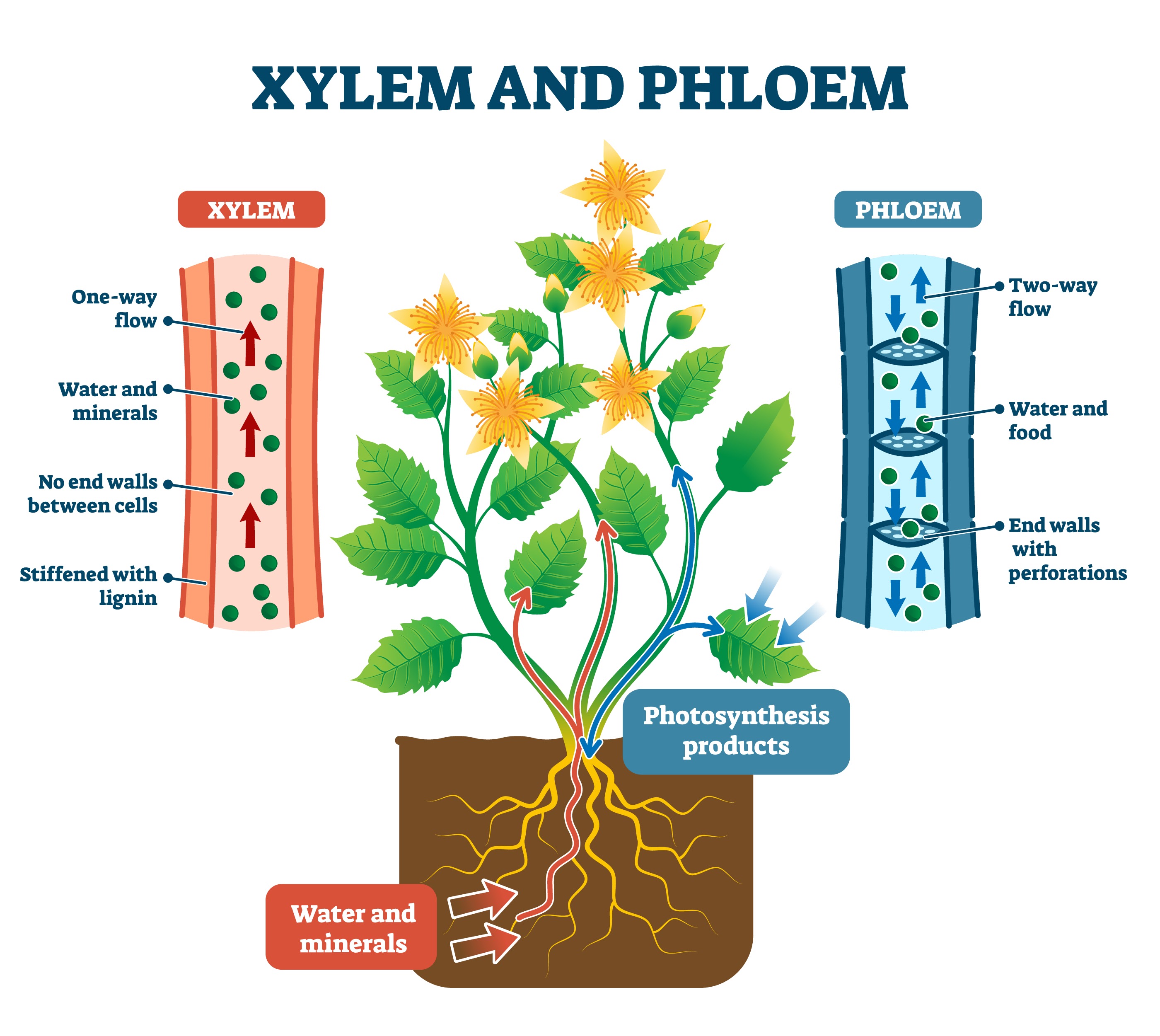
Which two cell types in xylem are specialized for transport?
What are the two types of vascular tissue and their primary functions?
A: Xylem transports water and minerals from the roots to the leaves. Phloem transports carbohydrates (sucrose/food) systemically from "source" tissues (leaves) to "sink" tissues (roots, fruits, or growing tips).
What are the two essential functions of Transpiration?
1. It creates the "pull" needed to transport water and minerals from roots to leaves. 2. It helps regulate leaf temperature through evaporative cooling.
What is the difference between "Source" and "Sink" tissues in phloem transport?
Source tissues (like mature leaves) produce or release sugar. Sink tissues (like roots, developing flowers, or storage organs) consume or store the sugar delivered by the phloem.
Which two cell types in xylem are specialized for transport?
Tracheids and Vessel Elements. Both are hollow, dead, and lack cytoplasm at maturity to allow for high-volume water flow.
How are Vessel Elements specialized for efficiency?
They are stacked end-to-end with perforated or completely open ends, creating a continuous "pipe" for xylem sap to move through.
Which xylem cells provide structural support?
Sclerenchyma cells (fibers) and the thickened walls of the tracheary elements themselves.
Which cell type is the primary conductor of phloem sap?
Sieve Tube Elements. Unlike xylem cells, these are living cells at maturity, though they lack a nucleus and many organelles to make room for sap flow.
What are Sieve Plates?
The perforated end-walls of sieve tube elements that allow sap to flow directly from one cell to the next.
What is the role of a Companion Cell?
It provides metabolic support (like proteins and energy) to the sieve tube element, which lacks the machinery to maintain itself.
What are Plasmodesmata?
Small channels that penetrate the cell walls of adjacent plant cells, allowing their cytoplasm to connect and exchange signaling molecules.
What is "Cytoplasmic Streaming" (Cyclosis)?
The rapid movement of cytosol within a large plant cell to distribute materials. It is powered by actin filaments, myosin motor proteins, and ATP.