L46 - Regulation of the Fluid Compartments and the Lymphatic System
 Call Kai
 Learn
Learn Practice Test
 Spaced Repetition
 Match
Match Flashcards
 Knowt Play
1/27

There's no tags or description
Looks like no tags are added yet.
Name | Mastery | Learn | Test | Matching | Spaced | Call with Kai |
|---|
No analytics yet
Send a link to your students to track their progress
28 Terms
What are the 2 major fluid compartments?
Intracellular fluid (fluid inside cells)
Extracellular fluid (fluid outside cells)
What is the approximate volume of each fluid compartment in an average adult?
In intracellular fluid, there’s around 28L.
In extracellular fluid, there around 14L.
What are the main components of extracellular fluid?
Plasma and interstitial fluid
How are volumes in intracellular and extracellular (plasma and interstitium) maintained?
Intracellular (cell) → Interstitial fluid
Osmosis
Interstitial fluid → Plasma (capillary)
Colloid osmotic pressure (absorption)
Plasma → Interstitial fluid
Hydrostatic pressure (filtration)
Interstitial fluid → Intracellular
Osmosis
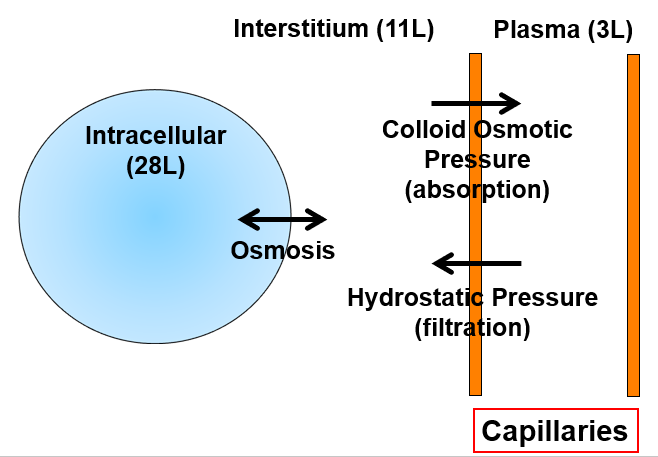
How is fluid exchange between intracellular fluid and interstitial fluid controlled?
Controlled by osmosis
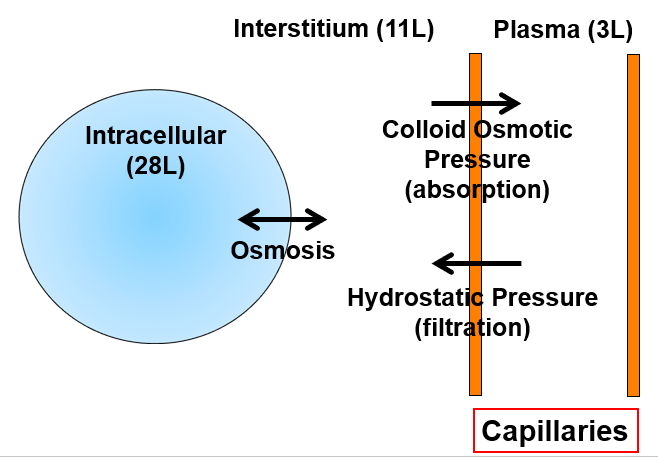
How does fluid move from interstitial fluid into plasma?
Movement is driven by colloid osmotic pressure (mainly due to plasma proteins like albumin).
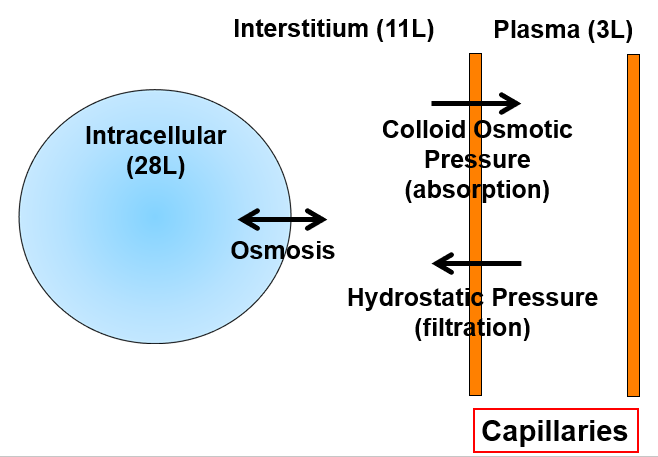
How does fluid move from plasma to interstitial fluid at capillaries?
The movement is driven by hydrostatic power
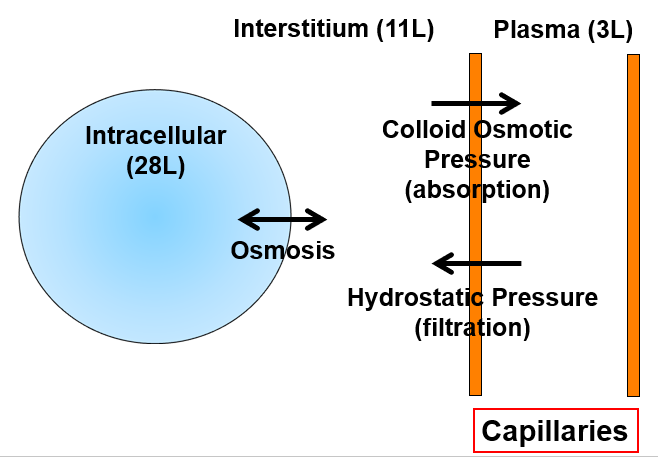
Summarize all the mechanisms maintain fluid balance across body compartments:
Intracellular fluid ↔ Interstitial fluid:
Plasma → Interstitial:
Interstitial → Plasma:
Intracellular fluid ↔ Interstitial fluid: Osmosis
Plasma → Interstitial: Hydrostatic pressure (filtration)
Interstitial → Plasma: Colloid osmotic pressure (reabsorption)
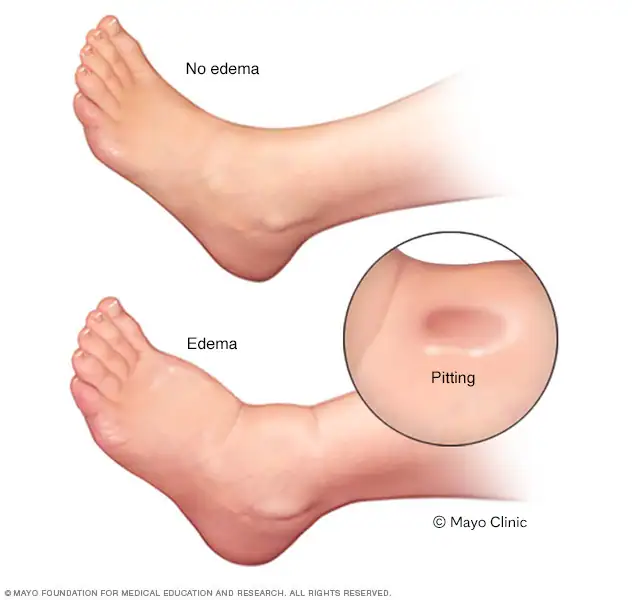
What happens if your body can’t regulate fluid compartments?
It leads to an oedema
What are osmoles?
The total number of particles in a solution is measured in terms of osmoles
What does 1 osmole (osm) equal?
1 osmole (osm) = 1 mol (6.02×10²³) of solute particles in 1L
1M glucose = 1 Osm
1M NaCl = 2 Osm
1M MgCl2 = 3 Osm
What are the permeability properties of cellular membranes and how do they affect fluid distribution?
Cellular membranes are permeable to water, but impermeable to ions (such as Na+, Cl-, K+, etc)
Therefore, water moves by osmosis, from low to high solute conc
This determines the distribution of water between intracellular and extracellular compartments
What is osmotic pressure?
Osmotic pressure is the pressure required to prevent osmosis.
It is directly proportional to the concentration of osmotically active particles in a solution.
What is the effect of changing the extracellular media upon cell size?
Establishment of osmotic equilibrium
Effect of extracellular fluid on cell size (osmosis)
Water moves across membranes to balance solute concentration (osmosis)
Isotonic (300 = 300 mOsm/L):
→ No net water movement
→ Cell size unchanged
Hypotonic (outside < inside, e.g. 200 mOsm/L):
→ Water enters cell
→ Cell swells
Hypertonic (outside > inside, e.g. 400 mOsm/L):
→ Water leaves cell
→ Cell shrinks
Rule:
Water moves from low solute → high solute
What do capillary membranes allow diffusion of?
Capillary membrane is semi-permeable
Permits diffusion of ions, water, oxygen, nutrients, and waste, but NOT proteins
What is colloid osmotic pressure?
Pressure exerted by the higher levels of protein in the plasma compared with the interstitial fluid
It draws water back into plasma by osmosis (absorption)
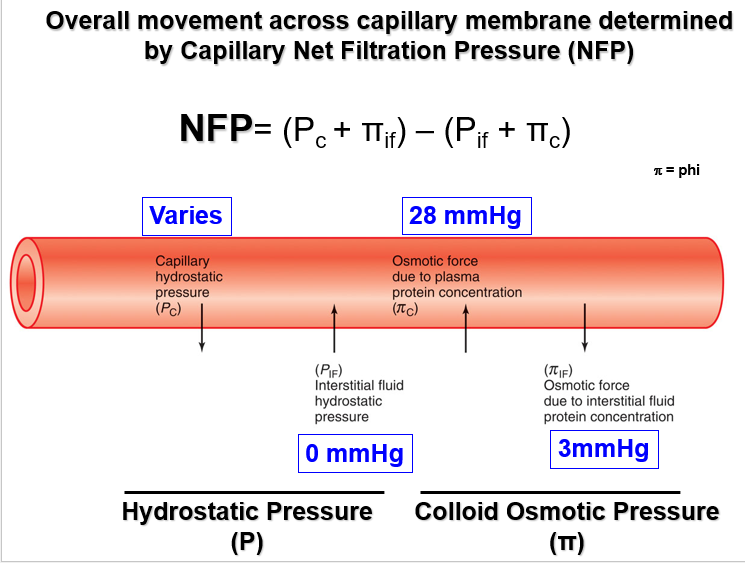
28mmHg (plasma) - 3mmHg (interstitium) = 25mmHg
What is hydrostatic pressure?
Hydrostatic pressure is the force exerted by the blood upon the capillary walls i.e. blood pressure
Hydrostatic pressure drives blood from plasma into interstitial space
Pressure drops as the blood moves through the capillaries (35mmHg to 15mmHg)
Overall movement across capillary membrane is determined by….
Capillary Net Filtration Pressure (NFP)
What is bulk flow?
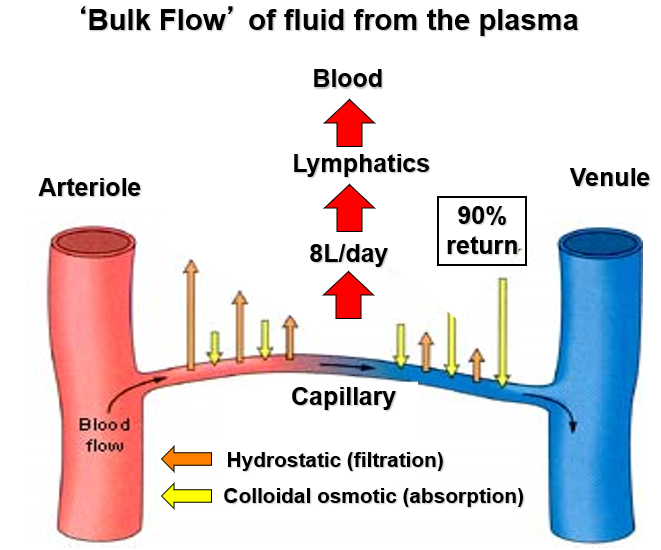
Bulk flow is the movement of fluid and dissolved substances together due to a pressure gradient. It is driven by differences in hydrostatic pressure (not concentration), moves large volumes at once, and occurs in processes like fluid leaving capillaries. Rule: bulk flow = pressure-driven movement of fluid.
What is the lymphatic system?
Lymph system is a parallel vascular system with 2 major functions
Draining fluid from the tissues and returning to the cardiovascular system
Maintenance of the immune response
How is lymph formed?
Excess fluid (plasma) passes into the lymph capillaries through lymph nodes, before passing back to blood stream at the beck
Structure of lymph vessels
Contains valves
Fluid is forced along by action of muscles and breathing
Larger lymph vessels are surrounded by smooth muscle that contract spontaneously and driven by pacemaker cells (heart)
What is the lymphatic system’s role in immunity?
Lymph fluid contains white immune blood cells
Collects antigens
Antigens recognised by B-lymphocytes in lymph nodes leads to activation of immunity
B-cells proliferate to produce antibodies. Lymph nodes also contain multiple other immune cells
Increased capillary hydrostatic pressure on both ends leads to…
heart failure
Decrease in colloid osmotic pressure leads to…
reduction in plasma proteins
Intracellular oedema
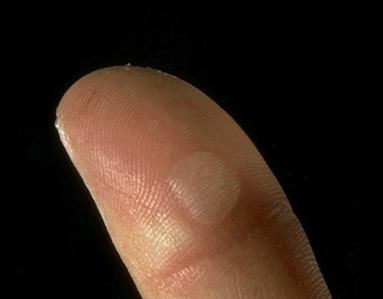
What causes oedema (swelling)?
Breakdown in the regulation of fluid compartments leads to oedema