Equilibrium in the invisible hand game
 Call Kai
 Learn
Learn Practice Test
 Spaced Repetition
 Match
Match Flashcards
 Knowt Play
1/7

Earn XP
Name | Mastery | Learn | Test | Matching | Spaced | Call with Kai |
|---|
No analytics yet
Send a link to your students to track their progress
8 Terms
What entails the best response?
-The strategy that gives the player the highest payoff, given the strategies that the other players select.
What entails a dominant strategy?
-Action that yields the highest payoff for a player, no matter what the others players do
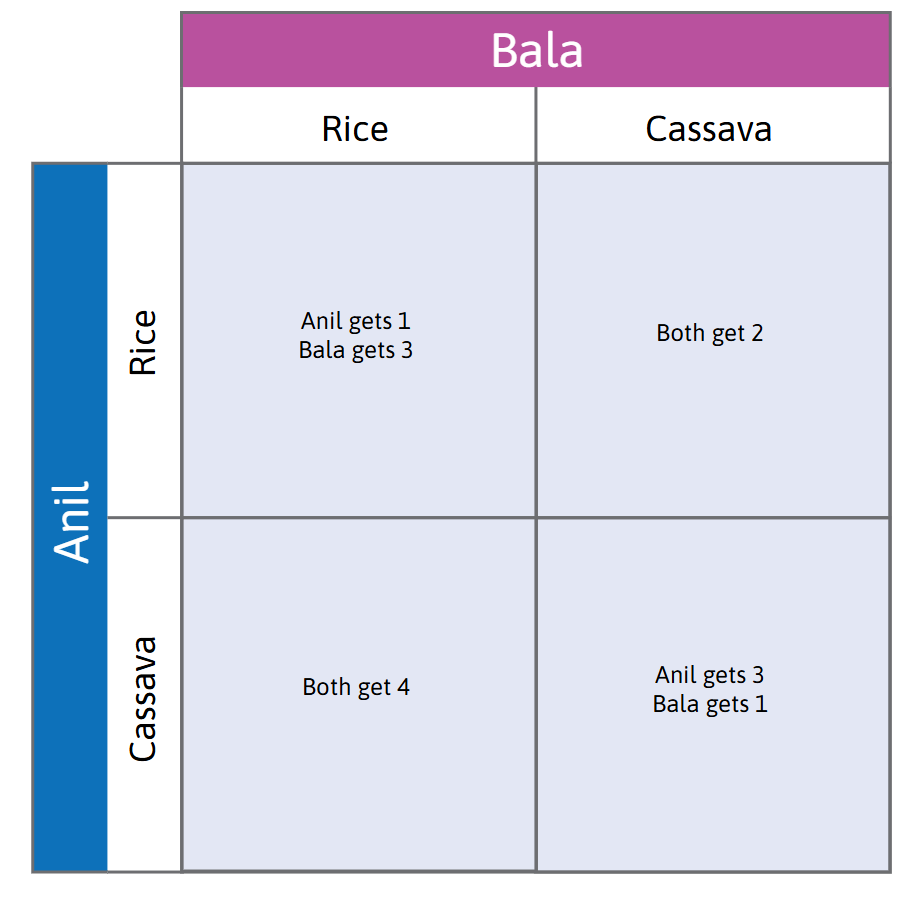
Given this, what are both players’ best responses, and do they have dominant strategies available?
-What outcome will happen?
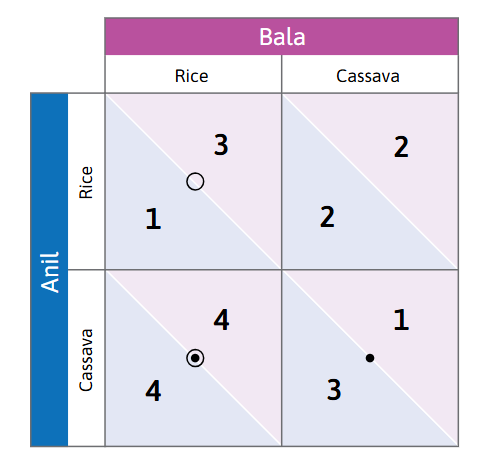
-Anil’s best response will be to grow cassava if Bala grows either rice (4>1) or cassava (3>2). Thus, cassava will always yield the highest payoff, making it a dominant strategy
-Bala’s best response will be to grow rice if Anil grows either rice (3>2) or cassava (4>1), thus another dominant strategy
-Because they will play their dominant strategies, the outcome that comes into fruition will be where Anil grows cassava, and Bala grows rice. Thus, the outcome represents the dominant strategy equilibrium.
Why can the invisible hand be relevant in this game?
-Anil and Bala went on with their own self-interest which was reflected in picking the strategy that maximised their payoff, which led to the best of the four possible outcomes for each player, and the strategy that yielded the largest total payoffs for the two farmers combined.
-They independently pursued their self-interests, yet were guided by an invisible hand, to an outcome that was in the interest of both parties.
What is the Homo Economicus (Economic man) referring to?
-A nickname, given to the selfish and calculating character found in economic textbooks.
Why is there a great debate about the usage of homo economicus?
-Adam Smith stated that we weren’t homo economicus and rather we actually are quite selfless too.
-Francis Edgeworth (1845-1926) talks about how every man is homo economicus
-H.L. Mencken (1880-1956) talks that helping others and caring about social norms is self-interest with a long time horizon.
Generally speaking, what have the experiments after 1990 shown in terms of if humans are homo economicus?
-Generally speaking, after using economic games, they see self-interested behaviour, altruism, reciprocity, aversion to inequality and other preferences that differ from self-interest
-Many experiments show that homo economicus is the minority
-So instead of thinking that humans are just homo economicus, they also add on other traits found in their experiments. That homo economicus may be appropriate in discussing certain economic settings, like shopping, but not in other settings, like paying taxes.