bio chapter 4
 Call Kai
 Learn
Learn Practice Test
 Spaced Repetition
 Match
Match Flashcards
 Knowt Play
1/52

There's no tags or description
Looks like no tags are added yet.
Name | Mastery | Learn | Test | Matching | Spaced | Call with Kai |
|---|
No analytics yet
Send a link to your students to track their progress
53 Terms
Cell theory
Cells are fundamentally units of life
All living organisms are composed of cells
All cells come from preexisting cells
Everything inside a cell except for the nucleus I those cells that have one is termed
Cytoplasm
Cytoplasm
Is water, along with thousands of substances that differ in identity and concentration from the composition of the outside of the cell.
Cell membrane
Performs the vital role of keeping the internal chemicals of a cell which carry out life’s functions, different from the chemical composition outside of the cell.
Fluid mosaic model
Random movements (fluid) and separatrness of the proteins and lipids (mosaic)
Phospholipids
The major lipid componet of biological membranes.
Phospholipids form thin bilayers
About 8 nanometer thick, with their charged, hydrophillic phospholipids “heads” on the external surfaces
is the simplest structural unit of a living
organism
cell
What are the 3 components of cell theory?
1. Cells are the fundamental units of life
2. All living organisms are composed of cells
3. All cells come from preexisting cells.
Which statement is one of the tenets of cell theory?
a. All cells take in energy and matter from the
environment.
b. Cells are separated from their environment by a cell
membrane.
c. All cells come from preexisting cells.
d. All cells contain mitochondria.
e. Cells sustain the living state through chemical
transformations.
c
A general function of all cellular membranes is to
a. regulate which materials can enter or leave the cell.
b. support the cell and determine its shape.
c. produce energy for the cell.
d. produce proteins for the cell.
e. move the cell.
a
The cytosol and _______ are two components of the
cytoplasm in a prokaryotic cell.
a. Golgi apparatus
b. chloroplasts
c. mitochondria
d. ribosomes
e. smooth ER
D
What is the fluid mosaic model of cell membranes?
Lipids and proteins move laterally though the membrane.
Phospholipids form
bilayers
Phospholipids form bilayers with the charged,
hydrophilic “heads” of the phospholipid bilayer are on the ___ of the membrane
outside
The nonpolar hydrophobic fatty acid “tails” of the phospholipid bilayer are on the ___of the membrane
inside.
The hydrophobic interior prevents
molecules and ions through the membrane.
A general function of all cellular membranes is to
a. regulate which materials can enter or leave the cell.
b. support the cell and determine its shape.
c. produce energy for the cell.
d. produce proteins for the cell.
e. move the cell.
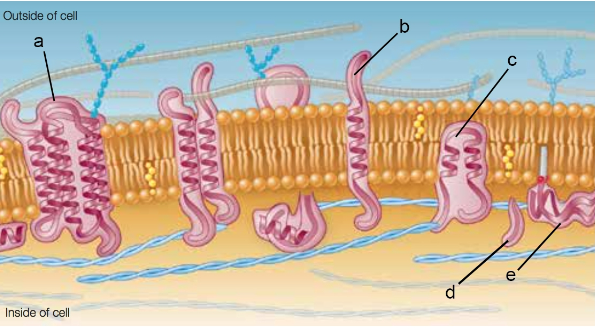
A section of the cell membrane is shown below. Which
letter(s) in the figure represent transmembrane proteins?
a. a and b
b. b and c
c. c and e
d. b, only
e. d and e
Membrane fluidity is influenced by:
• Lipid composition—short, unsaturated chains
increase fluidity; cholesterol alters interactions
among fatty acid side chains
• Temperature—fluidity decreases in cold
conditions; some organisms alter lipid
composition in cold environments
Membranes differ in lipid composition by
phospholipids vary in terms of fatty acid chain
length, degree of saturation, and polar groups.
at least partly
embedded in phospholipid bilayer. Hydrophobic
regions interact with membrane interior;
hydrophilic regions interact with the aqueous
environment.
integral membrane proteins
covalently
attached to fatty acids or other lipid groups
Anchored membrane proteins
no hydrophobic
groups; not embedded in the bilayer—polar or
charged regions interact with exposed parts of
integral membrane proteins or with charged
heads of phospholipids.
Peripheral membrane proteins
extend through the
bilayer; they may have domains with different
functions on the inner and outer sides of the
membrane
Transmembrane proteins
carbohydrate attached to a lipid
Glycolipid
oligosaccharide attached to a
protein
Glycoprotein
many carbohydrates attached
to a protein
Proteoglycan
Which compounds in a biological membrane form a barrier
to the movement of hydrophilic materials across the
membrane?
a. Integral membrane proteins
b. Carbohydrates
c. Lipids
d. Amino acids
e. Peripheral membrane proteins
biological membranes
allow some substances, but not others, to pass
Selective permeability
does not require energy;
substances diffuse down a concentration
gradient
Passive transport
requires energy and the
assistance of specialized membrane proteins.
Active transport
random movement of particles toward a state of equilibrium; a net movement from regions of higher concentration to regions of lower concentration
Diffusion
Diffusion in water is slow; speed depends on:
• Diameter of molecules
• Temperature
• Concentration gradient
• Area and distance
Simple diffusion
net movement of water from a region
of lower solute concentration to a region of
higher solute concentration
osmosis
pressure that must be applied to a solution to prevent flow of water
across a membrane by osmosis:
= CRT
osmotic pressure
solute particles per liter of water
(solute concentration)
Osmotic pressure can be quantified by
osmolarity
relative concentration of solutes on either
side of a membrane; determines direction and extent of net water movement
tonicity
The main components of biological membranes are
cholesterol and polar water molecules.
monosaccharides and polysaccharides.
lipids, proteins, and carbohydrates.
enzymes, electron acceptors, and electron donors.
nucleotides and nucleosides.
lipids, proteins, and carbohydrates.
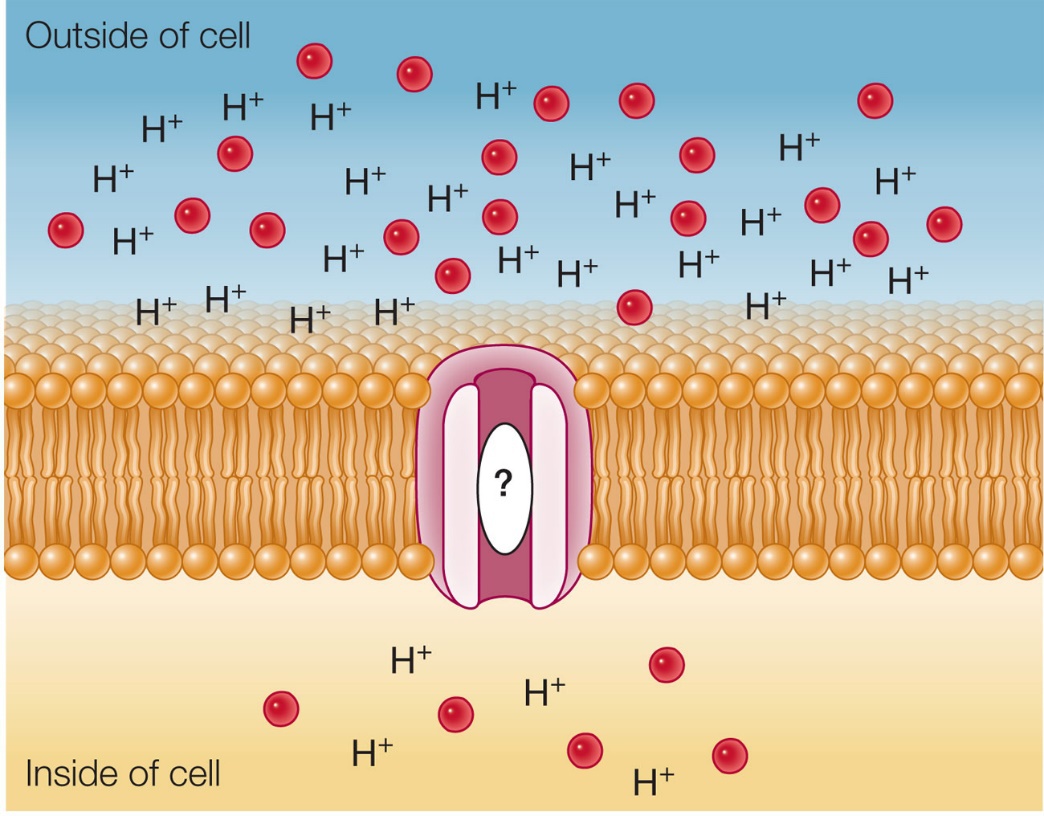
When completed, the figure will illustrate secondary active transport. The small red circles represent the molecules being transported, and the H+ symbols represent hydrogen ions. The natural concentration gradient of the red molecules is shown. The hydrogen ion gradient was established by a membrane protein that is not shown. Given this information, which symbol should appear in the oval to indicate the direction of movement of hydrogen ions and red molecules?


Which is a correct pairing of a substance and the process by which it is transported across cell membranes?
Water by secondary active transport
Cholesterol by pinocytosis
A solution by receptor-mediated endocytosis
Pancreatic digestive enzymes by exocytosis
Glucose by phagocytosis
Pancreatic digestive enzymes by exocytosis
Cell A | 1.0 µm |
Cell B | 2.0 µm |
Cell C | 3.0 µm |
How do the surface area-to-volume ratios compare for the cells listed in the table, and which cell will have the most rapid transport of materials into its interior? Assume the cells are spherical.
The surface area-to-volume ratios increase from C to B to A, with cell A having the most rapid transport.
The surface area-to-volume ratios increase from A to B to C, with cell A having the most rapid transport.
The surface area-to-volume ratios increase from C to B to A, with cell C having the most rapid transport.
The surface area-to-volume ratios increase from A to B to C, with cell B having the most rapid transport.
The surface area-to-volume ratios increase from A to B to C, with cell C having the most rapid transport.
The surface area-to-volume ratios increase from C to B to A, with cell A having the most rapid transport.
Refer to the table. Bean seeds were analyzed at various times before and during germination. At each time of analysis, the total protein content was determined as well as the protein content corresponding to glyoxysome enzymes. These values were then expressed as percentages, as shown in the table.
Condition | % of total protein corresponding to glyoxysomal enzymes |
|---|---|
Dry seed | 2 |
Seed exposed to moisture | 7 |
After 1 day | 8 |
After 2 days | 9 |
After 3 days | 14 |
After 4 days | 15 |
After 5 days | 17 |
After 6 days | 9 |
What do the results indicate about glyoxysomes and plant development?
Stored lipids in the seed are processed by glyoxysomes to supply chemical energy mainly for developing bean seedlings.
Refer to the table. The fatty acid composition of the intestinal cell membranes from three fish species were analyzed. One species lives in frigid Antarctic Ocean waters, another in the milder north Atlantic, and the third in the warm Mediterranean Sea.
Species | Saturated fatty acids | Monounsaturated fatty acids | Polyunsaturated fatty acids |
|---|---|---|---|
1 | 35% | 35% | 30% |
2 | 38% | 35% | 27% |
3 | 26% | 36% | 38% |
Use the data to match each species with its native waters.
Species 1: Antarctic; Species 2: Mediterranean; Species 3: north Atlantic
Species 1: north Atlantic; Species 2: Mediterranean; Species 3: Antarctic
Species 1: Mediterranean; Species 2: north Atlantic; Species 3: Antarctic
Species 1: north Atlantic; Species 2: Antarctic; Species 3: Mediterranean
Species 1: Mediterranean; Species 2: Antarctic; Species 3: north Atlantic
Species 1: north Atlantic; Species 2: Mediterranean; Species 3: Antarctic
The sodium–glucose co-transporter uses the _____________ of sodium ions down its concentration gradient causing _____________ to move glucose up its concentration gradient.
diffusion; active transport
An important difference between phagocytosis and receptor-mediated endocytosis is that
phagocytosis involves engulfment of larger substances, including whole cells.
Scientists have observed that in prokaryotes, translation of messenger RNAs begins before transcription has completed. In contrast, translation is completely separate from transcription in eukaryotes because DNA is isolated in the nucleus away from ribosomes, which carry out protein synthesis in the cytoplasm. What advantage does this compartmentalization provide eukaryotes?
It allows more opportunities for regulating gene expression.
Refer to the table. A student observed three single-celled organisms under a microscope and catalogued their features, as shown in the table.
Cell membrane | Cell wall | Flagellum | Photosynthetic | Mitochondria | Ribosomes | |
|---|---|---|---|---|---|---|
Organism A | Yes | Yes | No | No | Yes | Yes |
Organism B | Yes | No | No | Yes | No | Yes |
Organism C | Yes | No | Yes | No | No | No |
She concluded that all three were prokaryotes. Study the information that she recorded. Which organism or organisms should be reevaluated and/or reassigned?
Organisms A and C