STATS Introduction to ANOVA
 Call Kai
 Learn
Learn Practice Test
 Spaced Repetition
 Match
Match Flashcards
 Knowt Play
1/10

There's no tags or description
Looks like no tags are added yet.
Name | Mastery | Learn | Test | Matching | Spaced | Call with Kai |
|---|
No analytics yet
Send a link to your students to track their progress
11 Terms
Problem with multiple independent (t-)tests
Capitalising on chance = cumulating probability/chance of an error
If the .05 level of significance is adopted, the 5% chance of an error accumulates across the multiple tests (multiple tests being the DV across the different levels of the IV) → leading to a higher Type I error rate
Type I error (false positive)
Type II error (false negative)
Cumulative probability equation (Capitalising on chance)
Example: there are 6 separate independent t-tests (Each level of the IV: vocabulary learning method)
L1 direct translation vs L2 definitions
L1 direct translation vs Loci method
L1 direct translation vs Reminiscence
L2 definitions vs Loci method
L2 definitions vs Reminiscence
Loci method vs Reminiscence
= 1 - (1 - a)n Where n is the number of tests and a is the level of significance
= 1 - (1 - .05)6
= 0.26
Therefore, by doing 6 different t-tests you now have 26% of risk that you will make Type I error instead of the original 5% from .05
One-way between-subjects ANOVA
Only one IV (vocabulary learning method)
Each participant appears under only one level/condition
Difference between between-subjects ANOVA and T-tests
ANOVA (Analysis of Variance)
Compares means between 3 or more groups
Uses Variance to measure the differences (More variation = more difference between groups, no variation = no difference)
Between-groups variation vs within-group variation
T-tests
Compares means between 2 groups
Leads to: student’s t-test (assumes equal variance) or Welch’s t-test (does not assume equal variance)
Non-parametric alternative: Mann-Whitney U-test
t = obtained difference between two sample means / standard error
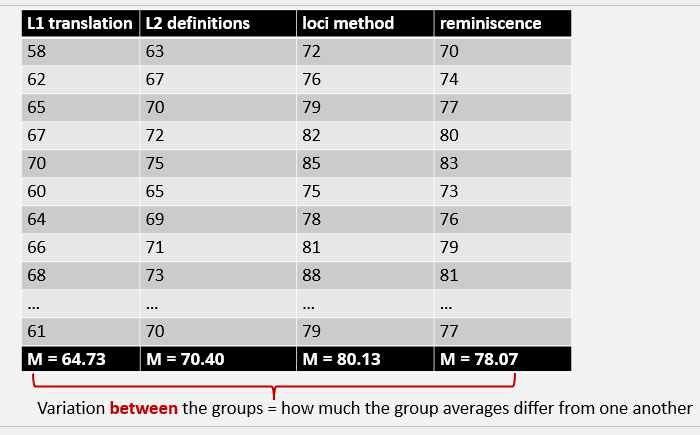
Between-group variation
Mean of each level of IV is calculated
Variation BETWEEN the means of groups is looked at (how much the group averages differ from one another)
Measures effect of error and treatment
Factors leading to between-group variation
Treatment effects
Each group uses a different vocabulary learning method; if some learn/remember better, the average vocabulary scores of the group will be different
Error
Variation could be due to chance rather than IV effect
Error in ANOVA = individual differences + random factors
Some may be stronger learners, tired, distracted
Small differences in testing conditions
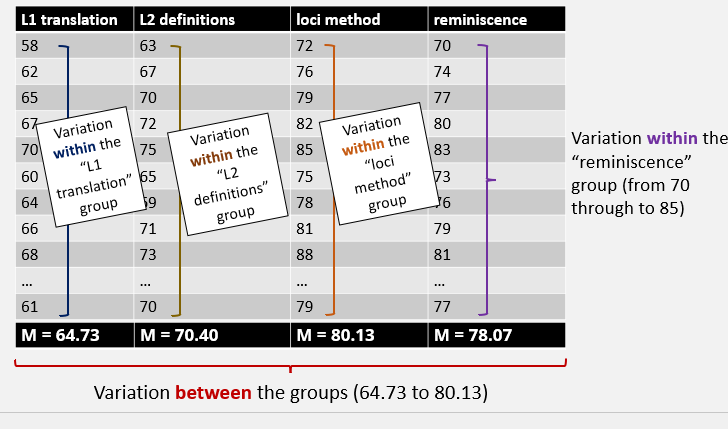
Within-group variation
Comparing how individual participant scores differ within each level of IV rather than the mean of each level
Measures effect of error
Causes of within-group variation
Error in ANOVA = individual differences + random factors
Some learners differ in ability despite the same technique, due to different memory ability, prior English knowledge and motivation
Random factors e.g. being tired, misunderstanding the question or the testing environment is noisy
Total variance
Between-group variance + within-groups variance = total variance (overall variation observed in the data)
ANOVA looks at the partition of total variation
Partition BREAKS DOWN the total variation observed the data into components
How to calculate Total variance
Calculate the mean for each group
Calculate the grand mean (sum of all individual scores from all groups, divide by number of observations) e.g. 4400/60 = 73.33
Calculate total variance of scores around sample means (within-groups variance) - how much do individuals differ from their own group mean?
Calculate variance of sample means around grand means (between-groups variance) - how much do the group means differ from the grand means?
F-ratio: the test statistic for ANOVA
F = Between-groups variance / Within-groups variance = treatment effect + error / error
Can vary from 0 to infinity
If the between-group variance > within-group variance, it means:
The F-value is large
The observed differences among groups means are unlikely to be due to chance alone