GENETICS - past exam questions
 Call Kai
 Learn
Learn Practice Test
 Spaced Repetition
 Match
Match Flashcards
 Knowt Play
1/142

There's no tags or description
Looks like no tags are added yet.
Name | Mastery | Learn | Test | Matching | Spaced | Call with Kai |
|---|
No analytics yet
Send a link to your students to track their progress
143 Terms
(T/F) the ability to fully determine the DNA sequence of a human in one day is currently not possible, it would take at least a month, possibly longer.
false
(T/F) cell membranes are formed in part by the hydrophobic and hydrophilic characteristics of fatty acid-like compounds in a water-based environment like the cytoplasm.
true
(T/F) stem cells isolated from the bone marrow are considered to be totipotent.
false
(T/F) during the process of mitosis, one diploid cell divides to form two haploid cells.
true
(T/F) meiosis is the form of cell division that produces haploid cells that all differ in their genetic information.
true
(T/F) the term synapsis, which occurs during meiosis, refers to when the chromosomes split at the centromere and begin to migrate to opposite ends of the cell.
false
(T/F) in metacentric chromosomes, the centromere is very near the center of the chromosome.
true
(T/F) embryonic stem cells would be considered cells that are arrested (non-dividing) in G0.
false
(T/F) in human cells, the normal genetically female diploid number of chromosomes is 22, XX.
true
(T/F) the cloning of frogs by nuclear transfer demonstrated that the nucleus of a mature cell maintains all the genetic information to create a full organism from a single cell.
true
(T/F) cancer chemotherapy often results in dramatic reductions of cells in the blood such as RBC and WBC of the immune system because the treatment also kills dividing stem cells in the bone marrow.
true
(T/F) Mendel’s breeding experiments showed that pea pants that have the same genotype also have the same phenotype.
true (genotype = phenotype)
(T/F) a recessive trait is expressed phenotypically in the heterozygous condition.
false
(T/F) karyotypes are made using cells that are stuck in S-phase of the cell cycle.
false
(T/F) the pattern of chromosome banding is the same for the X and Y chromosomes.
false
(T/F) trisomy refers to an increase in the number of the entire set of chromosomes of an organism.
false
The Haylick limit refers to
a. the technical limit in the rate of DNA sequencing
b. the limit in the type of stem cells than can be grown in culture
c. the lack of ability to visualize interphase chromosomes
d. the limit of the number of divisions for normal human cells in culture
e. the inability to detect certain chromosomal defects in a karyotype
d. the limit of the number of divisions for normal human cells in culture
For cells grown in the laboratory, the largest part of the cell cycle is:
a. interphase
b. mitosis
c. cytokinesis
d. they are all about equal
e. there is no regular pattern
a. interphase
for cells grown in the lab, the part of the cell cycle that immediately precedes mitosis is called
a. G3-phase
b. S-phase
c. G1-phase
d. G2-phase
e. telophase
d. G2-phase
an afrocentric chromosome is a chromosome that
a. has no centromere
b. has a defective centromere
c. has a centromere very close to one end of a chromosome
d. has a centromere close to the middle of a chromosome
e. has two centromeres
c. has a centromere very close to one end of a chromosome
the chromosomes are duplicated (DNA is synthesized) during
a. metaphase
b. telophase
c. anaphase
d. S phase
e. M phase
d. S phase
the purpose of preparing karyotypes in clinical settings can best be stated as:
a. to reveal chromosome abnormalities
b. to count the number of intact genes
c. to determine which genes are on which chromosomes
d. to isolate and analyze genes
e. all of these
a. to reveal chromosome abnormalities
the chromosome designation 11q refers to
a. the long arm of chromosome 11
b. a partial deletion of chromosome 11
c. a specific band on chromosome 11
d. an inversion on chromosome 11
e. the short arm of chromosome 11
a. the long arm of chromosome 11
the centromeres of sister chromatids uncouple and chromatids separate in which meiotic phase?
a. prophase II
b. anaphase I
c. metaphase II
d. telophase I
e. anaphase II
e. anaphase II
haploid gametes contain:
a. the 2n chromosome number
b. half the 2n chromosome number
c. twice the 2n chromosome number
d. half the n chromosome number
e. none of these
b. half the 2n chromosome number
which of the following would you predict would not result in any loss of genetic material?
a. monosomy
b. chromosome deletion
c. triploidy
d. centromere loss
e. haploidy
c. triploidy (gains extra set of chromosome)
which of the following are expected to have identical DNA sequences
a. homologous chromosomes that undergo synapsis
b. all X chromosomes
c. sister chromatids on mitotic chromosomes
d. all Y chromosomes
e. all autosomes
c. sister chromatids on mitotic chromosomes
when nondisjunction occurs during meiosis, one result is that
a. DNA continues to replicate
b. cells do not undergo cytokinesis
c. cells do not correctly partition mitochondria
d. chromosomal translocations occur
e. cells end up with an extra copy of a chromosome
e. cells end up with an extra copy of a chromosome
a cell that could not form spindle fibers could not perform:
a. mitosis
b. meiosis
c. protein synthesis
d. DNA replication
e. mitosis or meiosis
e. mitosis or meiosis
Gregor Mendel carried out his breeding and genetic studies in Europe during the
a. 1400s — about the time of Columbus
b. mid 1700’s — about the time of the American revolution
c. late 1800’s — around the time of the end of the US civil war
d. mid 20th century — about the same time Watson and Crick worked on DNA
e. late 20th century
c. late 1800’s — around the time of the end of the US civil war
what are the chances that two parents who have sickle-cell anemia (an autosomal recessive disease) will have a child with sickle cell anemia?
a. 10%
b. 0%
c. 25%
d. 50%
e. 100%
e. 100% (aa x aa)
what is the chance of two parents who are heterozygous for the recessive autosomal allele causing albinism having a child that is albino?
a. 25%
b. 50%
c. 0%
d. 75%
e. none of the above
a. 25%
during meiosis, homologous chromosomes that have undergone synapsis separate during
a. metaphase I
b. anaphase I
c. metaphase II
d. anaphase II
e. during cytokinesis
b. anaphase I
when a defect occurs such that part of one chromosome becomes attached to different chromosome, that event is called
a. nondisjunction
b. translocation
c. amplification
d. segregation
e. deletion
b. translocation
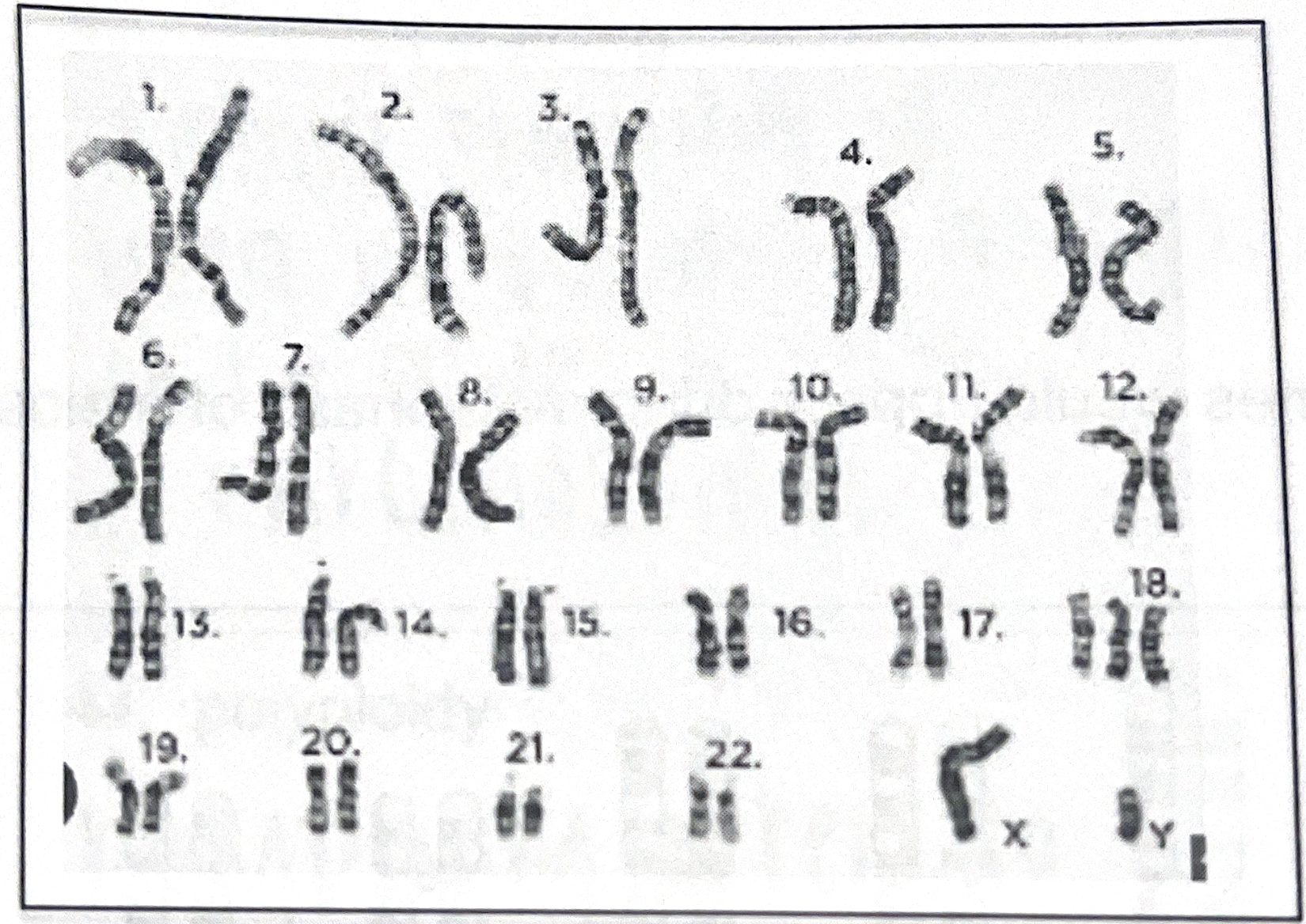
examine the karyotype
genetic male
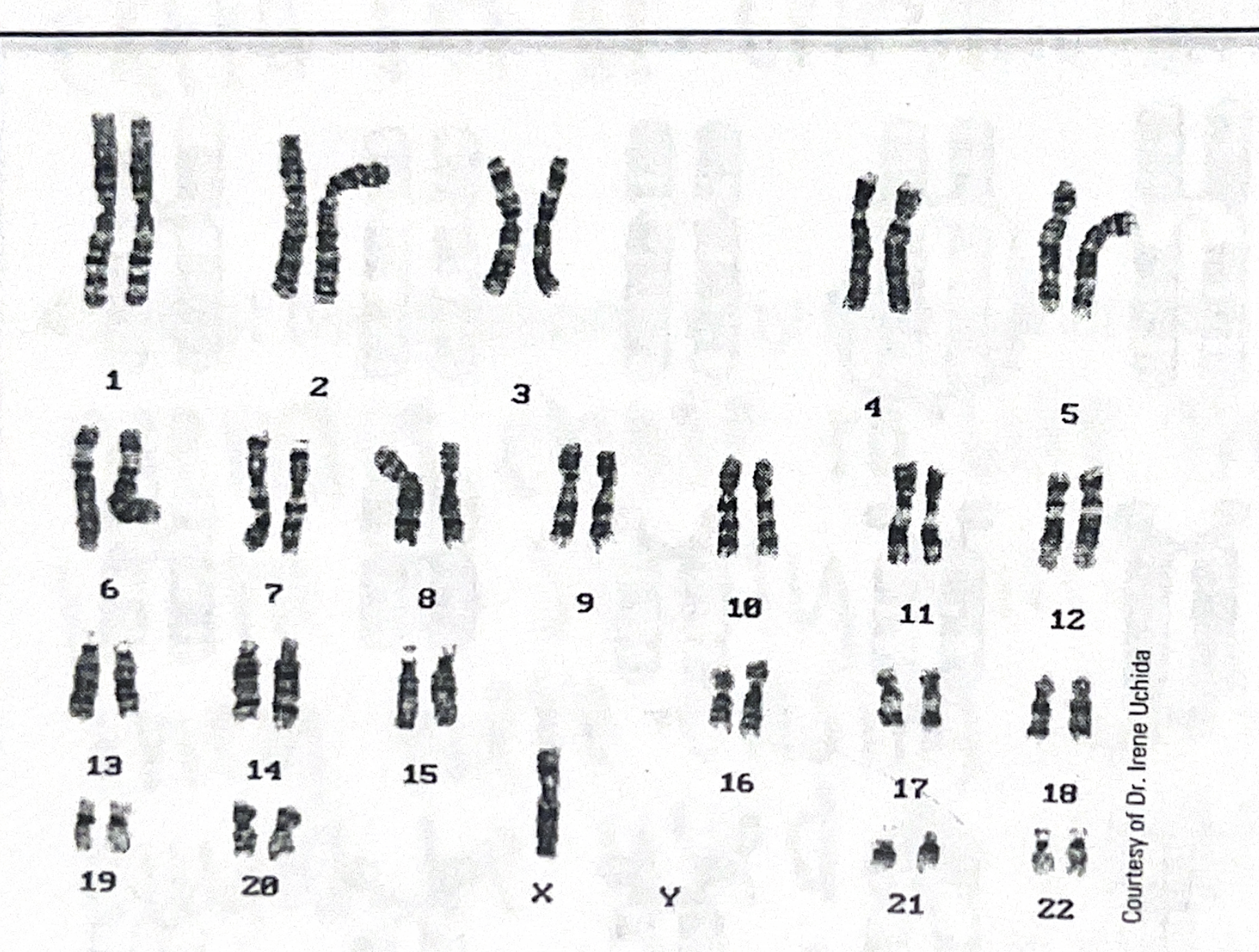
examine the karyotype
Turner Syndrome
examine the karyotype
Down Syndrome
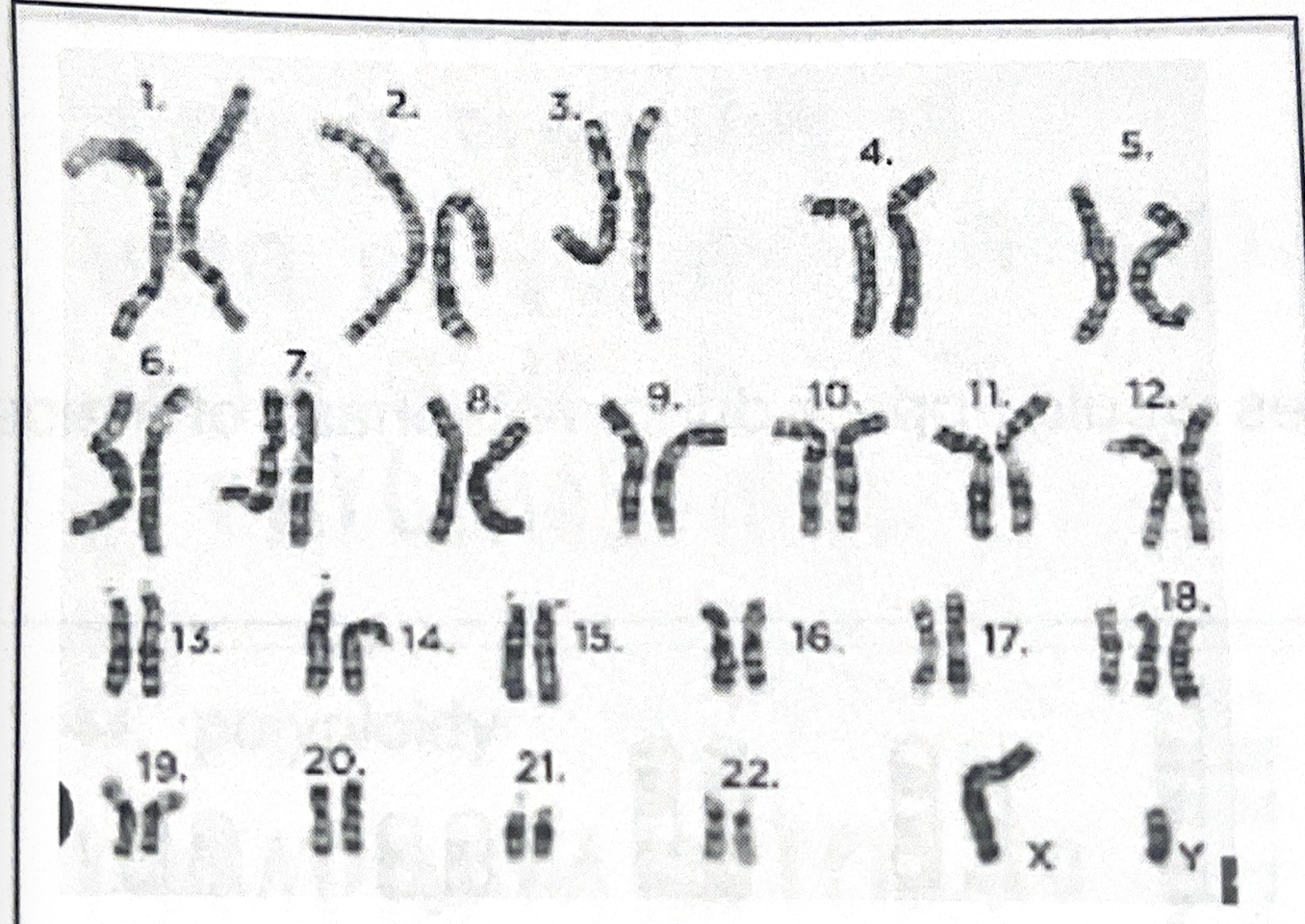
examine the karyotype
Edward’s syndrome
define round-up resistant soybeans
genetically modified crops to be resistant to herbicides
define amphipathic
both polar and nonpolar
define Giemsa staining
a staining technique of chromosomes to view their banding pattern
define polyploidy
extra set of chromosomes
list two reasons why Mendel chose to use the pea plant to study inheritance
easy to grow and have a short life cycle
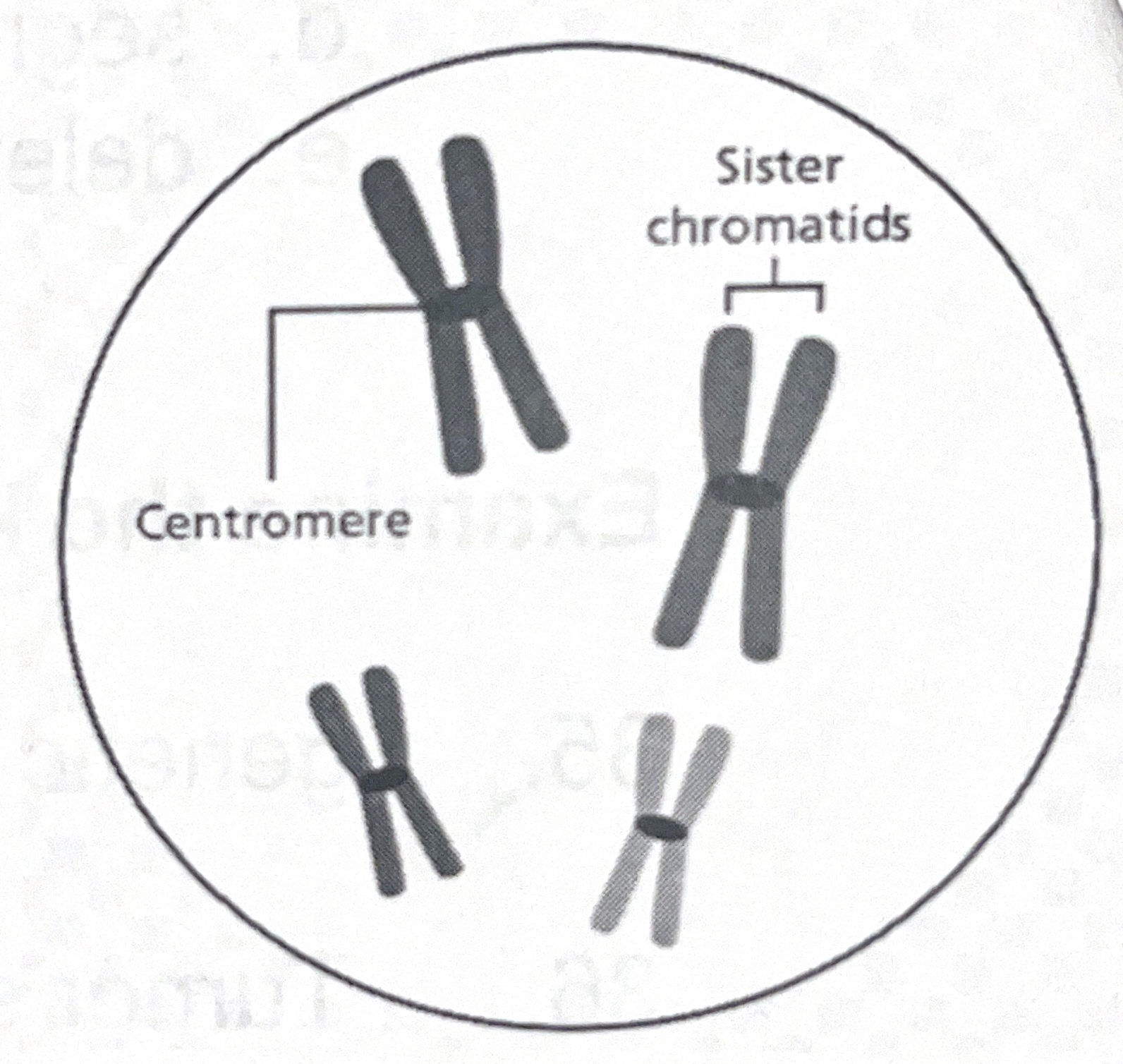
the diagram illustrates a cell that has a diploid number of 4 (n=4). after DNA replication and chromosome condensation prior to division, the cell can be illustrated like this. the chromosome pairs can be distinguished due to their size.
draw how the chromosomes would appear during metaphase of mitosis.
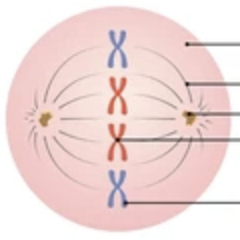
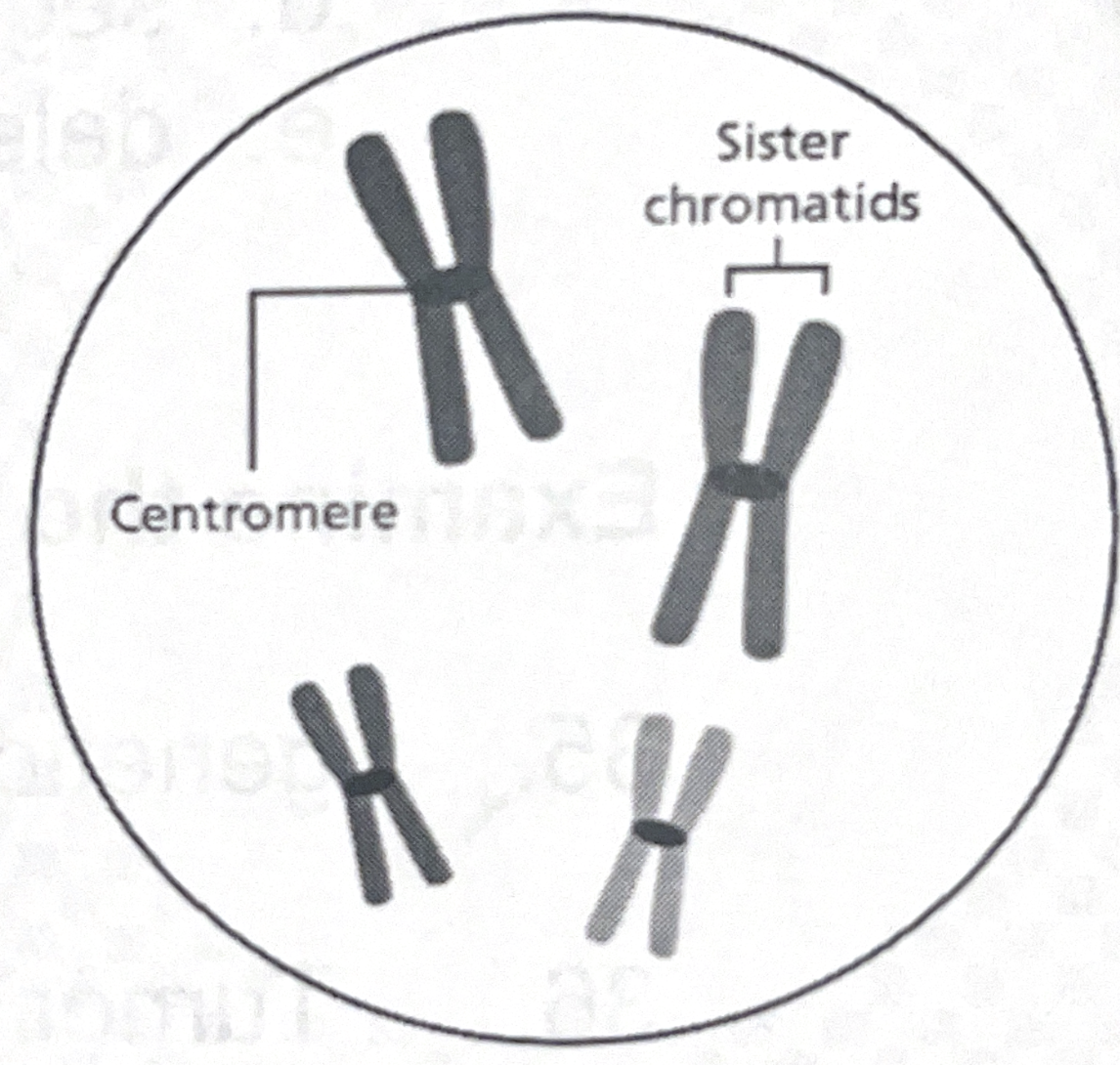
the diagram illustrates a cell that has a diploid number of 4 (n=4). after DNA replication and chromosome condensation prior to division, the cell can be illustrated like this. the chromosome pairs can be distinguished due to their size.
draw how the chromosomes would appear during metaphase of meiosis I.
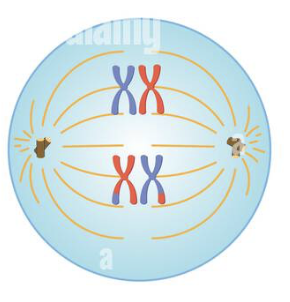
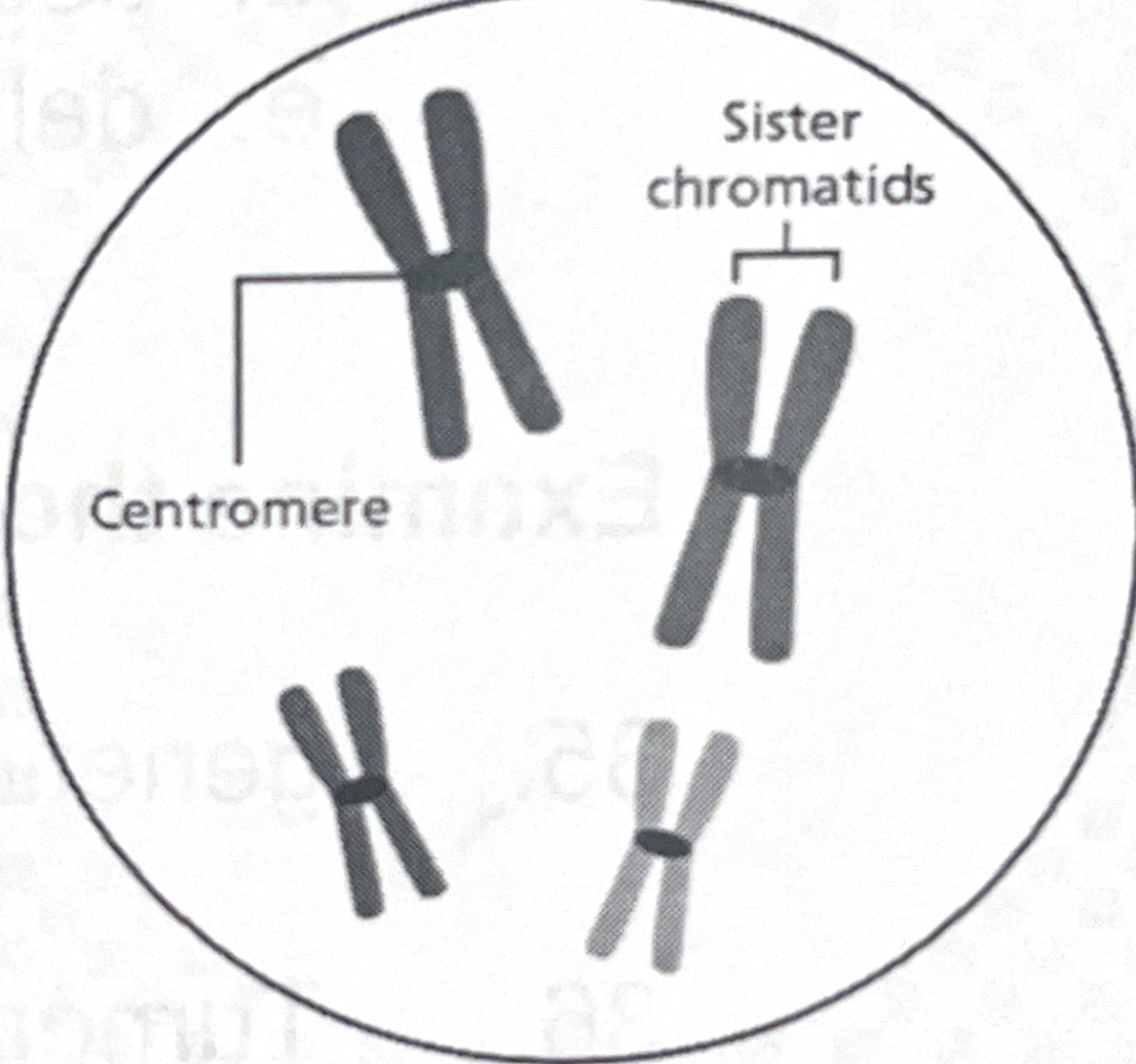
the diagram illustrates a cell that has a diploid number of 4 (n=4). after DNA replication and chromosome condensation prior to division, the cell can be illustrated like this. the chromosome pairs can be distinguished due to their size.
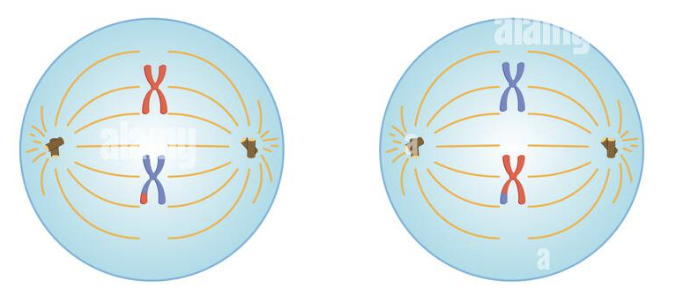
draw how the chromosomes would appear during metaphase of meiosis II.
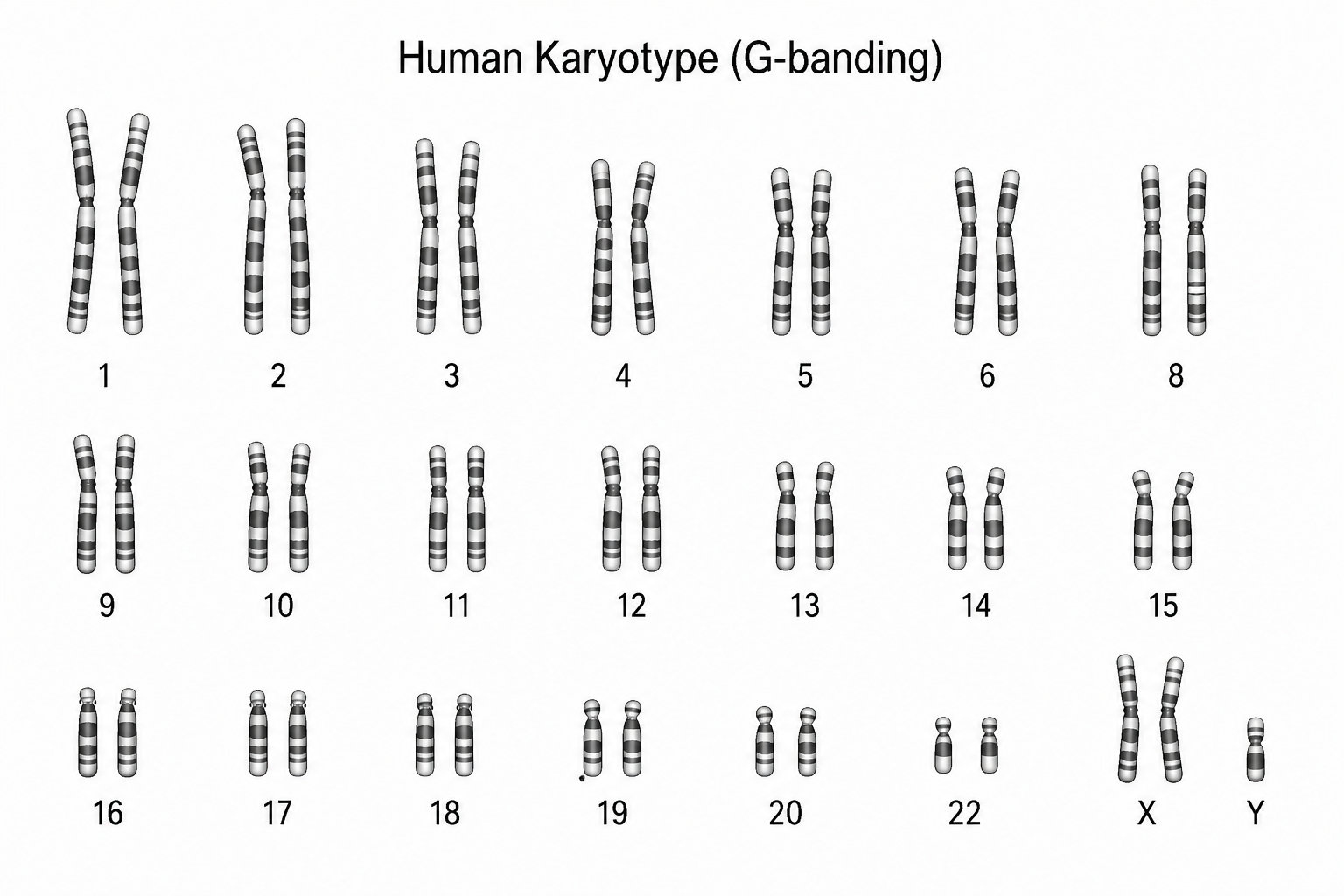
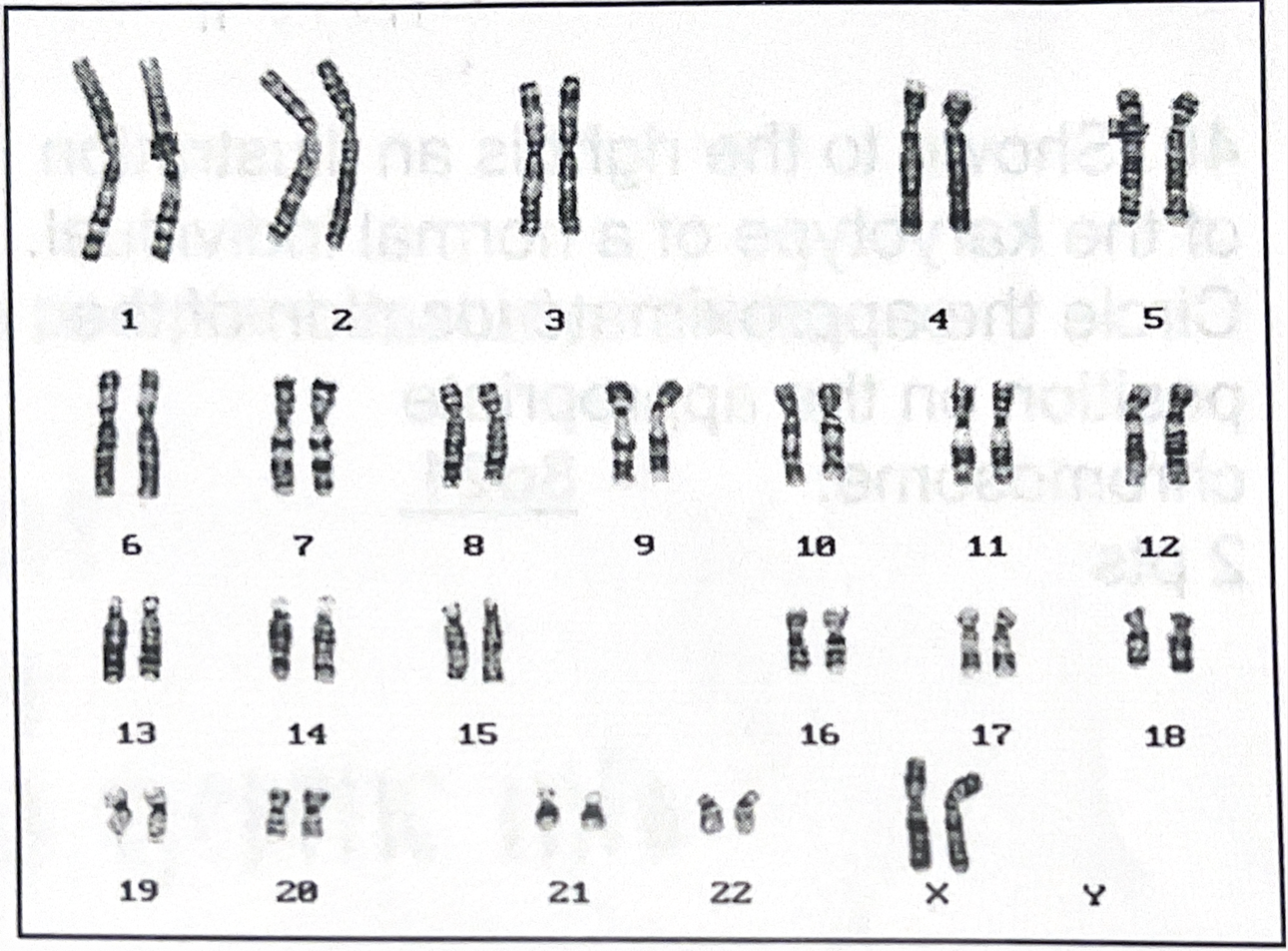
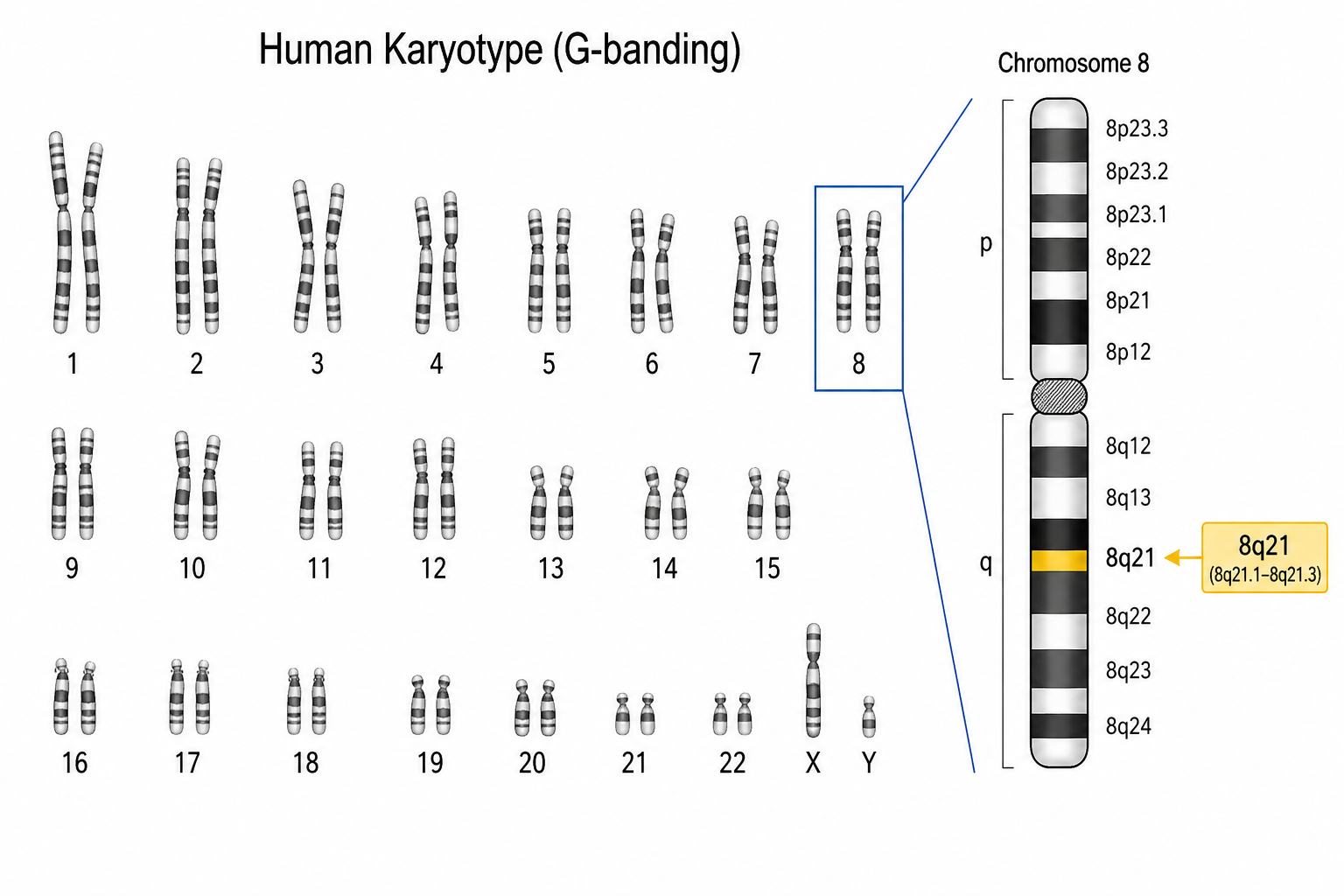
shown is an illustration of the karyotype of a normal individual. circle the approximate location of the position on the appropriate chromosome: 8q21
(T/F) maternal inheritance is another term for X-linked inheritance.
false
(T/F) males do not pass their X chromosome to any of their sons.
true
(T/F) mitochondrial inheritance is considered a non-Mendelian form of inheritance.
true
(T/F) the mormon community in Utah has been very helpful in creating large family pedigrees for studies of inheritance in humans.
true
(T/F) essential amino acids are those that we need to obtain through our diet because our cells cannot make them
true
(T/F) the amino acid sequence of a protein is considered the tertiary structure of a protein
false
(T/F) all amino acid R-groups are polar and can hydrogen bond with water
false
(T/F) the two strands of double stranded DNA are referred to as being antiparallel because the two strands are oriented in opposite directions.
true
(T/F) DNA contains two identical polynucleotide chains
false
(T/F) the main difference between RNA and DNA is that there is uracil in RNA and thymine in DNA
false
(T/F) although Watson and Crick’s model for the structure of DNA was correct, it still could not account for how DNA could undergo self-replication.
false
(T/F) proteins are macromolecules and are polymers of nucleotides
false
(T/F) the sugar found in DNA is called 2-deoxyribose.
true
if a plant with the genotype AAbb is crossed with a plant that is aabb, what proportion of the offspring will be AAbb? what proportion will be aabb? how many different genotypes will there be among the offspring from the cross?
a. 0/16
b. 2/16
c. 3/16
d. 8/16
e. 16/16
a. sixteen
b. eight
c. four
d. two
e. one
a. 0/16
a. 0/16
e. one
mutations in mitochondrial genes
a. have no effect on phenotype
b. are inherited from the mother
c. affect only females
d. affect only males
e. are inherited from the father
b. are inherited from the mother
which of the following organisms are used as a model genetic system by scientists studying genetics
a. zebrafish
b. the nematode C. elegans
c. drosphila melanogaster (fruit fly)
d. arabidopsis thaliana (a plant)
e. all of the above
e. all of the above
which virus was found to be contaminating the early poliovirus vaccine
a. poliovirus itself
b. a recent strain of bird flu virus
c. COVID 19
d. the tumor virus SV40
e. the RNA-based tobacco mosaic virus
d. the tumor virus SV40
y-linked males are
a. known as homozygous traits
b. known to skip generations in males
c. carried only by males and transmitted only to males
d. carried only by females. but never expressed
e. passed onto only 50% of female progeny
c. carried only by males and transmitted only to males
cystic fibrosis is an autosomal recessive disease and is most common in
a. asian americans
b. hispanic americans
c. African americans
d. European americans
e. none of the above
d. European americans
sickle cell anemia is a very debilitating autosomal recessive disease. individuals homozygous for the allele are very sick but individuals that are heterozygous for the allele and have one normal (dominant) allele appear to
a. be just as sick as homozygotes
b. be somewhat resistant to malaria
c. have a completely different inherited cancer syndrome
d. be somewhat resistant to dysentary
e. none of the above
b. be somewhat resistant to malaria
the basic unit of a protein molecule is the
a. nitrogenous base
b. sugar-phosphate backbone
c. amino acid
d. ribose sugar
e. nucleotide
c. amino acid
how many different amino acids are used in the assembly of proteins
a. four
b. hundreds
c. twenty
d. millions
e. can only be determined by AI
c. twenty
a very common simple 3D structure seen in proteins is
a. amino terminus
b. hydrogen bonding
c. phosphate bond
d. the beta sheet
e. all of the above
d. the beta sheet
the bonds that hold amino acids together in a protein are called
a. hydrogen bonds
b. weak bonds
c. amphipathic bonds
d. polar bonds
e. peptide bonds
e. peptide bonds
a simple alpha helix in a protein is referred to as
a. the linear structure
b. the secondary structure
c. the basic structure
d. the primary structure
e. the coding structure
b. the secondary structure
x-ray crystallography is a technique that can be used to
a. purify prion particles
b. amplify small amounts of DNA
c. isolate a specific gene for cloning
d. locate where a protein is
e. determine the structure of a protein
e. determine the structure of a protein
which individual won a Nobel prize for the discovery of the alpha helix secondary structure of proteins
a. Linus Palling
b. James Watson
c. Rosalind Franklin
d. Gregor Mendel
e. Harris Pastides
a. Linus Palling
the correct interactions of proteins is necessary to maintain healthy cells and tissues. the incorrect interactions of certain proteins are responsible for neurodegenerative diseases such as Alzheimer's disease and Huntington’s disease. what happens to these proteins?
a. they are degraded
b. they bind to the wrong motor proteins
c. they eventually refold into the correct structures
d. they form dysfunctional microtubules
e. they form protein aggregates
e. they form protein aggregates
the disease called kuru is a disease caused by prions and was originally discovered in a location in New Guinea where people were
a. purely vegetarians
b. heavily inbred with brother-sister marriages
c. heterozygous for a lethal recessive allele
d. practicing cannibalism
e. eating animals with Mad Cow disease
d. practicing cannibalism
which one of the following is part of Chargoff’s rules
a. the amount of cytosine = the amount of guanine in DNA
b. DNA is a right-handed helix
c. the amount of ribose = the amount of deoxyribose in DNA
d. G base pairs with C
e. all of the above
a. the amount of cytosine = the amount of guanine in DNA
how many different nitrogenous bases are found in RNA and DNA combined
a. four
b. five
c. twenty
d. fifty
e. thousands
b. five

which base pair is represented in the figure below
a. A-T
b. A-U
c. G-G
d. G-C
e. none of the above
d. G-C

in the figure the purine is located on the
a. right
b. left
c. neither — there is no purine
b. left
in the Watson-crick model of DNA, the two polynucleotide chains of the helix are:
a. of unequal length
b. held together by hydrogen bonds
c. arranged with the bases on the outside
d. built with the nucleotides as the backbone
e. both oriented in the same direction
b. held together by hydrogen bonds
RNA is very different than DNA in that RNA can have enzymatic activities in the cell. this is due to RNA
a. being single stranded
b. RNA having uracil
c. RNA having a ribose sugar with an extra -OH
d. complexing with histone
e. being a nucleic acid
c. RNA having a ribose sugar with an extra -OH
a ribozyme is an enzyme that is comprised of
a. RNA that is biochemically active
b. protein that is biochemically active
c. DNA that is biochemically active
d. a micelle
e. none of the above
a. RNA that is biochemically active
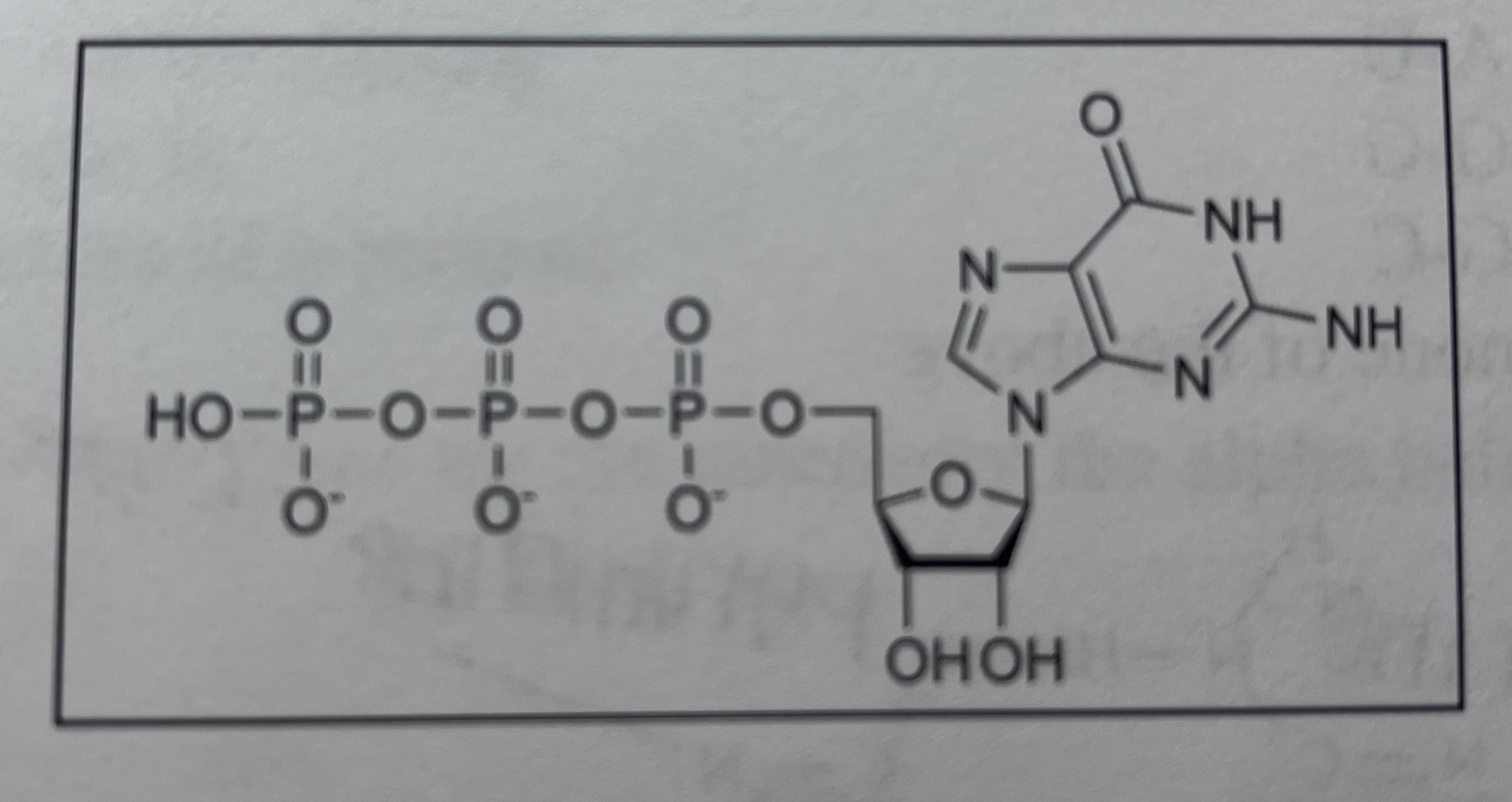
the chemical structure is a subunit of
a. a protein
b. membrane
c. DNA
d. RNA
e. fatty acid
d. RNA
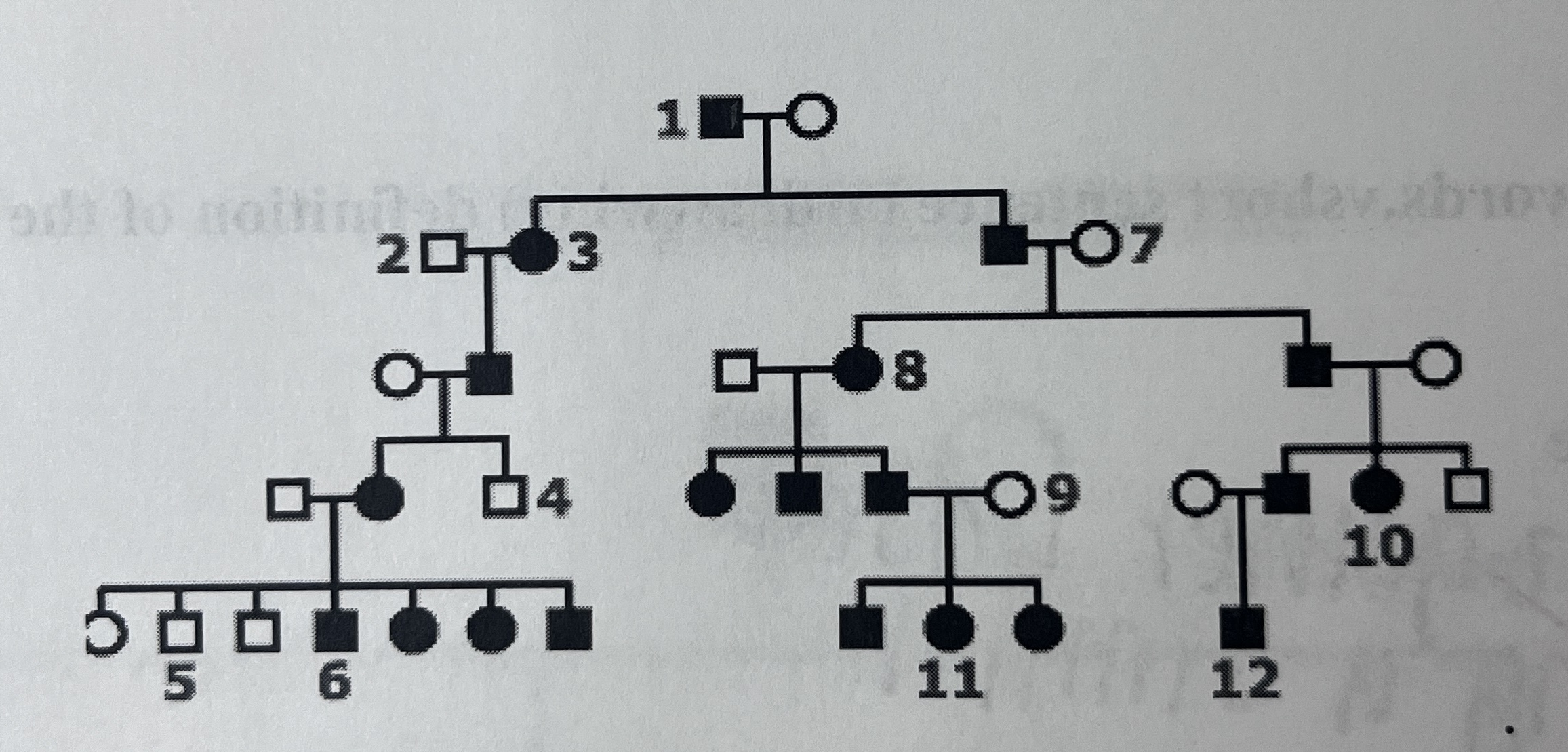
evaluating the pedigree, what is the predicted mode of inheritance of the phenotype
a. autosomal dominant
b. autosomal recessive
c. x-linked recessive
d. x-linked dominant
e. non-mendelian
a. autosomal dominant
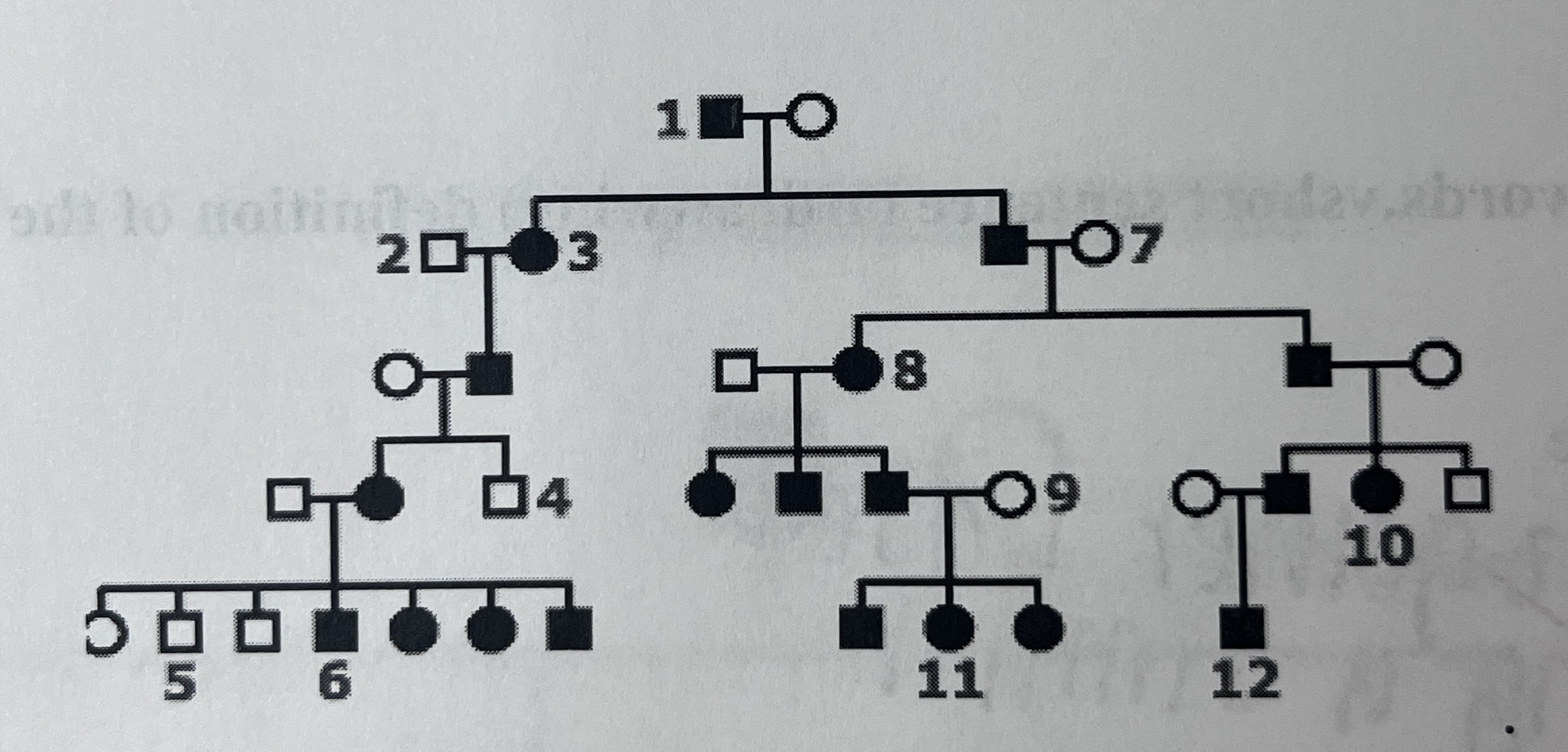
assuming A represents dominant and a represents recessive, the genotype of individual #3 is
a. AA
b. Aa
c. aa
b. Aa
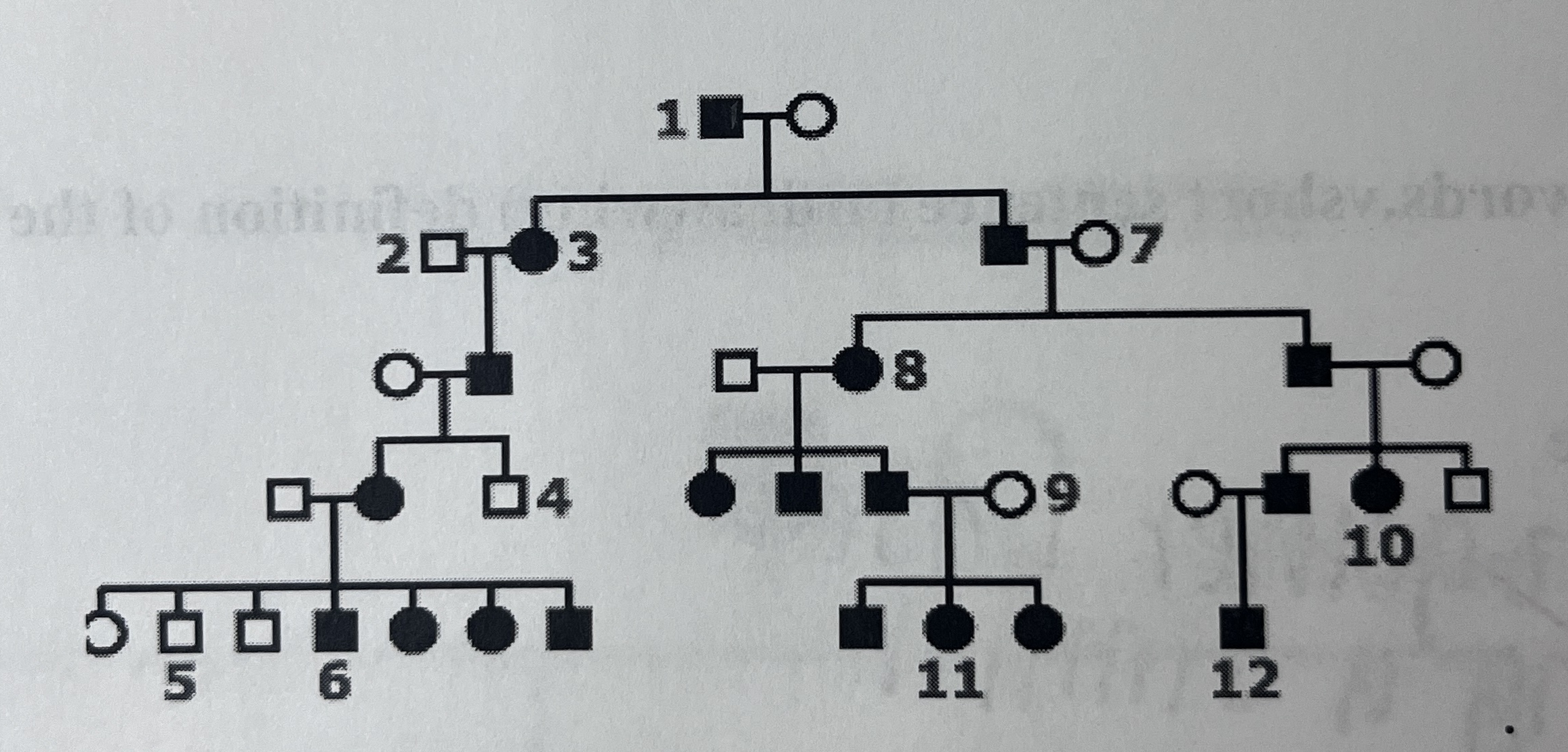
the genotype of individual #6 is
a. AA
b. Aa
c. aa
b. Aa
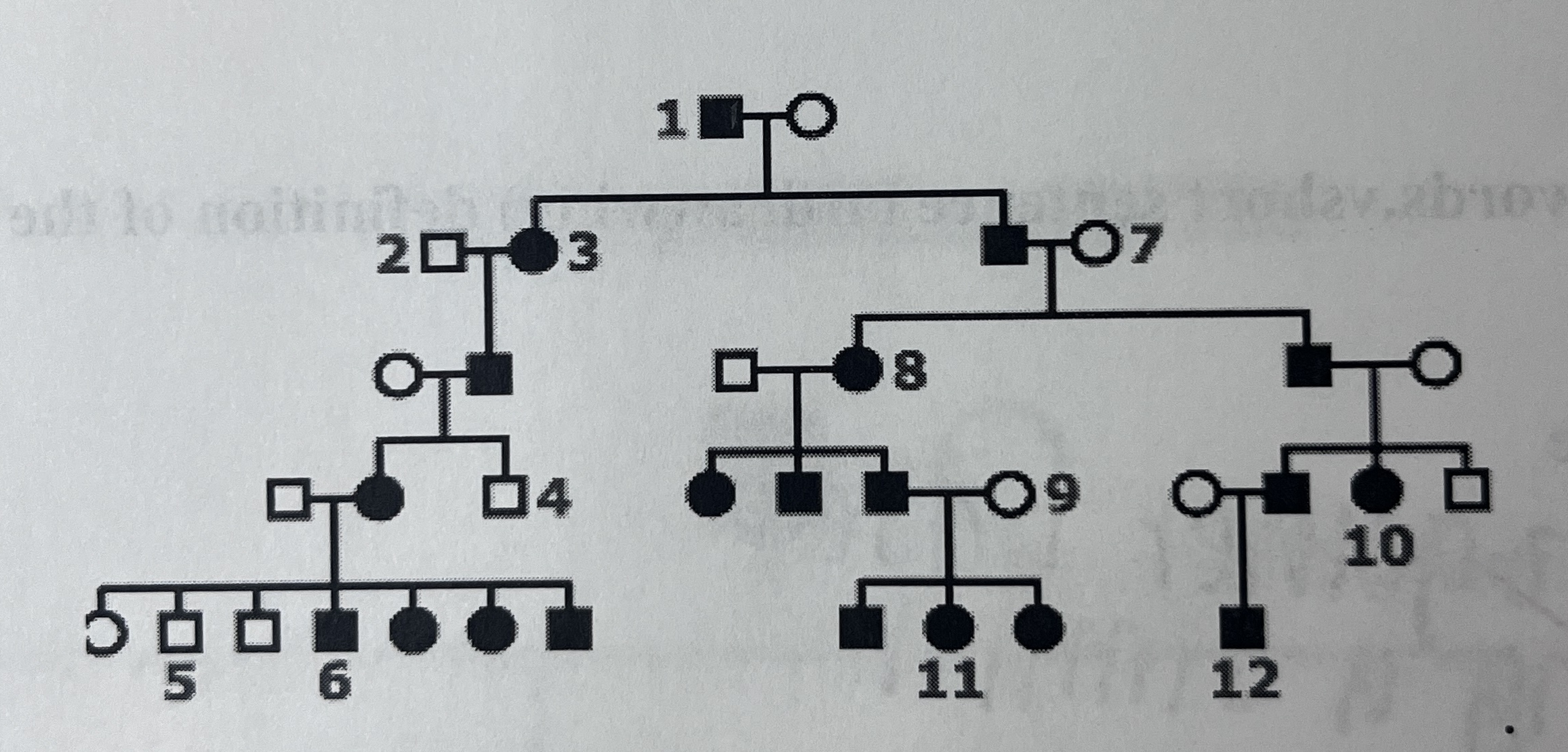
the genotype of individual #9 is
a. AA
b. Aa
c. aa
c. aa
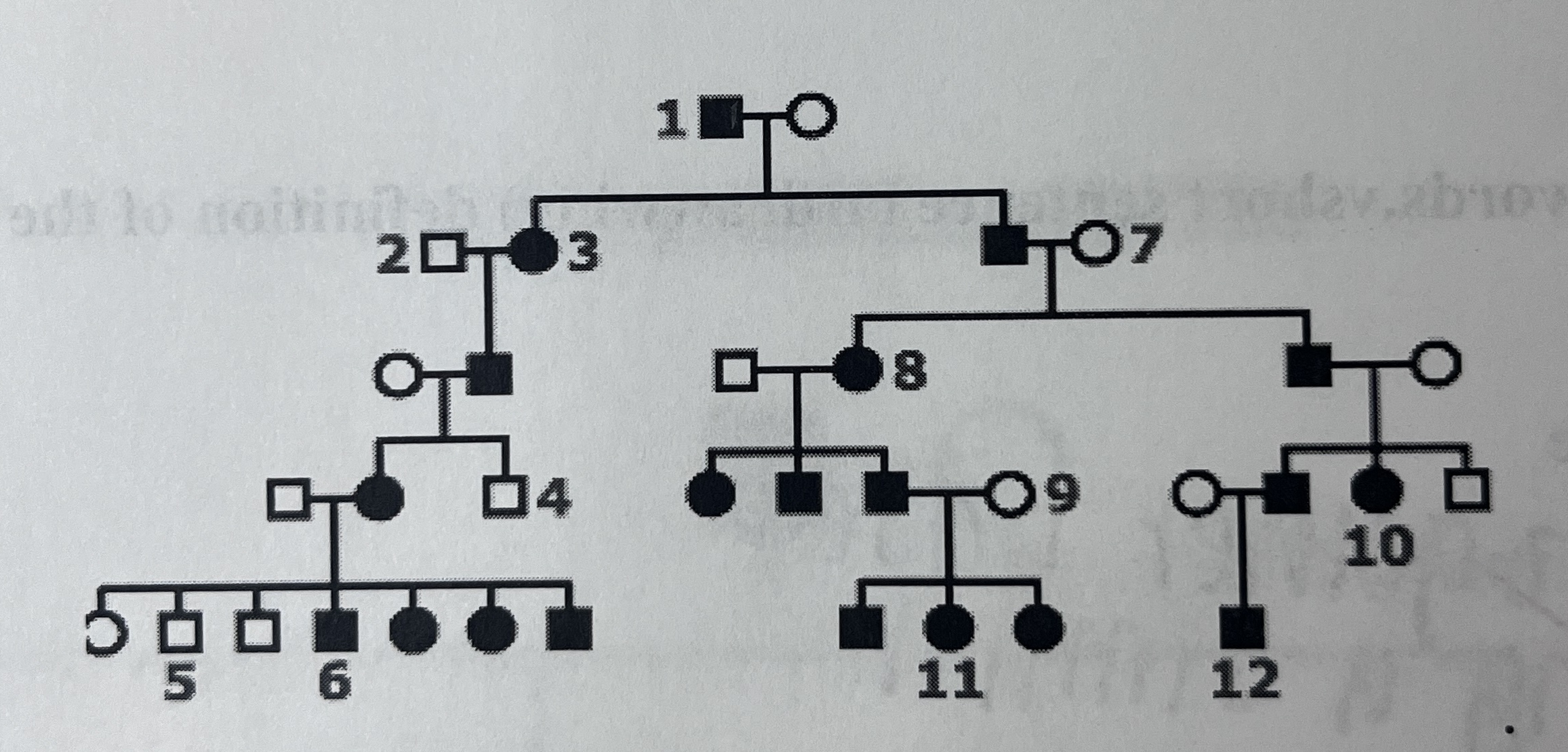
if individual #4 has a child with someone that does not have the disorder, what would the chances for the child to have the disorder
a. 100%
b. 75%
c. 50%
d. 25%
e. 0%
e. 0%
if individual #4 has a child with someone that is homozygous for the disorder, what would the chances for the child to have the disorder
a. 100%
b. 75%
c. 50%
d. 25%
e. 0%
a. 100%
define genetic linkage
genes located on the same chromosome that cannot separate
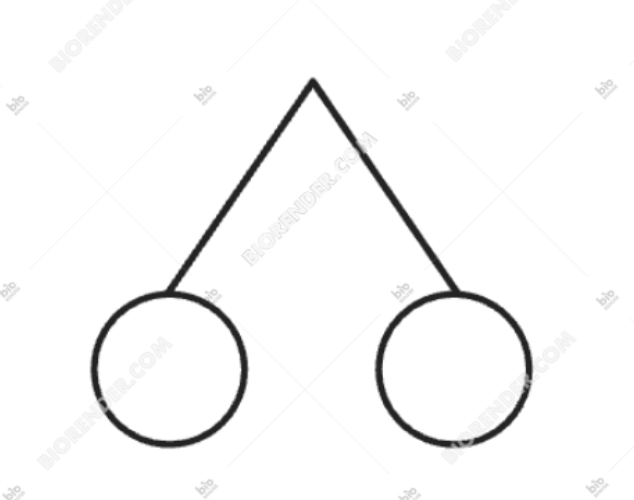
symbol used for di-zygotic (non-identical) twins in a pedigree
define the motor protein, kinesin
a vesicle and organelle transport
define protein quartenary structure
multiple protein subunits together (self-assembly)
define Chargoff’s rules
A+G = T+C
A = T, G = C
(T/F) in human cels, DNA replication begins at the top of each chromosome and spreads down the length until it reaches the other end.
false
(T/F) the breaking of the hydrogen bonds in DNA is necessary for DNA replication to occur
true
(T/F) DNA in nucleus is complexed with proteins called histones that help organize and compact the DNA
true
(T/F) spliceosomes are responsible for translating mRNA and synthesizing protein
false
(T/F) the promoter of a gene is responsible for splicing of exons to generate the mRNA
false