LAW frameworks + gaps
 Call Kai
 Learn
Learn Practice Test
 Spaced Repetition
 Match
Match Flashcards
 Knowt Play
1/29

There's no tags or description
Looks like no tags are added yet.
Name | Mastery | Learn | Test | Matching | Spaced | Call with Kai |
|---|
No analytics yet
Send a link to your students to track their progress
30 Terms
Elements of contract
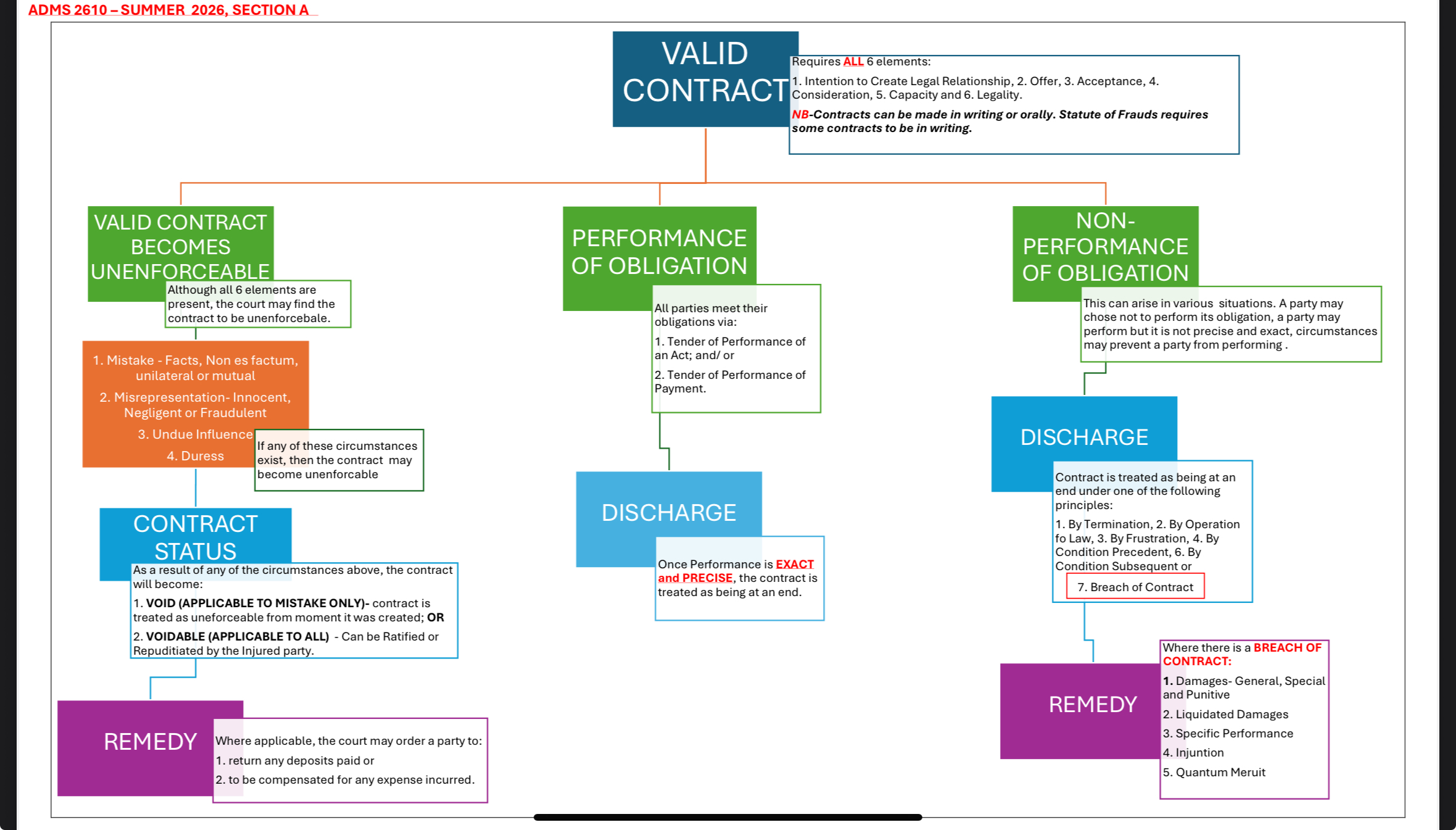
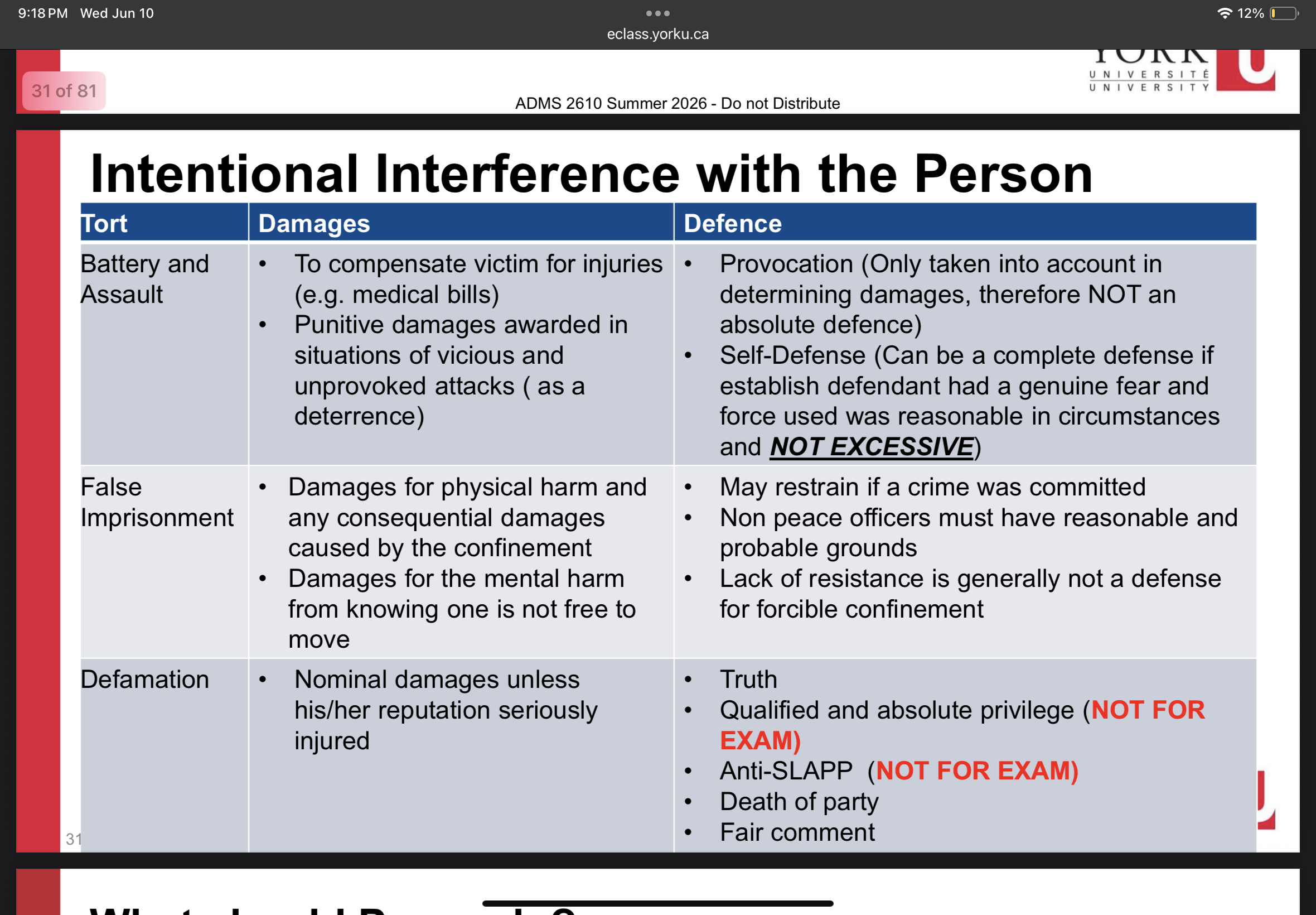
2 types of tort
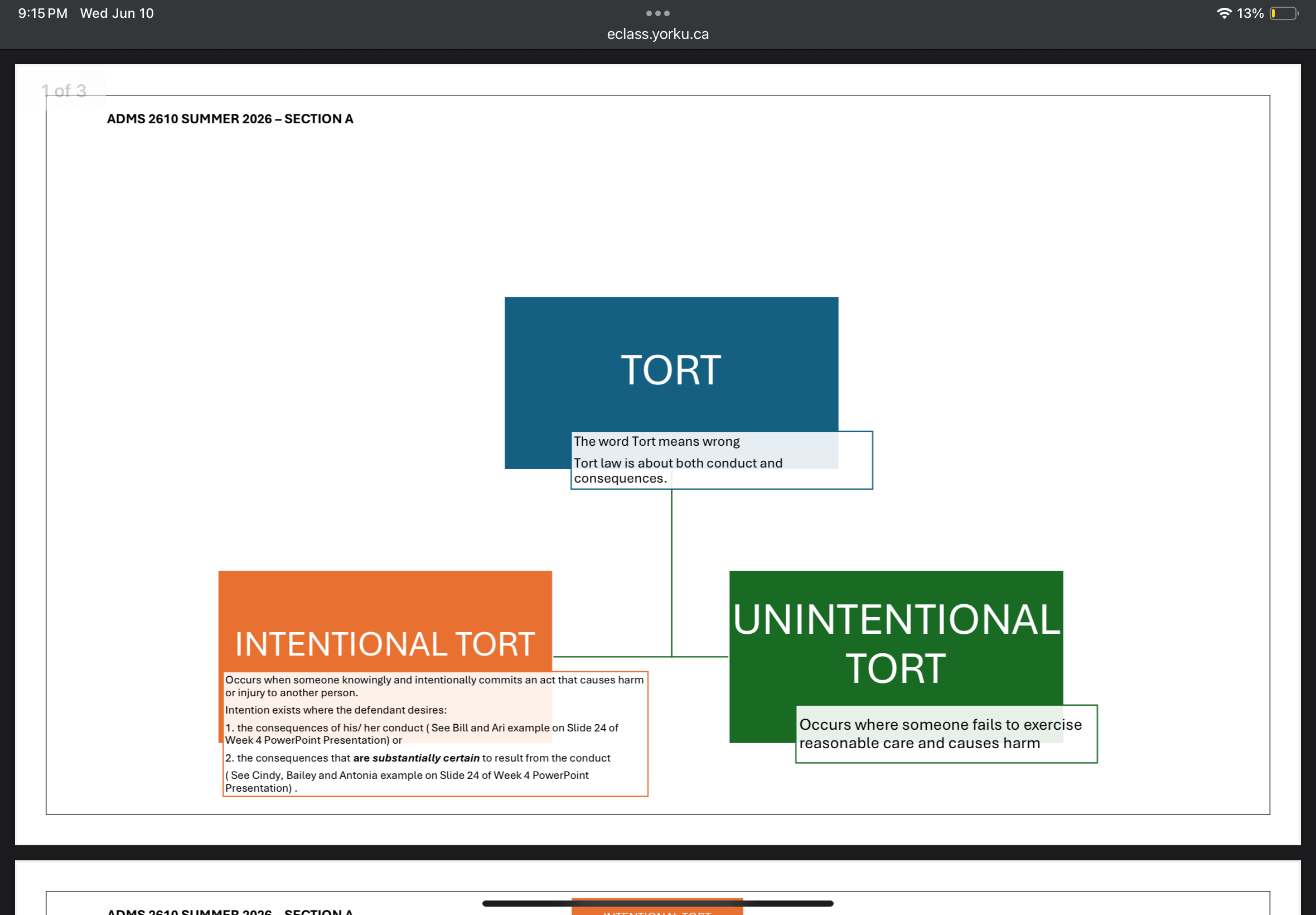
Types of intentional torts
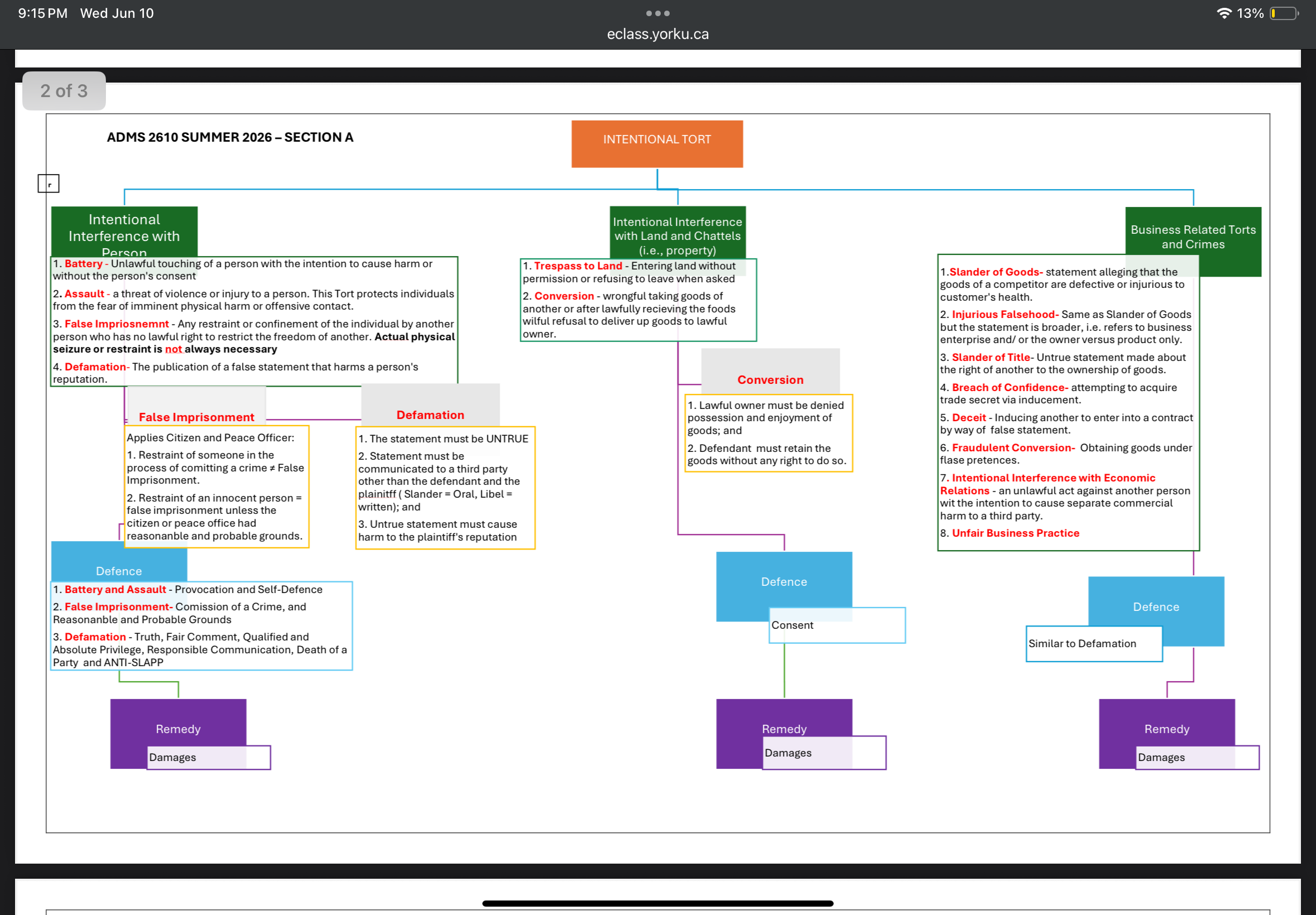
Types of unintentional torts
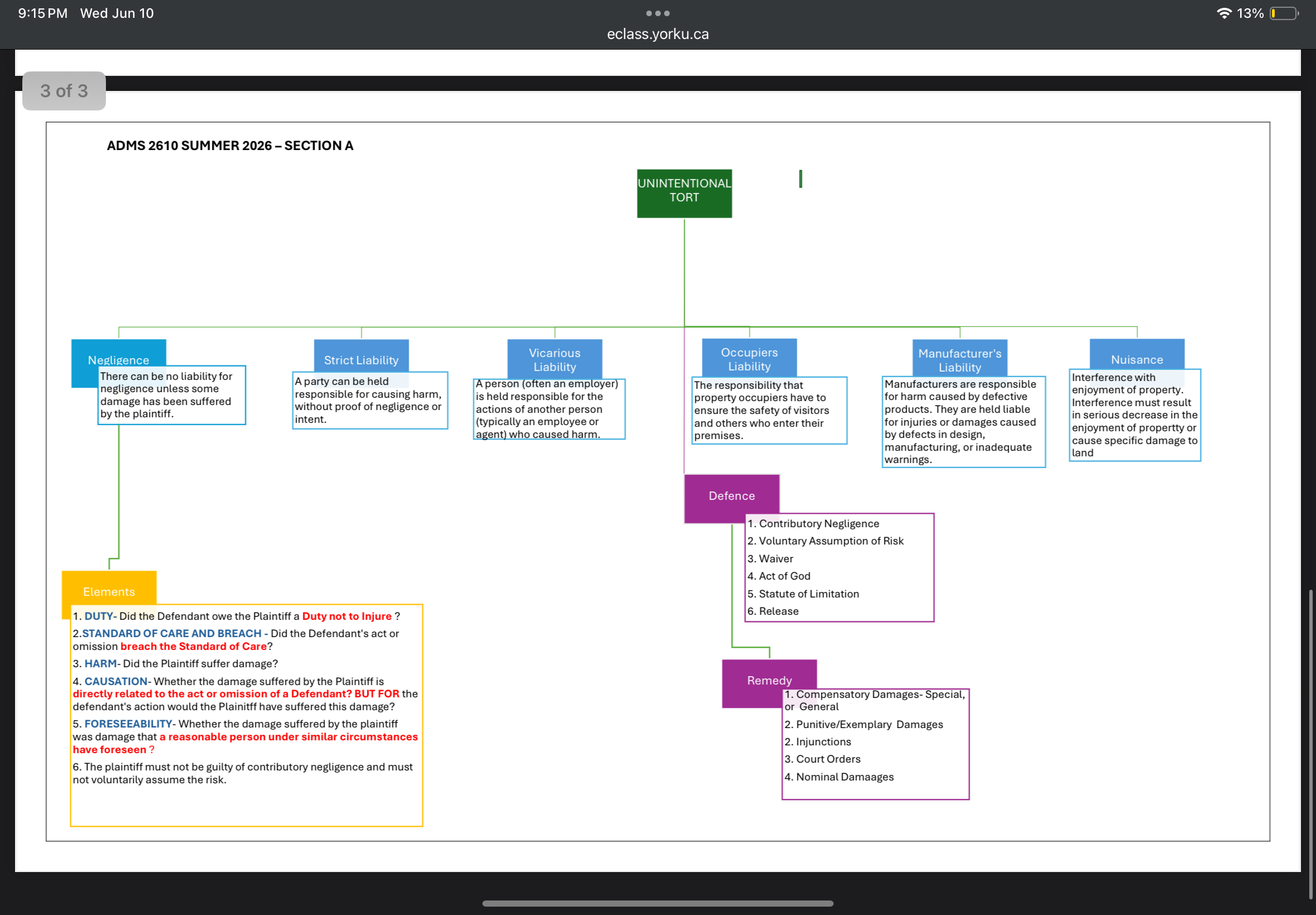
Contract exceptions
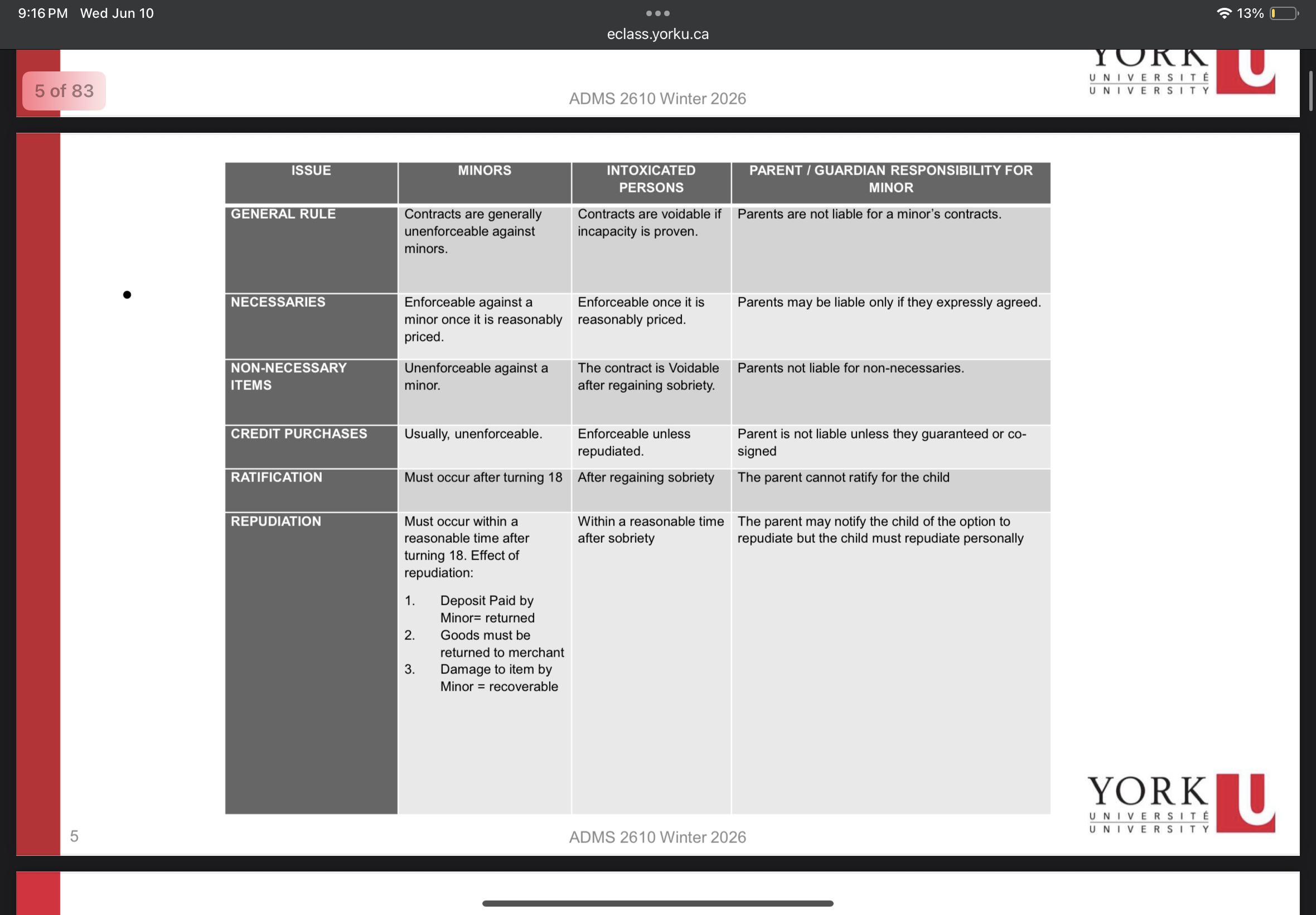
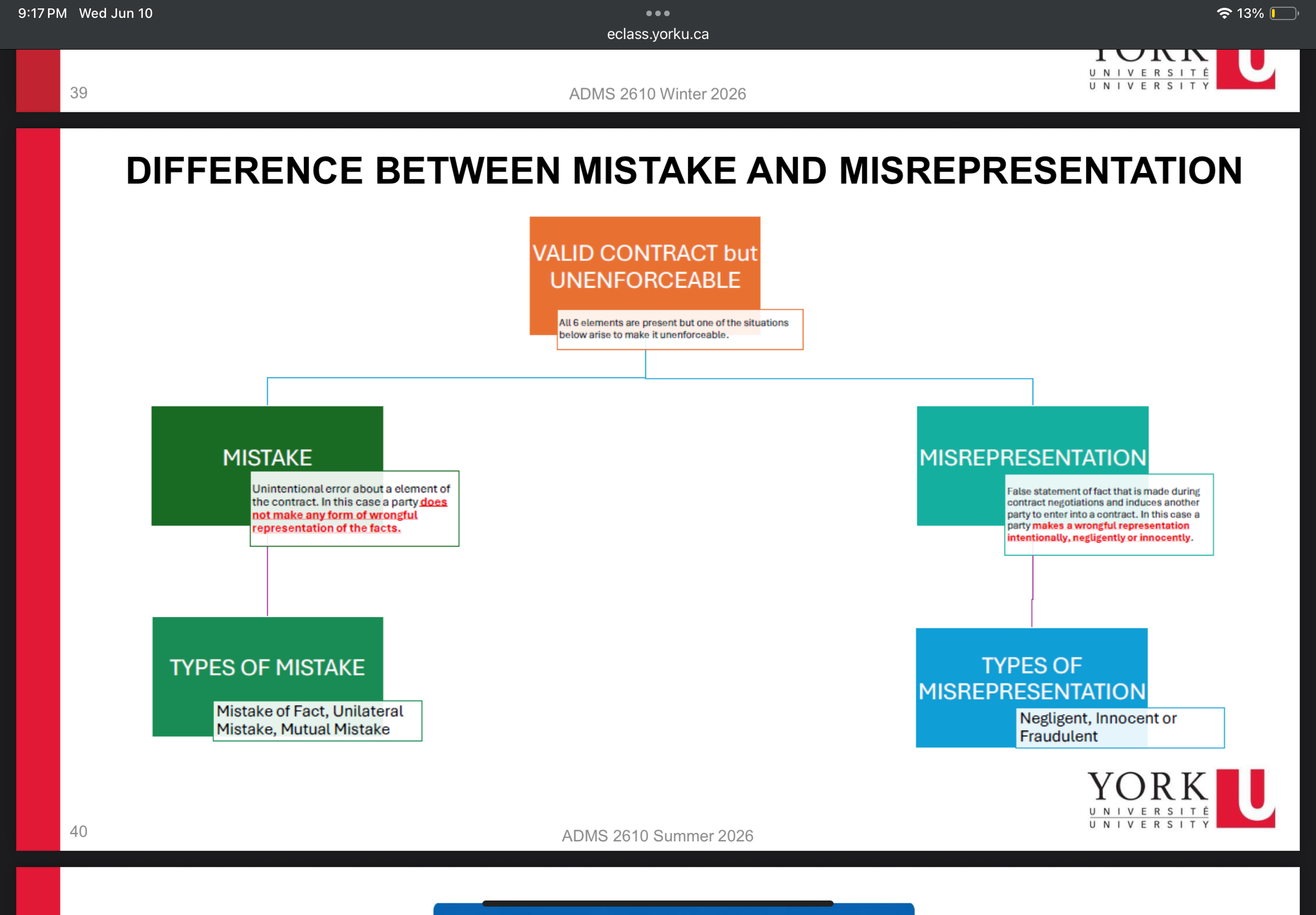
Mistakes and misrepresentations
Intentional interference
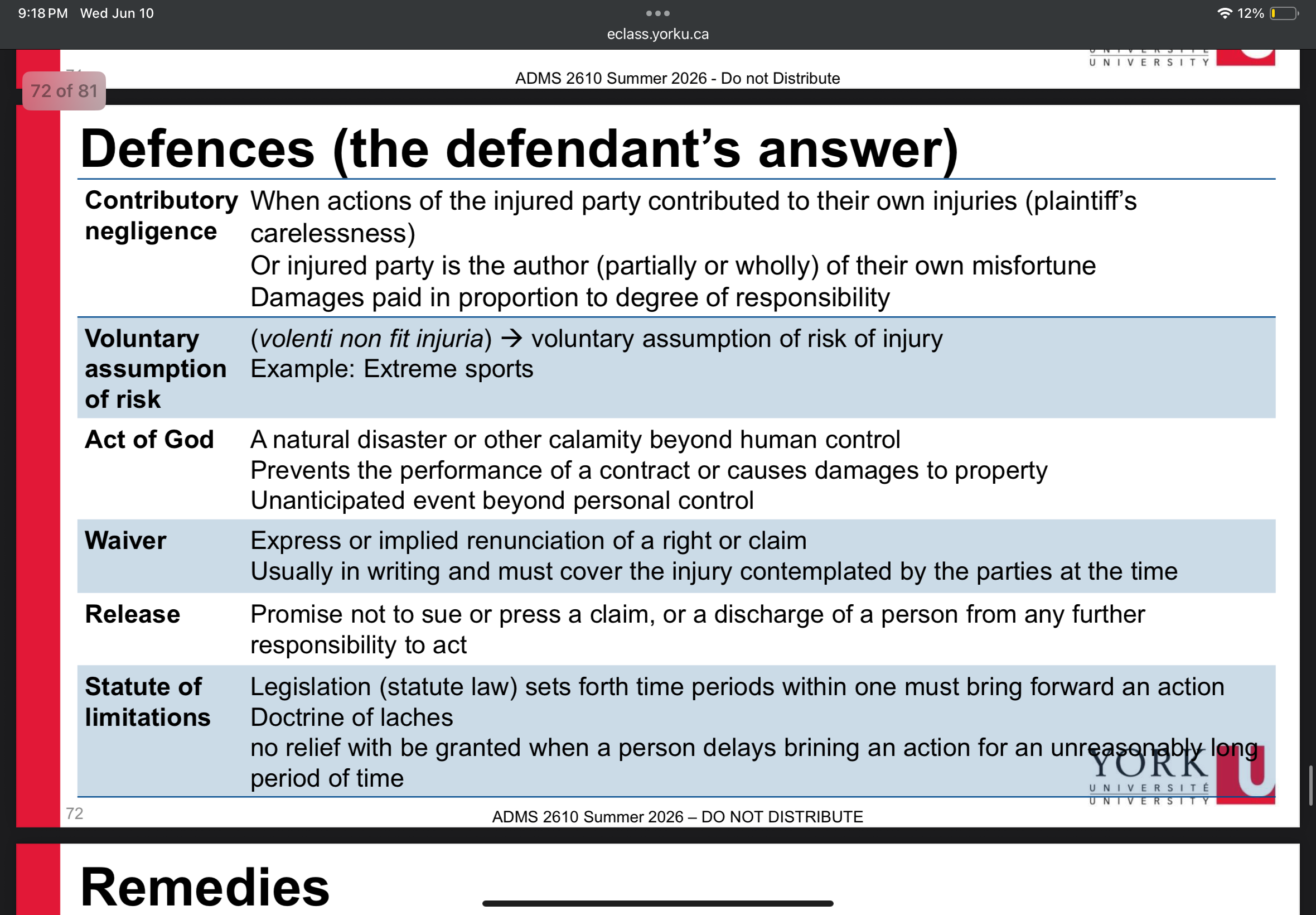
Defences
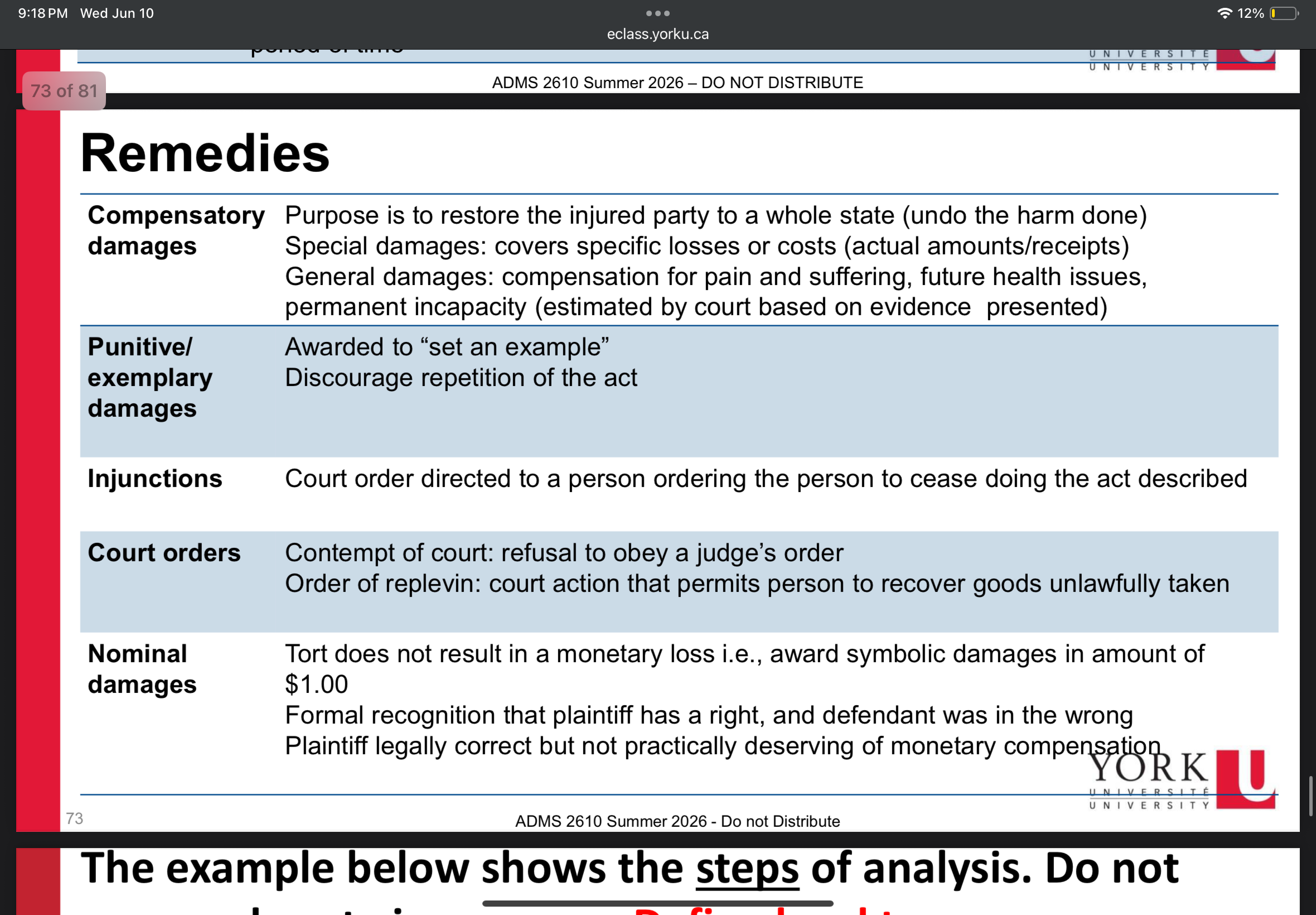
Remedies
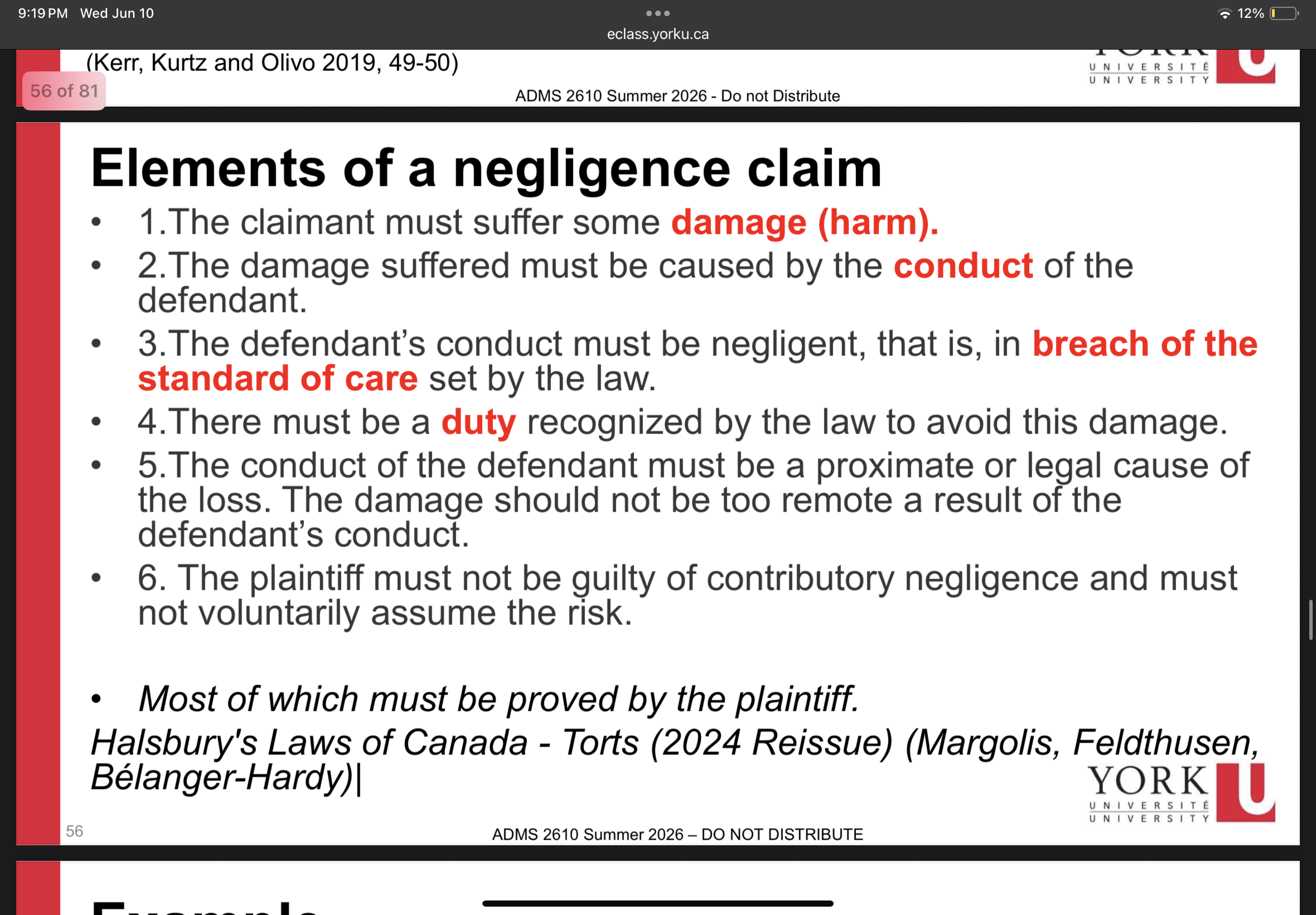
Elements of a negligence claim
What is the "Post-Box Rule"?
A contract is formed the moment an acceptance is placed in the mail, properly addressed and with postage paid.
Concept & Broader Category: Acceptance — part of Contract Formation under Contract Law.
Definition: Acceptance is effective upon posting, regardless of when it reaches the offeror. Example: A mails an acceptance on Monday; B receives it on Wednesday. The contract is binding on Monday.
Common Mistake: Thinking the offeror must read the letter for it to be binding.
IRAC Wording: "Under the post-box rule, a binding contract was created the moment the offeree placed the acceptance in the mail."
When is a revocation of an offer effective?
Revocation is only effective when it is actually received and communicated to the offeree.
Concept & Broader Category: Termination of Offer — Contract Law.
Definition: The withdrawal of an offer before it has been accepted.
Example: A sends a revocation email at 9 AM but the offeree mails an acceptance at 10 AM before reading the email. The acceptance wins.
Common Mistake: Applying the "post-box rule" to revocation (thinking it's effective when sent).
IRAC Wording: "A court would find the revocation ineffective because it was not received by the offeree until after acceptance was mailed."
What is "Consensus ad Idem"?
A "meeting of the minds" regarding the subject matter of the contract.
Concept & Broader Category: Intention/Offer — Contract Law.
Definition: An agreement where both parties are of one mind regarding the object of the contract.
Example: A thinks he's selling car X; B thinks she's buying car Y. There is no consensus ad idem.
Common Mistake: Using colloquial terms like "deliberation" or "making a deal."
IRAC Wording: "For a valid contract to exist, there must be a meeting of the minds, known as consensus ad idem."
What is the "Doctrine of Laches"?
An equitable doctrine denying relief to a person who has delayed bringing an action for an unreasonably long time.
Concept & Broader Category: Statute of Limitations — Tort/Contract Law.
Definition: The principle that a legal right is lost if not exercised within a reasonable timeframe.
Example: Waiting 10 years to sue for a broken window while evidence disappears.
Common Mistake: Confusing this with the "lapse" of an offer.
IRAC Wording: "The defendant may rely on the doctrine of laches, as the plaintiff's unreasonable delay in filing has prejudiced the defence."
What is "Specific Performance"?
A court order requiring a party to carry out their contractual obligations.
Concept & Broader Category: Remedies — Contract Law.
Definition: An equitable remedy used when monetary damages are inadequate, typically for unique goods or land.
Example: A court ordering a seller to transfer a specific antique painting rather than paying its value.
Common Mistake: Confusing this with "Quantum Meruit" (paying for work already done).
IRAC Wording: "Because the subject matter (land) is unique, the court may award the equitable remedy of specific performance."
What is "Innocent Misrepresentation"?
A false statement of material fact made by a party who honestly believed it to be true.
Concept & Broader Category: Vitiating Factors — Contract Law.
Definition: An untrue statement that induces a contract, made without intent to deceive.
Example: Selling a car you genuinely believe has 50k miles, when it actually has 150k.
Common Mistake: Labeling an honest mistake as "fraud" or "libel."
IRAC Wording: "A court would find innocent misrepresentation occurred, rendering the contract voidable at the option of the injured party."
What is "Non Est Factum"?
A defence allowing a person to avoid a contract because they were unaware of its true nature.
Concept & Broader Category: Mistake — Contract Law.
Definition: "It is not my deed"—applies when a person signs a document fundamentally different from what they thought it was.
Example: An elderly person signing a deed of sale believing it was a birthday card.
Common Mistake: Using this as a general excuse for not reading a contract.
IRAC Wording: "The defendant could plead non est factum if they can prove they were not careless and the document's nature was misrepresented."
What is the duty to "Mitigate"?
The obligation of an injured party to take reasonable steps to reduce the losses resulting from a breach.
Concept & Broader Category: Damages — Contract/Tort Law.
Definition: A plaintiff cannot recover losses that could have been avoided through reasonable effort.
Example: If a tenant leaves early, a landlord must try to find a new tenant rather than just suing for the full year's rent.
Common Mistake: Thinking the injured party can just sit back and collect full damages.
IRAC Wording: "The plaintiff's award may be reduced because they failed in their duty to mitigate their losses by [specific action]."
What are "Liquidated Damages"?
An estimate of the loss likely to flow from a breach, written into the contract itself.
Concept & Broader Category: Remedies — Contract Law.
Definition: Pre-agreed damages that the parties consider fair compensation if a specific breach occurs.
Example: A construction contract stating the builder pays $500 for every day the project is late.
Common Mistake: Confusing this with "punitive damages" intended to punish.
IRAC Wording: "As the parties provided for liquidated damages in Clause X, the court will enforce this pre-estimate of loss."
What defines "Undue Influence"?
A state of affairs where a person is so influenced by another that their judgment is no longer their own.
Concept & Broader Category: Vitiating Factors — Contract Law.
Definition: Improper pressure that robs a party of free will, often in relationships of trust.
Example: A caregiver pressuring a dependent patient to sign over their house.
Common Mistake: Confusing this with "duress" (which requires physical threats).
IRAC Wording: "Because a special relationship existed, there is a presumption of undue influence that the dominant party must rebut."
What is an "Intervening Event"?
An independent act that breaks the causal chain between the defendant's act and the resulting injury.
Concept & Broader Category: Causation — Negligence (Tort Law).
Definition: A separate act that occurs after the defendant's negligence and becomes the actual cause of the final harm.
Example: You hit someone with a car (broken leg), but they die because a lightning bolt hits the ambulance.
Common Mistake: Thinking the first negligent party is responsible for all subsequent bad luck.
IRAC Wording: "The distracted driver constitutes an intervening event, breaking the chain of causation between the bar's negligence and the concussion."
What is "Vicarious Liability"?
The liability of an employer for the torts of an employee committed during the course of employment.
Concept & Broader Category: Unintentional Torts — Tort Law.
Definition: Holding one party responsible for the wrongful acts of another due to their relationship.
Example: A delivery driver hits a pedestrian; the company is liable for the damages.
Common Mistake: Thinking the employer is liable even for the employee's personal actions outside of work.
IRAC Wording: "The employer is vicariously liable because the bouncer's tortious act was committed within the scope of her duties."
What is a "Fiduciary Duty"?
A duty to place a client's interest above the professional's own interests.
Concept & Broader Category: Professional Liability — Tort/Contract Law.
Definition: A relationship of utmost good faith where the professional must act in the client's best interest.
Example: A lawyer cannot profit from a business deal that would harm their client's case.
Common Mistake: Thinking this is just a regular duty of care; it is much higher.
IRAC Wording: "As a professional in a special relationship, the accountant owed a fiduciary duty to disclose all material risks."
What is "Quantum Meruit"?
"As much as he has earned"—a remedy permitting recovery of a reasonable price for services requested.
Concept & Broader Category: Remedies — Contract Law.
Definition: Payment for work done when no specific price was agreed upon in the contract.
Example: You ask a plumber to fix a leak without asking the price; you must pay the "going rate."
Common Mistake: Confusing this with "specific performance" (doing the work).
IRAC Wording: "In the absence of an agreed price, the plaintiff is entitled to compensation on a quantum meruit basis."
When does a contract become "Voidable"?
When one party has the option to either ratify (keep) or repudiate (cancel) the contract.
Concept & Broader Category: Contract Status — Contract Law.
Definition: A contract that is valid until the injured party takes steps to set it aside.
Example: A contract entered into by a minor for a non-necessary item.
Common Mistake: Confusing this with "Void," which means the contract never existed legally.
IRAC Wording: "Due to the misrepresentation, the contract is voidable at the option of the plaintiff."
What is the "But For" test?
A test for causation: "But for the defendant's actions, would the plaintiff have suffered the injury?"
Concept & Broader Category: Causation — Negligence (Tort Law).
Definition: Determining if the defendant's breach was the direct cause of the harm.
Example: But for the store owner's failure to salt the ice, the customer would not have slipped.
Common Mistake: Proving a breach but failing to connect it directly to the specific injury.
IRAC Wording: "Applying the 'but-for' test, the injury would not have occurred but for the defendant's failure to maintain the premises."
What defines "Innocent Intention" in commercial contracts?
In commercial deals, the law presumes parties intend to create a legal relationship.
Concept & Broader Category: Intention to create legal relationship — Contract Law.
Definition: The assumption that business persons dealing at arm's length intend their promises to be legally binding.
Example: Two companies signing a purchase order are presumed to intend a legal contract.
Common Mistake: Thinking that saying "it was just a joke" is an automatic defence in a business setting.
IRAC Wording: "As this was an arm's-length commercial transaction, the law presumes an intention to create a legal relationship."
What is "Repudiation"?
A refusal to perform a contract.
Concept & Broader Category: Breach — Contract Law.
Definition: An indication by words or conduct that a party does not intend to fulfill their obligations.
Example: A supplier calling a buyer to say they will not be delivering the goods next week.
Common Mistake: Confusing this with "revocation" (which happens before a contract is formed).
IRAC Wording: "The defendant's email stating they would not perform constitutes express repudiation of the contract."
What is "Contributory Negligence"?
A defence where the plaintiff’s own carelessness contributed to their injury.
Concept & Broader Category: Defences — Tort Law.
Definition: It allows the court to apportion the loss between the parties based on their degree of fault.
Example: A driver is hit by a speeder, but the driver wasn't wearing a seatbelt.
Common Mistake: Thinking it is a "complete" defence that results in no payout at all.
IRAC Wording: "The court would likely find contributory negligence because the plaintiff was running while checking her phone."
What is a "Bilateral Contract"?
A contract involving an exchange of promises.
Concept & Broader Category: Types of Contracts — Contract Law.
Definition: Both parties are bound to perform their respective promises in the future.
Example: "I promise to pay you $500 if you promise to deliver 50 cakes on Saturday."
Common Mistake: Confusing this with a "unilateral contract" (promise in exchange for an act).
IRAC Wording: "This is a bilateral contract as it was formed by the mutual exchange of promises between the parties."