9.2 Water transport in multicellular plants?
 Call Kai
 Learn
Learn Practice Test
 Spaced Repetition
 Match
Match Flashcards
 Knowt Play
1/59

There's no tags or description
Looks like no tags are added yet.
Name | Mastery | Learn | Test | Matching | Spaced | Call with Kai |
|---|
No analytics yet
Send a link to your students to track their progress
60 Terms
In a plant, what two things is water key in?
both the structure and metabolism of plants
What is turgor pressure (hydrostatic pressure) a result of in plant cells?
osmosis
What does turgor pressure (hydrostatic pressure) - as a result of osmosis - provide the plant with?
a hydrostatic skeleton to support the stems and leaves
What does turgor also drive?
cell expansion
Why is the loss of water by evaporation beneficial?
helps to keep the plant cool
What is transported in aqueous solutions (2)?
mineral ions and the products of photosynthesis
What is water a raw material for?
photosynthesis
Low water potential?
higher salt concentration
High water potential?
low salt concentration
If the water potential inside the cell is high where will water go?
water will move out of the cell by osmosis
If the water potential inside the cell is low where will water go?
will move into the cell by osmosis
What does water enter the cell down?
the water potential gradient
Where does water move when there is a low external water potential?
water moves out of the cell
When is a cell said to be plasmolysed?
when plants survive water moving out of the cell for short periods of time by shrinking their cell membrane away from the cell water
Where does water move when moving between cells?
water moves from the cell with the higher water potential to the cell with the lower (more negative) water potential
Root hair cells?
specialised exchange surfaces in plants
Root hair cells: function?
for the uptake of water and mineral ions into the plant from the soil
Root hair cells: size?
200 – 250μm
Root hair cells: a root hair?
a long, thin extension from a root hair cell - specialised epidermal cell
Root hairs: what are they well adapted as?
exchange surfaces
Root hairs - well adapted: what does their microscopic size allow them to do?
penetrate easily between soil particles
Root hairs - well adapted: how many are there on each root tip?
thousands - maximise surface area in contact with the soil
Root hairs - well adapted: size of each hairs SA:V ratio?
large
Root hairs - well adapted: why is having a thin surface layer (on each hair) beneficial?
diffusion and osmosis can take place through it quickly
Root hairs - well adapted: what is maintained between the soil water and the cell?
the water potential gradient - through the concentration of solutes in the cytoplasm of root hair cells
Root hairs - well adapted: Water potential of soil water?
high water potential - low concentration of dissolved minerals
Root hairs - well adapted: water potential of root hair cells?
low - contains many different solvents including su
Root hairs - well adapted: as a result, how does water move into the root hair cell?
by osmosis
Root hairs - well adapted: plasma membrane?
partially permeable
Where does the water continue to move across the root to once it has moved into the root hair cell?
moves across the root to the xylem
What are the 3 pathways water moves through the roots cells and into the xylem tube by?
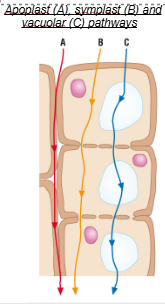
Symplast pathway, vacuolar pathway and apoplast pathway
What do all of these pathways allow the plant to do?
to get water in as fast as possible
The symplast pathway: symplast?
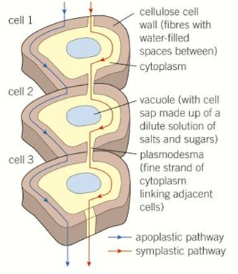
the continuous cytoplasm of the living plant cells that is connected through the plasmodesmata
The symplast pathway: what creates the continuous cytoplasmic network that is the symplast?
Plasmodesmata
The symplast pathway?
the movement of water through the living spaces of the cell (cytoplasm)
The symplast pathway: how does the water change between cells?
through the plasmodesmata
The symplast pathway: how does water move through the symplast?
by osmosis
The symplast pathway: how does water move from the root hair cell into the cell next door by osmosis?
the root hair cell has a higher water potential than the next cell along
The symplast pathway: why does the root hair cell has a higher water potential than the next cell along?
due to water diffusing in from the soil, which has made the cytoplasm more dilute
The symplast pathway: when does this process continue, from cell to cell across the root until?
until the xylem is reached
The symplast pathway: how is a steep water potential gradient between the soil and cell maintained?
as water leaves the root hair cell by osmosis, the water potential of the cytoplasm falls again
The symplast pathway: why is important to maintain a steep water potential gradient between the cell and soil?
to ensure that as much water as possible continues to move into the cell from the soil
The symplast pathway: why is water drawn up the plant?
each cell further away from the roots has a lower water potential so water is drawn up by the pant
The vacuolar pathway?
the same as the symplast pathway when the water moves through the cells vacuoles in addition to the cytoplasm
The vacuolar pathway: key feature of this route?
the slowest route
The Apoplast Pathway?
the movement of water through the apoplast - the cell wall and intracellular spaces
Apoplast?
the cell wall and intracellular spaces
The Apoplast Pathway: what does water fill?
the spaces between the loose, open network of fibres in the cellulose cell wall
The Apoplast Pathway: as water molecules move into the xylem, why are more water molecules pulled through the apoplast behind them?
due to cohesive forces between the water molecules
The Apoplast Pathway: what does the pull from water moving into the xylem and up the plant along with the cohesive forces between the water molecules create?
a tension that means there is a continuous flow of water through the open structure of the cellulose wall - which offers little or no resistance
The Apoplast Pathway: therefore, what pulls water up the plant?
cohesive and tension forces acting on the cell
The apoplast, symplast and vacuolar pathways along which water moves across the root diagram?
…
The apoplast and symplast pathways along which water moves across the root diagram?
…
Water moves across the root in the apoplast, vacuolar and symplast pathways until it reaches what?
the endodermis
The endodermis?
the layer of cells surrounding the vascular tissue (xylem and phloem) of the roots
Why is the endodermis particularly noticeable in the roots?
the effects of the casparian strip (which the endodermis is home to)
The casparian strip?
impermeable, waxy layer of suberin around the endodermal cells
The casparian strip: at this point what is the apoplast pathway forced into as it can go no further?
forced into the cytoplasm of the cell, joining the water in the symplast pathway