NEET Biology - NCERT Chapter 19 (Excretory Products and Their Elimination)
 Call Kai
 Learn
Learn Practice Test
 Spaced Repetition
 Match
Match Flashcards
 Knowt Play
1/808

There's no tags or description
Looks like no tags are added yet.
Name | Mastery | Learn | Test | Matching | Spaced | Call with Kai |
|---|
No analytics yet
Send a link to your students to track their progress
809 Terms
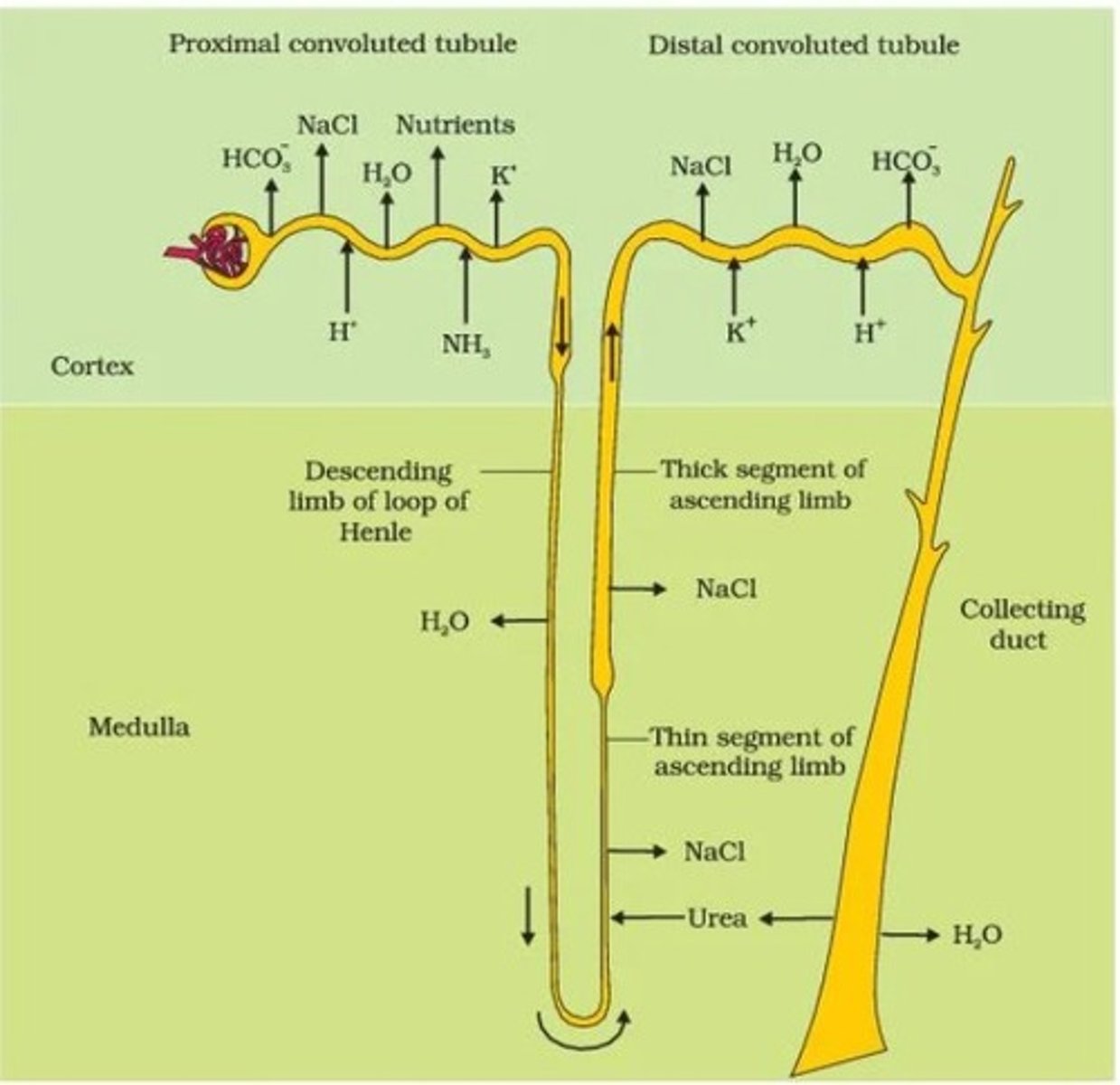
the urine turns acidic because of the presence of H+ ions in it
What is the result of H+ ions being actively secreted by the PCT and DCT into the filtrate urine?dsw2
ammonia, uric acid, urea, carbon dioxide, water, and ions like Na+, K+, Cl-, phosphate, sulphate, etc.
Which substances/ions are accumulated by animals by metabolic activities or through excess ingestion and must be removed totally or partially by the body from the blood?
ammonia, urea, and uric acid
What are the three nitrogenous wastes produced by animals?
ammonotelism
What is the process of excreting ammonia called?
ammonotelic, ureotelic, and uricotelic
Which three categories can organisms be divided into based on the type of waste they excrete?
bony fishes (basically just fishes in general), aquatic amphibians, and aquatic insects
What type of animals are ammonotelic in nature?
True
True or False: Ammonia is readily soluble
ammonia is readily soluble and is generally excreted by diffusion across body surfaces or through gill surfaces (in fish) as ammonium ions, and therefore, kidneys do not play a significant role in its removal
How is ammonia excreted by bony fishes, aquatic amphibians, and aquatic insects? Does its excretion require the use of any kidneys?
kidneys do not play a role in the removal of ammonia from ammonotelic animals because ammonia is readily soluble and generally excreted by diffusion across body surfaces or through gill surfaces (in fish) as ammonium ions
Does the removal of ammonia in ammonotelic animals require the use of kidneys? Why or why not?
no, in ammonotelic animals, ammonia does not get excreted in the gaseous state
In ammonotelic animals, do ammonium ions (basically ammonia) get excreted in the gaseous state?
no, kidneys do not play a significant role in the removal of ammonia
Does the excretion of ammonia require the use of kidneys?
Toxicity levels: ammonia > urea > uric acid
Compare the toxicities of the following nitrogenous wastes: ammonia, urea, and uric acid
terrestrial adaptation (living on land) required the production of less toxic nitrogenous wastes so that water may be conserved (since ammonia must be diluted with a significant amount of water in order for it be properly excreted, and water isn't as readily available on land as it is in water)
What was required for the production of less toxic nitrogenous wastes like urea and uric acid? Why were these less nitrogenous wastes required?
-unlike ammonotelic animals (bony fishes, aquatic insects, and aquatic amphibians) that excrete ammonia, water isn't as readily present to ureotelic and uricotelic animals in order for them to be dilute the ammonia with enough water to be able to excrete, and so since urea and uric acid require much less water for dilution to lower the toxicity, they are better choices
-Note that ammonotelic animals live in water and so water is always available to them, but ureotelic and uricotelic animals mostly live on land (except for terrestrial amphibians and some reptiles)
As opposed to ammonia, which is a waste which requires a significant amount of water to dilute it and lower its toxicity, why are urea and uric acid more beneficial wastes for animals that are ureotelic and uricotelic?
by diluting the waste with water
How is the toxicity of any nitrogenous waste lowered?
-the greater the amount of water required for the dilution, the greater the toxicity of the waste
-therefore, ammonia requires the most water for dilution, then urea, and then uric acid requires the least
How can we compare the toxicity of nitrogenous wastes based on the amount of water required to dilute them?
mammals are incapable of excreting ammonia because it is too acidic and toxic and ammonia requires a significant amount of water (500 ml per 1g of ammonia) in order to dilute it and this amount of water isn't readily available on land, and so the anus would only end up getting injured/damaged from excreting ammonia since there wouldn't be enough water present while excreting the waste to lower the toxicity of ammonia by diluting it
Why cannot mammals excrete ammonia as their nitrogenous waste?
500 mL
How many mL of water is required to dilute 1 gram of ammonia waste in order to reduce its toxicity enough so that it may be excreted safely?
animals including mammals, terrestrial amphibians, and marine fishes (saltwater fishes whose endoskeleton is made of cartilage) since they excrete urea
Which animals are classified as ureotelic?
marine fishes are strictly saltwater fishes whose endoskeleton is made up of cartilage, while aquatic fishes can be freshwater or saltwater fishes, but their endoskeleton is made up of bones
What is the difference between aquatic fishes and marine fishes?
both types of amphibians live on both land and in water, but terrestrial amphibians spend more time on land that in water, and aquatic amphibians spend more time in water than on land
What is the difference between terrestrial and aquatic amphibians?
Amphibian
cold-blooded vertebrate which lives both on land and in water
even though bony fishes are ammonotelic and marine fishes are ureotelic, we classify fishes in general as ammonotelic when answering any particular question
For fishes in general, do we classify them as ammonotelic or ureotelic?
-ammonia is converted into urea in the liver, and from here this urea is released into the blood which is filtered and excreted out by the kidneys
-Note: some amount of urea may be retained in the kidney matrix of some of these animals to maintain the desired osmolarity (total number of solute particles per liter)
Since ureotelic animals cannot excrete ammonia, where is the ammonia converted into urea? What happens once this conversion takes place?
urea is a less toxic nitrogenous waste
In comparison to ammonia, is urea a more or less toxic nitrogenous waste?
100 - 200 mL
For a single gram of urea, how many mL of water is required to dilute it so that its toxicity may be reduced and so that it may be safely excreted?
reptiles, birds, land snails, and insects are classified as uricotelic since they excrete uric acid
Which animals are classified as uricotelic?
in the form of pellet or paste with a minimum loss of water (since out of the 3 nitrogenous wastes, uric acid requires the least amount of water to dilute it in order to lower its toxicity, since it isn't that toxic as compared to the other two nitrogenous wastes)
How do uricotelic animals excrete uric acid?
since out of the 3 nitrogenous wastes, uric acid requires the least amount of water to dilute it in order to lower its toxicity, since it isn't that toxic as compared to the other two nitrogenous wastes
Why does excreting uric acid result in a minimum loss of water?
5 - 10 mL
For 1 gram of uric acid, how many mL of water is required to dilute it so that its toxicity is lowered and it may be safely excreted?
ammonia is more toxic
In comparison to urea, how toxic is ammonia as a nitrogenous waste?
uric acid is less toxic
In comparison to urea, how toxic is uric acid as a nitrogenous waste?
ammonia is much more toxic than uric acid
In comparison to uric acid, how toxic is ammonia as a nitrogenous waste?
uric acid is much less toxic
In comparison to ammonia, how toxic is uric acid as a nitrogenous waste?
-increasing order of solubility: ammonia < urea < uric acid
-this is because 1g of ammonia requires 500 mL of water for dilution and so it is not easily soluble in water, 1g of urea requires 100 - 200 mL so it is more soluble than ammonia, and 1g of uric acid requires only 5 - 10 mL of water and so it is very soluble in water
Compare the solubilities of the three nitrogenous wastes in water?
only vertebrates
Which animals use kidneys to filter out their nitrogenous wastes?
no, only vertebrates use kidneys (complex tubular organs) to filter out their nitrogenous wastes, and other animals (all the invertebrates) use simple tubular forms
Do all animals use kidneys to filter out their nitrogenous wastes?
invertebrates
Which animals use simple tubular forms/structures for excretion of nitrogenous wastes?
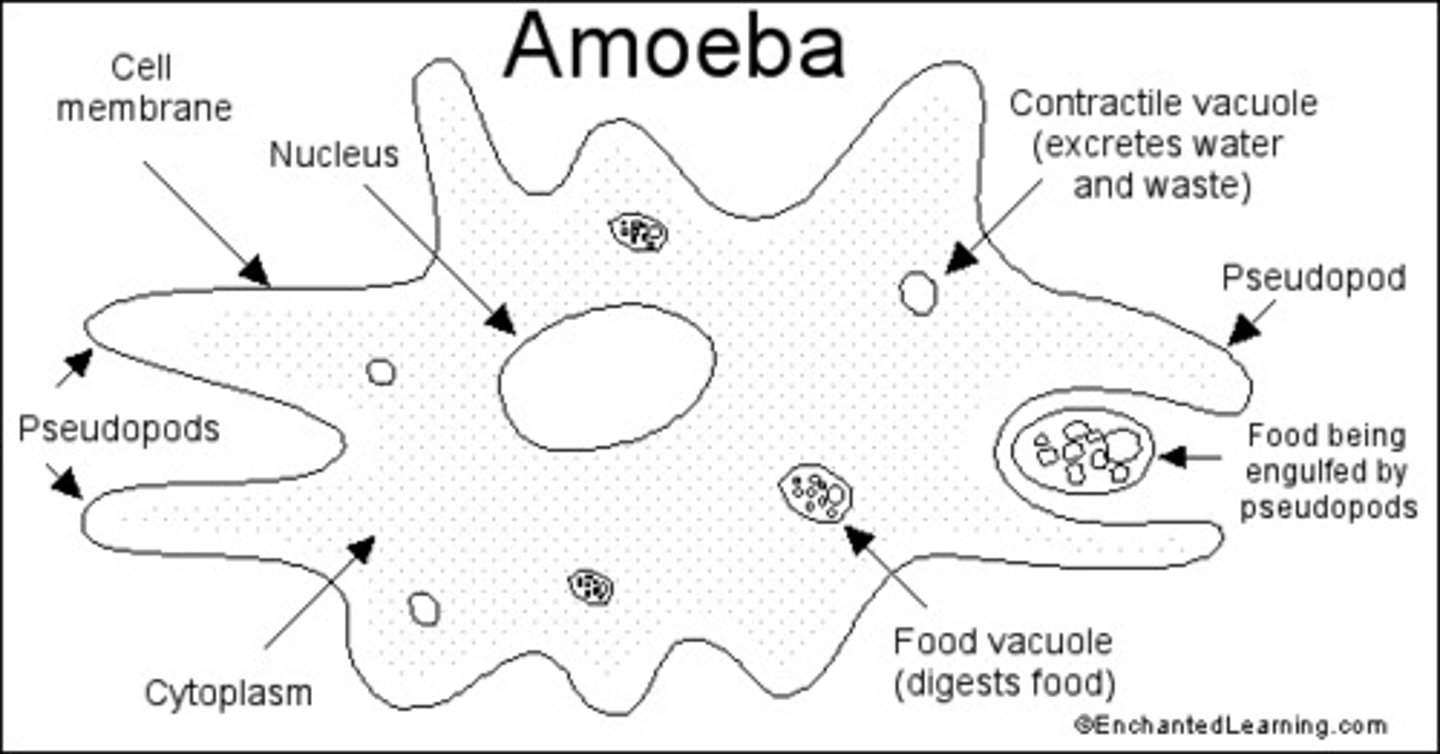
contractile vacuoles and plasma membrane
What is the excretion organ in protozoans (such as amoeba)?
their general body surface (meaning they excrete waste through their surface)
What is the excretion organ in hydra and sponges?
renette cells
What is the excretion organ of animals in phylum Aschelminthes (such as nematodes, rotifers, etc.)?
flame cells (solenocytes and protonephridia)
What is the excretion organ in planaria (phylum Platyhelminthes; flatworms)?
nephridia and chloragogen cells
What is the excretion organ in earthworms (annelids -- phylum Annelida)?
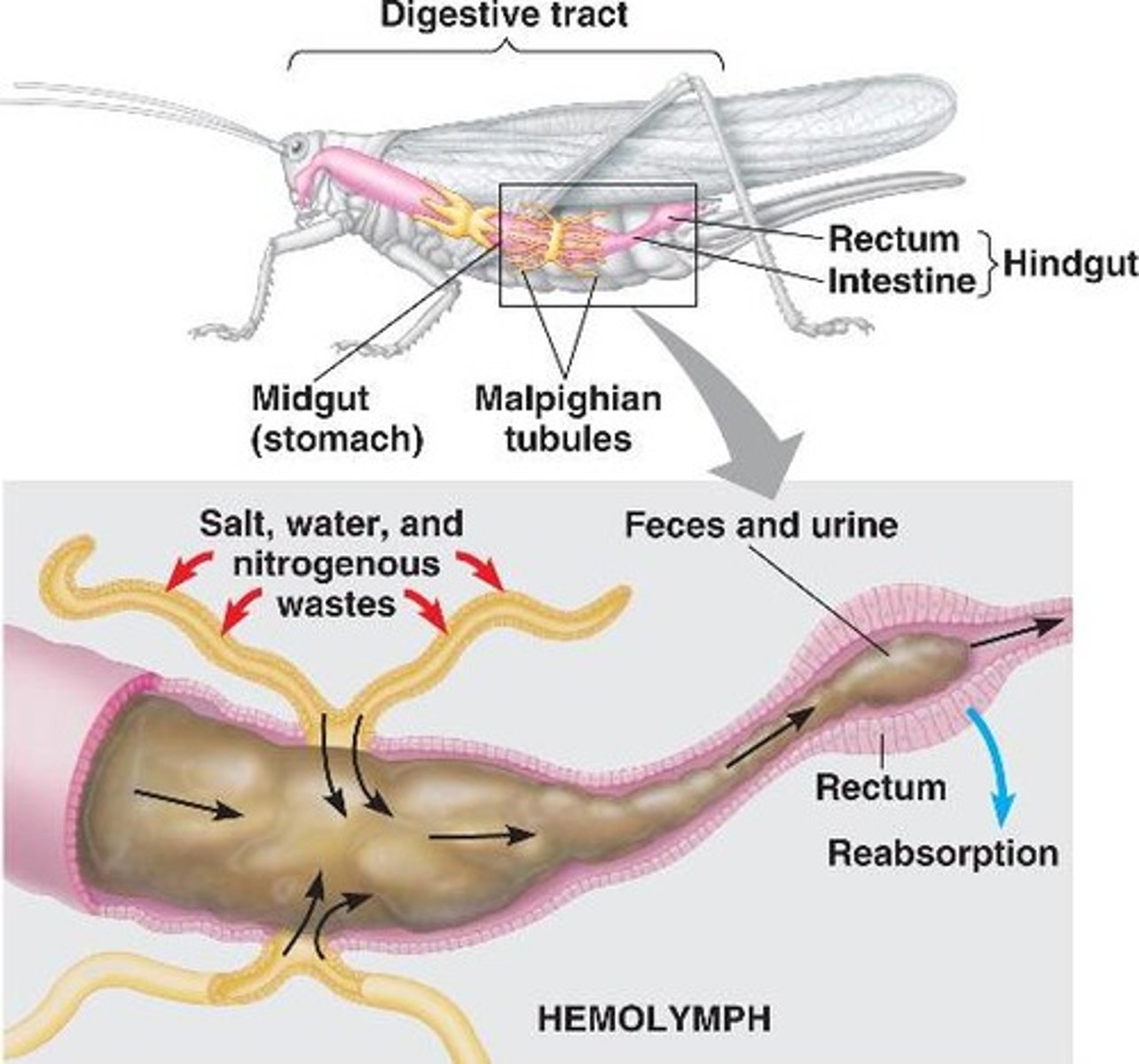
malpighian tubules
What is the excretion organ in insects (phylum Arthropoda -- EXCLUDING SPIDERS) and cockroaches?
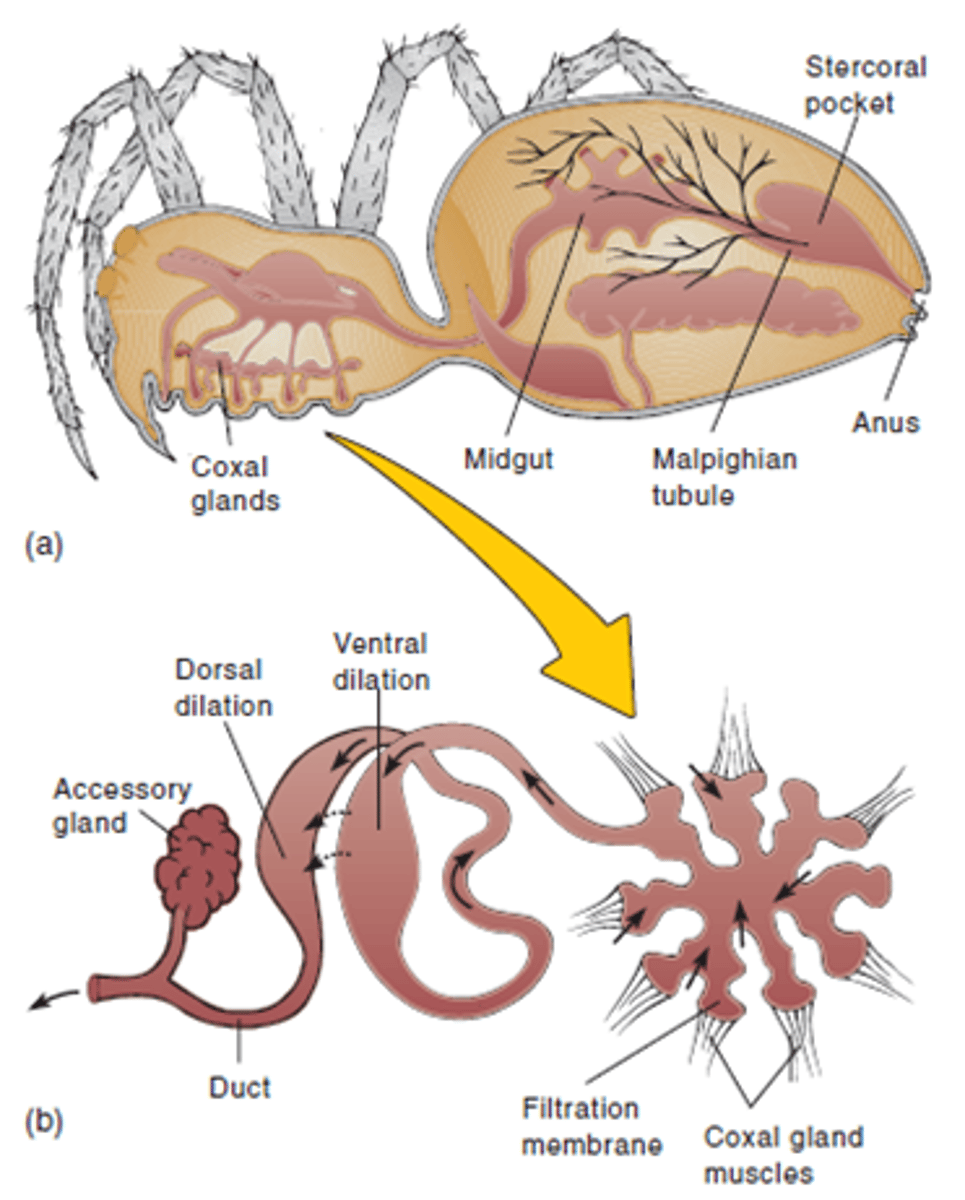
coxal glands
What is the excretion organ in spiders (class Arachnida, phylum Arthropoda)?
antennal glands or green glands
What is the excretion organ in prawns (class Crustacea, phylum Arthropoda)?
Keber's organ and organs of Bojanus
What is the excretion organ of animals in phylum Mollusca?
kidneys
What is the excretion organ in vertebrates?
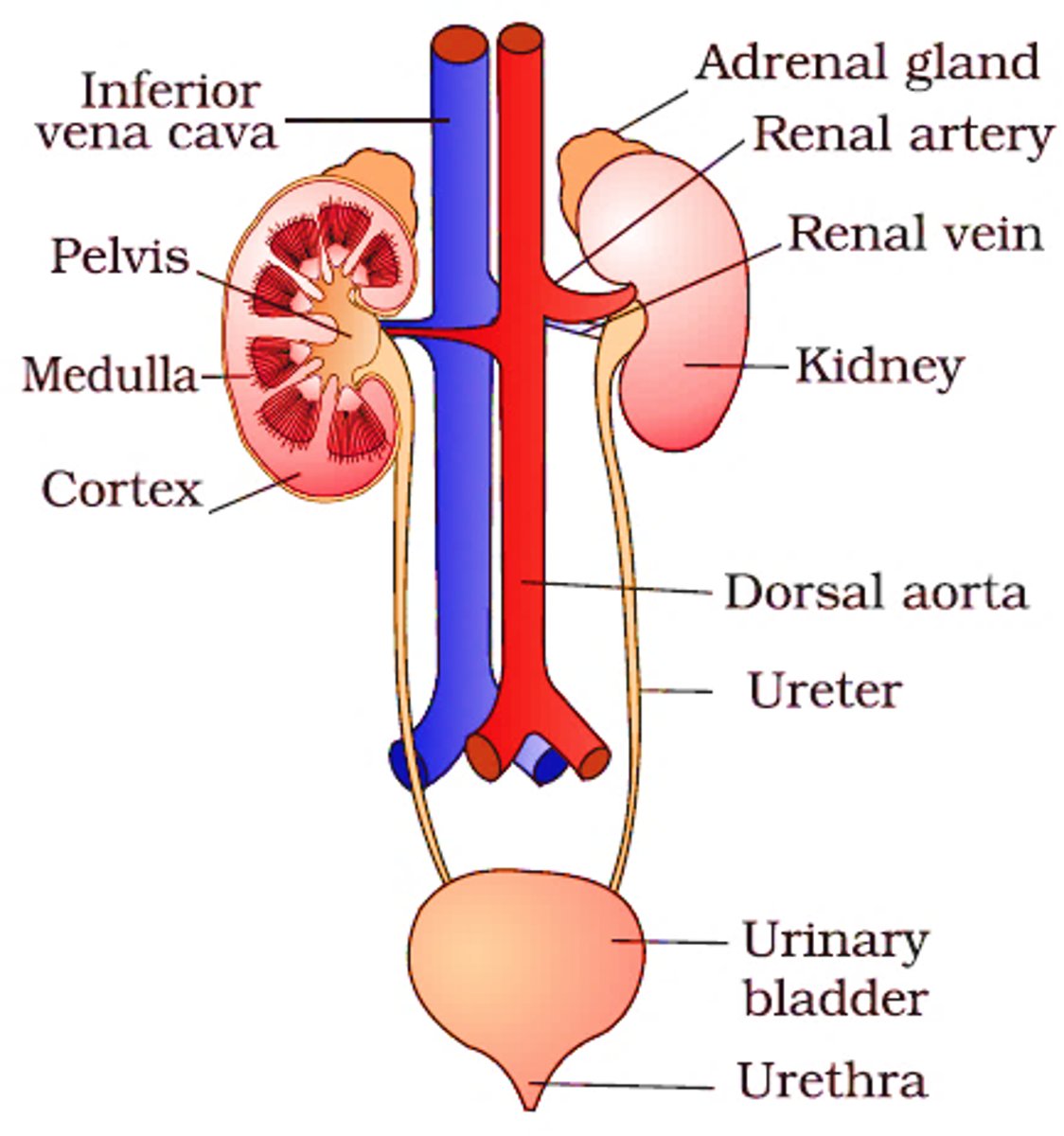
-the human excretory system consists of a pair of kidneys (two kidneys), one pair of ureters (two ureters), a urinary bladder, and a urethra
-the role of this excretory system is the production and removal of urine from the body
What is the human excretory system consisted of? What is the role of this excretory system?
-both the kidneys are reddish-brown and bean shaped
-they are situated between the levels of the last thoracic and third lumbar vertebra
-the right kidney is a little lower than the left close to the dorsal inner wall of the abdominal cavity just below the diaphragm
In humans, what is the shape and color of the kidneys? Where are they located?
10 - 12 cm in length, 5 - 7 cm in width, and 2 - 3 cm in thickness with an average weight of 120 - 170 grams
In adult humans, what are the dimensions of each kidney?
10 - 12 cm in length
In adult humans, what is the length of each kidney?
5 - 7 cm in width
In adult humans, what is the width of each kidney?
2 - 3 cm in thickness
In adult humans, what is the thickness of each kidney?
120 - 170 grams
In adult humans, what is the weight of each kidney?
Human urinary system
also known as the human excretory system
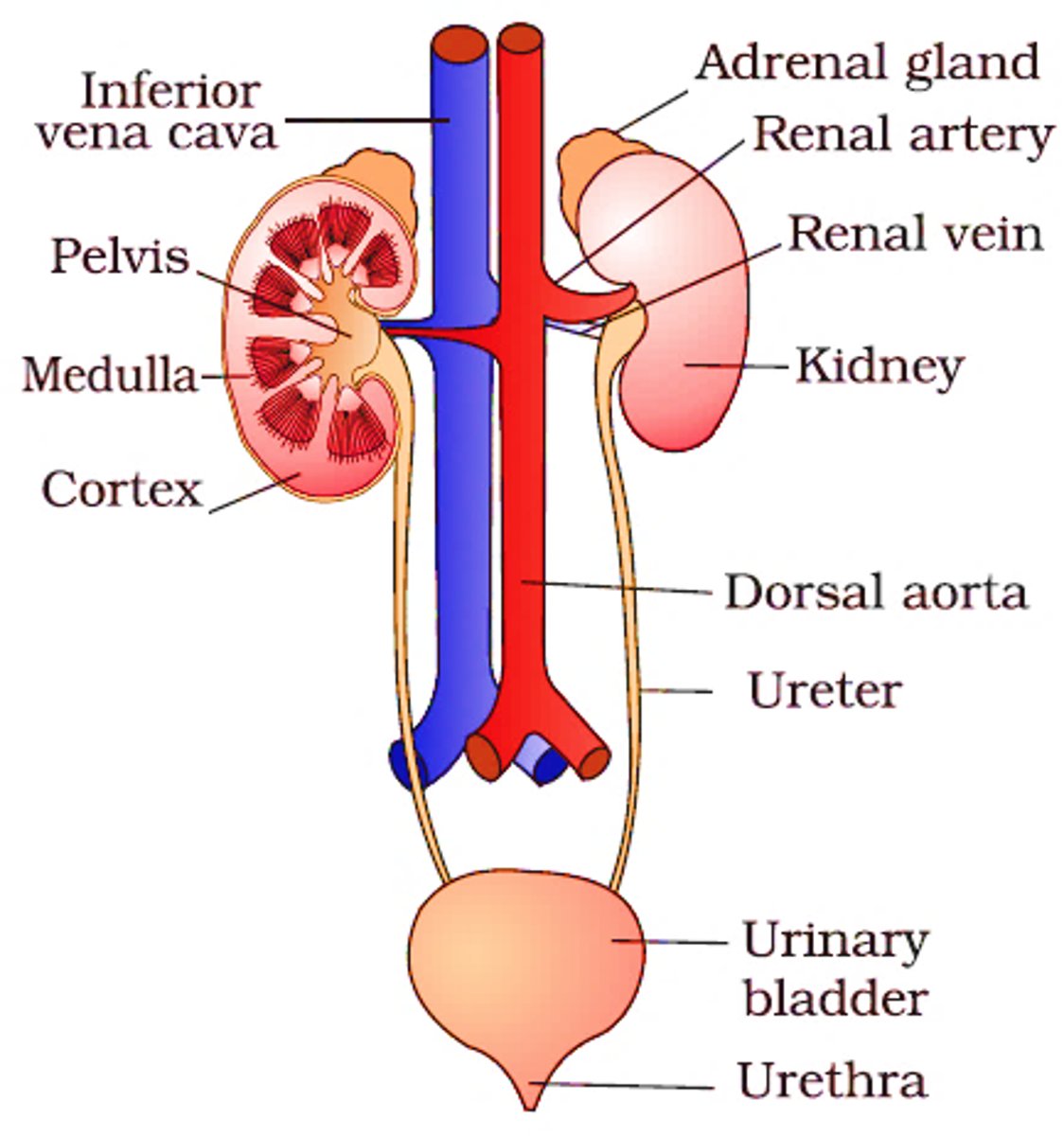
they are just tubes that carry the urine from the kidney to the urinary bladder
What is the role of the ureters that comprise the human urinary system?
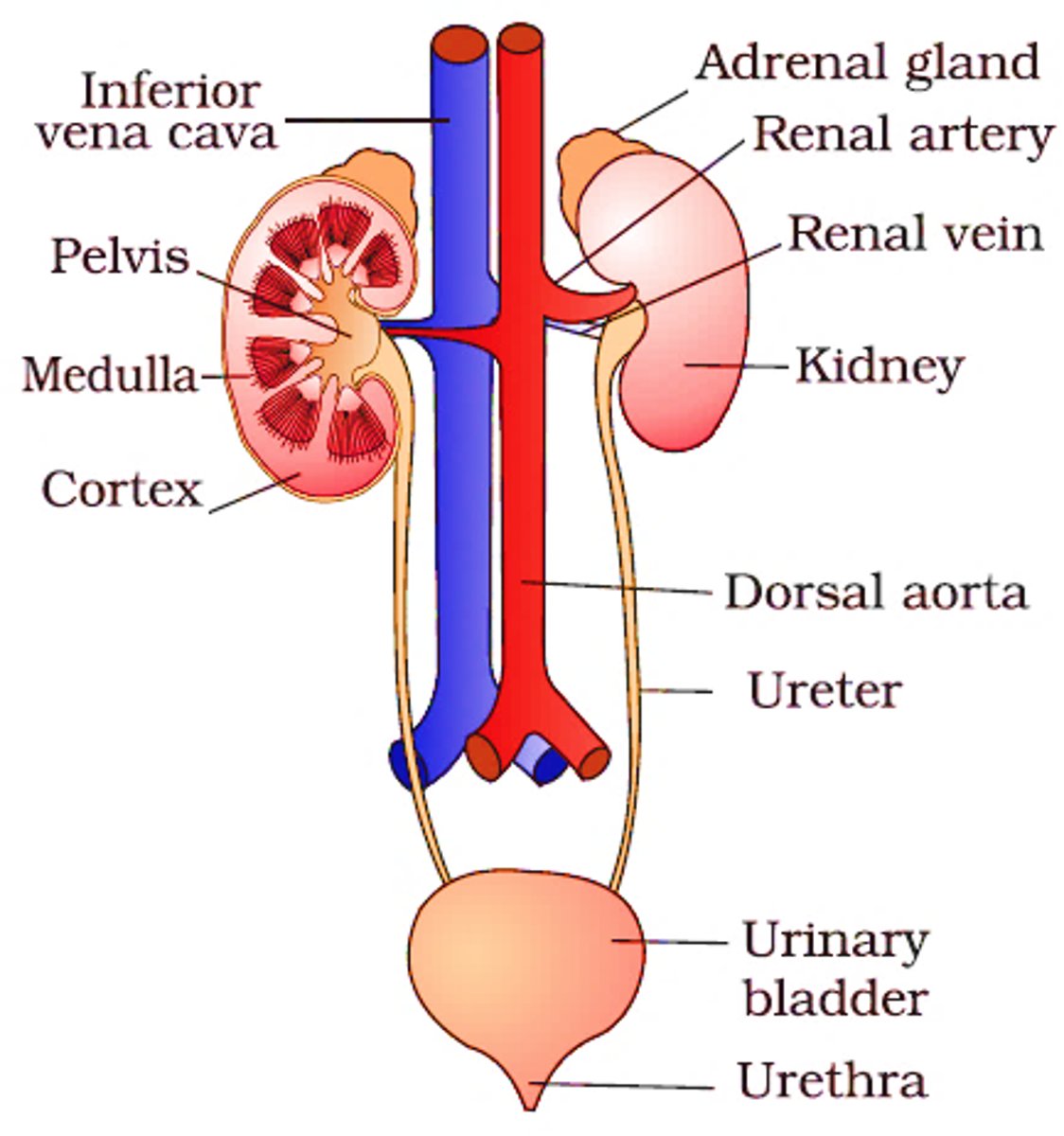
it is a temporary storage reservoir for urine, where the ureters can transport the urine from the kidney and temporarily store it here
What is the role of the urinary bladder which helps comprise the human urinary system?
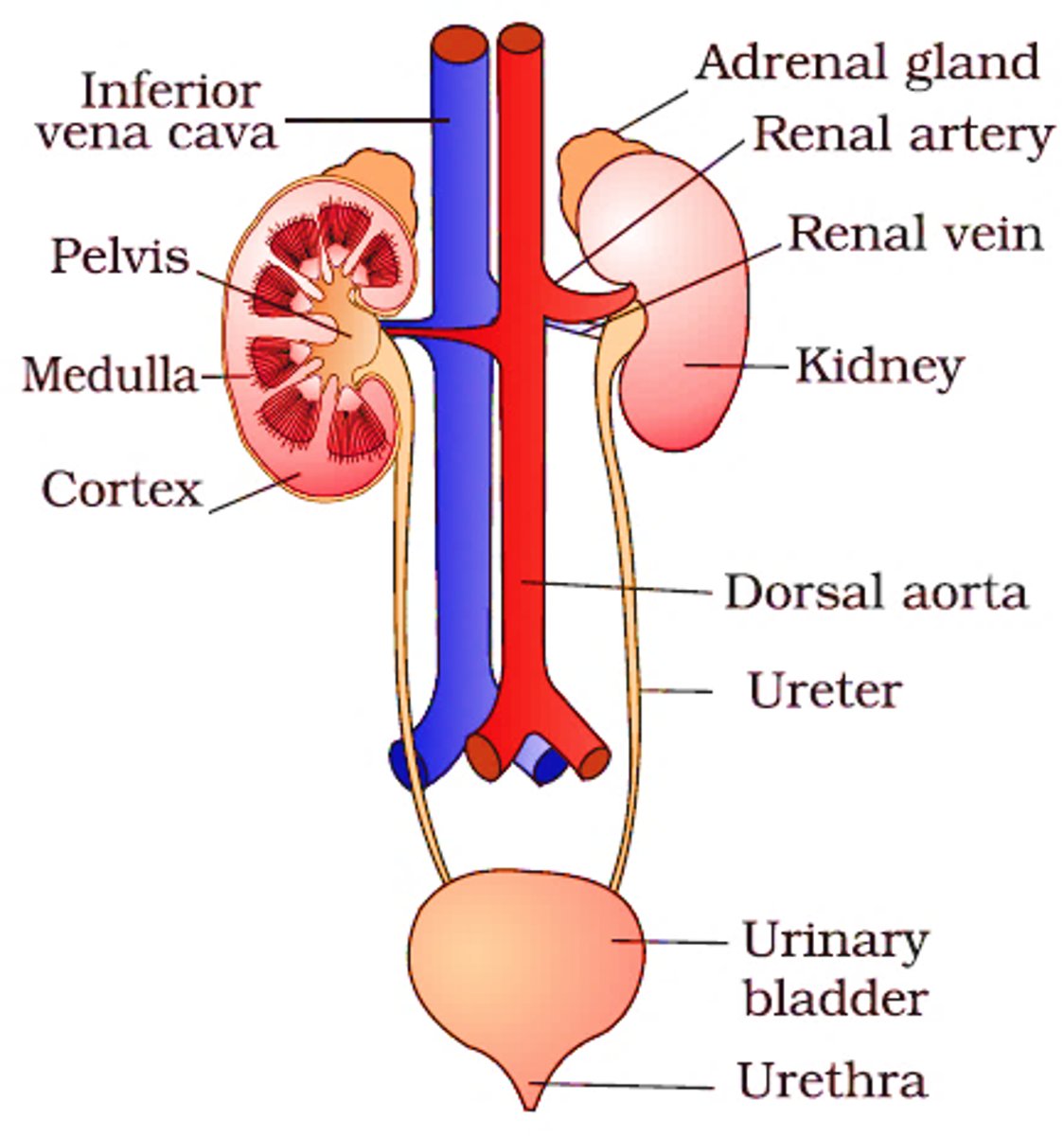
it is the tube that allows the urine which has been temporarily stored in the urinary bladder to pass out or exit the body through the penis
What is the role of the urethra which helps comprise the human urinary system?
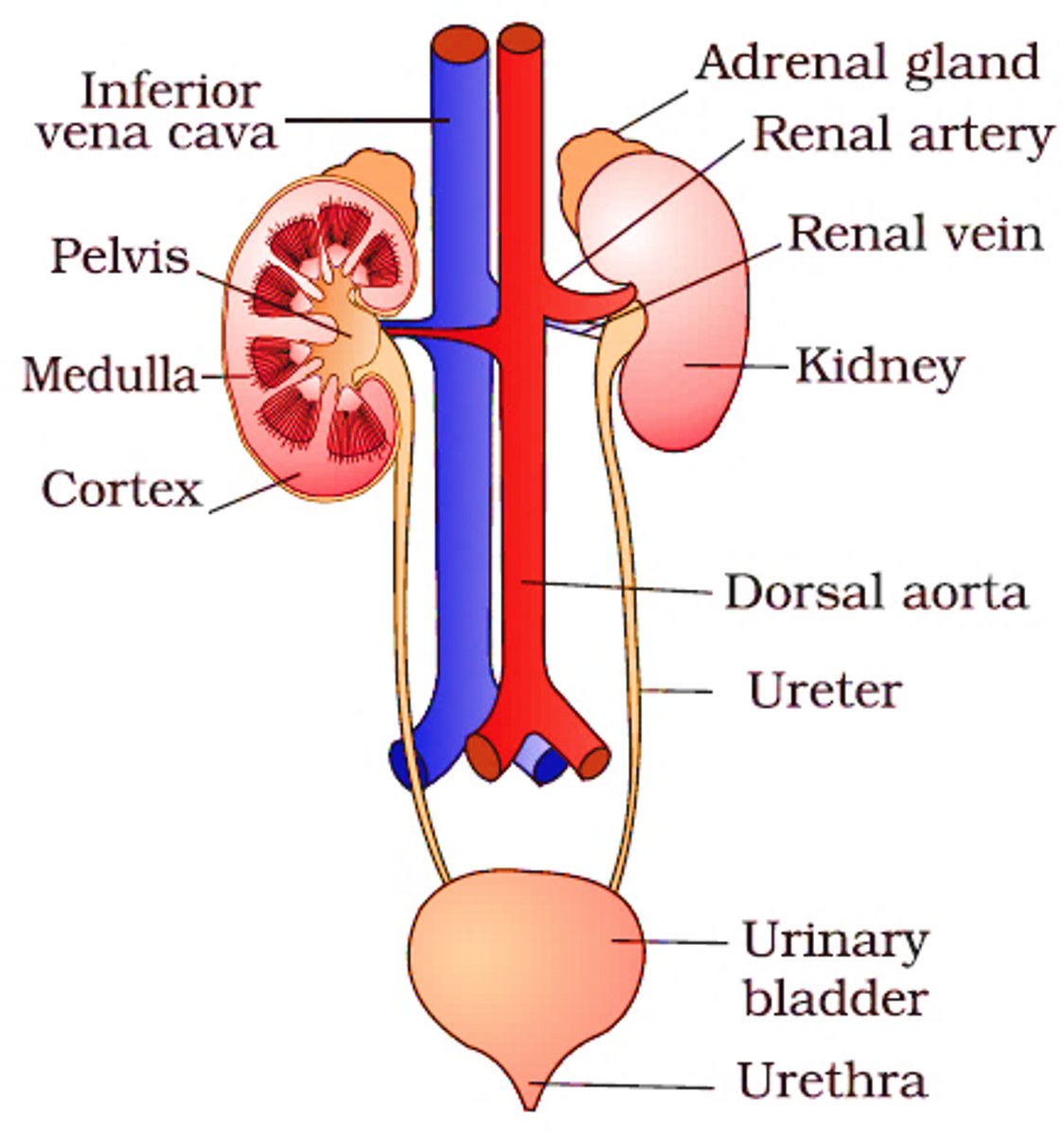
it is used for the temporary storage of urine
Is the urinary bladder used for temporary or permanent storage of urine which is transported to it from the kidney through the ureters?
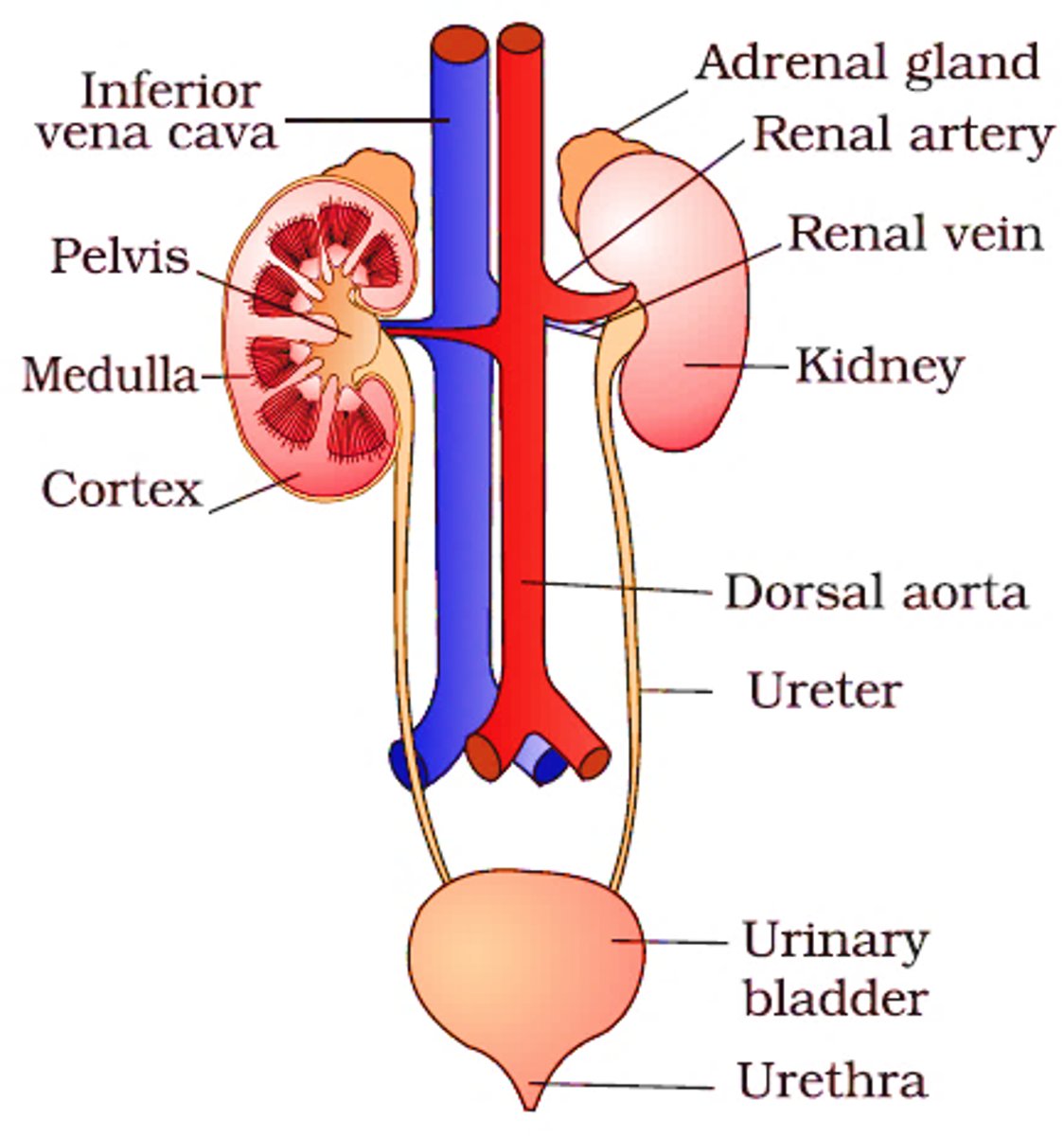
Brings blood to lower body and forms the renal arteries which connect through the hilum in the kidney
What is the role of the dorsal aorta in the human urinary system?
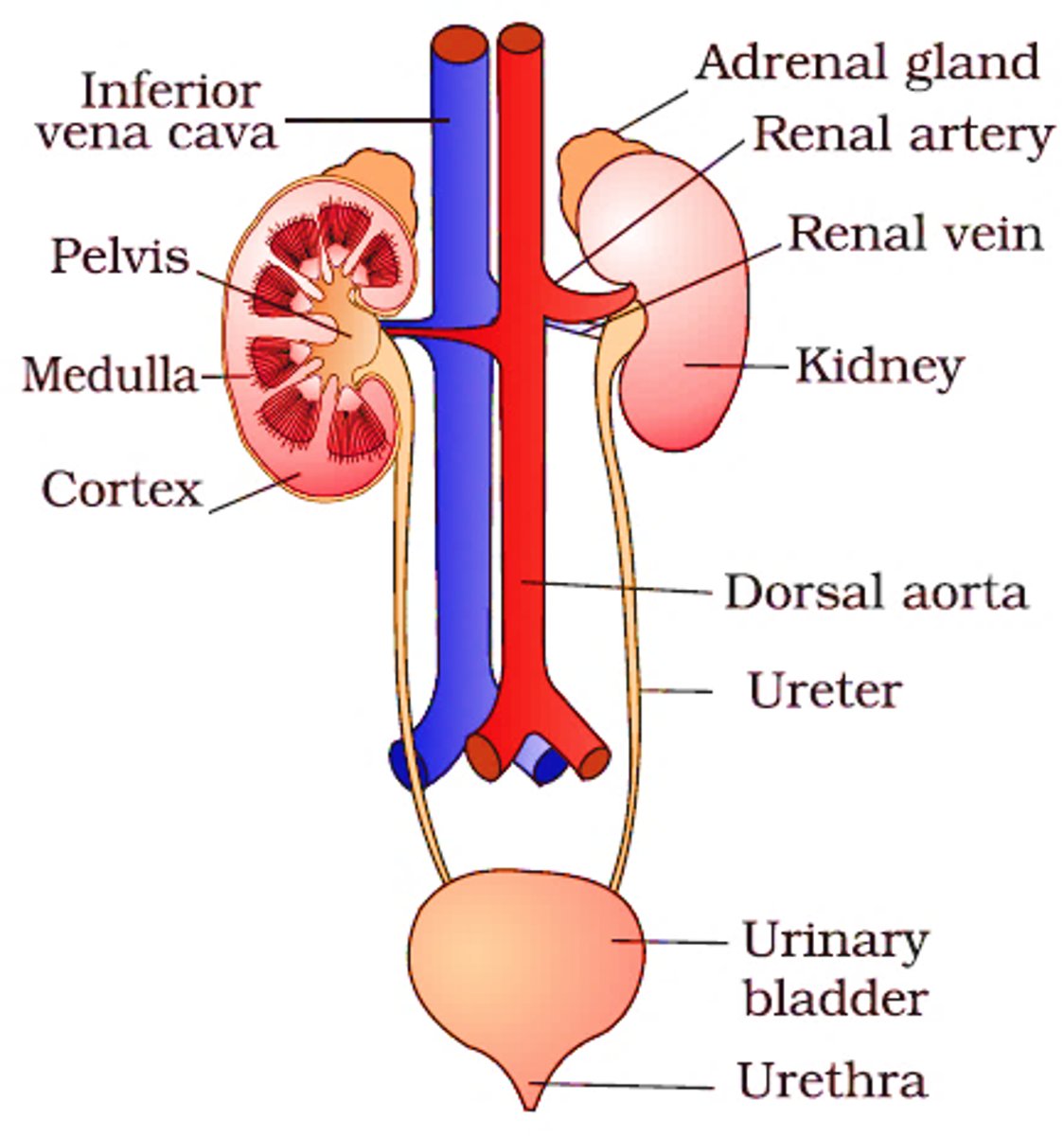
-responsible for the transport of almost all venous blood (deoxygenated blood) from the kidneys back to the right side of the heart (more specifically, right atrium of the heart) for oxygenation
-Note that the renal vein is what connects this blood vein to the kidney through the kidney's hilum
What is the role of the inferior vena cava in the human urinary system?
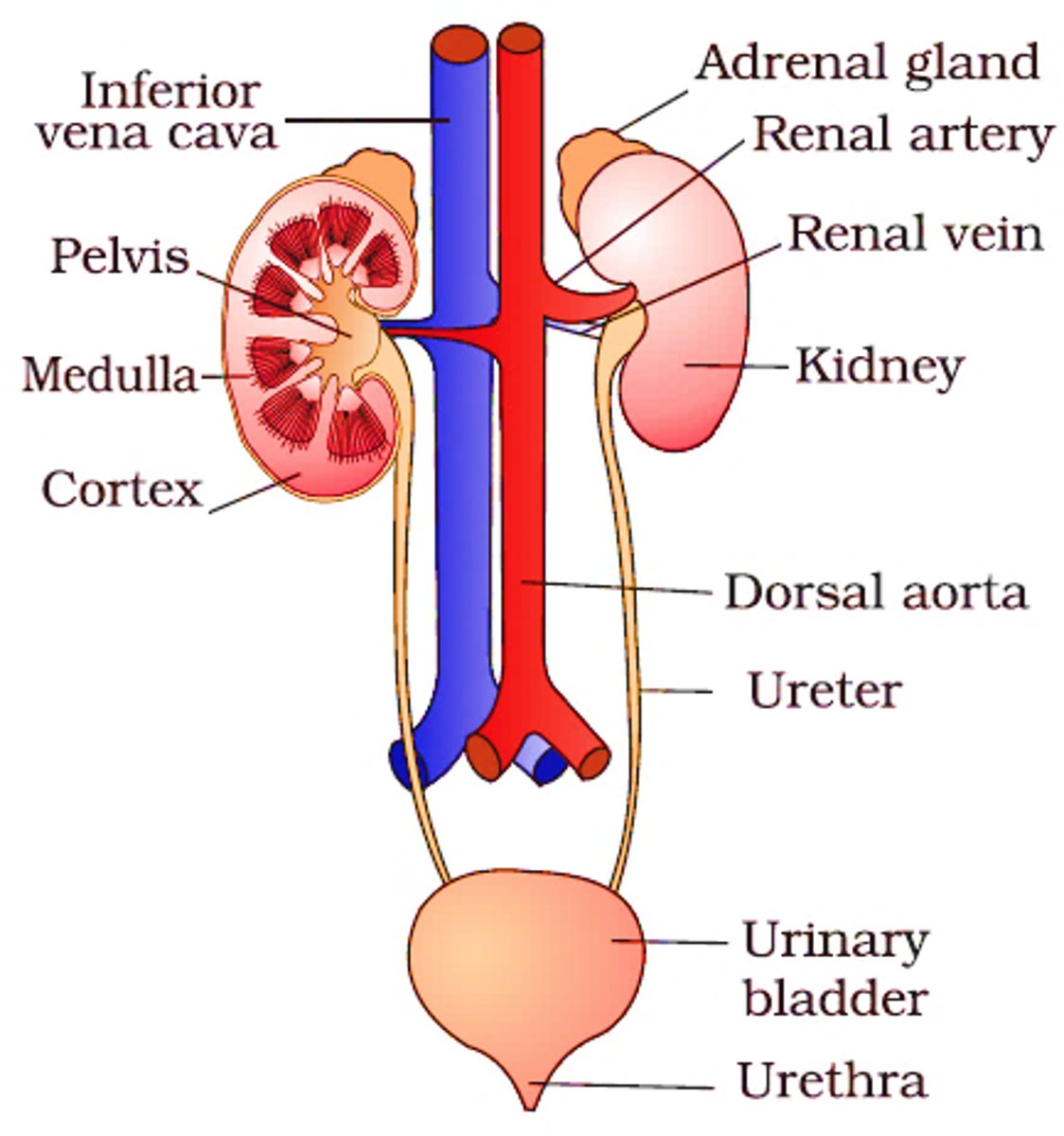
these help connect the kidneys and the dorsal aorta, which helps bring blood from the upper body, into the kidneys for filtration
What is the role of the renal arteries in the human urinary system?
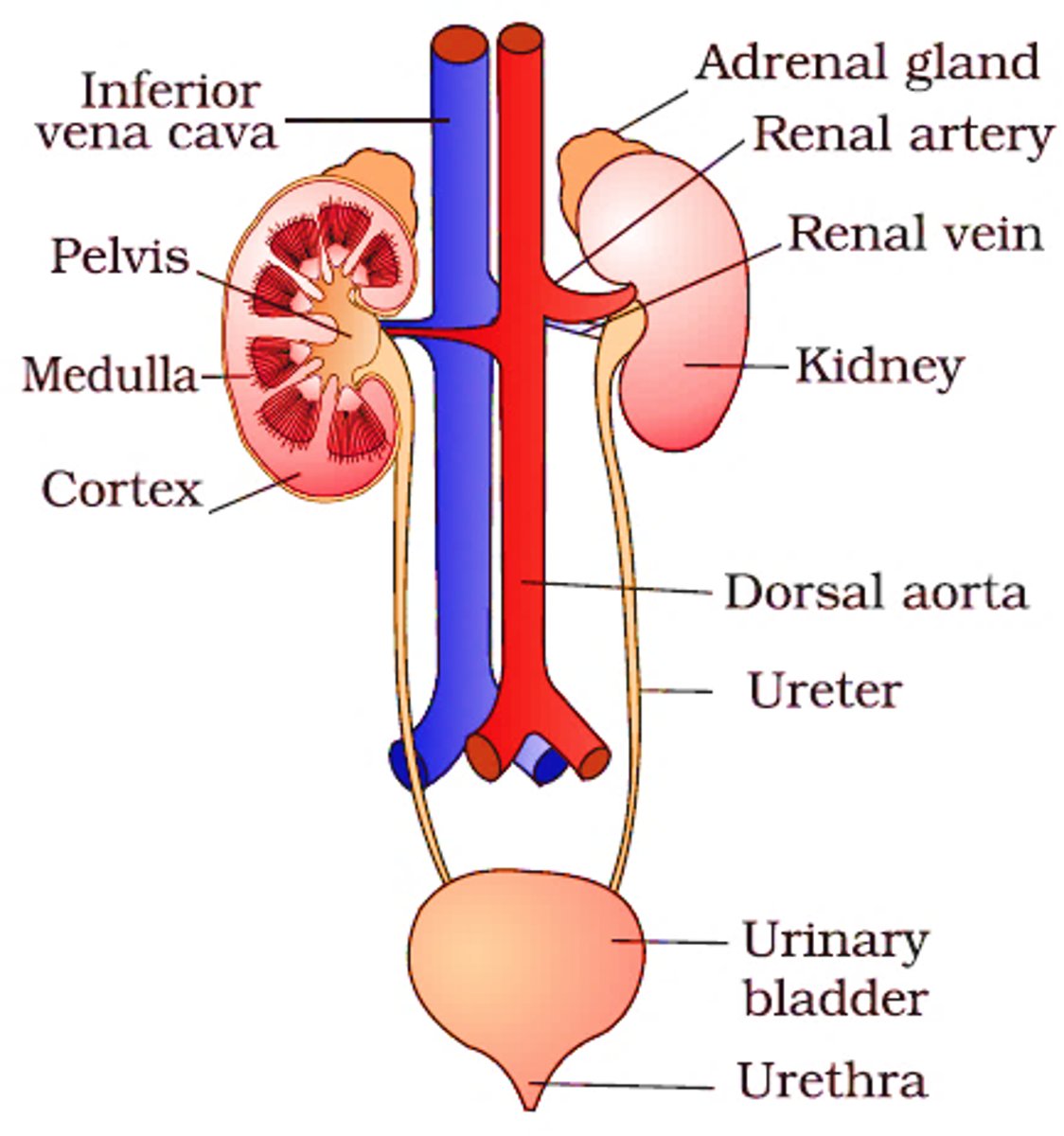
these help connect the kidneys to the inferior vena cava, which helps in bringing all the venous (deoxygenated) and filtered blood from the kidneys back to the right side (more specifically, right atrium) of the heart for oxygenation
What is the role of the renal veins in the human urinary system?
towards the center of the inner concave surface of the kidney is a notch called the hilum, through which the ureter, blood vessels, and nerves enter or leave the kidney
What is the hilum of a human kidney?
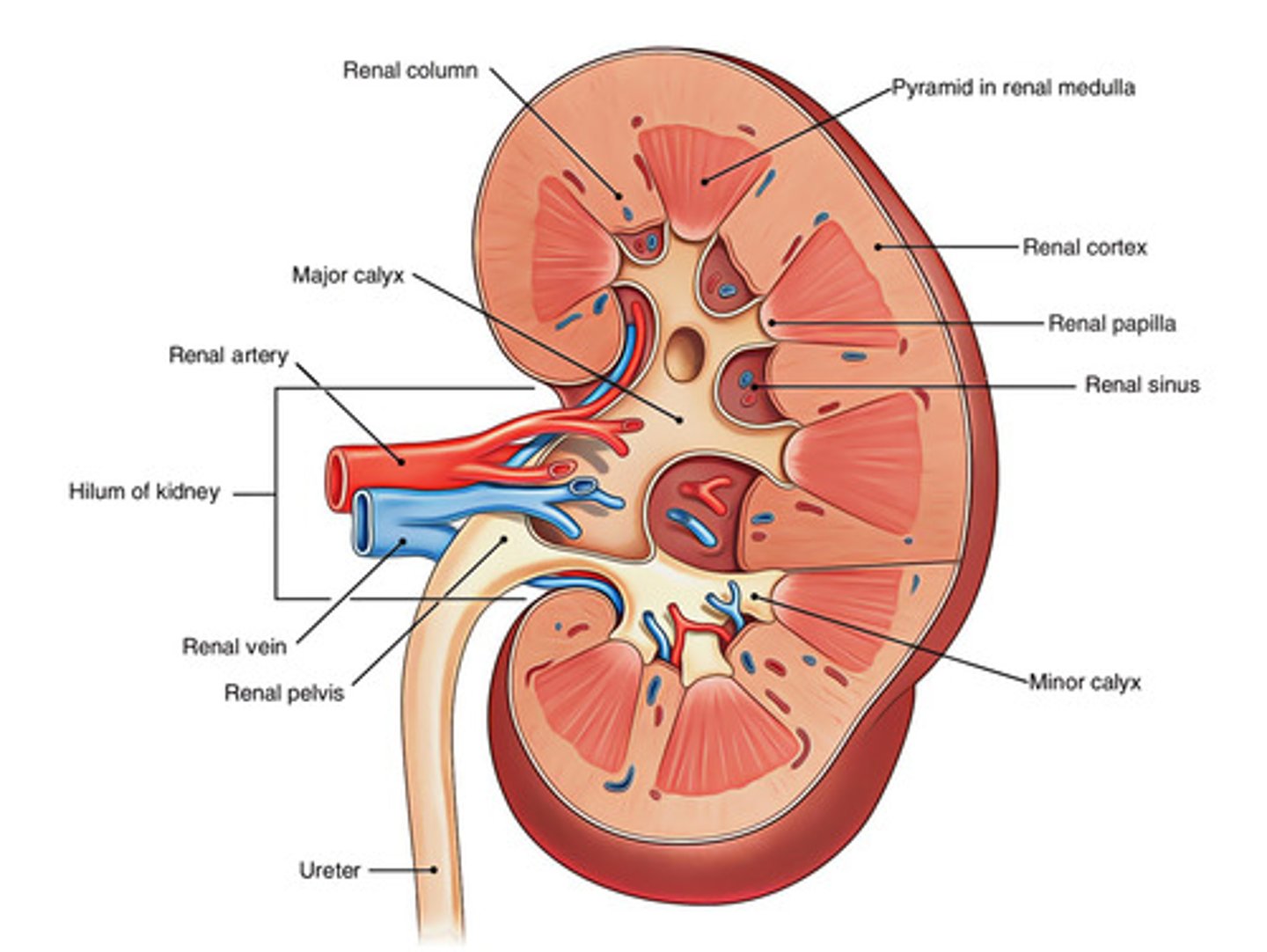
inner to the hilum is a broad funnel shaped space called the renal pelvis
What is the renal pelvis of a human kidney?
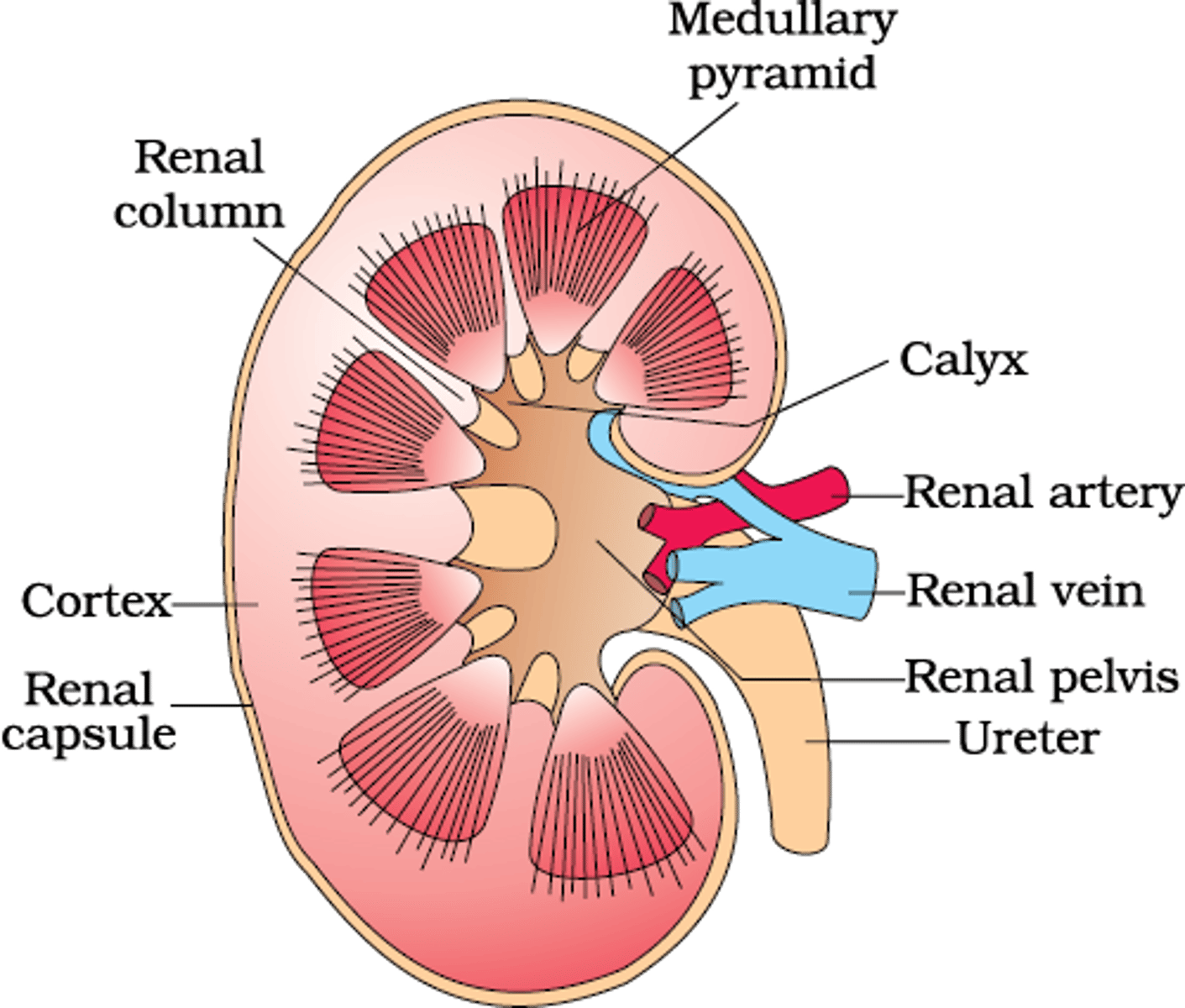
-the projections which occur from the renal pelvis, which is a broad funnel shaped space inner to the hilum
-two types of these projections: major ________ and minor __________
What are the calyces of a human kidney?
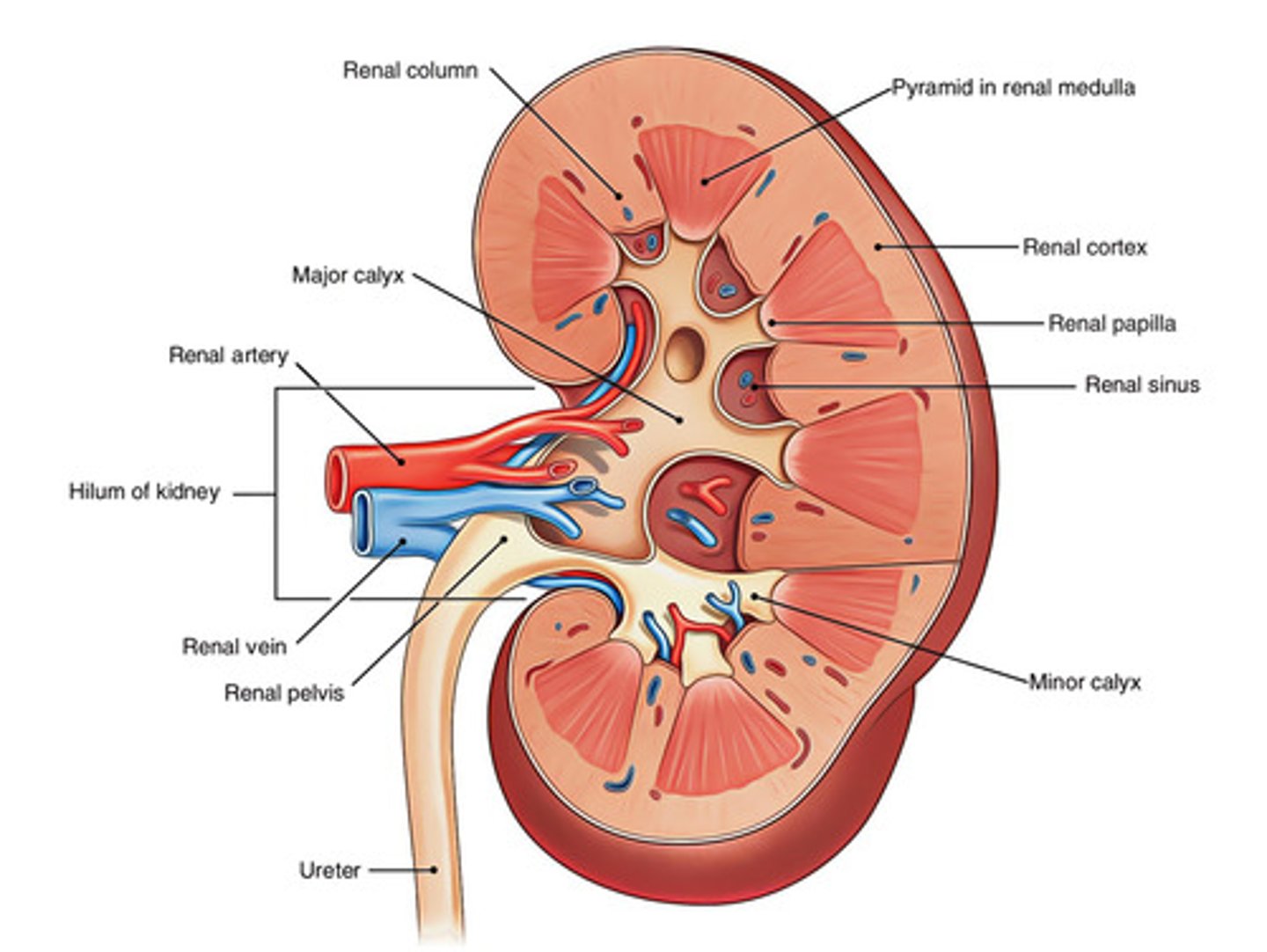
A minor calyx surrounds the renal papillae of each renal pyramid and collects urine from that pyramid.
What is the role of minor calyces in human kidneys?
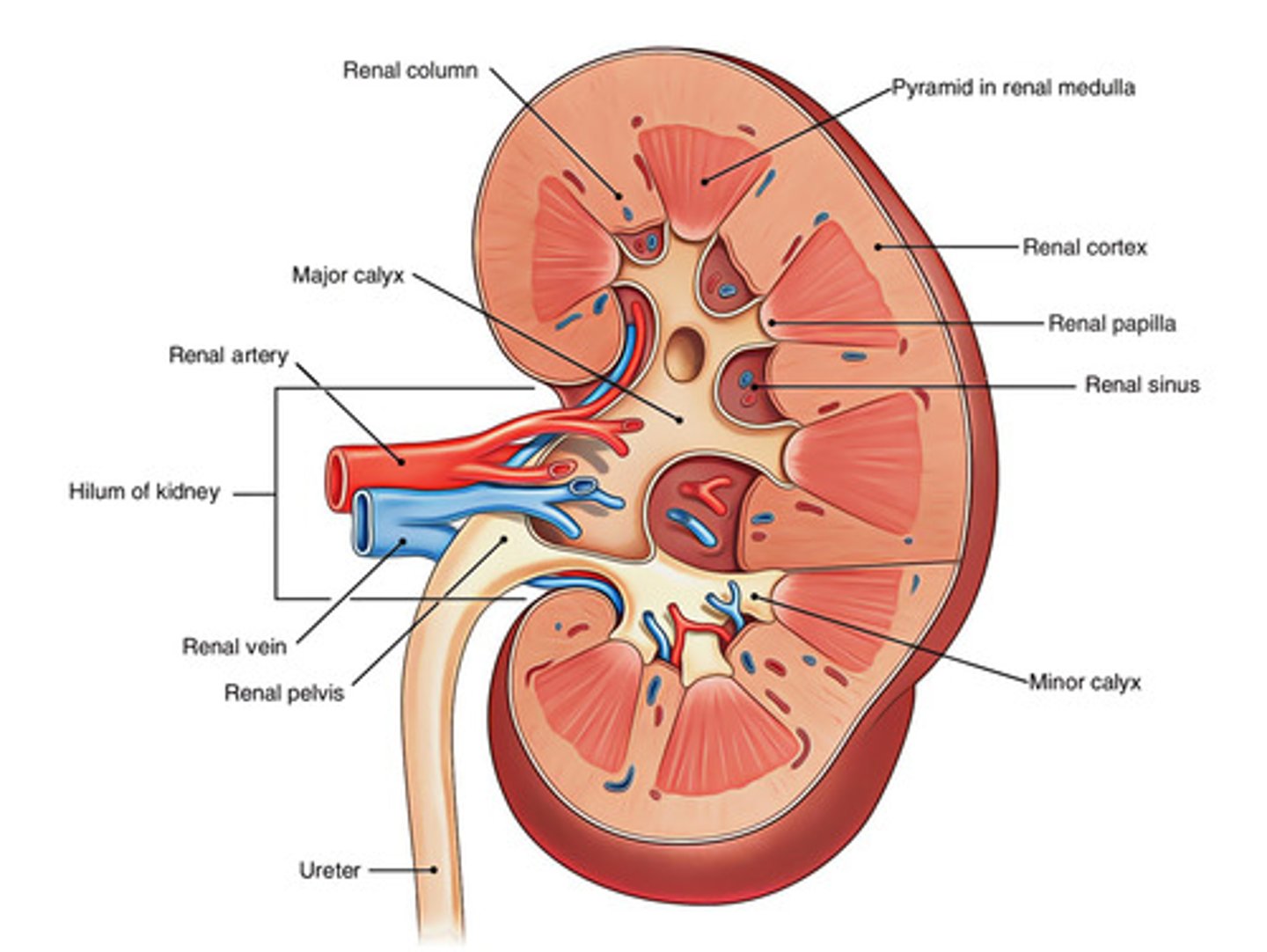
A minor calyx surrounds the renal papillae of each renal pyramid and collects urine from that pyramid. Several minor calyces converge to form a major calyx
What is the difference between major and minor calyces of a human kidney?
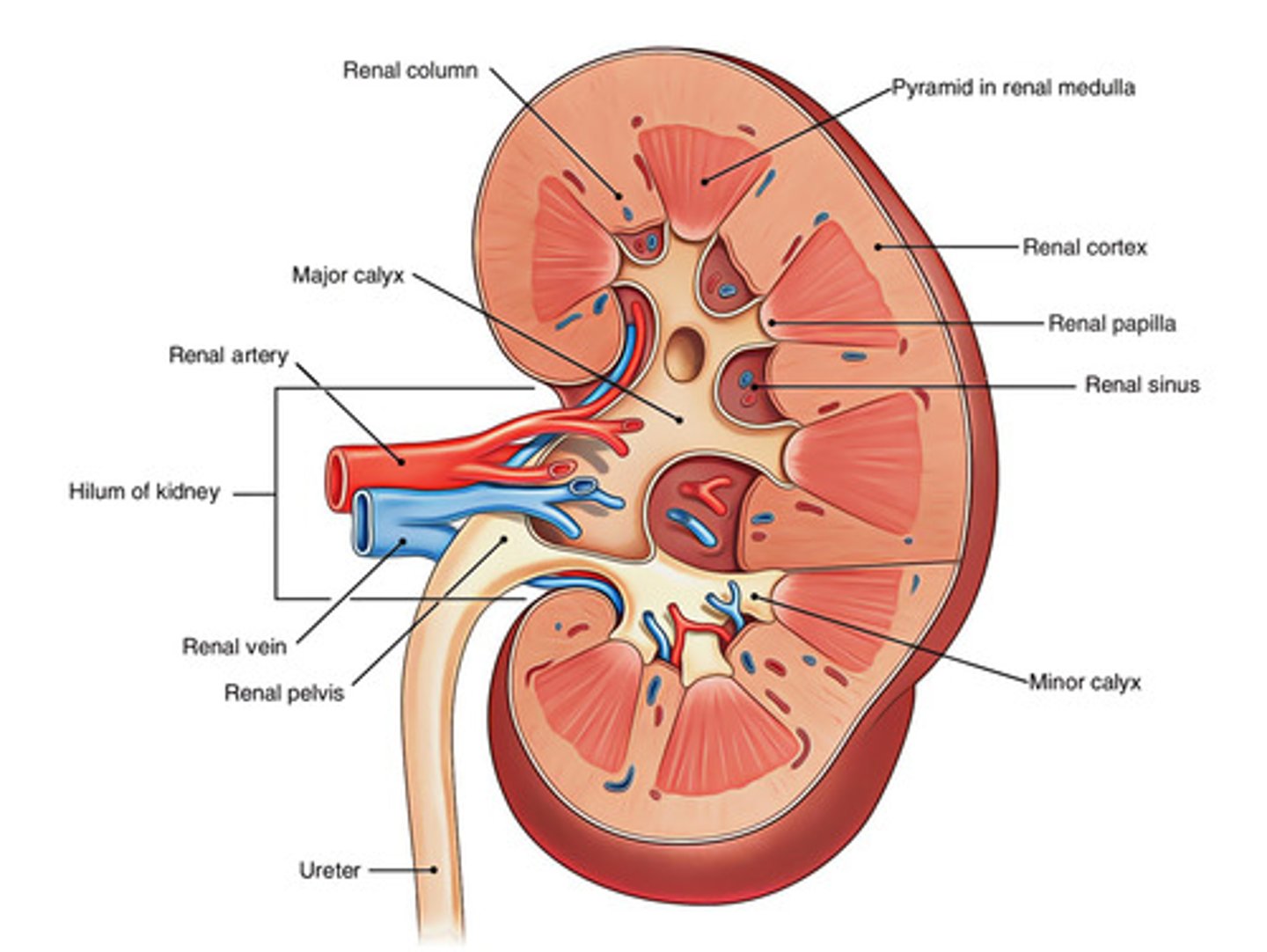
it is a tough capsule known as the renal capsule
What is the outer layer of a human kidney like?
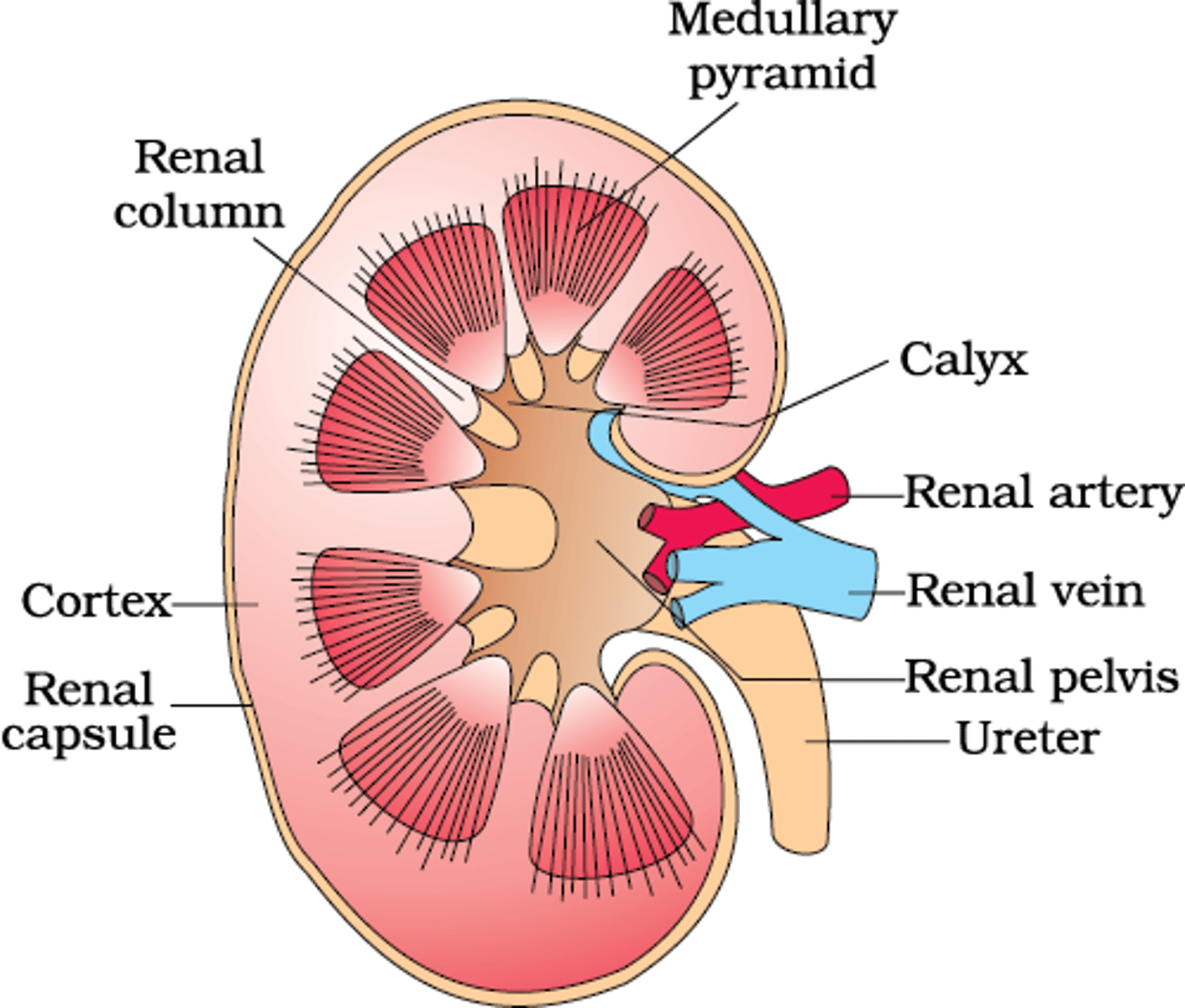
-the outer cortex and the inner medulla are the two main zones of the human kidney, where the medulla is divided into a few conical masses known as medullary/renal pyramids that project into the calyces
-the cortex extends in between the medullary pyramids as renal columns, and these columns are known as the columns of bertini
What are the two main zones of a human kidney?
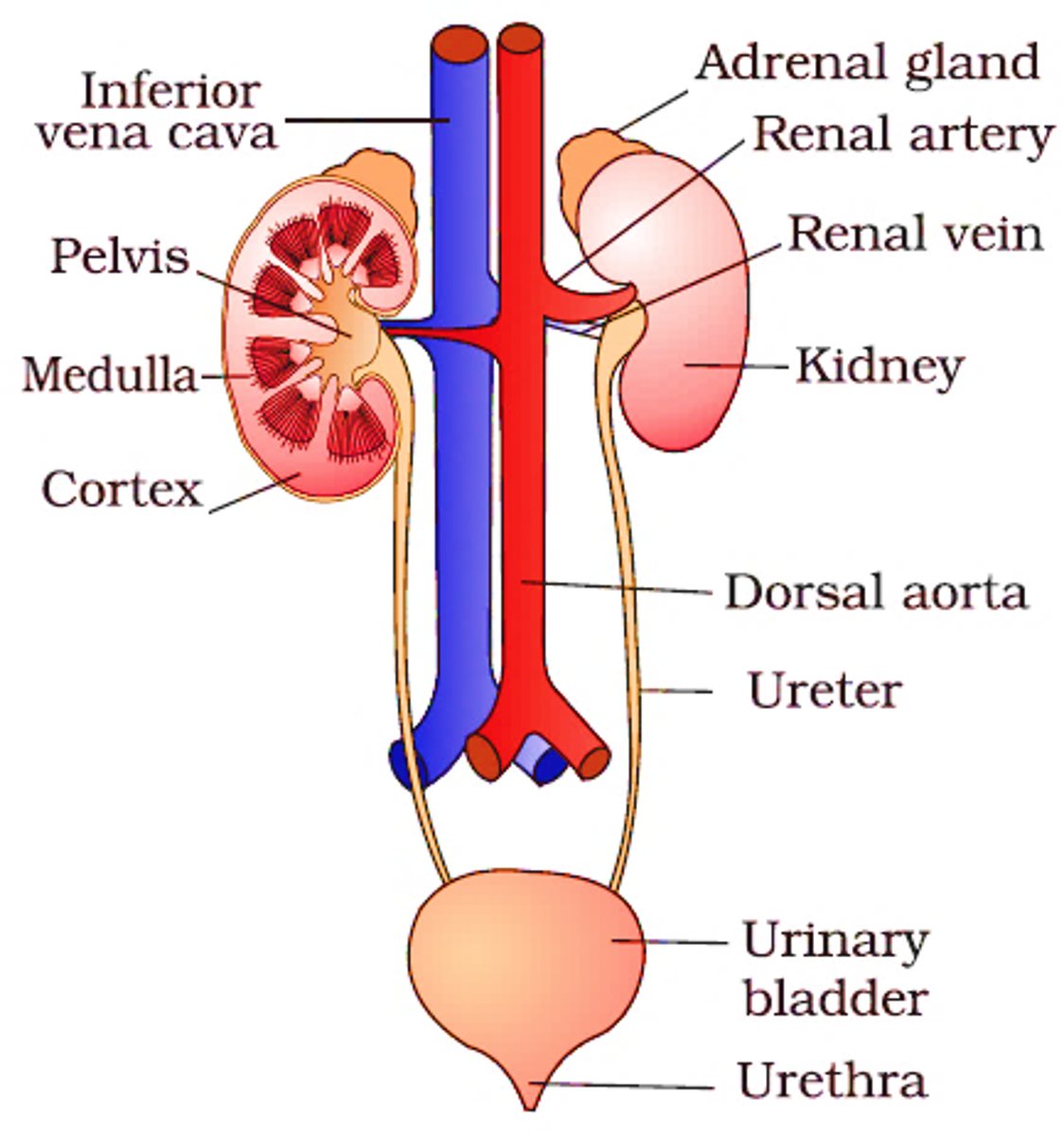
a few conical masses known as medullary/renal pyramids that project into the calyces
What is the medulla of a human kidney divided into?
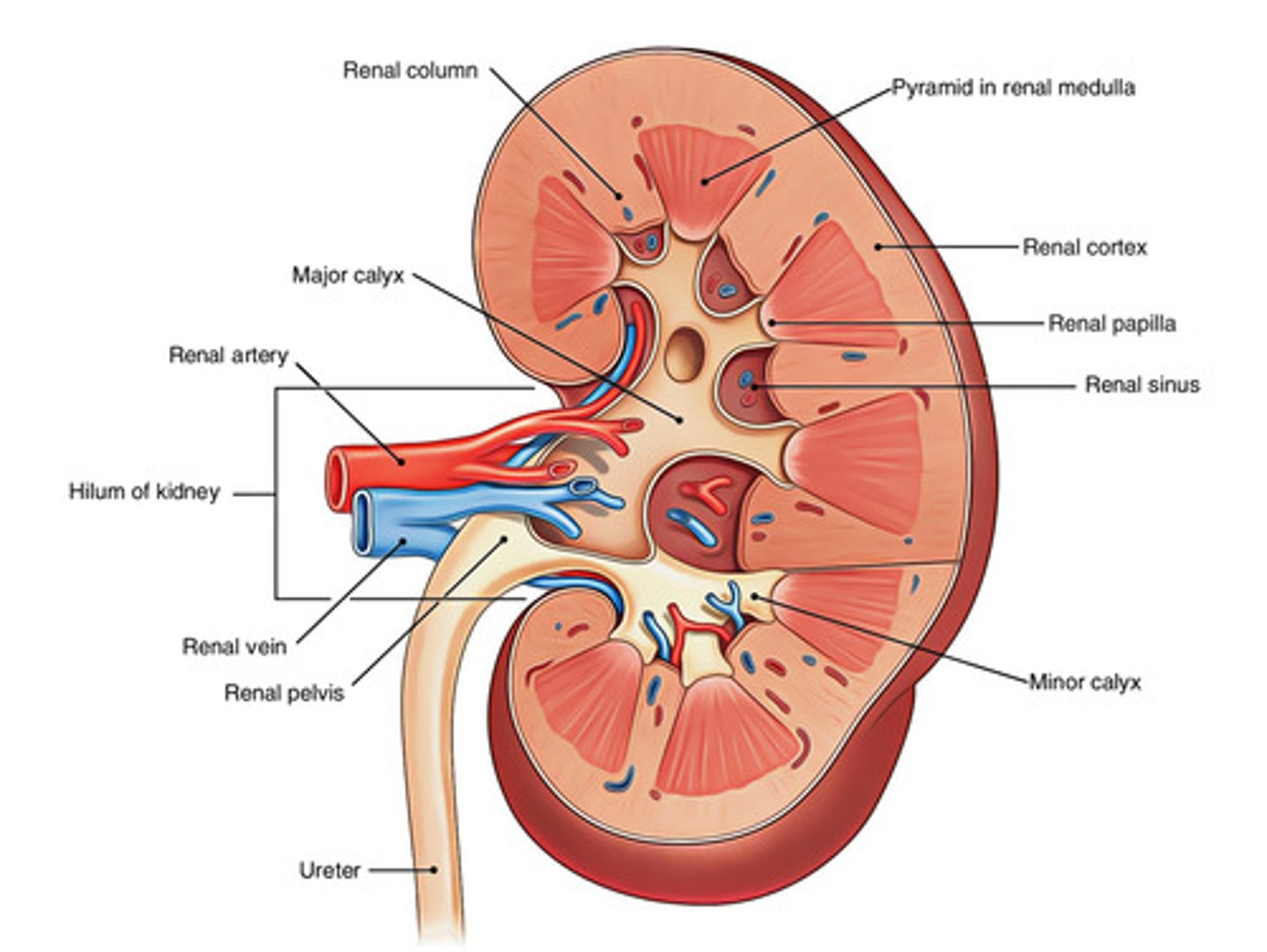
these are the renal columns formed by the cortex of the kidney extending in between the medullary pyramids of the medulla
What are the columns of bertini of a human kidney?
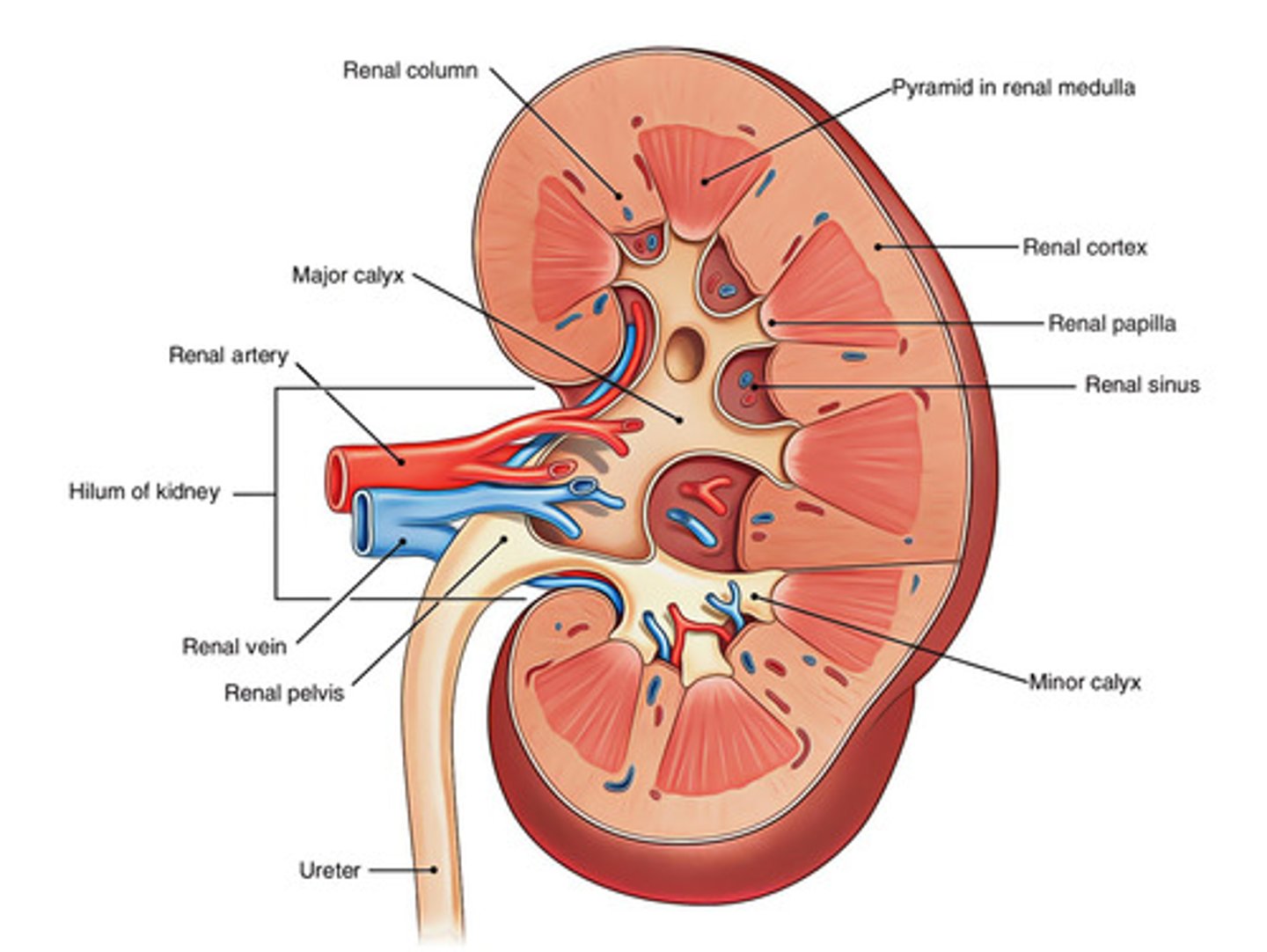
they project into the minor calyces
The medullary pyramids of the medulla of a human kidney project into what other part of the medulla?
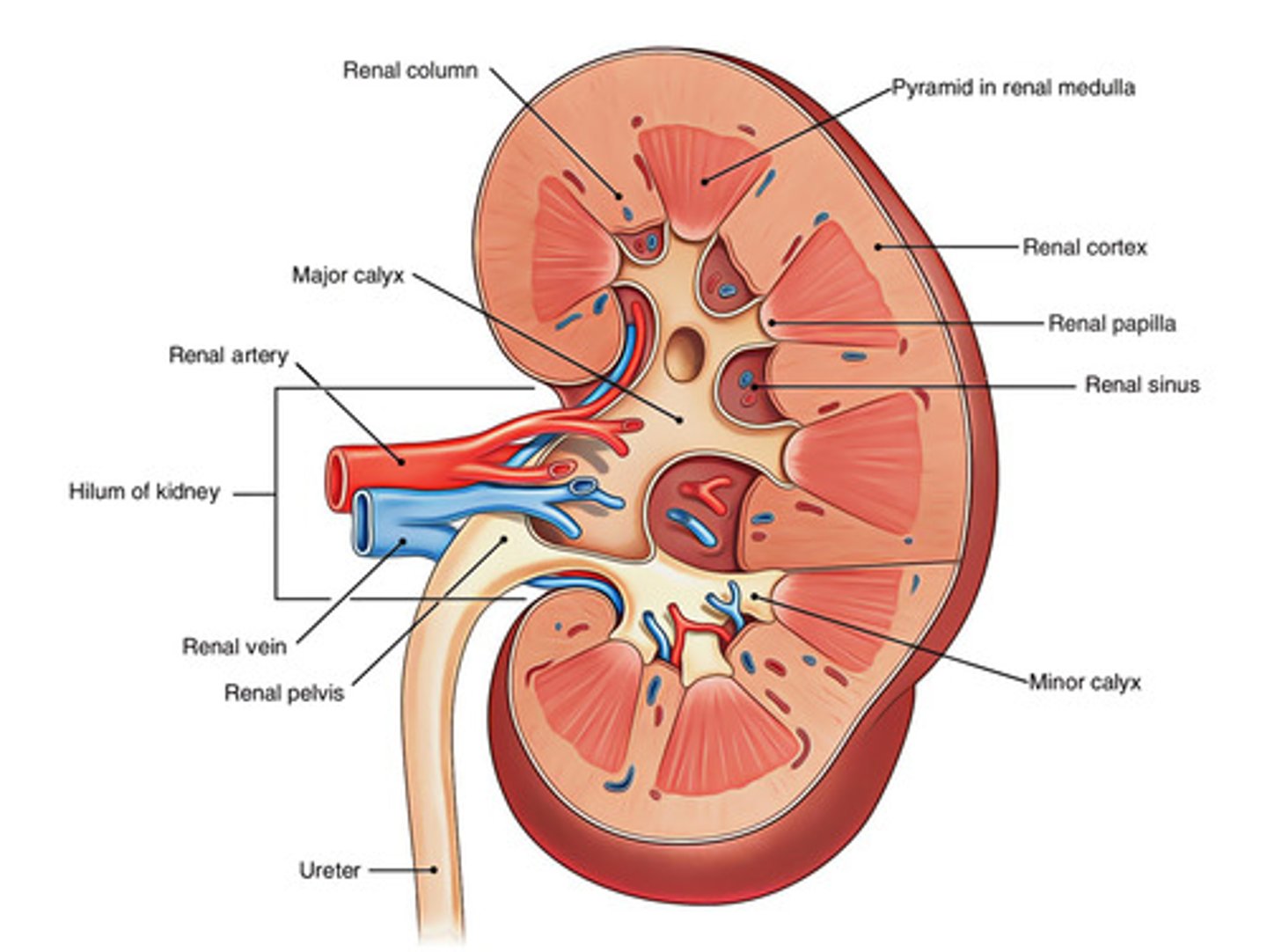
nephrons
What are the functional units of a human kidney that actually filter out the waste from the blood?
1 million
How many nephrons are located in each human kidney?
in the medulla
Where are nephrons located in the human kidney?
2 million (since there are 1 million in each kidney)
How many total nephrons does the human urinary system contain?
the left kidney is positioned higher
In a human body, is the left kidney or right kidney higher?
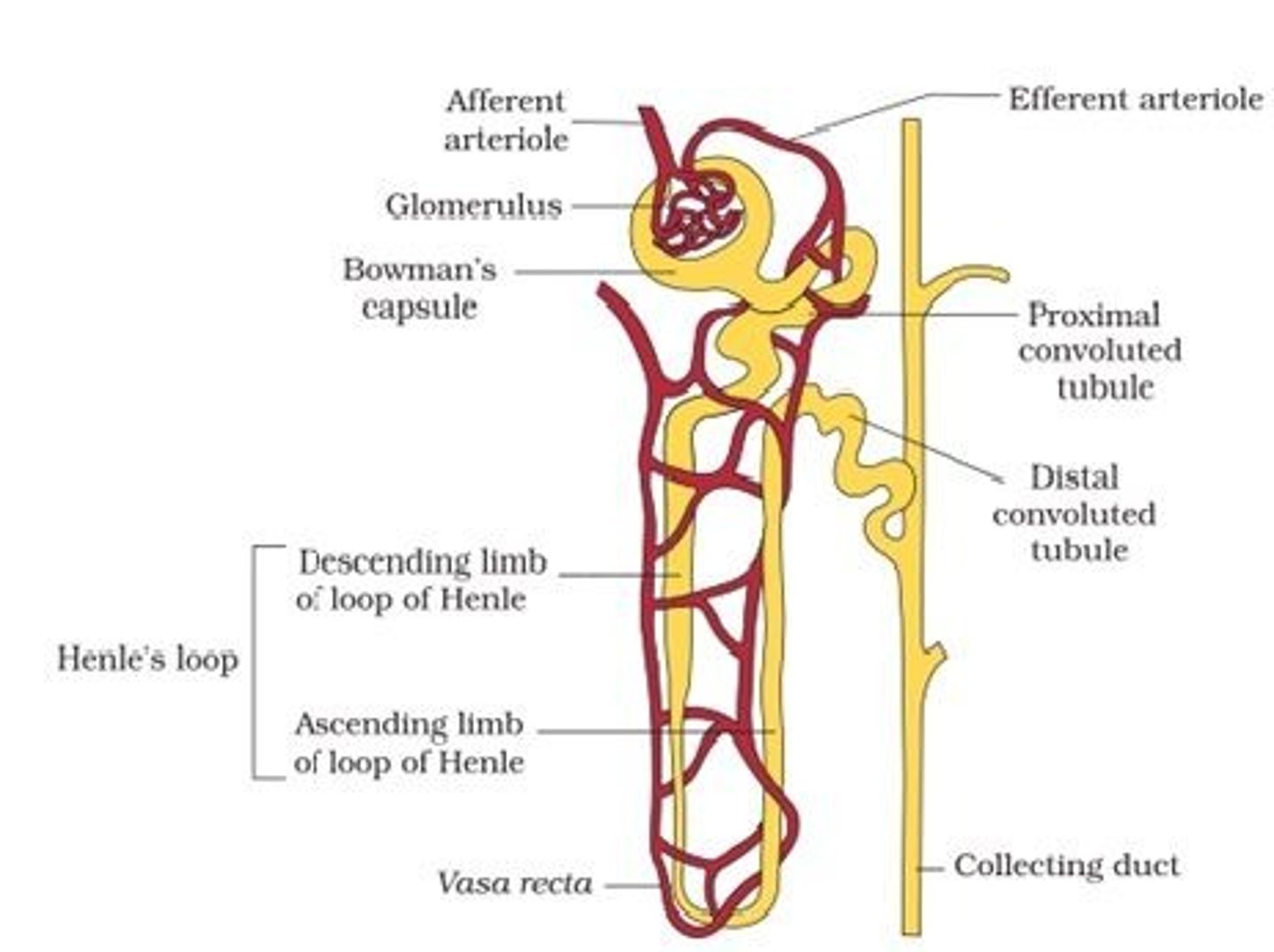
the glomerulus and renal tubule
Each nephron consists of which two major parts?
a tuft (collection) of capillaries formed by the afferent arteriole
What is the glomerulus of a human kidney?
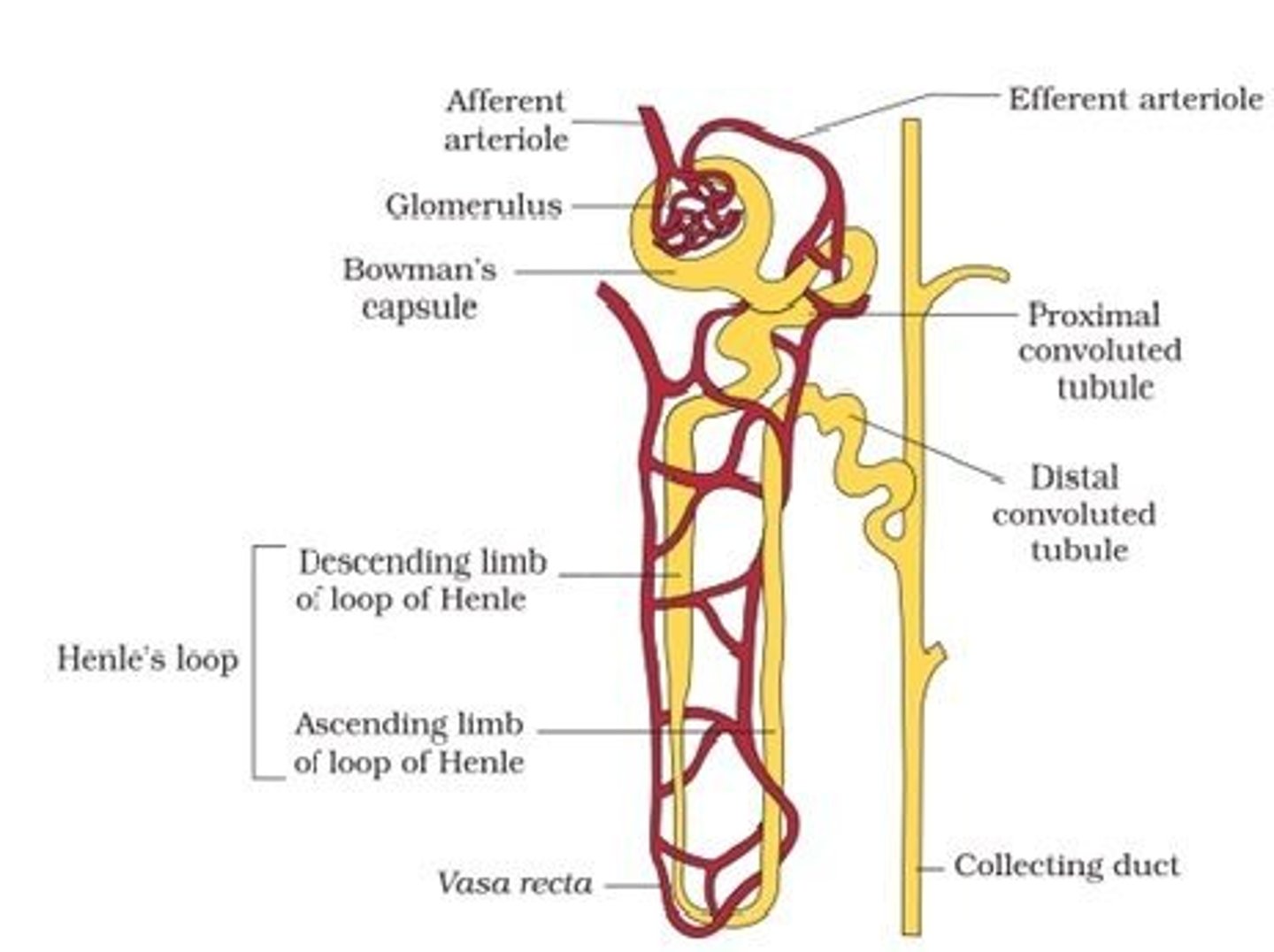
a fine branch of the renal artery through which blood that needs to be filtered enters the nephrons
What is the afferent arteriole of a nephron in a human kidney
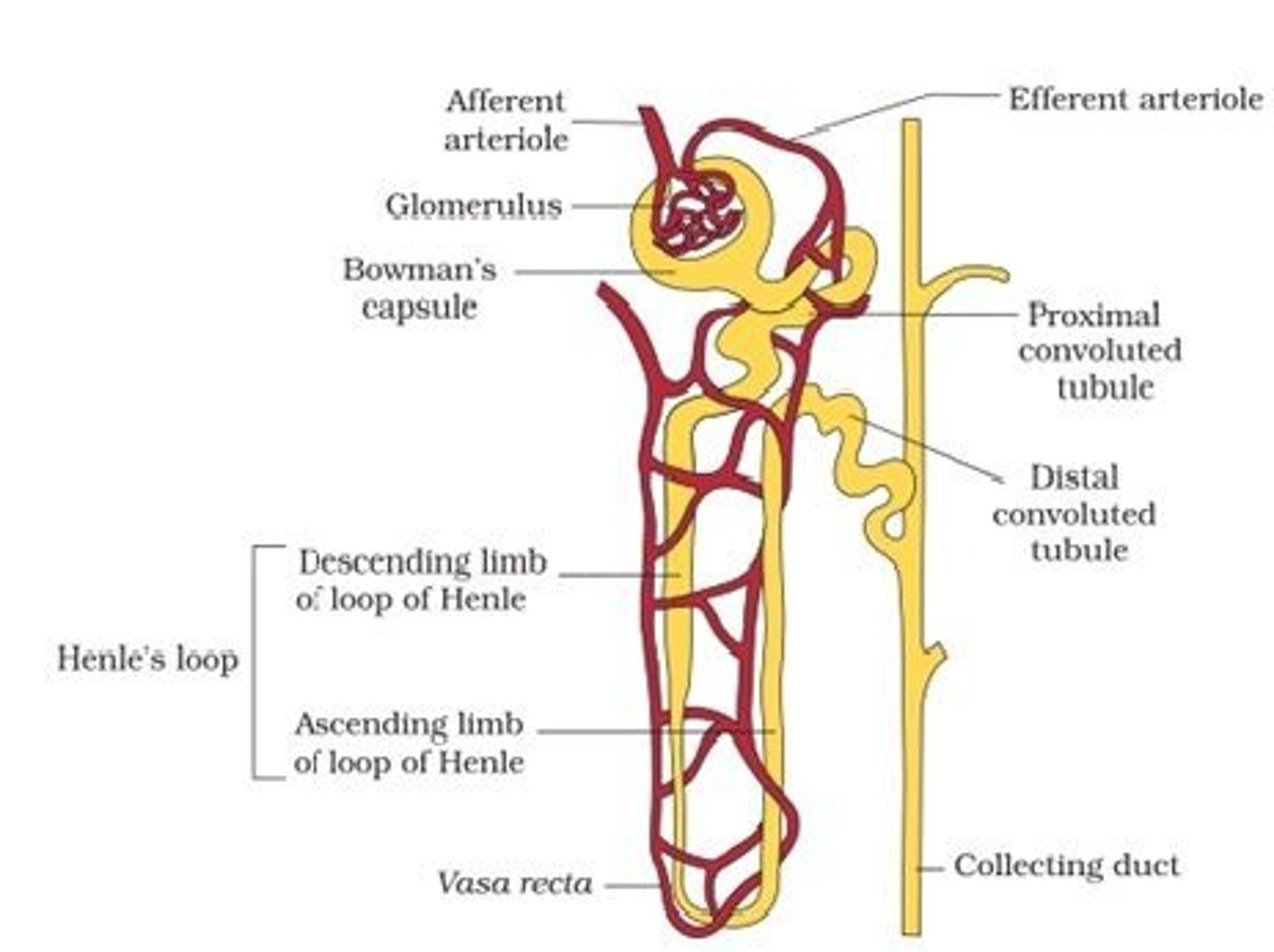
the blood flows down through the dorsal aorta from the heart and into the renal artery, which then connects to the afferent arteriole, which is what brings the unfiltered blood into the nephron
What brings unfiltered blood (blood with waste in it) into the glomerulus of the nephron of a human kidney? Where does this blood initially come from?
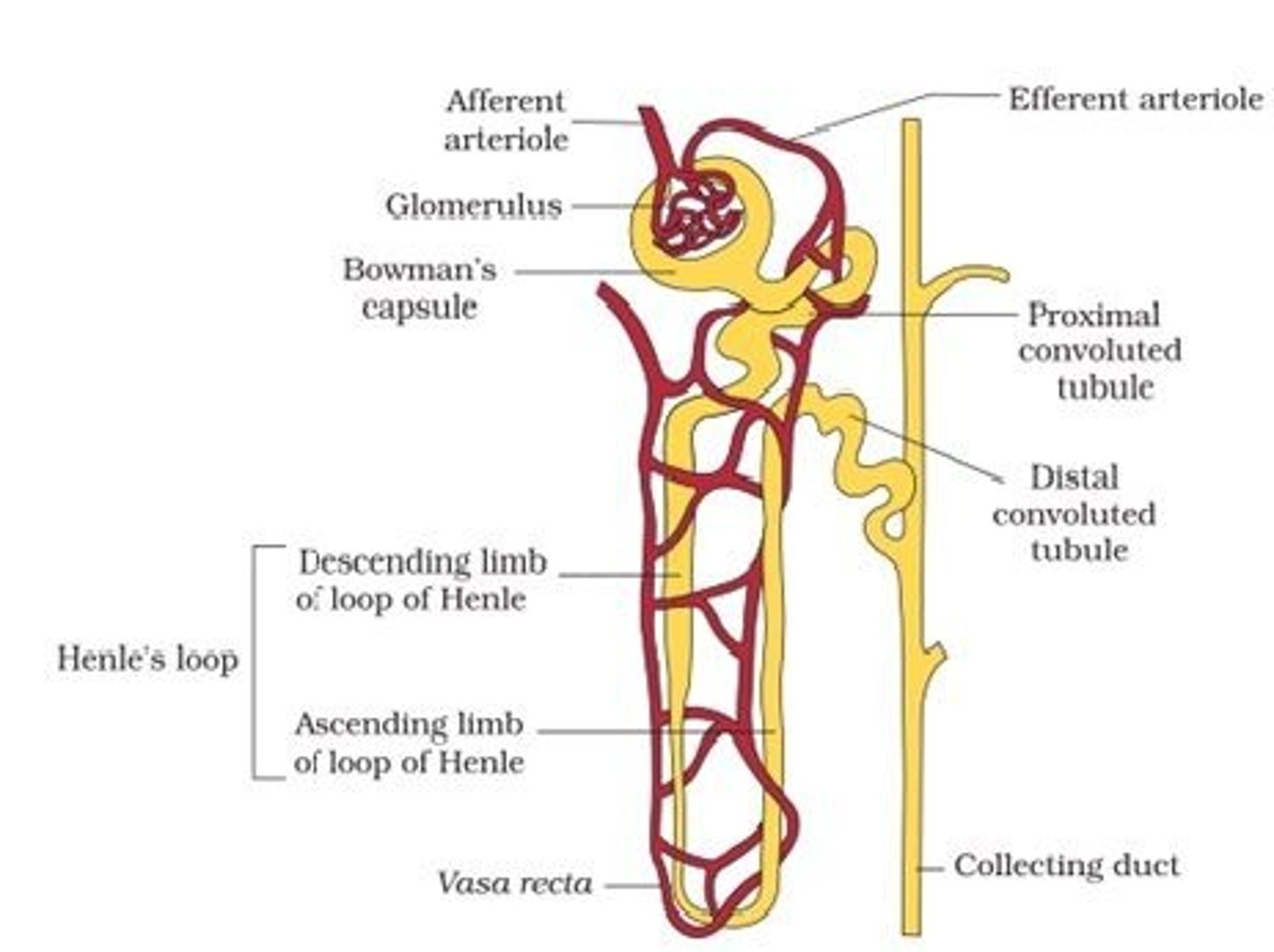
-the efferent arteriole carries the filtered blood out from the glomerulus and eventually connects to the renal vein, which then carries this blood into the IVC, which then takes it back up to the right atrium of the heart
What takes away the filtered/pure blood out from the glomerulus of a nephron in a human kidney? Where does it take this filtered blood?
-the most amount of filtration of blood occurs within the glomerulus, where the afferent arteriole brings blood into the glomerulus and the efferent arteriole carries away the filtered/pure blood back to the renal vein which takes it to the IVC, which then takes it back to the right atrium of the heart
-the waste which has been filtered out still contains a small amount of blood left in it and so this is taken through the renal tubule where more filtration occurs
What occurs in the glomerulus of a nephron in a human kidney?
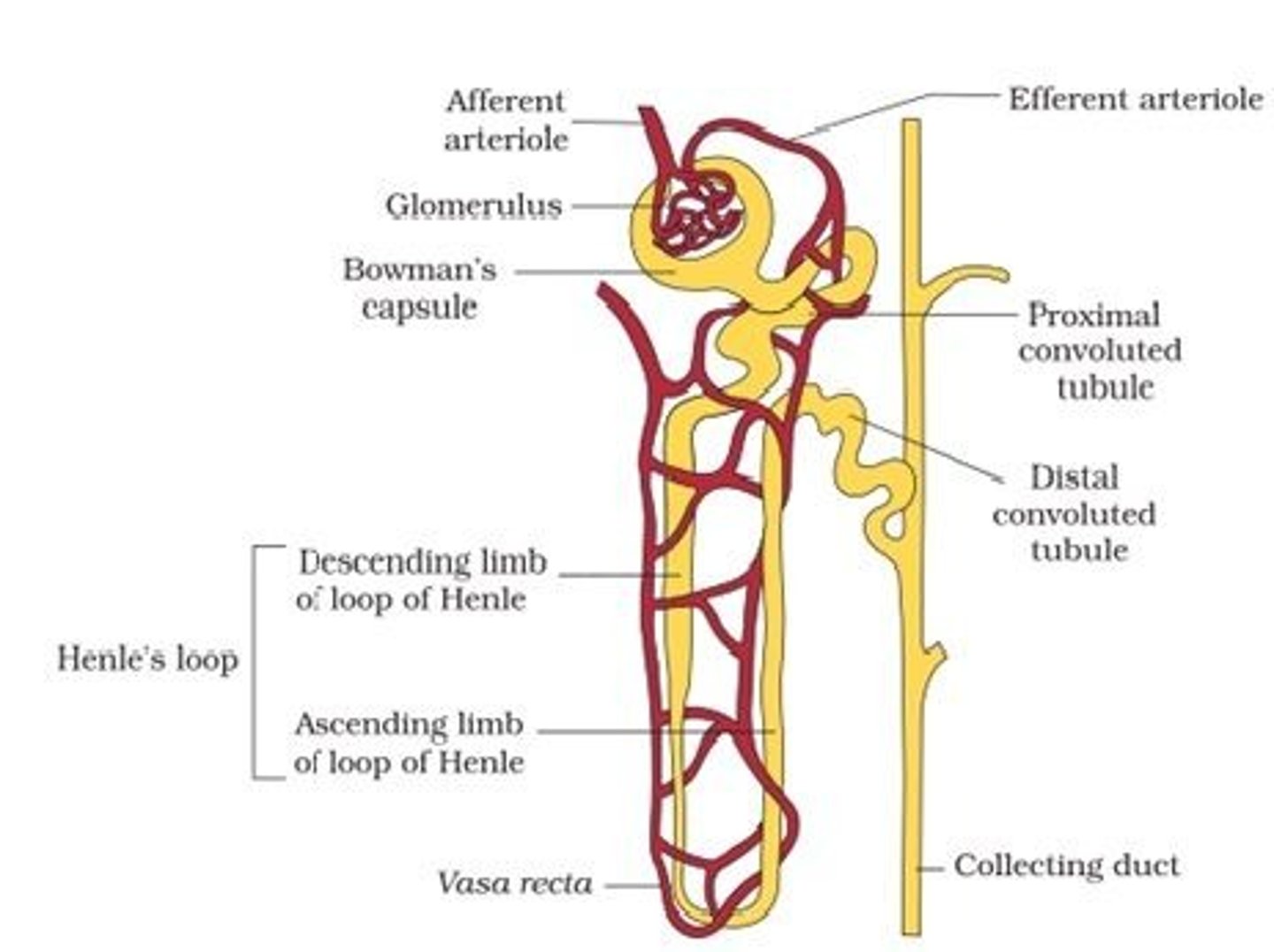
it is located within Bowman's Capsule
In the nephron, what is the glomerulus located within?
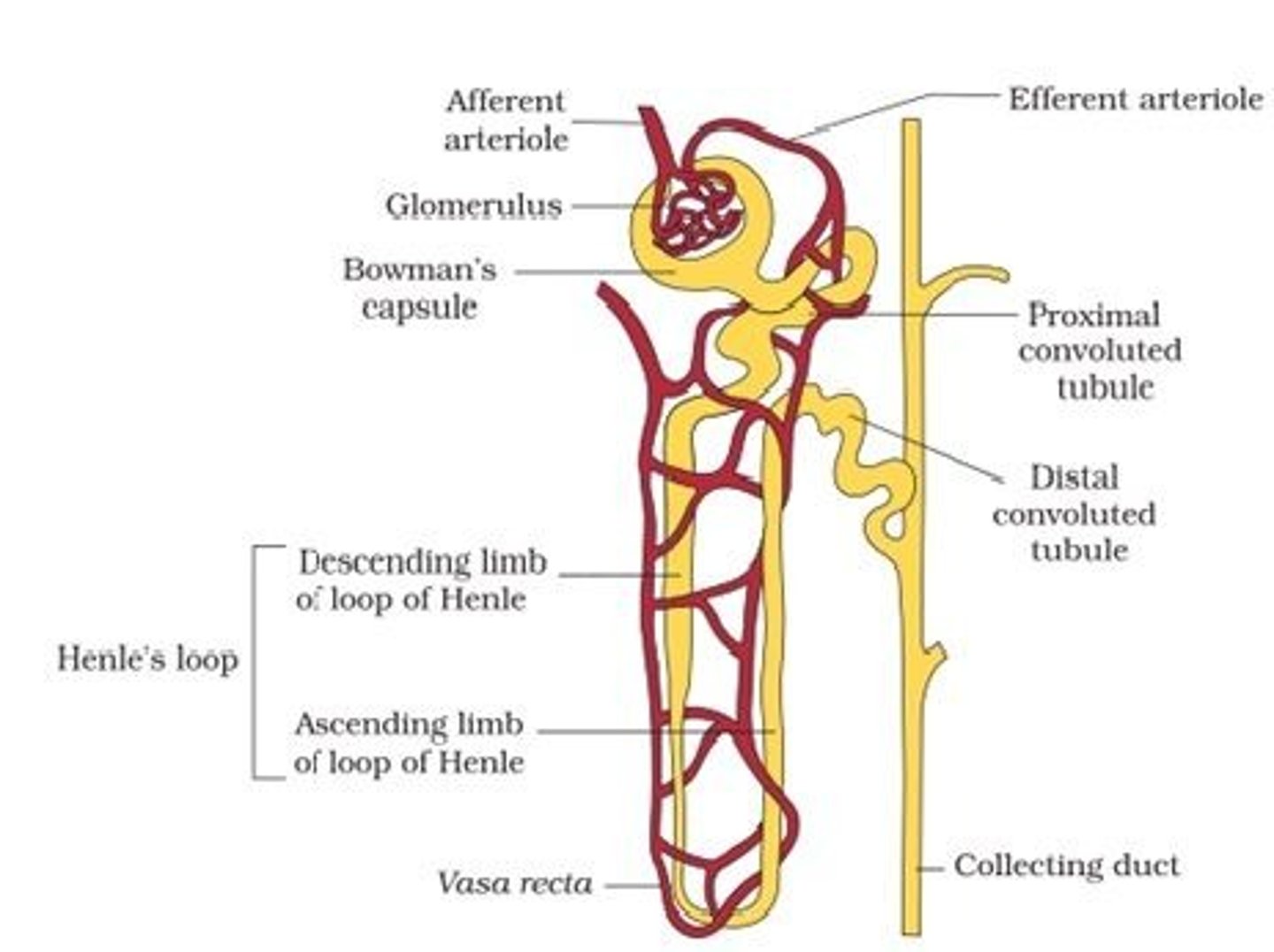
it is the start of the renal tubule, and it is a double walled cup-like structure that encloses the glomerulus
What is Bowman's capsule of a nephron in a human kidney?
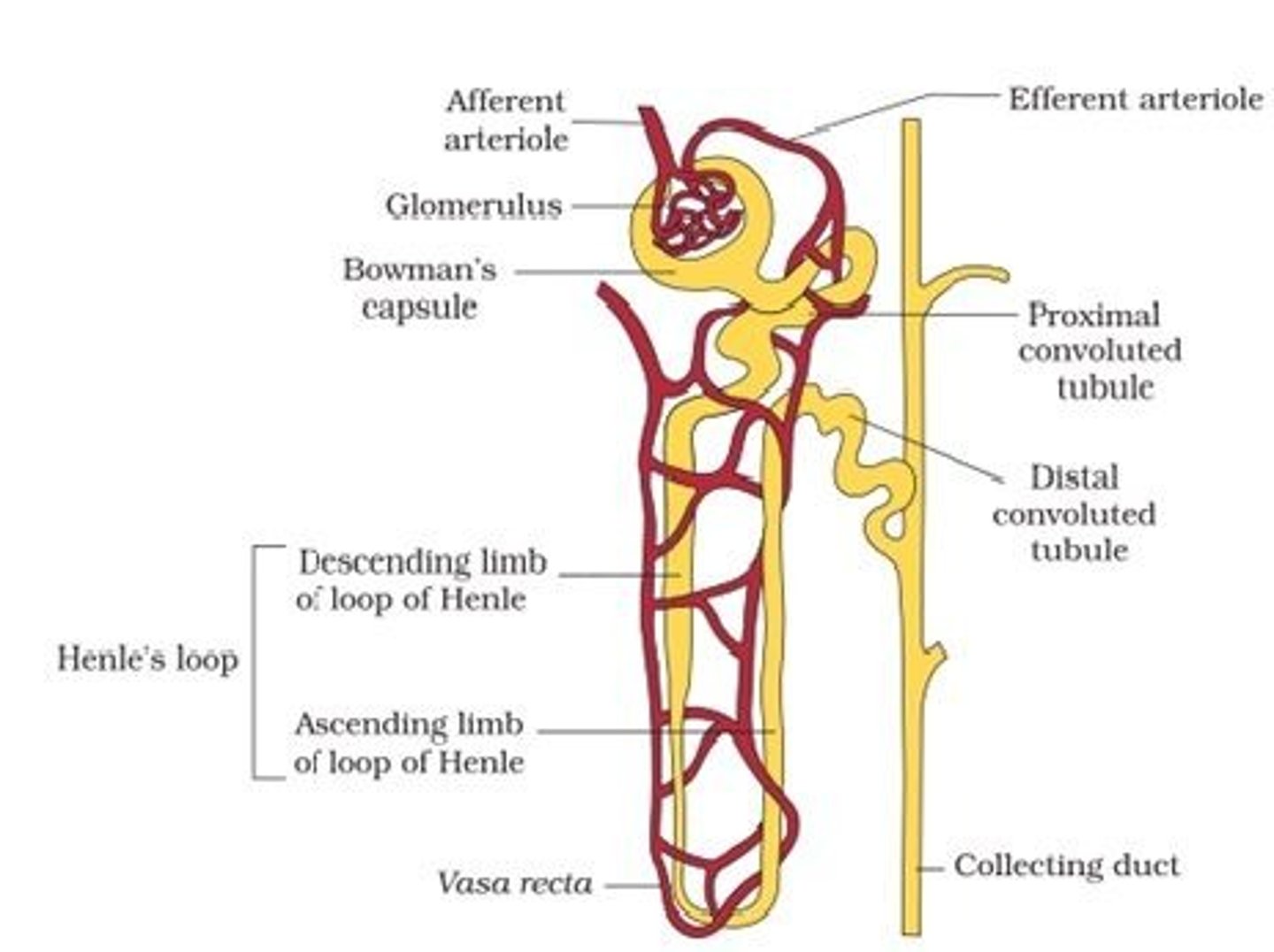
it is double-walled
Is Bowman's Capsule of a nephron in a human kidney, single-walled or double-walled?
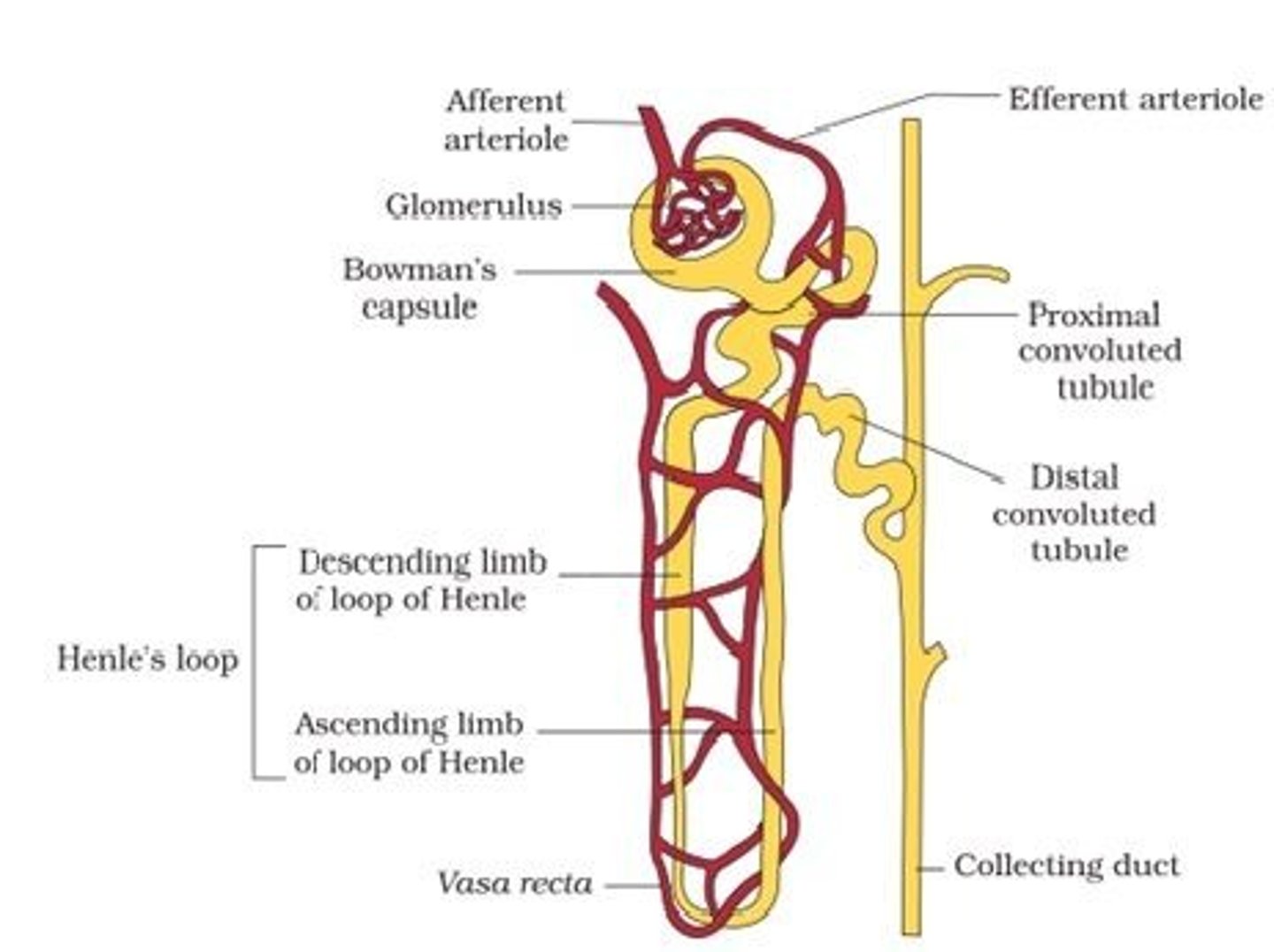
bowman's capsule
Which structure defines the beginning of the renal tube in a nephron in a human kidney?
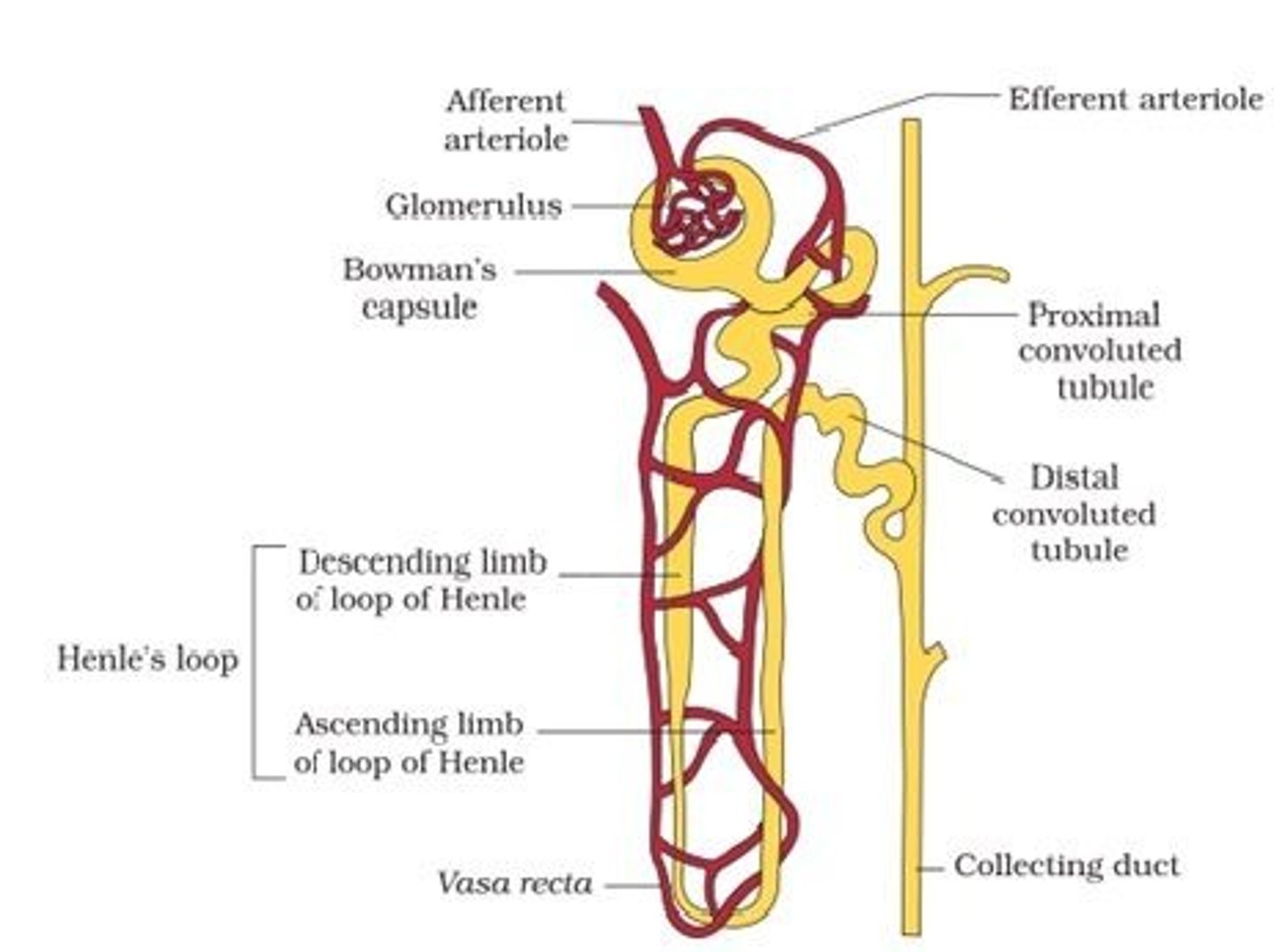
the malpighian body or renal corpuscle
What is the glomerulus along with Bowman's capsule, collectively called?
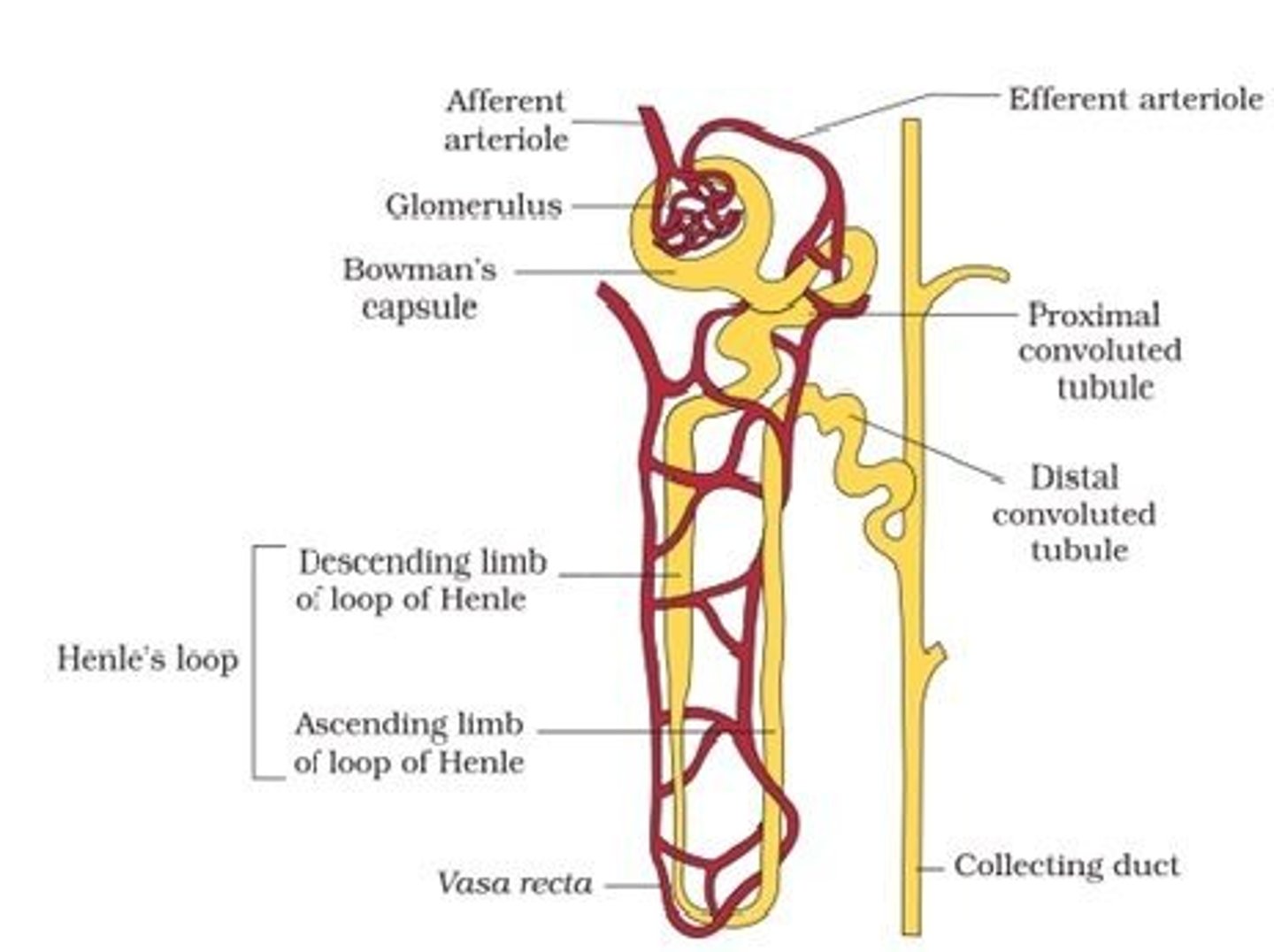
it forms a highly coiled network called the proximal convoluted tubule (PCT)
Once the renal tubule leaves bowman's capsule in a nephron of a human kidney, what does it form?
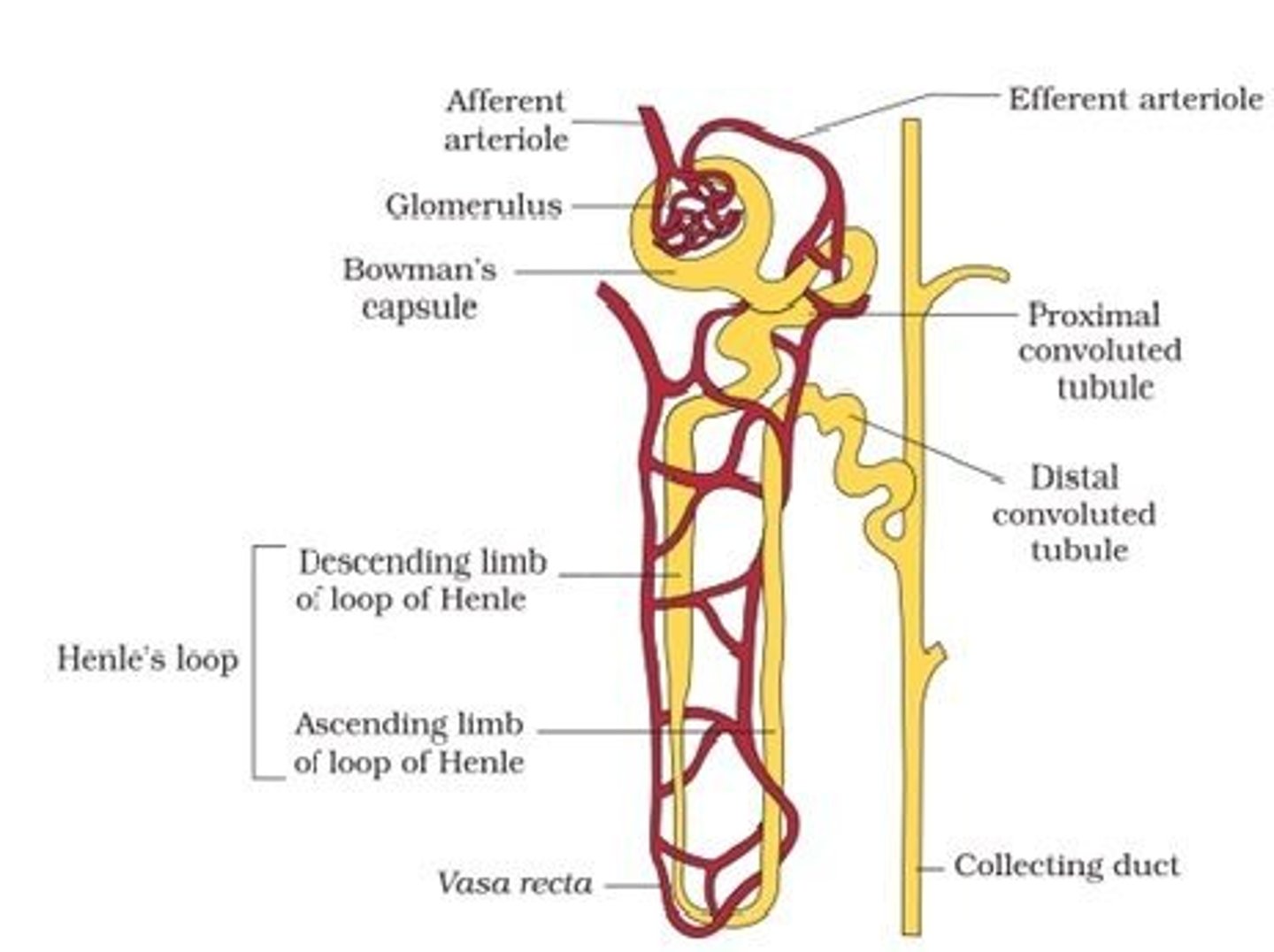
Henle's loop, which contains a descending and ascending limb, and so the PCT connects to the descending limb of Henle's loop
After the PCT, what part comes next in the renal tubule of a nephron in a human kidney?
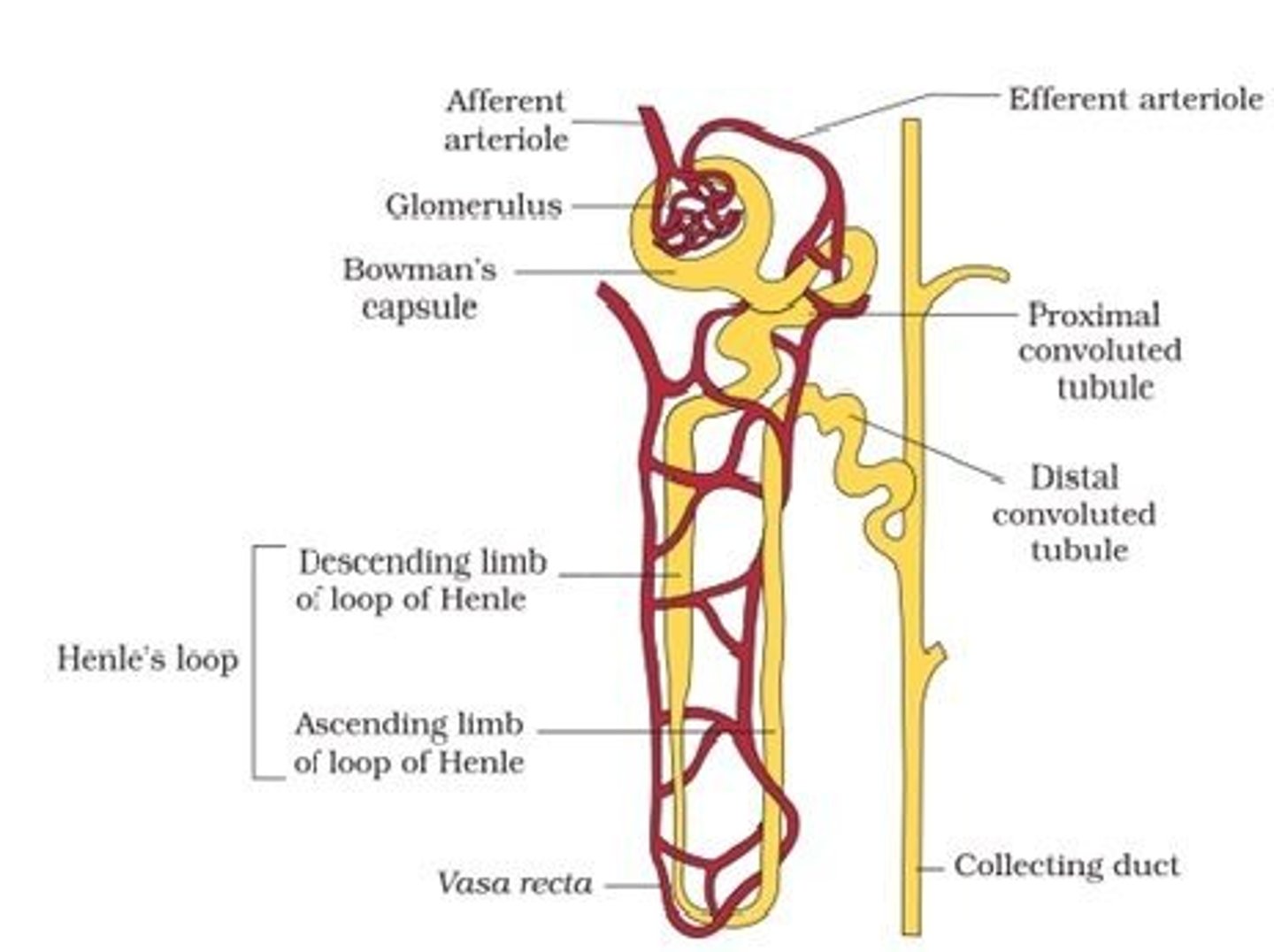
the ascending limb of Henle's loop connects to the distal convoluted tubule (DCT)
After Henle's loop, what part comes next in the renal tubule of a nephron in a human kidney?
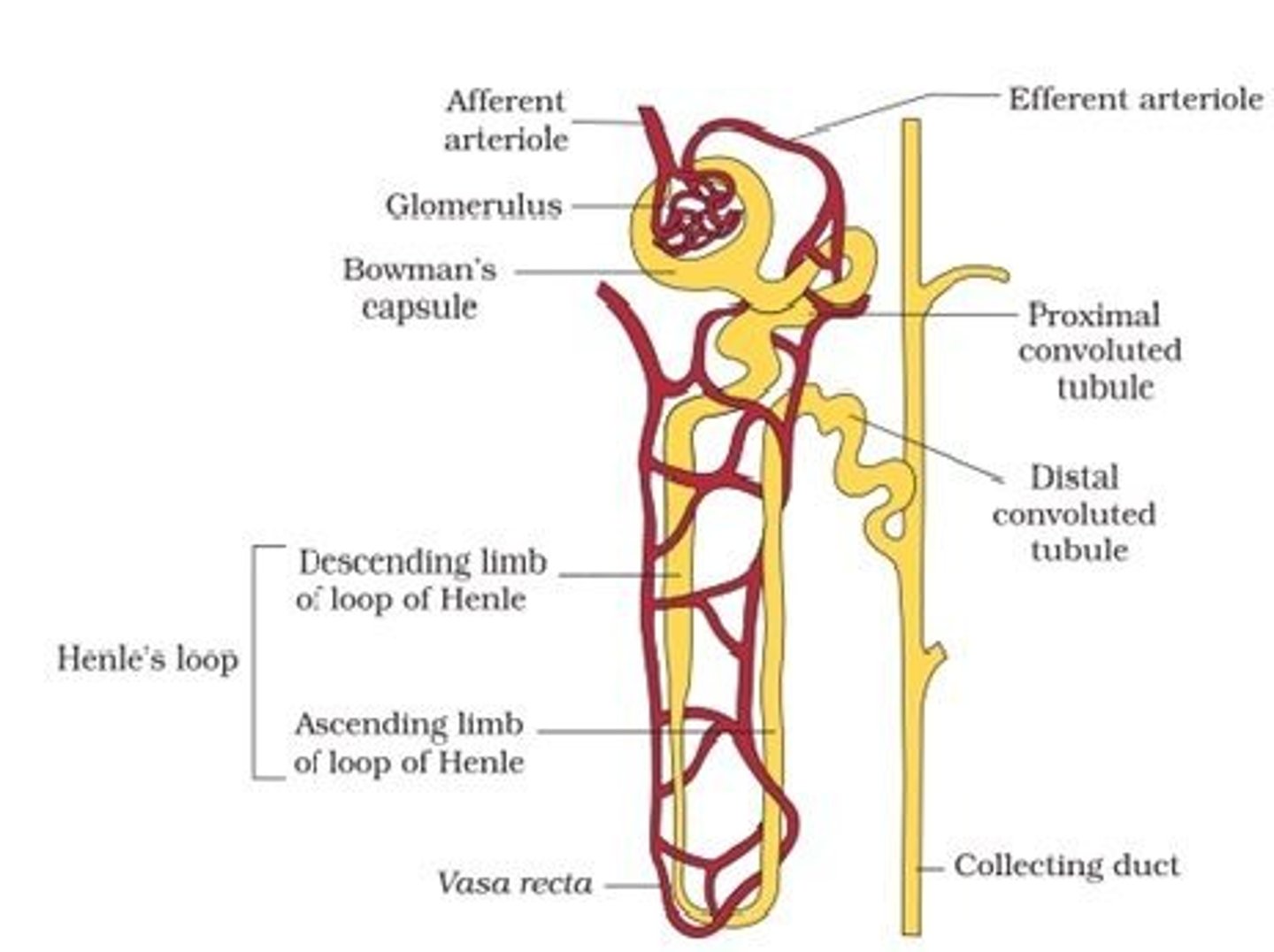
-the part that comes in the renal tubule at the end of the ascending limb of Henle's loop
-it is a highly coiled tubular region
What is the DCT of a nephron in a human kidney?
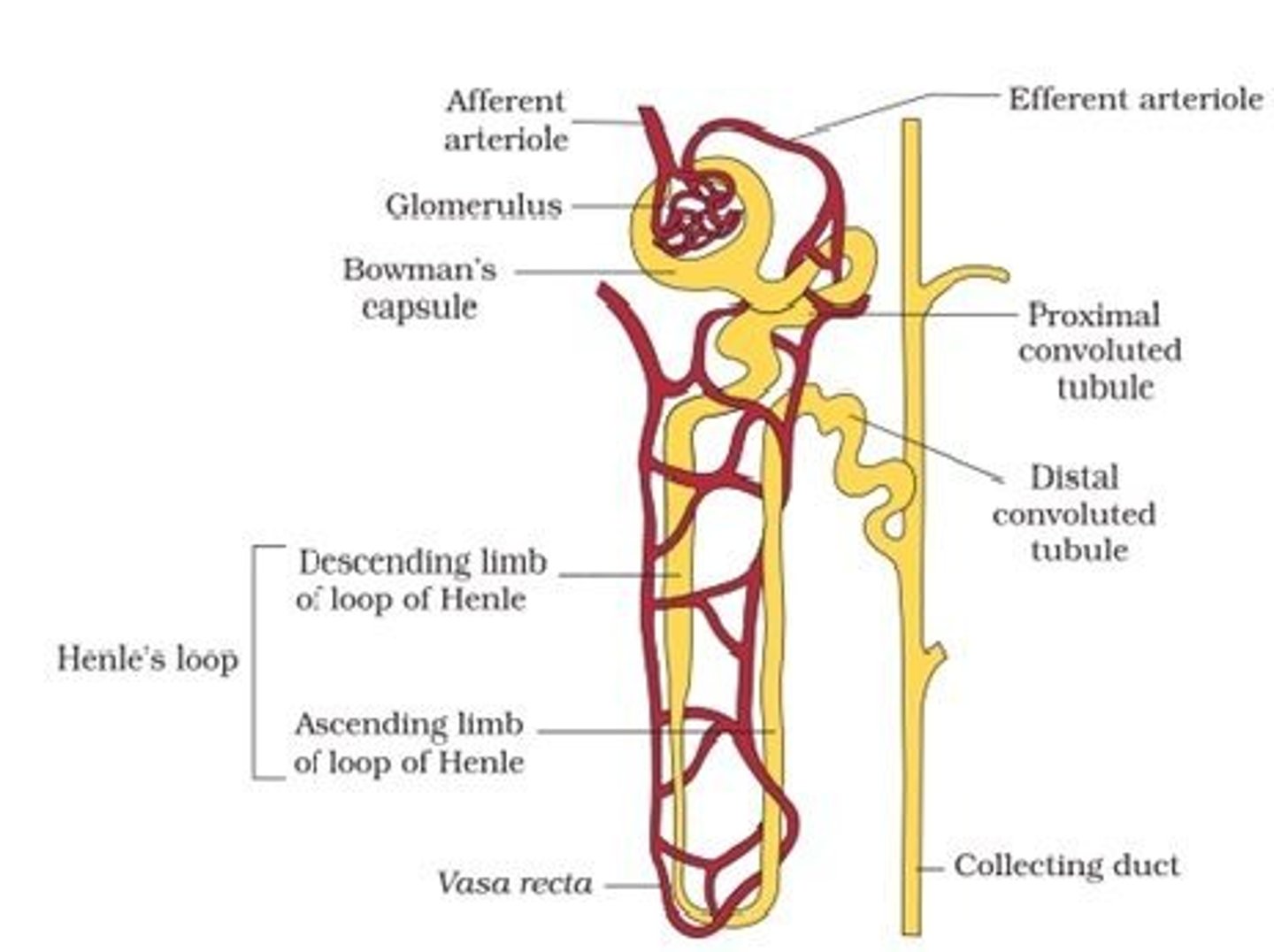
the collecting tubule/duct
The DCT of a nephron in a human kidney connects to what?
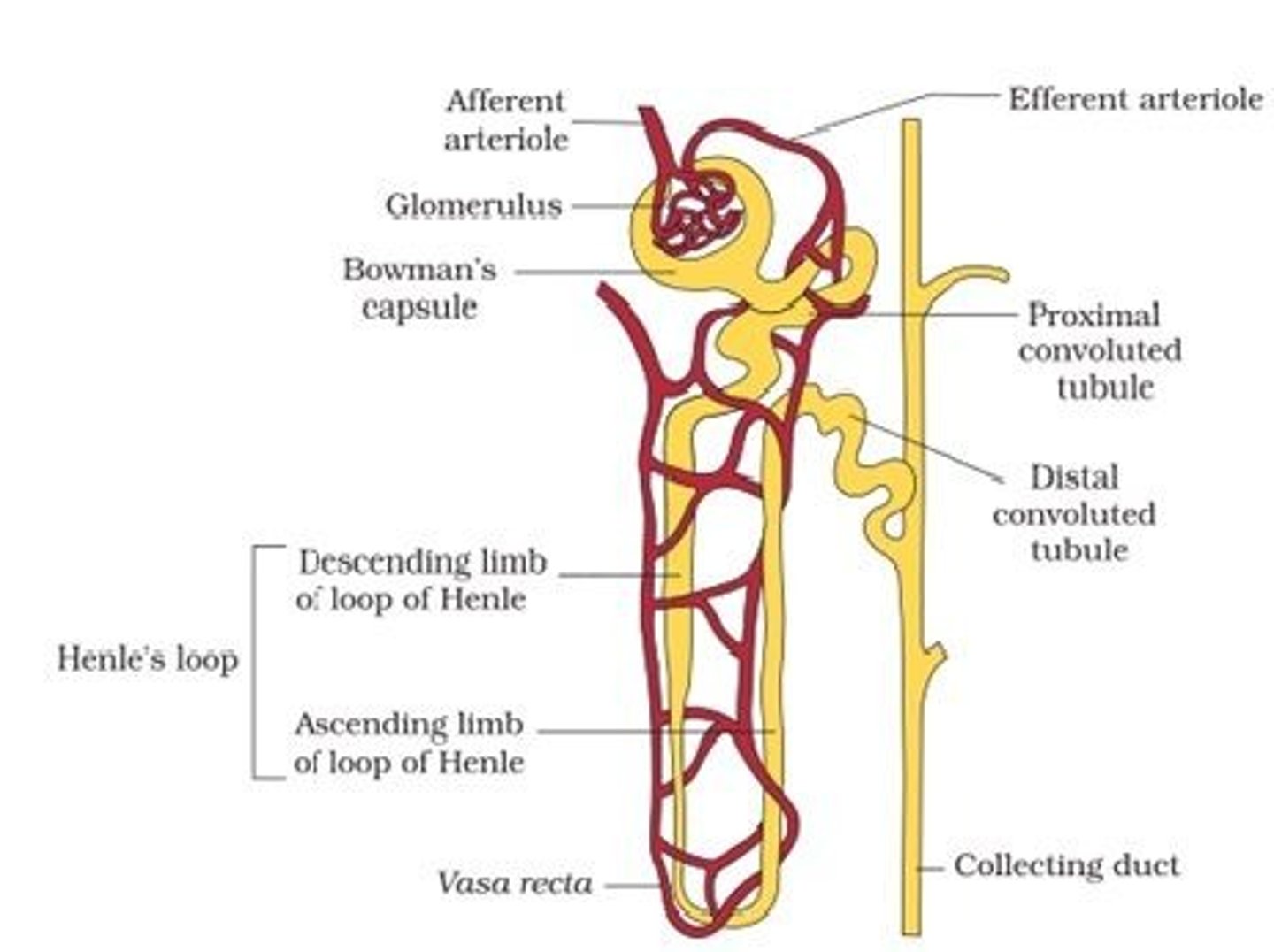
two (since one at the top and one at the bottom)
How many exit points exist per collecting tubule/duct in a nephron of a human kidney?
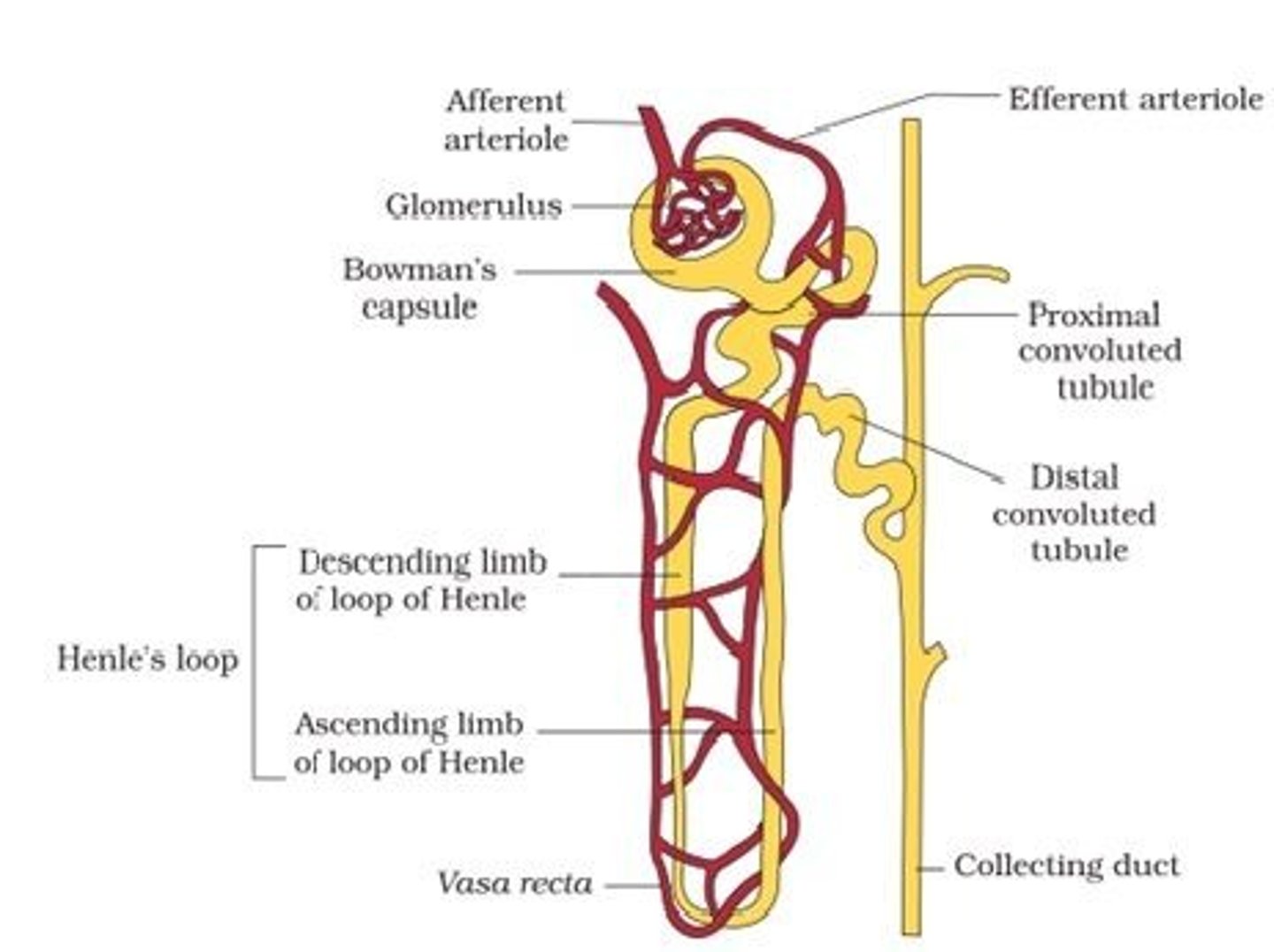
into the renal pelvis, through the medullary pyramids in the calyces (and from here, we connect to the ureters, using which, the urine is transported to the urinary bladder)
The collecting ducts of multiple nephrons converge and open in what part of the kidney?
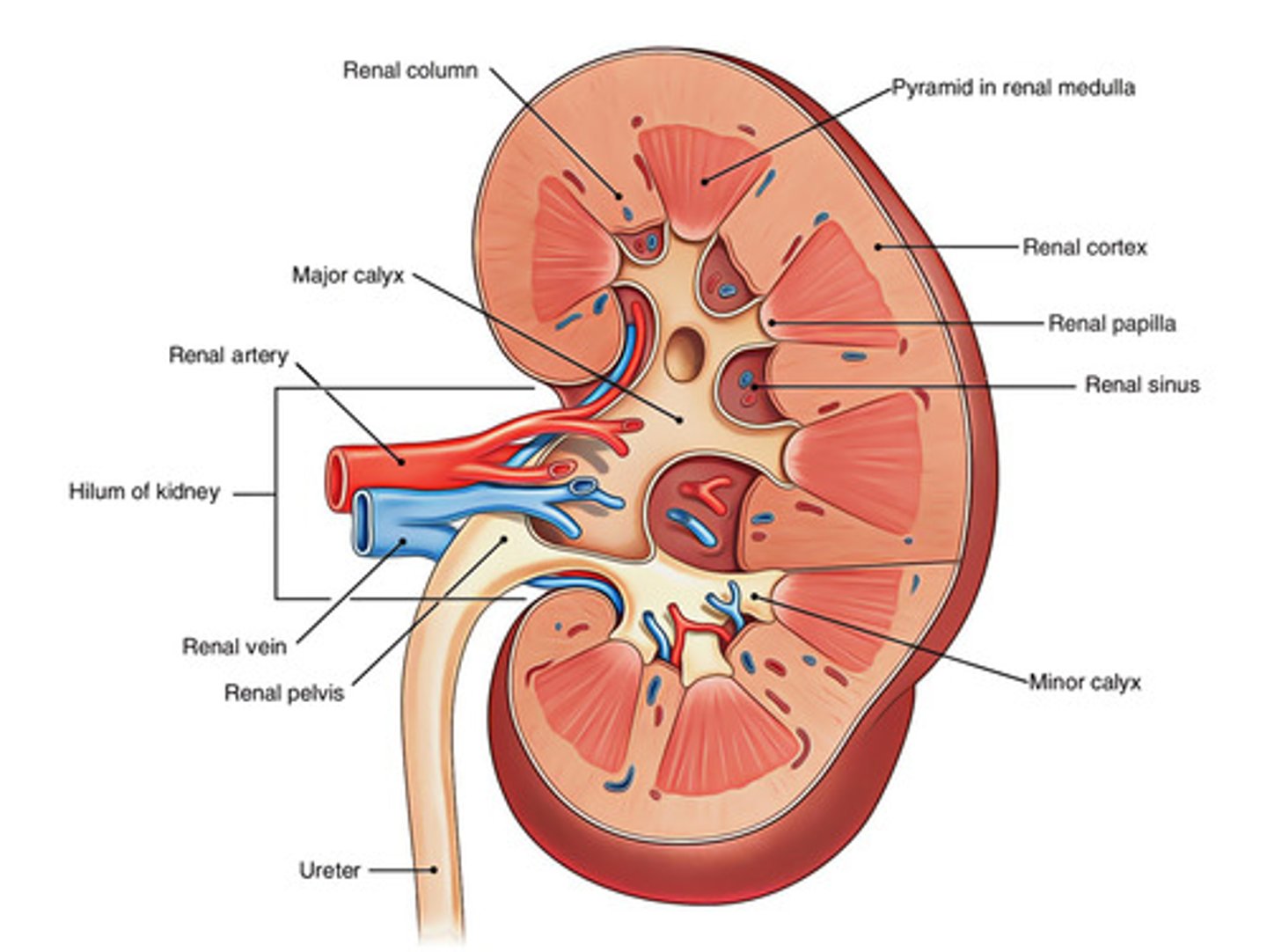
in the cortical region (meaning in the cortex of the kidney)
The malpighian/renal corpuscle (includes glomerulus + bowman's capsule), PCT, and DCT of a nephron in a human kidney, are situated in which region of the kidney?
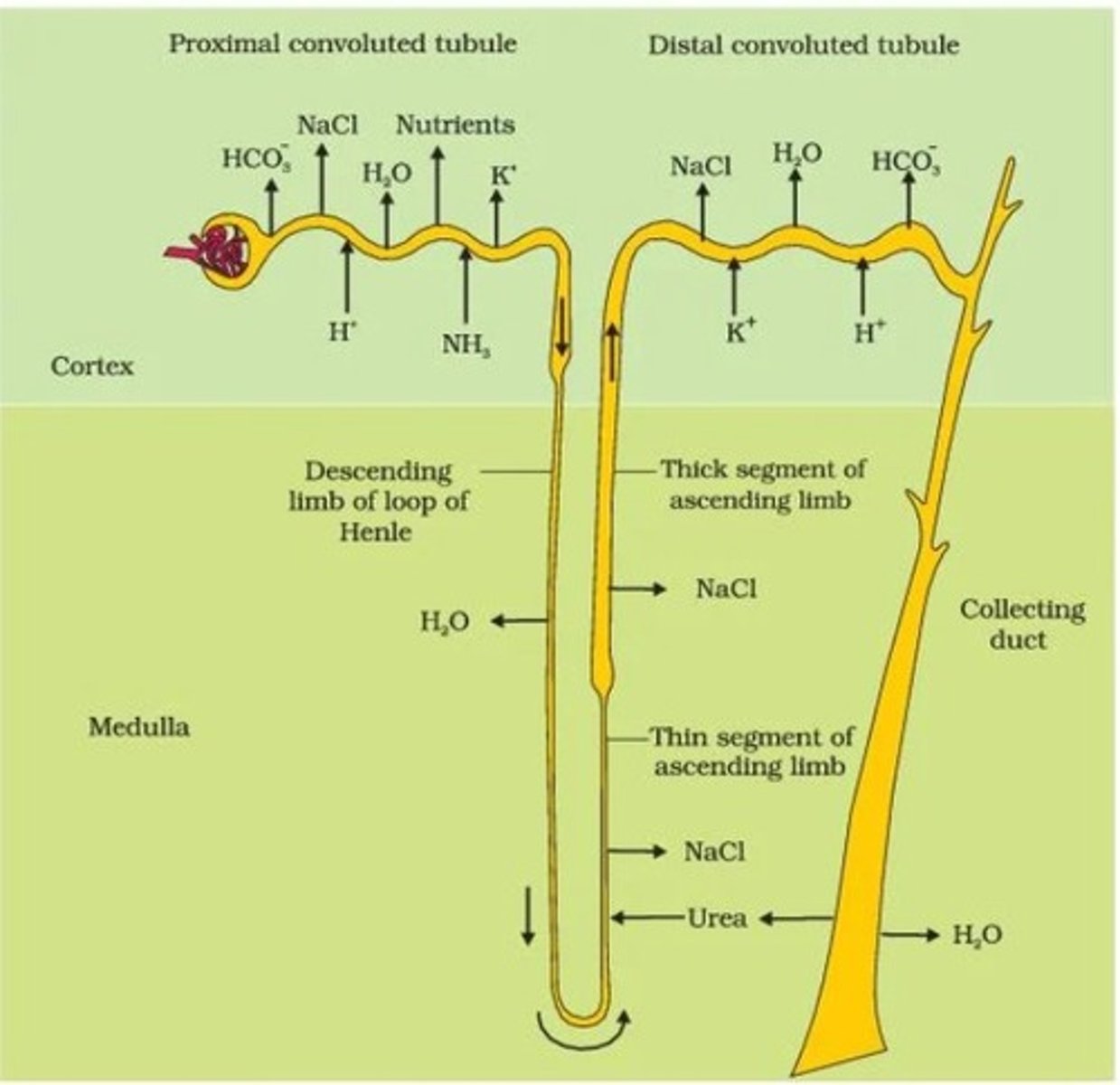
the loop of Henle dips into the medullar region of the kidney (basically, it dips into the medulla)
The loop of Henle of a nephron in a human kidney, is situated in which region of the kidney?
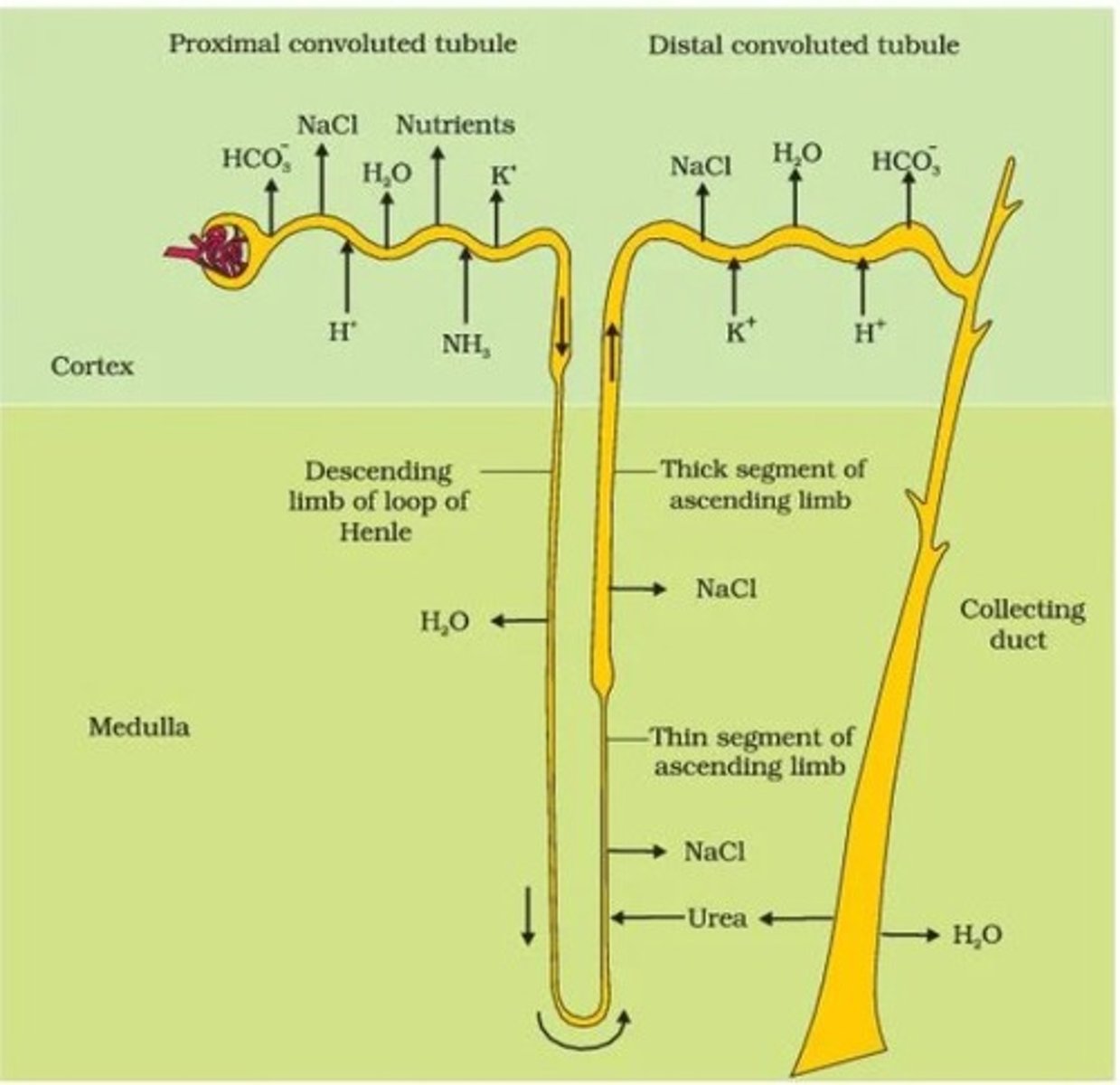
-in a cortical nephron, the loop of Henle is too short and extends only very little into the medulla
-majority of nephrons (85%) in human kidney are of this type
What is a cortical nephron in a human kidney?