Final Vocab BUSML 3250 Piletz- Principles of Marketing OSU
 Call Kai
 Learn
Learn Practice Test
 Spaced Repetition
 Match
Match Flashcards
 Knowt Play
1/158

There's no tags or description
Looks like no tags are added yet.
Name | Mastery | Learn | Test | Matching | Spaced | Call with Kai |
|---|
No analytics yet
Send a link to your students to track their progress
159 Terms
Situation Analysis (5Cs)
1. Company2. Customers3. Collaborators4. Competitors5. Context
Company
A business or association usually formed to manufacture or supply products or services for profit.
Context
the circumstances surrounding a user's interaction with a brand
Customer
someone who pays for goods or services
Competitors
companies in the same industry that sell similar products or services to customers
Collaborators
firms that facilitate or provide one or more of the marketing functions other than buying or selling
SWOT Analysis
a planning tool used to analyze an organization's strengths, weaknesses, opportunities, and threats
Market Research
The activity of gathering information about consumers' needs and preferences.
Primary Research
your own research
Secondary Research
public research others have done
Insights
frustration with a situation led to a personal idea that solves the problem; observations you can make from collected datasets that businesses use to inform their marketing strategy
Segmentation
Involves aggregating prospective buyers into groups, or segments, that (1) have common needs and (2) will respond similarly to a marketing action
Geographic Segementation
based on where prospective customers live or work (region, city size)
Demographic Segmentation
based on some objective physical (gender, race), measurable (age, income), or other classification attribute (birth era, occupation) of prospective customers
Psychographic Segmentation
based on some subjective mental or emotional attributes (personality), aspirations (lifestyle), or needs of prospective customers
Behavioral Segmentation
based on some observable actions or attitudes by prospective customers—such as where they buy, what benefits they seek, how frequently they buy, and why they buy
Targeting
A strategy in which marketers evaluate the attractiveness of each potential segment and decide in which of these groups they will invest resources to try to turn them into customers.
1. size of prize
2. right to win
(market size, expected growth, competitive position, cost of reaching, company compatibility)
Positioning
how you want to be perceived
Positioning Statement
a statement that summarizes company or brand positioning using this form:
For (target market), brand X is the only brand among all (competitive set) that (benefit/unique selling proposition) because (reasons to believe).
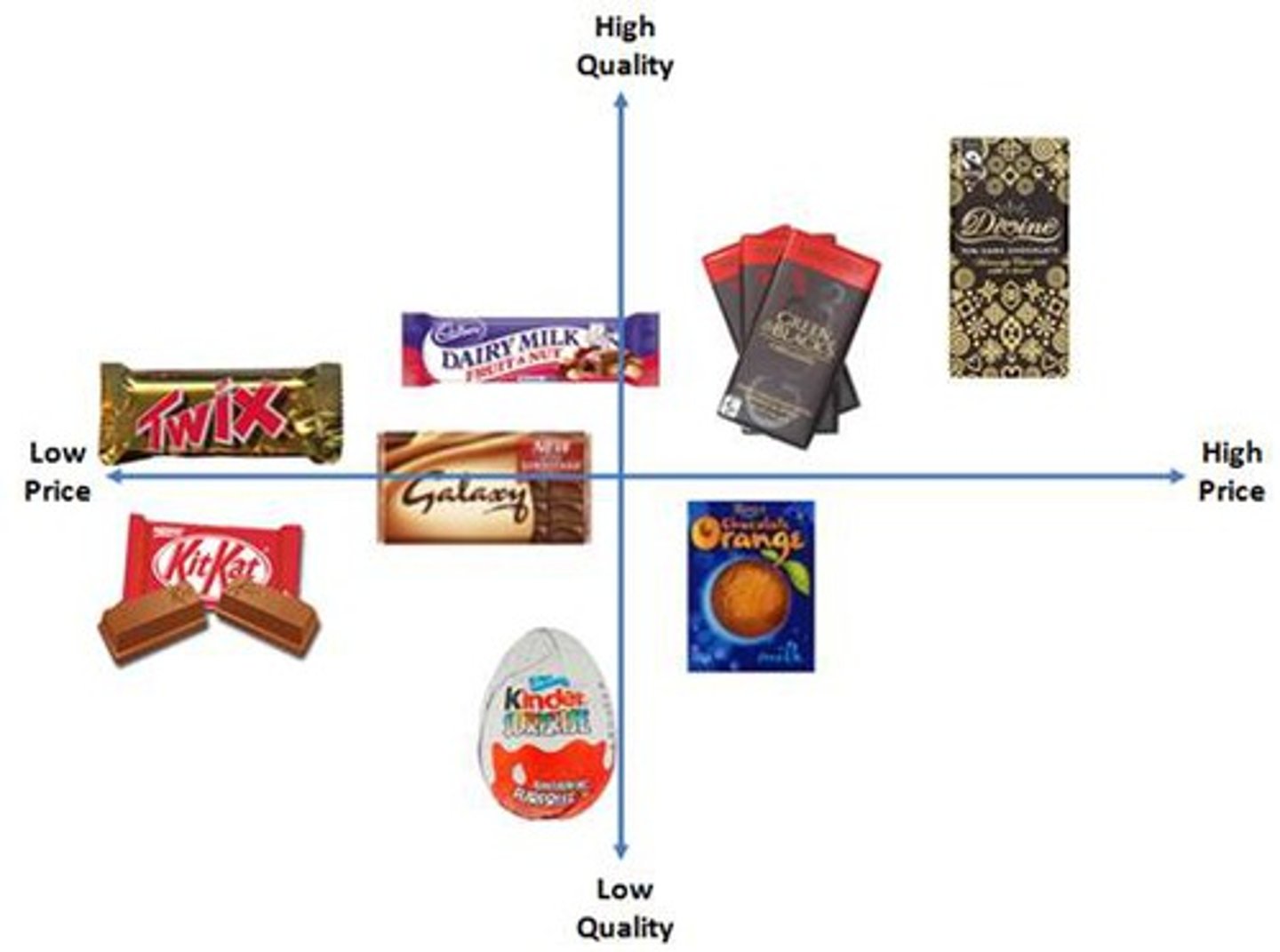
Perceptual Map
a means of displaying in two dimensions the location of products or brands in the minds of consumers to enable a manager to see how they perceive competing products or brands, as well as the firm's own product or brand
Marketing Channel
consists of individuals and firms involved in the process of making a product or service available for use or consumption by consumers or industrial users
Agent or Broker
intermediaries who represent sellers but do not actually take title to products-- their role is to bring a seller and buyer together
Wholesaler
A type of business that buys goods in large amounts and resells them to other businesses in smaller lots.
Transactional Functions
intermediaries perform this when they buy and sell products or services
Logistical Functions
gathering, sorting, and dispersing products
Facilitating Functions
functions of channel intermediaries that make the purchase process easier for customers and manufacturers
Direct Channel
a distribution channel in which producers sell directly to consumers
Indirect Channel
intermediaries are inserted between the producer and consumers and perform numerous channel functions
Direct to Consumer Marketing Channels
allow consumers to buy products by interacting with various print or electronic media without a face-to-face meeting with a salesperson
Multi-channel/Omni-channel Marketing
the blending of different communication and delivery channels that are mutually reinforcing in attracting, retaining and building relationships with consumers who shop and buy in traditional intermediaries and online
Vertical Marketing Systems
professionally managed and centrally coordinated marketing channels designed to achieve channel economies and maximum marketing impact
Corporate Vertical Marketing Systems
the combination of successive stages of production and distribution under a single ownership
Intensive Distribution
a firm tries to place its products and services in as many outlets as possible
Exclusive Distribution
only one retailer in a specified geographical area carries the firm's products
Selective Distribution
a firm selects a few retailers in a specific geographical area to carry its products
Buyer Requirements (four categories)
1. information
2. convenience
3. variety
4. pre- or postsale services
Channel Conflict
arises when one channel member believes another channel member is engaged in behavior that prevents it from achieving its goals
Vertical Conflict
channel conflict that occurs between different levels of the same channel
Disintermediation
when a channel member bypasses another member and sells or buys products direct
Horizontal Conflict
a channel conflict that occurs among channel members on the same level
Channel Captain
a channel member that coordinates, directs, and supports other channel members
Logistics
those activities that focus on getting the right amount of the right products to the right place at the right time at the lowest possible cost
Supply Chain
the various firms involved in performing the activities required to create and deliver a product or service to consumers or industrial users
Supply Chain Management
the integration and organization of information and logistics activities across firms in a supply chain for the purpose of creating and delivering products and services that provide value to consumers
Consumer Utilities
Utilities provided by retailers create value for consumers (time, place, form and possession); Form utility refers to the value of a product's design and features, time utility is the value added by making a product available when customers need it, place utility is the value of making a product accessible where customers want it, and possession utility is the value of transferring ownership to the consumer
Form of Ownership
distinguishes retail outlets based on whether independent retailers, corporate chains, or contractual systems own the outlet
Level of Service
Describes the degree of service provided to the customer from three types of retailers: self-, limited-, and full-service.
Merchandise Line
describes how many different types of products a store carries and in what assortment
Independent Retailer
form of ownership that involves an independent business owned by an individual
Corporate Chain
A form of ownership that involves multiple outlets under common ownership
Franchising
selling to a foreign organization the rights to use a brand name and operating know-how in return for a lump-sum payment and a share of the profits
Self Service
requires that customers perform many functions during the purchase process (gas station, Costco, redbox)
Limited Service
provide some services, such as credit and merchandise return, but not others, such as clothing alterations (Walmart, Target, general merch)
Full Service
provide many services to their customers (Nordstrom, Saks Fifth Ave)
Depth of Product Line
the store carries a large assortment of each item, such as a shoe store that offers running shoes, dress shoes, and children's shoes
Supercenter
combines a typical merchandise store with a full size grocery store
Breadth of Product Line
the variety of different items a store carries
Automatic Vending
the use of machines to dispense products
Direct Mail and Catalogs
"the store that comes to the door"
Television Home Shopping
a form of selling in which products are presented to television viewers, who can buy them by calling a toll-free number and paying with a credit card
Online Retailing
allows consumers to search for, evaluate, and order products through the internet
Telemarketing
using the telephone to sell directly to customers
Direct Selling
selling to consumers in their homes or where they work
Retail Positioning Matrix
A matrix that positions retail outlets on two dimensions: breadth of product line and value added, such as location, product reliability, or prestige.
Retailing Mix
the activities related to managing the store and the merchandise in the store, which includes retail pricing, store location, retail communication, and merchandise
Markup
how much should be added to the cost the retailer paid for a product to reach the final selling price
Markdown
occurs when the product does not sell at the original price and an adjustment is necessary
Everyday Low Pricing (EDLP)
A strategy companies use to emphasize the continuity of their retail prices at a level somewhere between the regular, nonsale price and the deep-discount sale prices their competitors may offer.
Off-Price Retailing
selling brand-name merchandise at lower than regular prices
Retail Image
the way in which the store is defined in the shopper's mind, partly by its functional qualities and partly by an aura of psychological attributes
Shopper Marketing
the use of displays, coupons, product samples, and other brand communications to influence shopping behavior in a store
Category Management
an approach to managing the assortment of merchandise in which a manager is assigned the responsibility for selecting all products that consumers in a market segment might view as substitutes for each other, with the objective of maximizing sales and profits in the category
Retail Life Cycle
the process of growth and decline that retail outlets, like products, experience, consisting of the early growth, accelerated development, maturity, and decline stages
Marketplace
buyers and sellers engage in face-to-face exchange relationships in a material environment characterized by physical facilities and mostly tangible objects
Digital Marketspace
a digitally enabled environment characterized by face-to-screen exchange relationships and electronic images and offerings
Interactive Marketing
Two-way buyer-seller electronic communication in which the buyer controls the kind and amount of information received from the seller.
Choiceboards
An interactive, digitally enabled system that allows individual customers to design their own products and services by answering a few questions and choosing from a menu of product or service attributes (or components), prices, and delivery options.
Personalization
the consumer-initiated practice of generating content on a marketer's website that is custom tailored to an individual's specific needs and preferences
Permission Marketing
The solicitation of a consumer's consent (called "opt-in") to receive e-mail and advertising based on personal data supplied by the consumer.
Customer Experience
the sum total of the interactions that a customer has with a company's website, from the initial look at a home page through the entire purchase decision process
Eight-Second Rule
a view that customers will abandon their efforts to enter and navigate a website if download time exceeds eight seconds
Customerization
the growing practice of not only customizing a product or service but also personalizing the marketing and overall shopping and buying interaction for each customer
Viral Marketing
A digitally enabled promotional strategy that encourages individuals to forward marketer-initiated messages to others via e-mail, social networking websites, and blogs.
Cookies
computer files that a marketer can download onto the computer and mobile phone of an online shopper who visits the marketer's website
Behavioral Targeting
uses information provided by cookies for directing online advertising from marketers to those online shoppers whose behavioral profiles suggest they would be interested in such advertising
Social Commerce
the use of social networks for browsing and buying
Cross-Channel Consumers
online consumers who shop online but buy offline, or shop offline but buy online
Showrooming
the practice of examining products in a store and then buying them online for a cheaper price
Webrooming
the practice of examining products online and then buying them in a store
Marketing Attribution
the practice and techniques used to credit or value a particular channel and consumer touchpoint
Promotional Mix
the combination of one or more of the communication tools used to inform, persuade, or remind prospective buyers
Advertising
any paid form of non-personal presentation and promotion of ideas, goods, or services by an identified sponsor
Personal Selling
The two-way flow of communication between a buyer and a seller that is designed to influence the buyer's purchase decision.
Public Relations
a form of communication management that seeks to influence the feelings, opinions, or beliefs held by customers, prospective customers, stockholders, suppliers, employees, and other publics about a company and its products or services
Sales Promotion
a short-term inducement of value offered to arouse interest in buying a product or service
Direct Marketing
uses direct communication with consumers to generate a response in the form of an order, a request for further information, or a visit to a retail outlet
Product Life Cycle and Promotion Strategy
Introduction—to inform; Growth—to persuade; Maturity—to remind; and Decline—to phase out.
Product Characteristics
The proper blend of elements in the promotional mix also depends on the type of product. Three specific characteristics should be considered: complexity, risk, and ancillary services.
Stages of the Consumer Journey
1. pre-purchase
2. purchase
3. post-purchase
Push Strategy
directing the promotional mix to channel members to gain their cooperation in ordering and stocking the product