response to internal and external environments
 Call Kai
 Learn
Learn Practice Test
 Spaced Repetition
 Match
Match Flashcards
 Knowt Play
1/86

There's no tags or description
Looks like no tags are added yet.
Name | Mastery | Learn | Test | Matching | Spaced | Call with Kai |
|---|
No analytics yet
Send a link to your students to track their progress
87 Terms
What are animals’ (invertebrates) behavioural response?
Innate behaviour, which is inherited and controlled by their genetic makeup
What are the two types of response movement made by animals?
Taxis - directional movement towards (positive) or away (negative) from a directional stimuli
Kinesis - non directional (random) movement in response to a intensity stimuli
How is turning affected in a more unfavourable environment?
Less turning at an increased speed
How is turning affected in a more favourable environment?
More turning at a slower speed
what are two different types of kinesis?
orthokinesis - change in the speed of movement
Klinokinesis - change in the rate of turning
What are the three main stimuli that plants are sensitive too?
Light , moisture and gravity
What are tropisms?
Growth responses to stimuli
What hormone causes these tropisms?
Auxin (IAA)
How do tropisms work?
auxin made in tip and passes down to tip of root
This depends on the distribution of exposure to the stimuli
e.g IAA speeds up cell growth in shots but slows cell growth down in roots
This results in a negative / positive tropism
what is phototropism?
Growth movement in response to light
What is hydrotropism?
Growth movement in response to water
What is geotropism?
Growth movement in response to gravity
How is phototropism measured in plants?
In a clinostat - where plant slowly turns to be exposed to light at all sides
What are the 5 growth factors in plants?
auxin (IAA) → promotes shoot growth due to phototropisms
Ethane → gas released from ripening fruits, stems, ageing leaves and flowers
Gibberellins → regulate growth and influence various development processes e.g germination and flowering
Cytokinins → chemicals that promote cell division
ABA → growth inhibitor
What is a stimulus ?
Change in the internal or external environment
What does a receptor do?
Detect change e.g the chemoreceptors eyes and ears
What does a co ordinator do?
Controls responses e.g brain
What does an effector do?
Brings about the response e.g muscles and glands
What is a response?
The reaction to a stimulus
What are the steps of responding to a stimulus in the central nervous system?
Stimulus
Receptor (sensory neurone)
Relay neurone (co ordinator)
Effector (motor neurone)
Response
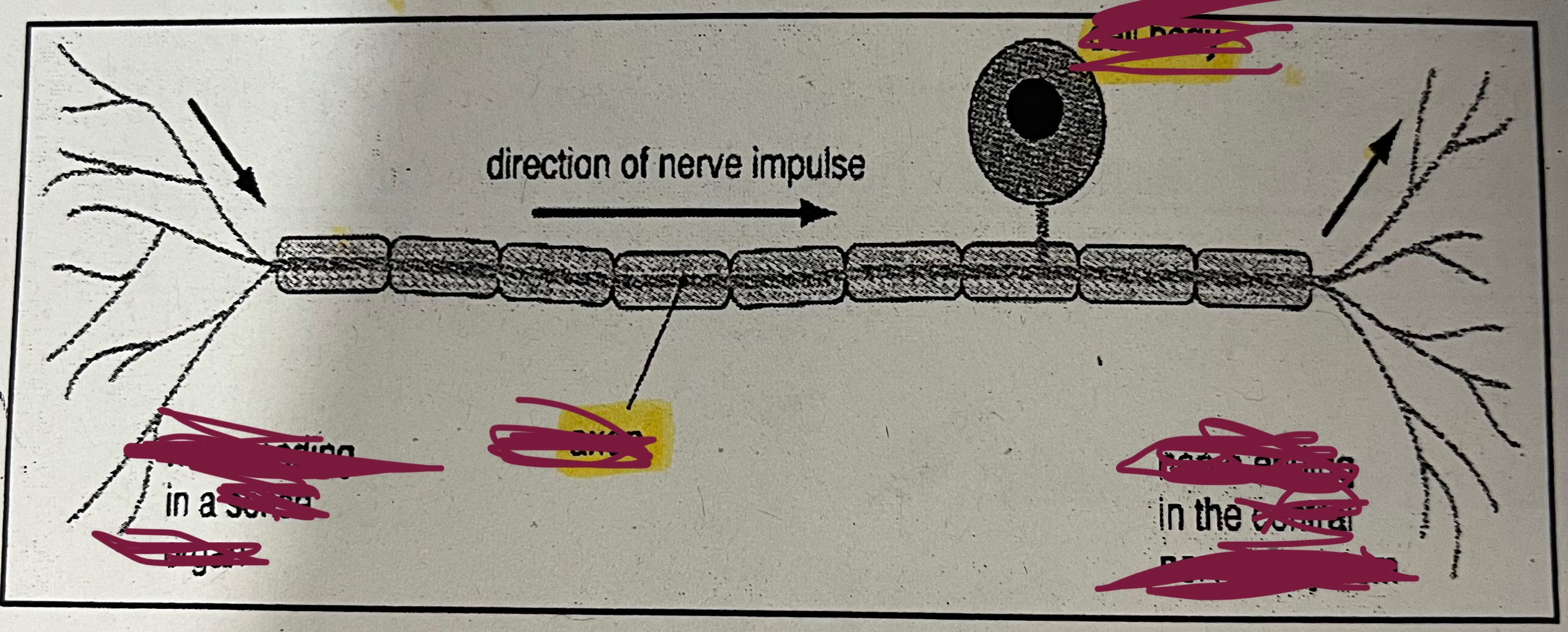
What is the structure of a neurone?

What is the role of the sensory neurone?
Carries electrical impulses from receptor to CNS
What do motor neurones do?
Carry electrical impulses from CNS to effector organ
What do relay neurones do?
Carry electrical impulses between sensory and motor neurons
What do human receptor cells do?
act as transducers converting energy of stimulus into electrical energy, generating a nerve impulse from the sensory neurone to CNS
E.g chemoreceptors , photoreceptors
What are the three different reflex actions?
automatic - without thought
Involuntary - uncontrollable
Stereotyped - protect from harm
What is a hormone?
Steroids or proteins that are chemical messengers
what’s the difference between non steroid and steroid hormones?
non steroid - specific protein receptors on surface of target cells
Steroid - specific protein receptors in the targets cytoplasm and are lipid soluble
What are the differences in nervous and endocrine systems and local chemical mediators?
Nervous
communication by electrical impulses
Response is fast and short lived
Endocrine
communication by chemical messengers (hormones)
Responses are slower and often long lasting
Mediators
communication by chemicals
Resonse quicker than hormones and lasts as long as the chemical is secreted
how does the skin respond to mechanical, thermal and chemical stimuli?
Sensory receptors transform mechanical, thermal and chemical energy into impulses that travel to the brain
What receptor responds to mechanical stimuli in the skin?
Pacinian corpsucles
How are each Pacinian corpsucles structured?
Myelin sheath connects to a nerve fibre which is surrounded by concentric layers of lamellae
the lamellae is separated by gel
How do Pacinian corpsucles respond to stimuli e.g pressure?
sodium channels open allowing Na+ to diffuse in by facilitated diffusion
This creates a nerve impulse
these charged ions moving into the channels creates a generator potential (inside of nerve becomes less negative than the outside)
What is the role of the sclera, fovea, retina, iris, and chloroid in the eye?
sclera → outer layer of eye that maintains shape
Fovea → has great density of photoreceptors
Iris → controls the amount of light entering the eye by contracting to prevent light from entering and damaging cells in the eye
Chloroid → contains blood vessels that supply the retina, and black pigments to prevent reflection
What wavelengths of light is the human eye sensitive to?
360-780nm is the visible spectrum
What are the two types of human photoreceptors?
Rods and cones
How are rods and cones different?
Rods have a rod shape end section containing rhodopsin pigment
Cones have cone shaped end section containing iodospin pigment
How do photoreceptors work?
light enters eye and hits the photoreceptors
Light absorbed by the pigments, causing them to become bleached
This leads to a chemical change, altering the permeability of the cell membrane to sodium ions
This creates a generator potential, leading to nerve impulses being send along a bipolar neurone if the threshold potential is reached
This neurone connects the photoreceptors to the optical nerve, which takes impulses to the brain
What is visual acuity?
(Resolution) the ability to tell apart points that are very close together
What is visual acuity like in rods and cones?
Rods → low visual acuity as there are many rods joined to the same bipolar neurone → produced black and white image with fuzzy edge in little light
Cones → high visual acuity because only one cone joins to one bipolar neurone → produces coloured and sharp images in bright light
What is the trichromatic theory of colour vision?
each of the three types of cone (red, green and blue) have different sensitivities to light, but the ranges of sensitivities overlap, meaning wavelengths stimulate at least 2 types of cones
If all three are stimulated, impulses are interpreted as white light
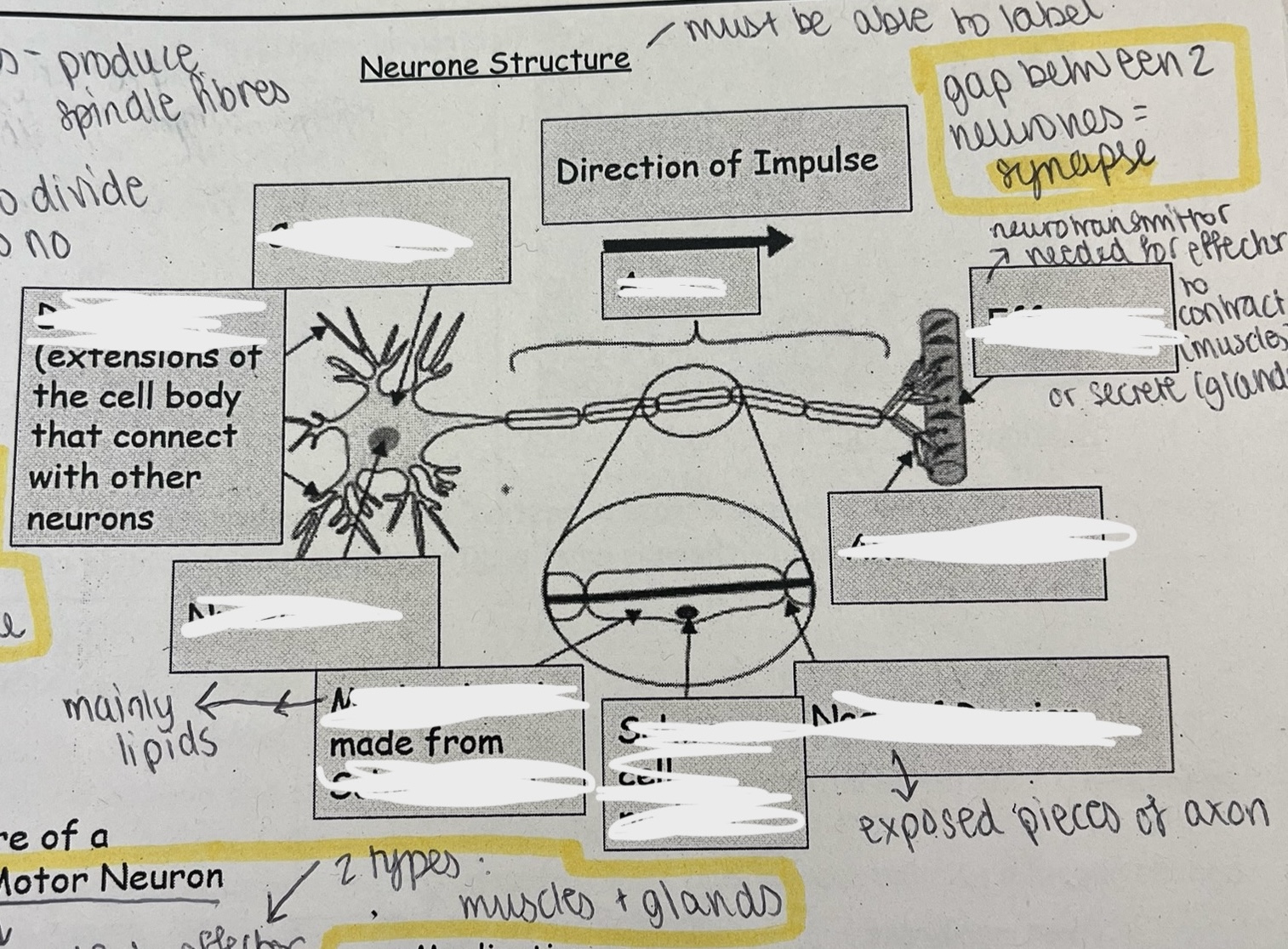
What is the structure of a neurone?

What is the term for the gap between two neurones?
The synapse
What is meant by a myelinated neurone?
neurones that have an insulating cover from the myelin sheath
The myelin sheath is made up of Schwann cell phospholipid membranes
This prevents the movement of water soluble charged ions from entering by facilitated diffusion
What is meant by resting potential?
The difference in charge across a resting neurone membrane (when there is a net positive charge on the outside (high cons of sodium ions) compared to the inside (high conc of potassium ions))
What two mechanisms maintain the potential difference?
sodium-potassium pumps by active transport
Differential permeability by facilitated diffusion
How does the sodium potassium pump work?
Using ATP every turn
The pump moves 3 sodium ions out and 2 potassium ions in via active transport for every turn
This caused the inside of the membrane to become negatively charged compared to the outside
How does differential permeability work?
sodium and potassium ions move by facilitated diffusion through axon membrane using their own specific channel proteins
Axons membranes contain more potassium than sodium channels, meaning more potassium ions move out than sodium ions in
Therefore the inside of the membrane becomes negatively charged in comparison to the inside
What is the generator potential?
detected stimulus causes the excitement of the cell membrane, making it become more permeable
So, more ions move in and out
This changed the potential difference
What is meant by the all or nothing nature of the action potential?
If the generator potential is large enough, it will trigger an action potential if the generator potential reaches the threshold level
What is depolarisation?
impulse passing along an axon causes the resting potential to be momentarily reversed
Causing a sudden change in the inside becoming positive compared the outside (depolarisation of the membrane)
This happens because sodium channels open, allowing sodium to enter the axon
What is repolarisation?
depolarisation leaves the action potential to be 40mV
This caused the sodium channels open to close and potassium channels to open, causing potassium to diffuse out
When the inside returns to resting potential of -70mV, potassium channels close
In summary, what is the 7 stages of the transmission of impulses?
Resting potential of -70mV
Depolarisation → neurone stimulated, causing sodium channels to open, allowing sodium to diffuse in to axon
Depolarisation → inside of membrane becomes more positive than the outside and localised electrical current created which moved the impulse along the axon
Repolarisation → action potential reaches 40mV, causing potassium channels to open
Repolarisation → potassium leaves axon and inside of membrane becomes less negative than outside
Refraction period → potassium channels close, but slower than the sodium channels once the impulse has passed
Axon membrane returns to resting potential of -70mV from the action of sodium potassium pump and differential permeability

What is summation?
Post synaptic neurones receive impulses from pre synaptic cells
the neurones response depends on the sum of all the potentials it recieves
What is spatial summation?
neurotransmitter is released, diffusing into the synapse and binding to receptors on the postsynaptic neurone
Caused sodium channels to open, creating an action potential
What is temporal summation?
One impulse arrives when there is only a small amount of neurotransmitter in the synaptic cleft
Causes post synaptic knob to depolarise, but threshold value is not reached so no action potential is sent along postsynaptic neurone
What factors affect the speed of nervous transmission?
mylenation
Axon diameter
Temperature
What is myelination?
myelin sheath provides insulated on neurones due to it being made up of Shawn cells, which are phospholipid membranes
This speeds up nervous transmission
How does myelination speed up nervous transmission?
there are nodes of ranvier inbetween Schwann cells, where sodium ion channels are concentrated
Depolarisation happens at the nodes, where the neuron conducts electrical charge to depolarise the next node
Allows the impulse to jump from node to node (saltatory conducition)
How does the diameter of the axon determine speed?
greater the diameter, the faster the speed
Myelinated axons conducts faster than non myelinated
How does the temperature of the axon determine speed?
higher the temp, the more kinetic energy, the faster the conductions
Too high temperature causes enzymes to denature so no impulses are conducted
How do inhibitory drugs impact nervous transmission?
they block the receptor site on the postsynaptic membrane, or blocking the release of neurotransmitters
This prevents depolarisation
E.g atropine competing with acetylcholine
How do excitatory drugs impact nervous transmission?
bind to receptor site to mimic the transmitter
Caused more frequent depolarisation
E.g nicotine mimics acetylcholine, increasing the effect of dopamine
How is heart beats controlled?
Impulses produced by sino-atrial node (SAN) conducted through atria, stimulating atria to contract (atrial systole)
Impulses stimulate AV node at base of atria
Impulses from AV node pass down the bundle of His, which are fibres that seperate into the left and right ventricles
These fibres spread through the walls at the base of the ventricles
Purkinje fibres carry impulses up through the walls of the ventricles
Impulses from purkinje fibres cause beneficial muscles to contract from base upwards (ventricular systole)
What is the role of baroreceptors and chemoreceptors?
baroreceptors detect change in blood pressure
Chemoreceptors detect chemical changes in the blood
How do blood pressure stimuli detected by baroreceptors cause increased or decreased heart rate?
baroreceptors detect high pressure → impulses sent to medulla → impulses sent along parasympathetic neurone → acetylcholine secreted, which binds to SAN receptors → heart rate slows down to reduce blood pressure
Baroreceptors detect low blood pressure → impulses sent to medulla → impulses sent along sympathetic neurone → noradrenaline secreted, which binds to SAN receptors → heart rate speeds up to incredible blood pressure
How do blood o2, co2, or pH levels stimuli detected by chemoreceptors cause increased or decreased heart rate?
high blood o2, low co2, high pH detected by chemoreceptors → impulses sent to medulla → impulses sent along parasympathetic neurone → acetylcholine secreted, which binds to SAN receptors → heart rate decreased to return levels to normal
Low blood o2, high co2, low pH detected by chemoreceptors→ impulses sent to medulla → impulses sent along sympathetic neurones → noradrenaline secreted, which binds to SAN receptors → heart rate increased to return levels back to normal
What are the three types of muscles?
smooth muscle → contracts without conscious control → found in walls of internal organs
Cardiac muscle → contracts without conscious control → found in heart
Skeletal muscle → is a voluntary muscle → e.g biceps and triceps to move lower arm
What can muscles do and can’t do?
Can pull, cannot push
How do you straighten the arm?
tricep contracts
Bicep relaxes
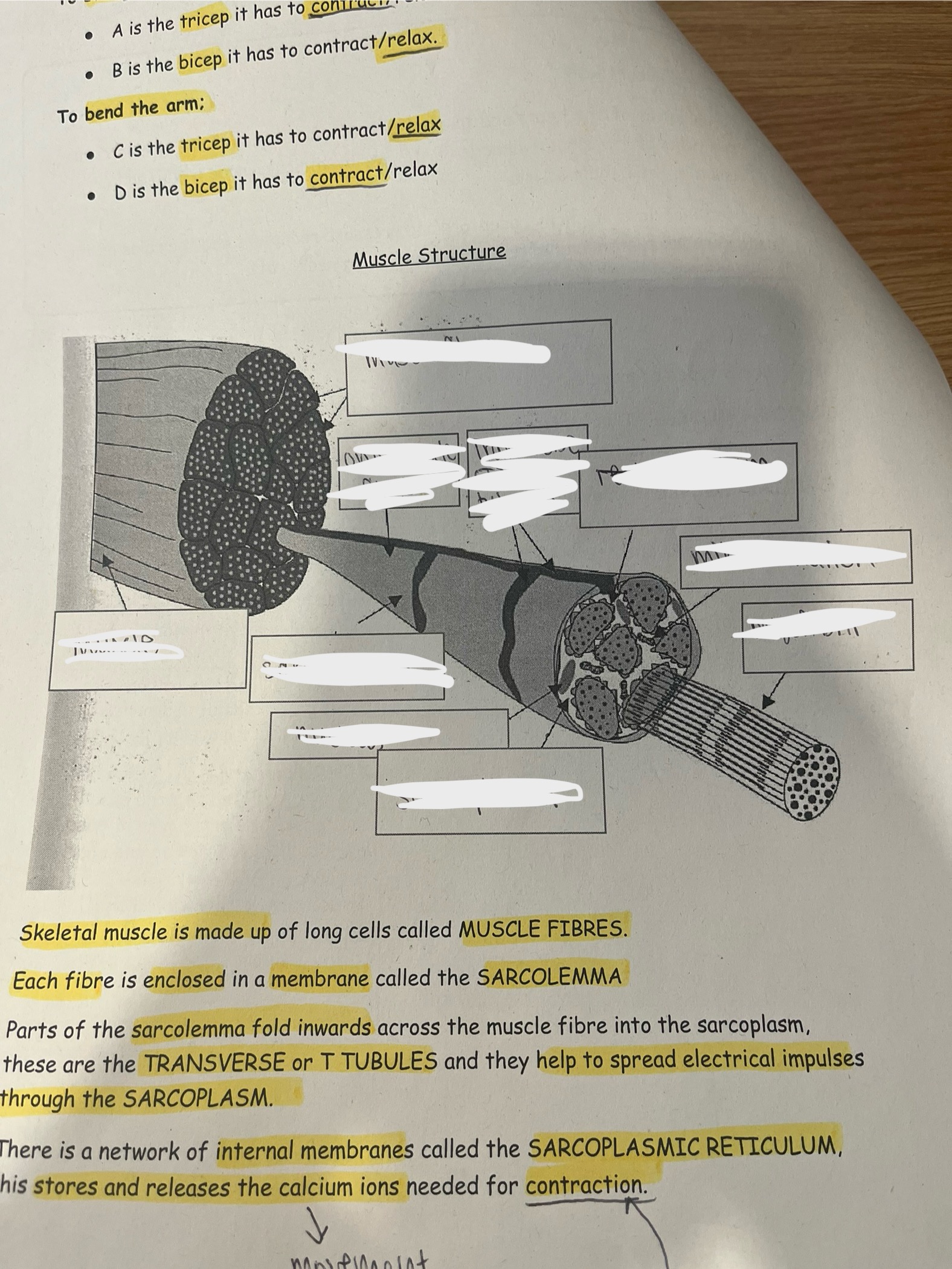
What is the structure of a skeletal muscle?
skeletal muscle made up of muscle fibres, which contain many nuclei and have many organelles called myofibrils
Each muscle fibre enclosed in sarcolemma
Sarcolemma folds inwards into the sarcoplasm, forming T tubules which help spread electrical impulses through the sarcoplasm
Internal membranes called sarcoplasmic reticulum, which stores and releases calcium ions needed for contraction
Are many mitochondria in muscle fibres to provide ATP

What makes up myofibrils?
Bundles of thick and thin myofilaments, which move past each other to make muscles contract as well of many short units called sacromeres
What are the thick and thin myofilaments made up of??
Thick - protein myosin
Thin - protein actin
How are sacromeres structured?
ends → marked with Z line
Middle of myosin filaments → marked with M line
H zone → contains only myosin filaments
I bands → are two in each sacromere, composed of actin and shortens during contraction
A band → full length of the myosin filaments
What is myosin?
Singular → A filamentous tertiary structure protein molecule with a long tail and a specifically shaped head
Many → tails are intertwined with heads sticking up at 360 degrees so they can bind to actin
What is actin?
The sites myosin binds to
What two proteins are between the actin and what do they do?
troponin (calcium receptor) and tropomyosin
These help myofilaments move past each other
What is the sliding filament theory?
explains muscle contraction
Myosin binds to actin, allowing the two proteins to move past each other
This creates an action potential, which depolarises the sarcolemma
The depolarisation travels down the t tubules and to the sarcoplasmic reticulum, releasing calcium ions, which triggers muscle contraction
Calcium ions bind to troponin, pulling the tropomyosin out of the actin-myosin binding site, which allows the myosin head to bind to an actin filament called an actin-myosin cross bridge
Calcium ions also active ATPase, which hydrolyses ATP into ADP+Pi, providing the energy needed for contraction by moving the myosin head to the side, which pulls the actin filament along
ATP hydrolysis also breaks the actin-myosin cross bridge, causing the myosin head to detach from the actin filament, the head then reattaches to a diff binding site on the actin filament
Why is calcium ions so important for the sliding filament theory?
Because without stimulation, the calcium ions moved by active transport back to the sarcoplasmic reticulum and the troponin returns to its original shape and the sacromeres return to their original length
How does neuromuscular junction work?
ACH binds, causing the gate sodium channels to open and the sarcolemma to become depolarised
This leads to the action potential travelling along the sarcolemma and into a t tubule
This carries the action potential into fibre
The action potential makes sarcoplasmic reticulum release calcium ions, which triggers muscle contraction
What three ways is ATP generated to be used for muscle contraction?
Aerobic respiration
Anaerobic respiration
ATP-PCr - ATP-Phosphocreatine system
How does aerobic respiration generate ATP?
mitochondria generates the vast majority of the ATP by oxidative phosphorylation
To work, this needs sufficient oxygen
The ATP produced by this is good for long periods of low intensity exercise e.g a long walk
How does anaerobic respiration generate ATP?
ATP made rapidly during glycolysis, which produces pyruvate
Pyruvate converted into lactic acid, which can quickly build up in muscles causing muscle fatigue (cramps)
The ATP produced by this is good for short periods of hard exercise e.g a sprint
How does ATP-PCr - ATP-Phosphocreatine system generate ATP?
ATP made by phosphorylation of ADP when the phosphate group is taken from creatine
This is catalysed by creatine kinase
PCr is stored inside cells, which generates ATP quickly
This production of ATP is good for short bursts of vigorous exercise e.g tennis serve
Positives → no oxygen needed
Negatives → affected by metabolic rate (slows with age)
What are the two types of muscle fibres?
Slow twitch and fast twitch
What are slow twitch muscle fibres like?
contracts half the speed of fast twitch
Can work for a long time without getting tired
Contain many more mitochondria and blood vessels than fast twitch
Produces ATP mainly through aerobic respiration
Are rich in myoglobin so are red in colour and can store lots of oxygen
Mainly used whilst jogging, walking and maintaining posture
What are fast twitch muscle fibres like?
contract very rapidly
Get tired fast
Produce ATP very quickly through anaerobic respiration of glycogen using stores of PCR
have few mitochondria and blood vessels
Have little myoglobin so cannot store much oxygen and are whitish in colour
Mainly used for sprinting and jumping