Evolution Rehbit 4/22
 Call Kai
 Learn
Learn Practice Test
 Spaced Repetition
 Match
Match Flashcards
 Knowt Play
1/28

There's no tags or description
Looks like no tags are added yet.
Name | Mastery | Learn | Test | Matching | Spaced | Call with Kai |
|---|
No analytics yet
Send a link to your students to track their progress
29 Terms
Jean-Baptiste Lamarck (1744-1829)
Concluded more complex organisms descended from less complex organisms
Evolution
A change in a species over time
Two Wrong Ideas About Evolution
Use and Disuse- if you don’t use a part, you lose it. The parts you use the most get stronger.
Inheritance of Acquired Traits- the characteristics acquired by an organism during its lifespan are passed onto its offspring. Ex. if a person has an arm amputated then her children will not have arms
Experiment Disproving Lamarck’s Theory
In late 1800s by August Weismann
Cut off the tails of mice
Mated the tailless mice
Many generations
The offspring of the tailless mice were always born with normal length tails
Acquired traits are not inherited by offspring
Charles Darwin (1809-1882)
Proposed the theory of natural selection (mechanism of evolution) and was interested in how variation between members of a species provided adaptations unique to the environment
Overproduction in Natural Selection
Organisms produce more offspring than can possibly survive. (Darwin drew ideas from economist Thomas Malthus). Reasoned that the environment limits the populations of all organisms by causing deaths or limiting births.
Genetic Variation in Natural Selection
Many differences are found among individuals of a species due to meiosis and genetic inheritance
Competition in Natural Selection
Some variations provide “adaptations” (traits that help an organism to survive). They will compete with one another for survival.
Differential Reproduction in Natural Selection
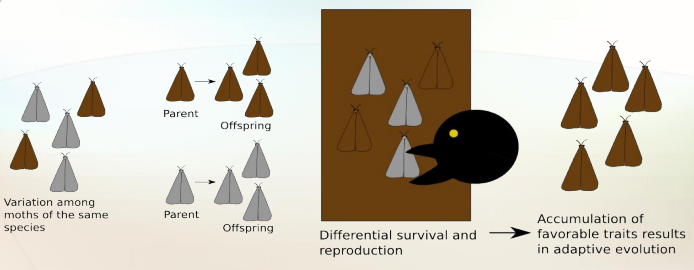
Organisms with the best adaptations are most likely to survive and reproduce. Overtime, these adaptations will become more and more frequent in the population. Populations (group of individuals of the same species) may begin to differ as they become adapted to different environments.
How does evolution occur?
Overproduction —> Competition —> Survival of the fittest (organism with best adaptation for current environment) —> Natural Selection —> Reproduction
Adaptation (does not equal adapt)
Inherited traits that increases the chance of survival (not always “visible”)
Sources of Adaptation
Random Mutations
Due to radiation, chemicals, pesticides, pollution, mistakes in DNA Replication, viruses, etc.
Occur in both Asexually and Sexually Reproducing Populations
Events specific to Sexual Reproduction:
Crossing-over of homologous chromosomes (meiosis)
Independent assortment of chromosomes (meiosis)
Random fertilization
Did Darwin know the source of these variations?
NO! He did not know about DNA or genes
Structural Adaptations
Physical appearance
Large ears
Thorns
Behavioral Adaptations
Control how an organism acts
Hibernation
Blooming only at night
Physiological Adaptations
Based on body chemistry and metabolism; usually don’t show
Toxins in plants
Desert animals have efficient kidneys
Inherited Behavioral Adaptations
Migration
Hibernation
Being Nocturnal
Defensive behaviors
Mating or courtship behaviors

Learned Behavioral Adaptations
How to find food
Making a shelter
How to communicate
How to get along in a group
Looking out for predators
Individual Behaviors
Courtship
Hibernation
Mating
Group Behaviors
Flocking
Schooling
Herding
Team hunting
Migrating
Swarming
Cause for Natural Selection
Environment
Cause for Artificial Selection
Humans
Speed of change of Natural Selection
Slow
Speed of change for Artificial Selection
Fast
Reason for Natural Selection
The selected trait improves the organism’s chances of surviving and reproducing
Reason for Artificial Selection
The trait is desirable to human breeders
Effect of Natural Selection on fitness
Improves fitness (although only for the circumstances in which it is selected. If conditions change, (driving force for evolution) the selected trait may no longer be advantageous.)
Effect of Artificial Selection on fitness
Often causes decrease in fitness
ex. wolf —> dog