MICRO- Biology of the Genome
 Call Kai
 Learn
Learn Practice Test
 Spaced Repetition
 Match
Match Flashcards
 Knowt Play
1/16

There's no tags or description
Looks like no tags are added yet.
Name | Mastery | Learn | Test | Matching | Spaced | Call with Kai |
|---|
No analytics yet
Send a link to your students to track their progress
17 Terms
Twins
family share some genes with each other and with each parent. identical twins are genetically identical. bacteria may acquire genes encoding virulence factors, converting them into pathogenic strains, like E.coli
genotype- sequence of DNA
phenotype- outside characteristics
Gregor Mendel
crossed pea plants
idea of dominant alleles
Punnet squares
cell alga have cell morphology that can be observed.
cap, stalk, foot (nucleus)
removed cap, new cap regenerate
remove foot, new foot no regenerate
Two morph different species
Foot determines gene expression even if grafted new
Griffiths work on transformation
transformation, transduction, and conjugation
rough strain (no capsule) and smooth strain (capsulated)
take rough and put it into animal, animal lives
take smooth and put it into animal, animal dies
Take smooth strain and kill with heat, put into animal, animal lives
take living strain (no death) mix with heat killed strain, put into animal, animal dies
autopsy: find living with capsules on it
Transformation
chromosome fragments from a lysed cell are accepted by recipient cell; genetic code of DNA fragment acquired by recipient
donor and recipient cells can be unrelated
Transduction: Martha Chase and Alfred Hershey
batch of phage incorporated into DNA, another batch incorporated into protein coat
bacteria infected with phage. researchers were looking to id if viral DNA or viral protein entered host cell
cultures blended and centrifuged to separate phage from bacteria. centrifuge separated lighter phage particles from heavier bacterial cells
bacteria infected with first labeled DNA produced same phage. Bacteria infected with second phage produced unlabeled phage
Gives DNA in cell
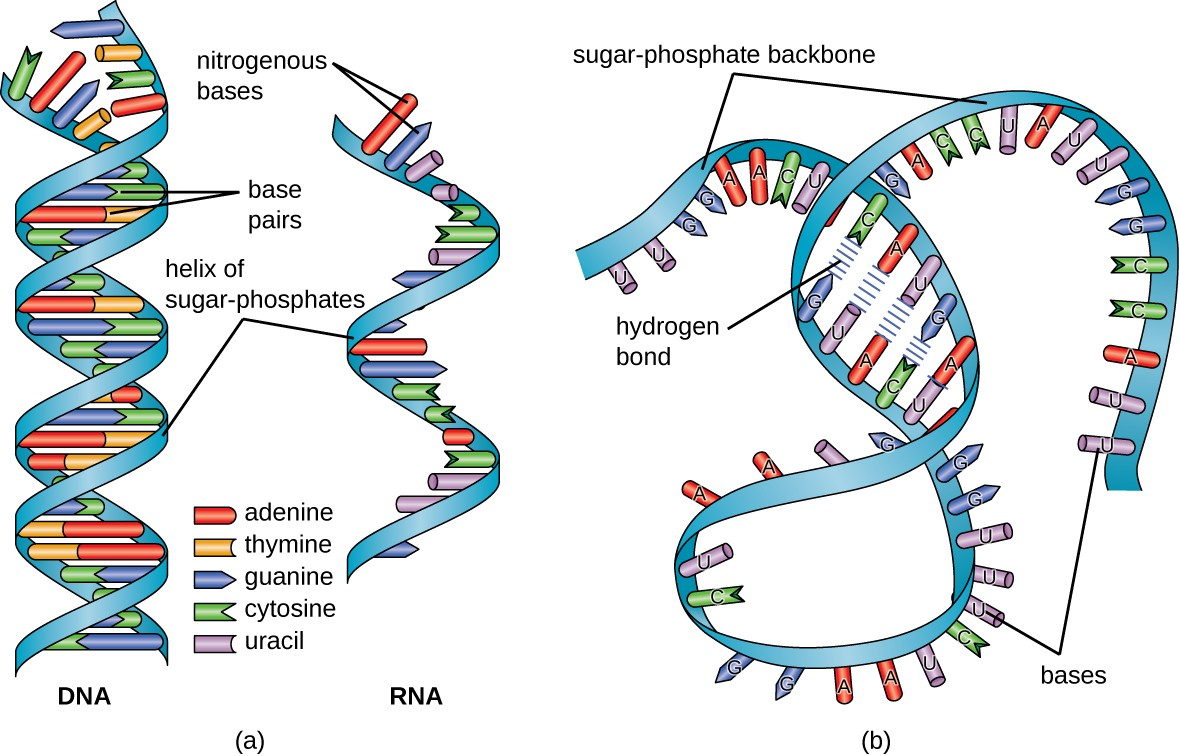
Nucleotides
sugar
phosphate group
nitrogenous base
hydrogen bonds form on interior of DNA
Pyrimidines: 3 hydrogen bonds
thymine
cytosine
Purines: 2 hydrogen bonds
Adenine
guanine
DNA semi conservative
original strand 5’ → 3’
the duplicated is opposite 3’ → 5’
antiparallel
bend with no O is a carbon
Helicase unwinds strands and can be used as a template to synthesize the compliment
parental strands DNA
daughter strands DNA
2 complementary Parental strands can be similar to daughter strands
however semi conservative; half is shared to daughter
History
Watson and Crick: double helix model for DNA
antiparallel- side by side, however 5’-3’ and 3’-5’
can be denatured to separate DNA strands
PCR makes copies/ amplifying of DNA in lab
Barbara McClintock noticed that some maize kernels had unstable color patterns.
She traced these patterns to pieces of DNA that:
inserted into pigment genes → gene turned off
jumped out later → gene turned back on
This movement created the mosaic appearance.
Her work revealed:
genomes are dynamic, not static
gene regulation can occur through mobile elements
transposons are a universal feature of life (found in bacteria, plants, animals, humans)
RNA
single stranded, have uracil instead of thymine
made up of ribose
RNA folds upon itself, folds stabilized by short areas of complementary base pairing within the molecule, forming a 3D structure
mRNA and tRNA used in protein synthesis
tRNA connects to mRNA to make codons to then make amino acids → proteins
tRNA single stranded, intracellular base pairing, 3D shape
3 bases- codon = 1 amino acid
tRNA- anticodon
Chromosomes
significant amount of noncoding DNA, intergenic regions
Human genone → nuclear genome
mitochondrial sharing with mom but…
mitochondria from spermatozoa make way into egg!
Why are microbes good subjects for genetic study?
Microbes are good genetic study subjects because they grow fast, have simple genomes, produce large populations, show clear mutations, exchange genes readily, and are easy and inexpensive to manipulate.
Define
Genetics — The study of how traits are inherited through genes.
Genome — The complete set of genetic material in an organism.
Genes — Segments of DNA that code for functional products, usually proteins.
Chromosome — A DNA molecule packaged with proteins that carries genetic information.
Antiparallel — Describes the opposite 5'→3' orientations of the two DNA strands.
Semiconservative — DNA replication where each new molecule contains one old strand and one new strand.
Bidirectional — Replication that proceeds outward in both directions from the origin.
Replication — The process of copying DNA before cell division.
Template — The original DNA strand used to synthesize a complementary strand.
Leading strand — The DNA strand synthesized continuously toward the replication fork.
Lagging strand — The DNA strand synthesized in short fragments (Okazaki fragments) away from the fork.
🧬 Gene Expression
Transcription — The process of synthesizing RNA from a DNA template.
Translation — The process where ribosomes use mRNA to build a polypeptide.
Genotype — The genetic makeup of an organism.
Phenotype — The observable traits produced by gene expression.
Triplet code — The system where three DNA bases specify one amino acid.
Codon — A three‑base sequence on mRNA that specifies an amino acid.
Anticodon — A three‑base sequence on tRNA that pairs with an mRNA codon.
Definitions
Gene Regulation & RNA Processing
Promoter — A DNA sequence where RNA polymerase binds to start transcription.
Operator — A regulatory DNA segment where repressors bind to control transcription.
Repressor — A protein that binds DNA to block transcription.
Introns — Noncoding RNA segments removed during mRNA processing.
Exons — Coding RNA segments that remain in mature mRNA.
Oncogenic — Capable of causing cancer by promoting uncontrolled cell growth.
Induction — Activation of gene expression in response to a stimulus.
Repression — The inhibition of gene expression by a regulatory protein blocking transcription.
Operon — A cluster of genes under the control of a single promoter and operator, transcribed together.
Mutation — A heritable change in the nucleotide sequence of DNA.
Wild type — The normal, non‑mutated form of a gene or organism found in nature.
Transposon — A mobile DNA segment that can move to new locations within a genome.
Plasmid — A small, circular, self‑replicating DNA molecule found in bacteria.
Conjugation — The transfer of DNA between bacteria through direct cell‑to‑cell contact via a pilus.
Definitions
Transformation — The uptake of free, naked DNA from the environment by a bacterial cell.
Transduction — The transfer of bacterial DNA from one cell to another via a bacteriophage.
Translocation — The movement of a DNA segment from one chromosomal location to another.
Recombinant DNA — DNA formed by combining genetic material from two different sources.
Vectors — DNA molecules (like plasmids or viruses) used to carry foreign genes into host cells.
Restriction endonuclease — An enzyme that cuts DNA at specific nucleotide sequences.
Palindrome — A DNA sequence that reads the same in the 5'→3' direction on both strands.
Ligase — An enzyme that joins DNA fragments by forming phosphodiester bonds.
Polymerase chain reaction (PCR) — A technique that amplifies specific DNA sequences through repeated heating and cooling cycles.
Describe what is meant by the antiparallel arrangement of DNA.
Antiparallel arrangement means that the two strands of DNA run side‑by‑side but in opposite directions, with one oriented 5'→3' and the other 3'→5', allowing complementary base pairing and proper replication
Name several structural characteristics of DNA that allow it to be replicated with such great fidelity, generation upon generation
DNA replicates with high fidelity because complementary base pairing, antiparallel strands, stable hydrogen bonding, consistent helix geometry, and semiconservative replication all guide accurate copying, while DNA polymerase proofreading corrects mistakes.
What is the central dogma of biology?
The central dogma of biology states that genetic information flows in one direction: DNA → RNA → Protein, through the processes of replication, transcription, and translation.
What message does a gene provide? How is a gene expressed?
What message does a gene provide?
A gene provides the coded information for the sequence of amino acids in a protein.
How is a gene expressed?
A gene is expressed when it is transcribed into mRNA and then translated by ribosomes into a functional protein, producing the trait associated with that gene.
If a protein is 3,000 amino acids long, what is the fewest number of nucleotide pairs of DNA required to code for it?
To code a protein that is 3,000 amino acids long, the DNA must provide one codon (3 nucleotides) per amino acid.
Step‑by‑step
Each amino acid = 1 codon
Each codon = 3 nucleotides
So:
3,000 amino acids×3 nucleotides=9,000 nucleotides
Because DNA is double‑stranded, that means 9,000 nucleotide pairs.
⭐ Final Answer
A 3,000‑amino‑acid protein requires at least 9,000 nucleotide pairs of DNA to code for it.
What is a palindrome? Which enzymes recognize these sequences?
A palindrome in DNA is a sequence that reads the same in the 5'→3' direction on both strands, meaning the top and bottom strands are reverse‑complements with identical wording when read in opposite directions.
Example
5' — GAATTC — 3'
3' — CTTAAG — 5'
Both read GAATTC when oriented 5'→3'.
Which enzymes recognize these sequences?
Restriction endonucleases (restriction enzymes) recognize and cut specific palindromic DNA sequences.
These include classic enzymes like EcoRI, HindIII, BamHI, and many others used in recombinant DNA work.