1) electric field
 Call Kai
 Learn
Learn Practice Test
 Spaced Repetition
 Match
Match Flashcards
 Knowt Play
1/10

Earn XP
Description and Tags
Coulomb's law; E field (+definition) of 1) point charge 2) multiple point charges 3) long straight wire ; induced charges; field lines
Name | Mastery | Learn | Test | Matching | Spaced | Call with Kai |
|---|
No analytics yet
Send a link to your students to track their progress
11 Terms
Coulomb’s law (in vaccuum)
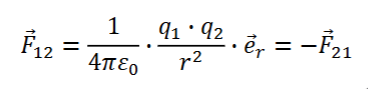
what happens to mutual forces between q1 and q2 when other charges are present?
no influence
E units
[V/m] or [N/C]
define electric field
force applied by a given charge on a positive unit charge at a specific position produced by the given charge at that position
force on a charge q in an electric field E
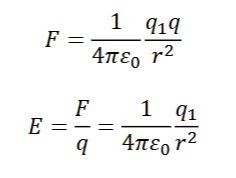
electric field of one point charge q1: give the force, E field magnitude
add small test charge q (+) close to q1
=> E decreases with 1/r²
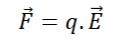
=> force on a charge q in this E field: F=qE
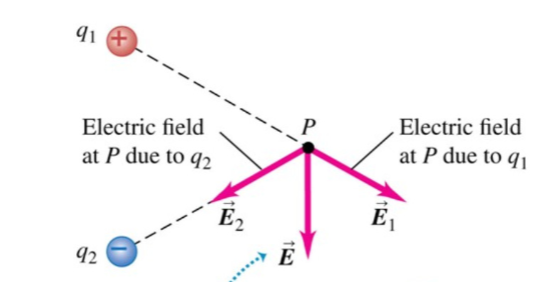
electric field of multiple point charges
1) superposition: E = E1 + E2
=> force on a charge q: F=qE
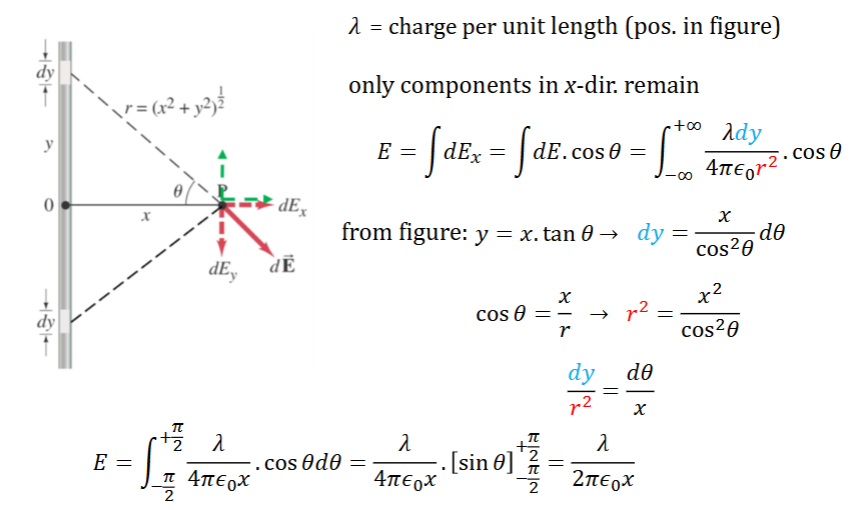
electric field of long straight charged wire
1) trig; only x-components remain
=> E decreases with 1/x = 1/r² and is perpendicular to wire
how to induce charges (hint: Faraday cage)
bring conductor in electric field produced by 2 charged plates:
inside conductor: Etot = Eext + Eint = 0
why does Etot inside conductor for inducing charges = 0?
free charges inside conductor keep moving til equilibrium
give 4 characteristics shown by field lines
1 - E is always tan to field line
2 - E has same direction as field line
3 - field line density ~ magnitude (=strength) of field
4 - field lines never cross