final exam anatomy LESS GOO
 Call Kai
 Learn
Learn Practice Test
 Spaced Repetition
 Match
Match Flashcards
 Knowt Play
1/62

There's no tags or description
Looks like no tags are added yet.
Name | Mastery | Learn | Test | Matching | Spaced | Call with Kai |
|---|
No analytics yet
Send a link to your students to track their progress
63 Terms
what are the layers of the alimentary canal and the functions of each layer?
mucosa: absorbs nutrients, secretes mucus
submucosa: blood vessels, nerves
muscularis: moves food via contractions
serosa: protective outer layer
what body systems carry excretory functions?
digestive
urinary
respiratory
integumentary
anabolism vs. catabolism
anabolism: building molecules → uses energy
catabolism: breaking molecules → releases energy
*both build and repair tissues and fuel the body
what is the difference between glycogen and glucagon?
glycogen → a stored form of glucose
glucagon →hormone that breaks glycogen down + raises blood sugar
what are microvilli in relation to the small intestine?
microvilli increase surface area massively which increases nutrient absorption
what organelle of the cell is responsible for the production of energy for cellular processes
mitochondria
what are the difference between all the digestive terms?
mastication: chewing
maceration: softening
deglutition: swallowing → *buccal and pharyngeal phase
peristalsis: wave-like propulsions through small and large intestine
segmentation: mixing contractions
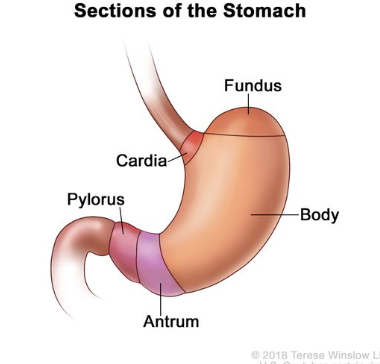
what are the four parts of the stomach?
cardia, fundus, body, pyloris
what are the 3 muscles in the stomach wall?
oblique: inner most → churning
circular: middle most → squeezing
longitudinal: out most → shortening/moving food
what is the function of rugae, parietal cells, chyme, and hydrochloric acid?
Rugae: folds the allow the stomach to expand
parietal cells: secrete hydrochloric acid and intrinsic factor
chyme: semifluid mixture of food + gastric juices sent to small intestine
hydrochloric: breaks down food, kills bacteria, and activates pepsin
What is the path of urine flow through various parts of the kidney?
Gomerulus → Bowmans capsule → PCT → loop of henle → DCT → collecting duct → renal pelvis → ureter → bladder → urethra
what urine production terms?
Filteration: glomerulus filters blood into the Bowman’s capsule
Reabsoprtion: PCT and Loop of henle reabsorb water/nutrients
secretion: DCT and secretes waste into filterate
what is the difference between healthy and unhealthy urine?
unhealthy: ketones, glucose, blood, bacteria
healthy: water, urea, salts, yellow color, slightly acidic
What is the signifcance of the urinarys system’s ability to reabsorb blood components back into the bloodstream?
prevents loss of essential substances, maintains homeostasis, blood pressure, and fluid balance
what is the involvement of ions in action potential?
NA+ → sodium rushes in causes depolarization
K+ → potassium rushes out causing repolarizatiom
sodium potassium pump → restores the resting state
do you understand and graph the electrical charges on both sides on the neuron membrane?
yes
compare nervous impulse to flipping a light switch and flushing the toilet
light swtich: all-or-nothing neuron firing
flushing toilet: refractory period; must reset before firing again
what are all the kinds of divisions?
sensory (afferent) → arrives to the brain
motor (efferent) → exits the brain to the muscles
sympathetic: fight or flight
parasympathetic: resting sensations
autonomic: involuntary functions
somatic: voluntary functions
what are the names and functions of the 6 neuroglia?
astrocytes: star shaped, form blood brain barrier, support and nourish neurons
microglia: small, immune defense, remove debris
ependymal: cells line ventricles, produces cerebral spinal fluid
Oligodendrocytes: maintain the myelin sheath
schwann cells: form myelin insulation in the PNS
satellite cells: support neurons in PNS ganglia
acetylcholine vs acetylcholinesterase
ACH: transmits nerve signals across synapses
erase: enzymes that breaks down ACH to stop the signal
what are the parts of the brain
cerebrum: thinking, memory, movement, senses
cerebellum: balance and coordinations
brainstem: (medulla, pons, midbrain) → breathing, heart rate, and reflexes
thalamus: sensory relay
hypothalamus: homeostasis, hunger, and temperature
What are the main parts of the eye?
cornea: refracts light
lens: focuses light
iris: controls pupil size
pupil: lets light in the eye
optic nerve: sends signals to the brain
sclera: protective white outer layer
what are the five kinds of receptors?
thermo: temperature
noci: pain detectors
mechano: pressure/touch
photo: loght
chemo: taste/smell
what are the function, contents, and location of the lacrimal glands?
located in the upper corner of each eye
function: produces tears to lubricate/protect eye
contents: water, salts, and lysozyme
what are the functions of the four lobes of the cerebrum?
frontal: decision-making, personality
parietal: touch, spatial awareness
temporal: hearing
occipital: eye-sight
what is the difference between exocrine and endocrine glands?
exocrine: ducts to the surface → such as salivary or sweat glands
endocrine: hormones into blood
what does the anterior pituitary gland secrete?
Thyroid stimulating: causes thyroid to produce thyroxine
ACTH: stimulates adrenal glands
growth: stimulates growth in bones and muscles
melanocyte: stimulates melanocytes to produce melanin
prolactin: breast milk production
gonadotropins: (lutenizing: stimulates release of sex hormones) (follicle stimulating: stimulates egg and sperm productiom)
what does the posterior pituitary gland secrete?
ADH: water retention in the kidneys
oxytocin: contractions during childbirth
what does the pineal gland secrete?
melatonin: tiredness → sleep-wake cycle
what does the thyroid gland secrete?
calcitonin: decreases calcium levels in the blood (parathyroid glands do the opposite of this)
thyroid hormones: (T3: oxygen usage and maintains blood pressure) (T4: regulate metabolism and body heat production)
what do the adrenal glands secrete?
medulla → epinephrine and norephinephrine
cortex → cortisol/DHEA: precurser to sex hormones & aldosterone: regulate electrolyte balance
Cushings vs Addisons disease:
cushings → too much cortisol: weight gain, moon face, high BP
addisons → too little cortisol: weight loss, fatique, low BP
what is the difference between diabetes mellitus and insipidus?
mellitus: lack of insulin/resistance → high blood glucose
insipidus: lack of ADH → dilute urine/dehydration
what does the pancreas secrete?
beta cells → insulin: lowers blood glucose
alpha cells → glucagon: raises blood glucose
what does the thymus gland secrete?
produces thymopoetin, thymic factor, and thymosin which is all involved in the development of the immune system
what does gonad(s) gland secrete?
females: estrogen = maturation of reproduction organs and secondary sex characteristics/ progesterone = causes breast development and control of menstrual cycle
males: testosterone and androgens + DHT = maturation of reproductive organs and secondary sex characteristics + sperm production/
negative vs positive feedback:
negative: shuts of the stimulus; ex: insulin
positive: amplifies the stimulus; ex: oxytocin during childbirth
Why is blood considered a connective tissues?
blood has cells suspended in a matrix called plasma
describe the layers of the heart?
protective surface of the heart: pericardium
epicardium (visceral): inner layer of serous membrane; attached to the surface of the heart
(minor serous layer) Parietal Layer: The outer portion of the serous pericardium that is fused to the inside of the fibrous pericardium.
myocardium: thick twisting bundles of cardiac muscles to provide contractions
endocardium: thin layer lining the heart chambers
difference between the pulmonary and systemic circuts?
pulmonary: heart → lungs → heart (picks up oxygen)
systemic: heart → body → heart (delivers oxygen)
do you know the blood circulation through the heart?
yes
what are the four major valves of the heart
tricuspid: right atrium/ventricle
pulmonary: right ventricle → pulmonary artery
LUNGS
bicuspid: left atrium/ventricle
aortic: left ventricle → aorta
describe the pathway of the heart through diastole and systole:
atria contracts: systole → ventricles relax diastole
^ other way around
what are the 2 major nodes in the heart? what is considered the cardiac pacemaker?
SA NODE: begins impulse and causes atrial contraction in the right atrium also known as the cardiac pacemaker
AV NODE: between atria and ventricles, lets atria empty into the ventricles
compare arteries, veins, and capillaries:
arts: thick muscular walls, carries blood away from heart, high pressure
veins: thin walls, carries blood too heart, low pressure
caps: thick, site of gas/nutrient exchange
what is antherosclerosis?
plaque build up on artery walls
what are the parts/functions of the male repoductive system?
Seminiferous tubules – Tiny coiled tubes inside the testes where sperm are produced.
Testes – Male reproductive organs that produce sperm and the hormone testosterone.
Epididymis – A long, coiled tube on the back of each testis where sperm mature and are stored.
Ductus deferens (vas deferens) – A tube that carries sperm from the epididymis to the ejaculatory duct.
Seminal vesicles – Glands that add a sugary fluid to sperm to help nourish and energize them.
Prostate gland – A gland that adds fluid to semen to help protect and activate sperm.
Ejaculatory duct – A short tube that carries semen into the urethra during ejaculation.
Penis – The external male reproductive organ that delivers semen and also allows urine to leave the body.
what is oogenesis vs spermatogenesis?
spermato: continous sperm production since puberty
oog: egg production, before birth
what is the difference between primary and secondary reproductive organs?
primary: F/M gonads → produce gametes and hormones
secondary: all other structures that support reproduction
what are some symptoms of sexually transmitted diseases?
burning
itching
fever/swollen neck glands
discharge
list goes on… be safe yall
Describe the parts of the lymphatic system:
Lymph nodes: act as the body’s security checkpoints in the neck
tonsils: protect ring around the throat to block foreign invaders
Peyer’s patches: lymphocytes near the small intestine to filter food and keep good bacteria within
thymus: produces thymosin → T lymph maturation
spleen: (white pulp: filters the blood) (red pulp: removes worn-out RBC)
active vs passive immunity:
active: body makes its own antibodies: infection
passive: antibodies are recieved: injection/mothers milk
plasma vs lymph vs interstitial fluid:
plasma: in blood vessels, carries cells/ nutrients
lymph: in lymph vessels/ excess fluid is collected and brought to the blood
interstitial: surrounds cells in tissues
humoral vs cell-mediated immunity:
humoral: uses b lymphocytes → produces antibodies against pathogens in blood
cell-mediated: uses t lymphocytes → t helped cells help activate immune response while killer t cells destroy infected cells directly
what are some major functions of the blood:
transport oxygen and carbon dioxide, nutrients, hormones, waste; regulates temperature and protect via clotting and immunity
what are the %/components of blood:
plasma: 55%, liquid matrix, less dense
buffy coat: <1% WBCs and platelets
RBC: 45%, most dense
what are all the types/functions of leukocytes?
Neutrophils – The most common white blood cells; they quickly attack and destroy bacteria and are the body’s first responders to infection.
Lymphocytes – Cells involved in specific immunity; B cells make antibodies, while T cells attack infected or abnormal cells.
Monocytes – Large white blood cells that develop into macrophages and clean up dead cells, bacteria, and debris. (agran)
Eosinophils – White blood cells that help fight parasites and are involved in allergic reactions and asthma.
Basophils – The least common leukocytes; they release histamine and other chemicals during allergic and inflammatory responses. (agran)
what is the universal donor? recipient?
donor: TYPE O NEGATIVE/ has no antigens to cause reactions with others
recipient: TYPE AB POSITIVE/ has ALL antigens so no reaction occurs
describe the trachea, bronchi, pharynx, bronchioles, and aveoli:
Trachea – the windpipe that carries air to the lungs
Bronchi – two main tubes that branch from the trachea into the lungs
Pharynx – the throat; passageway for air and food
Bronchioles – smaller branches inside the lungs that carry air to alveoli
Alveoli – tiny air sacs where oxygen and carbon dioxide are exchanged
what are the major functions of the respiratory system:
gas exchange
regulates blood PH
filters warm/humid air
function of the diaphragm?
dome shaped muscle below the lungs
contracts → lungs expand → flattens
relaxes → domes → lungs compress
what are 5 effects of vaping on the lungs?
lung inflammation
death
popcorn lung
nicotine addiction
risk of infection
do you know the respiratory infections?
yes