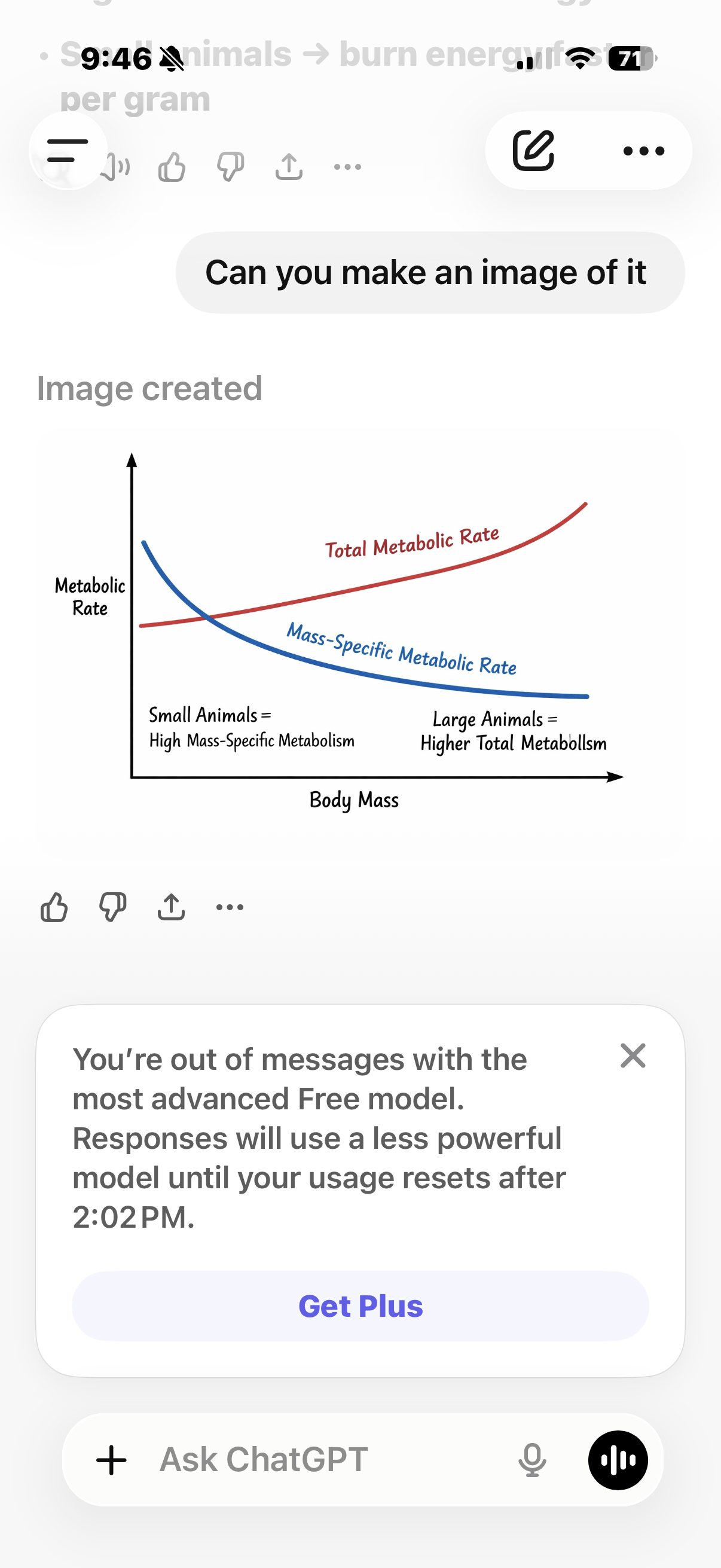
Metabolic Rates and Circulatory Function in Animals
 Call Kai
 Learn
Learn Practice Test
 Spaced Repetition
 Match
Match Flashcards
 Knowt Play
1/37

Earn XP
Description and Tags
Flashcards covering metabolic rates, physiological adaptations, and the circulatory function in animals based on lecture notes.
Name | Mastery | Learn | Test | Matching | Spaced | Call with Kai |
|---|
No analytics yet
Send a link to your students to track their progress
38 Terms
Basal Metabolic Rate (BMR)
The minimum energy needed to be at rest.
Standard Metabolic Rate (SMR)
Minimum metabolic rate for ectotherms.
Total Metabolic Rate
Total energy used in an organism.
Thermoneutral Zone
Range of environmental temperatures where BMR is sufficient to maintain body temperature, requiring no energy.
Name 5 different physiological adaptation responses an animal might use going into and through a cold season.
Increased insulation
Shivering Thermogenesis
Non-Shivering Thermogenesis
Reduced metabolic rate
Peripherial vasoconstriction
Evaporation (HV)
Heat loss through sweating.
Convection (HC)
Heat transfer to moving air.
Radiation (HR)
Heat lost or gained through infrared waves.
Evaporation Loss (HE)
Water loss resulting in a cooling effect.
Storage Heat (HS)
Heat retained in the body.
Warm-blooded
Animals that maintain a stable body temperature.
Homotherms
Organisms maintaining body temperature using internal heat.
Endotherms
Organisms that generate heat internally to maintain their temperature.
Cold Blooded
Animals whose body temperature is based on the environment.
Poikilotherms
Organisms whose temperature changes based on environmental conditions.
Ectotherms
Organisms that rely on external heat sources to regulate body temperature.
Heterothermic Endotherms
Endotherms that can drop their stable body temperature during periods such as hibernation.
Behavioral Heat Regulation
Adaptations to maintain temperature by changing position, such as sitting in sun or shade.
Physiological Heat Regulation
Internal changes such as adjusting heart rate, blood flow, and metabolic rate to regulate temperature.
Heart Function
A pump that contracts to move blood through the body, sending deoxygenated blood to the lungs and oxygenated blood to tissues.
Pulmonary Circulation
Carries deoxygenated blood from the heart to the lungs and back.
Systemic Circulation
Carries oxygenated blood from the heart to the rest of the body and returns deoxygenated blood back.
Blood Pressure and Velocity Relationship
As cross-sectional area increases, blood velocity decreases and pressure drops.
What is a thermoneutral zone
Range of environmental temperatures where BMR is sufficient to maintain body temperature(no energy needed)
Warm-blooded
animals maintain a stable body temperature
Homotherms
Maintaining body temp, using internal heat
Endotherms
generate heat internally to maintain temperature
Cold Blooded
body temp based on environment
Poikilotherms
temp changes based off environment
Ectotherms
Rely on external heat
Homothermic endotherms
stable temp and internal heat
Heterothermic Endotherms
Heterothermic Endotherms
Describe the difference between behavioral and physiological regulation of heat using the marine iguana example.
Behavior: Sit in the, move to the shade, change posture
Physiological: Change heart rate, blood flow, and metabolism
Describe the function of the heart as a circulatory pump
The heart is a pump that contracts to move blood through the body. It sends deoxygenated blood to the lungs for oxygen and pumps the oxygenated blood to tissues to give nutrients and remove waste.
Define the difference between pulmonary and systemic circulation
pulmonary: carries deoxygenated blood from the heart to the lungs to get oxygen and send it back to the heart
Systematic: carries oxygenated blood from the heart to the rest of the body and returns deoxgented back to the heart
What is the relationship between the whole body atriel cross section area, blood pressure, and velocity?
As cross section increses, the blood velocity decreases and the pressure drops. Arteries have high pressure and fast flow, while capilaries have the greatest total area and the slowest flow for each
Draw this