Lung & Liver Flukes
 Call Kai
 Learn
Learn Practice Test
 Spaced Repetition
 Match
Match Flashcards
 Knowt Play
1/39

There's no tags or description
Looks like no tags are added yet.
Name | Mastery | Learn | Test | Matching | Spaced | Call with Kai |
|---|
No analytics yet
Send a link to your students to track their progress
40 Terms
C sinensis is a type of _____ fluke
LIVER
Humans are infected with S. sinensis from ingesting uncooked _____
freshwater fish
C. sinensis is _____ in size that the Fasciola spp.
SMALLER
C. sinensis can live up to _____ in the human _____ tract
25 years; biliary
C. sinensis mostly causes _____ disease and only 50% of people get sick because the worms are _____ and don’t _____ the bile duct
asymptomatic; smaller; block
how do you diagnose C. sinensis?
eggs in stool
What are the TWO distinguishing features of C. sinensis eggs?
opercualted with shoulder; SMALLER
what is the geographic distribution of Clonorchis?
E and SE asia
True or False: Clonorchis can be found in the USA, despite not being an endemic area
TRUE → usually from immigrants bringing fish containing metacercariae
_____ does NOT kill the metacercariae → must be cooked
smooking/pickling
what is the infectious stage of C. sinensis for humans?
metacercariae
how do humans acquire C. sinensis?
ingestion of raw freshwater seafood
once ingesting the metacercariae; it will except in the _____ and adult will reside in the _____
duodenum; biliary duct
About how big are C. sinensis adults?
1-2.5 cm
Adult C. sinensis undergo _____ and produce _____ eggs that are released in the stool
self-fertilization; embryonated (DIFFERENT FROM F. buski and F. hepatica which released unembryonated eggs!)
The C. sinensis cercariae released from snails will encyst in the _____
skin of freshwater seafood
what type of host are humans for C. sinensis.
definitive
C. sinensis can cause _____ and _____ of the biliary ducts
finlammation; intermittent obstruction
what are the 4 main acute symptoms of C. sinensis?
abd. pain, nausea, diarrhea, eosinophilia
what at the the 4 main CHRONIC symptoms of C. sinensis?
cholangitis, cholelithiasis; pancreatitis; cholangiocarcinoma
what are the two primary ways of diagnosing C. sinensis?
eggs in stool or duodenal aspirate
C. sinensis eggs will not be excreted into stool when the _____ is _____
bile duct; obstructed
adult C. sinensis flukes can be recovered during _____
surgery
What is the primary treatment for C. sinensis?
prizaquantel or albendazole
Paragonimus westermani is known as the _____ fluke
lung
What is the geographic distribution of P. westermani?
Asia, India, Africa
P. westermani is transmitted to humans via cysts in undercooked _____
CRAB meat
P. westermani gggs are released in the tissue and thus case an _____ response followed by _____ reactions and eventually _____
immune; granulomatous; fibrosis
what are the 4 main symptoms of P. westermani?
cough, pleurisy, pulmonary pain, hemoptysis
how do you diagnose P. westermani?
eggs in SPUTUM
P. westermani eggs are REARELY found in the _____, but if they are, it is due to the individual _____ the eggs
feces; swallowing
_____ causes the USA-version of P. westermani in crayfish
P. kellicotti
after ingesting undercooked crab, the metacercariae will excyst in the _____ and adults will live in _____ found in the _____
duodenum; cystic cavities; lungs
P. westermani is shed into the environment via _____ eggs that are released in _____ or _____
unembryonated; sputum; stool (rare)
what is the second intermediate host for P. westermani?
Crab/crustaceans
P. westermani eggs, similarly to the other flukes, are _____, but it can be destroyed during an _____ stain which is used for TB testing (causing false _____)
opercualted; acid-fast; negatives
P. westermani can also be visualized in _____
lung tissue biopsies
how can P. westermani eggs be differentiated from the other flukes?
found in sputum not stool! (also medium sized)
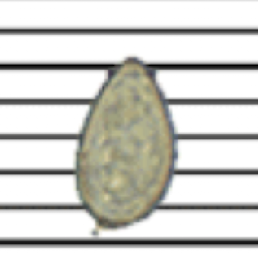
What fluke is this?
Clonorchis sinensis
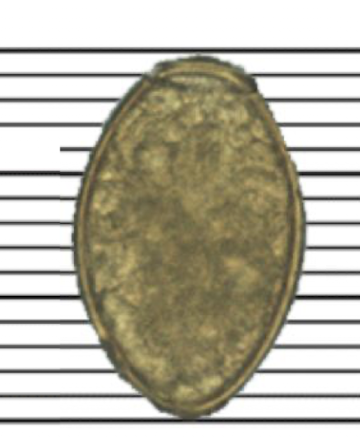
What fluke is this?
P. westermani