PSYC 3220 Hearing & Auditory Perception
 Call Kai
 Learn
Learn Practice Test
 Spaced Repetition
 Match
Match Flashcards
 Knowt Play
1/54

There's no tags or description
Looks like no tags are added yet.
Name | Mastery | Learn | Test | Matching | Spaced | Call with Kai |
|---|
No analytics yet
Send a link to your students to track their progress
55 Terms
Cochlea
Tiny, coiled structure in the inner ear, filled with fluid. Responsible for turning sound into signals your brain can understand
Hair cells
Tiny sensory cells inside of the cochlea, with little hair-like projections (stereocilia)
Bend when sound vibrations move through the cochlea, are the actual receptors for sound
Hair cells transduction
Convert sound waves (mechanical energy) → electrical signals (neural signals)
Hair cells role in hearing
Detect the vibrations, transduction allows for brain to interpret sound
Physical definition of sound
Sound is pressure changes
Perceptual definition of sound
The experience we have when we hear
Frequency
Number of cycles/second (physical)
Hertz
How we measure frequency
Sound amplitude
The height of the peaks in the wave
Decibel
How we measure sound amplitude
Perceptual aspects of sound
Pitch, loudness, timbre
Pitch
A tone's experienced highness or lowness; depends on frequency (perceptive)
Loudness
A sound's intensity perceived from sound amplitude
Timbre
Other perceptual aspects of sound beyond loudness, pitch, and duration
EX) Different musical instruments
Threshold for loudness
Absolute threshold, Magnitude estimation
Depend on loudness and frequencies
Thresholds
Audibility curve
Curve that shows the sound pressure level (SPL) at threshold for frequencies across the audible spectrum
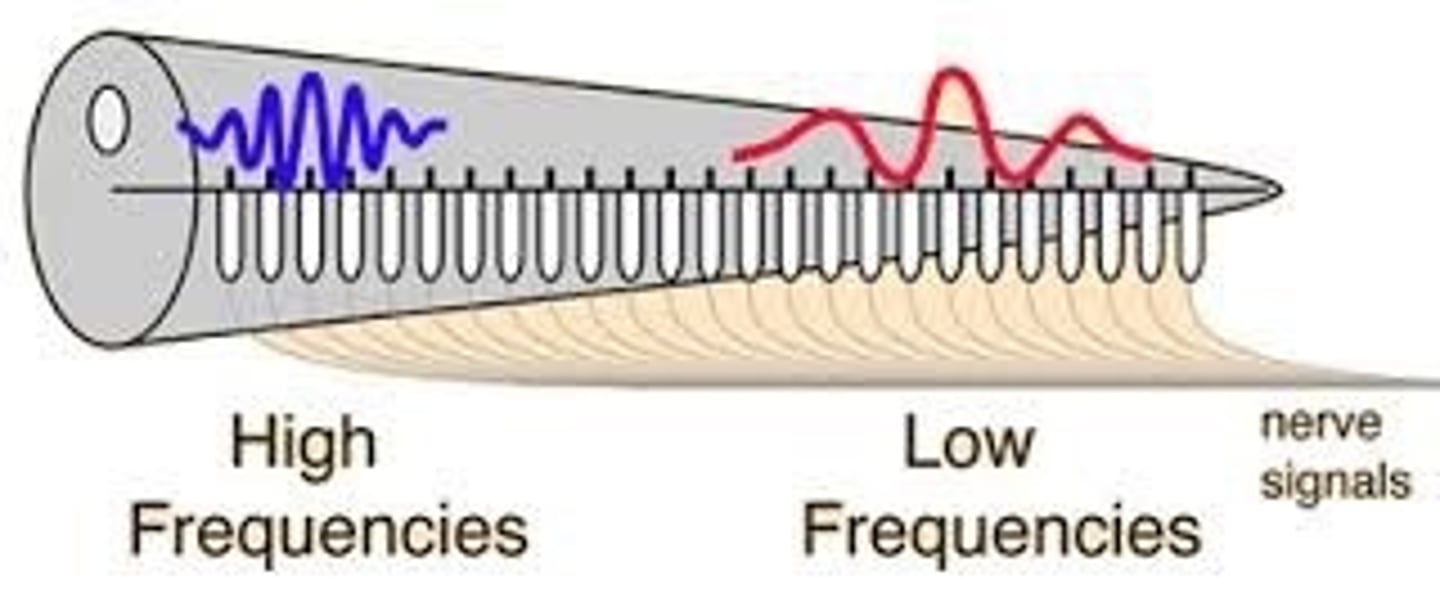
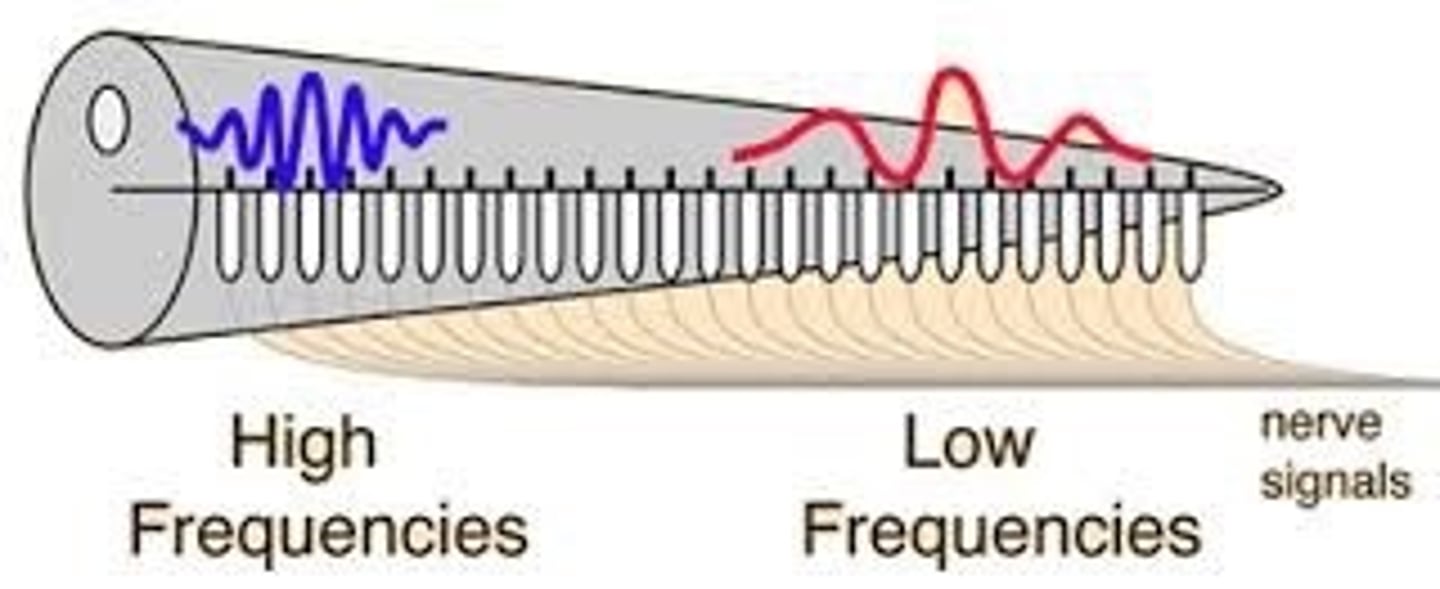
Frequency in cochlea
Which hair cells are activated corresponds to frequency of sound (place theory)
Hair cells near base
High frequencies (pitch)
Hair cells near apex
Low frequencies (pitch)
Hair cells → auditory nerve → cochlear nucleus → superior olivary complex → inferior colliculus→ MGN → A1
Steps in primary auditory pathway
Receptor of auditory pathway
Hair cells
Thalamic nucleus of auditory pathway
MGN (medial geniculate nucleus)
Primary receiving area of auditory pathway
A1 (primary auditory cortex)
Binaural cues
Location cues based on comparison of sound info received by the right ear and the left ear
ITD, ILD
Binaural cues
Interuaral timing difference (ITD)
Difference in timing sounds reach the right ear and the left ear
No ITD
Source is equal distance from both ears
EX) Sound right in front of you, both ears receive sound at same time
ITD
Source is to one side
EX) Sound from right side of room, right ear will receive sound before left ear
Interaural level difference (ILD)
Difference in sound pressure level reaching the right and left ear
For high frequency sounds
Decrease intensity in further ear
A1, Posterior belt area
Brain areas involved in locating sound
ITD detectors
Neurons that fire when signals reach them from both ears
Dorsal auditory processing stream
Where is the sound coming from?
Leaving A1, heading towards the parietal lobe
Dorsal auditory processing stream
Ventral auditory processing stream
What exactly did i hear?
Temporal Lobe
Ventral auditory processing stream
Lesion method, Neuroimaging , Neural recordings
Evidence for 2 auditory processing pathways
Direct sound
Sound reaches ear directly
EX) someone directly talking to you in a quiet room
Indirect sound
Sound that reaches ear after reflecting off of another surface
EX) sound echos off of halls when someone speaks
Precedence effect
When two identical or similar sounds reach the ear with a very short time gap, the listener perceives the first sounds that reaches the ear
Architechtual acoustics
Study of how sounds reflect in rooms
Auditory Scene analysis (ASA)
Process where the stimuli made by each source are separated; How your brain figures out what sounds belong together and what comes from different sources.
Simultaneous grouping
When sounds are perceptually grouped together since they happen simultaneously in time
Example of Simultaneous grouping
Grouping trumpets together in an orchestra; playing at the same time
Sequential grouping
Grouping when sounds come one after another in time
Example of Sequential grouping
Car alarm, beeps multiple times in a row; know it's one car and not multiple at once
Onset Synchrony
Onset synchrony is when different sounds start at the same time, and your brain groups them together as coming from the same source.
Example of Onset Synchrony
In a band, when a drum and guitar hit at the exact same moment, your brain groups them together as part of the same musical event.
Location, Onset Synchrony, Timbre & pitch
Cues for simultaneous grouping in ASA
Similarity in pitch, Gestalt principle of proximity, Auditory Continuity, Experience, Auditory Stream segregation
Cues for sequential grouping in ASA
Auditory Continuity (Principle of good continuity)
Sounds that stay constant or change smoothly are perceived as coming from the same source.
Example of auditory continuity
Imagine you hear a siren from an ambulance.
The pitch smoothly goes up and down as it passes by.
Even though the sound is changing, your brain hears it as one continuous sound from the same ambulance, not different sources.
Melody Schema
Representation of a familiar melody in memory (twinkle twinkle little star)
Auditory Stream Segregation
When your brain separates sounds into different streams because they are too different (in pitch, timing, or location) to be grouped together.
Auditory Stream Segregation Example
Imagine you’re listening to two instruments, like a flute and a drum.
They sound very different, so your brain separates them into two distinct streams, instead of hearing them as one combined sound.