Lecture 12: Fractures of Pelvic Limb I
 Call Kai
 Learn
Learn Practice Test
 Spaced Repetition
 Match
Match Flashcards
 Knowt Play
1/27

There's no tags or description
Looks like no tags are added yet.
Name | Mastery | Learn | Test | Matching | Spaced | Call with Kai |
|---|
No analytics yet
Send a link to your students to track their progress
28 Terms
What is a fracture that may occur secondary to preexisting bone pathologic condition?
pathologic fracture
What is the most common cause of pathologic fractures?
primary or metastatic bone tumors
What is seen radiographically if a primary or metastatic bone tumor is present before a fracture?
cortical lysis and new bone formation in area of fracture
What is the most common cause of traumatic femoral fractures?
high velocity injuries (such as HBC)
What common PE test may appear abnormal if a femoral fracture is present?
proprioception
Why should the contralateral limb be radiographed in a dog with a femoral fracture?
• Useful in assessing normal bone length & shape
• Used to contour bone plate more precisely before surgery =>reducing operative time
• As reference to select appropriately sized implants
True or false: casts/splints are contraindicated for femoral fractures.
true
What surgical implant is used for femoral diaphyseal fractures?
bone plates
True or false: femoral fractures are usually immobilized preoperatively.
false: Not usually immobilized preoperatively because of difficulty in applying coaptation splints
Normograde placement of femoral IM pins involves cutting pin at level of ______, because the pin end may injure sciatic nerve.
trochanter
How is a femoral IM pin placed retrograde?
Hold femur adducted & hip in extension driving IM pin through trochanteric fossa
Why is external skeletal fixation application to femur challenging?
surrounding muscle mass and abdomen and motion of stifle
What can bone plates serve as?
a. Neutralization
b. Compression
c. Bridging
What treatment is CONTRAINDICATED for femoral diaphyseal fracture?
Single IM pin used
What is the effect of unsuccessful reduction and stabilization of implants?
devascularized bone fragments
What common error in surgical fixation of femoral fractures leads to delayed union and nonunion, even in young animals?
failure to provide adequate rotational stability
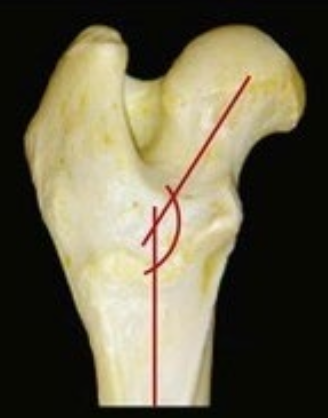
What is this?
angle of inclination
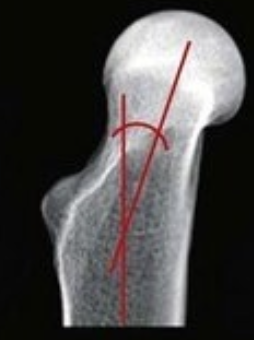
What is this?
angle of anteversion
What approach is most often used for femoral head and neck fractures?
craniolateral approach to hip
If alignment of femoral head or neck fracture is difficult, what procedure is performed to improve accessibility?
trochanteric osteotomy
How are femoral head and neck fractures best stabilized?
lag screws
What is the benefit of controlled limb use (physical rehab) after femoral fractures?
optimizes limb function after fracture healing, especially important after fractures affecting stifle
True or false: implants generally not removed unless they cause problem.
true
Femoral neck fractures that fail to heal are usually treated with ______.
FHO
What physis provides most of femoral length?
distal physis
Why is a very young animal with a physeal fracture concerning?
• Physeal fractures heal rapidly → Most often physis does not continue to function
• The younger the animal → More dramatic effects of premature closure of physis
Why is surgery required for tx of femoral physeal fractures?
prevent severe DJD and lameness
Why must a physis be anatomically reduced and stabilized with a tension band after a fracture with greater trochanter separation?
to counteract distractive forces of gluteal muscles