Structure and functions of phloem
 Call Kai
 Learn
Learn Practice Test
 Spaced Repetition
 Match
Match Flashcards
 Knowt Play
1/4

Earn XP
Description and Tags
https://www.youtube.com/watch?v=Ur7w9IdP8Xg
Name | Mastery | Learn | Test | Matching | Spaced | Call with Kai |
|---|
No analytics yet
Send a link to your students to track their progress
5 Terms
What is the job of the phloem
To transport the assimilates (sugars / amino acids produced by glucose from photosynthesis) from the leaves to other parts of the plant such as the roots or flowers/
Molecules can be moved up and down phloem , and the fluid moving in phloem is referred to as phloem sap
What is sieve tube element
Its a living tissue, consists of two different types of tissue
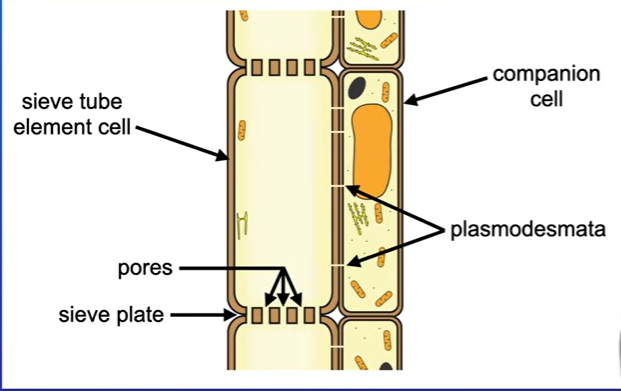
The sieve tube element cell - consists of a long line of cells arranged end to end, inside these cells, almost all of the organelles have been lost including nucleus and vacuole. This leaves the interior of these calls almost entirely free to transport phloem sap
Whats sieve plate
The end walls of these cells have been modified to contain large pores, these are called a sieve plate.
Sieve plates allow the phloem sap to move between the cells
What are companion cells
They are next to sieve tube element cells, companion cells contain a nucleus as well as large amounts of mitochondria.
Microscopic channels link the companion cells to the sieve tube, these are called plasmodesmata.
Molecules such as ATP and proteins can move through plasmodesmata into sieve tube element cells
So companion cells provide essential molecules to the sieve tube element cells.
What tissues do phloem include that provide support
These are called fibres and sclereids, both of these have thickened cell walls containing lignin
Fibres are long and narrow whereas schlereids have a variety of shapes,