Developmental Speech Disorders P1&2
 Call Kai
 Learn
Learn Practice Test
 Spaced Repetition
 Match
Match Flashcards
 Knowt Play
1/27

There's no tags or description
Looks like no tags are added yet.
Name | Mastery | Learn | Test | Matching | Spaced | Call with Kai |
|---|
No analytics yet
Send a link to your students to track their progress
28 Terms
What is the difference between articulation and phonology?
Articulation refers to the ability to produce sounds, while phonology involves the rules for combining sounds in a language.
What are speech sound disorders (SSDs)?
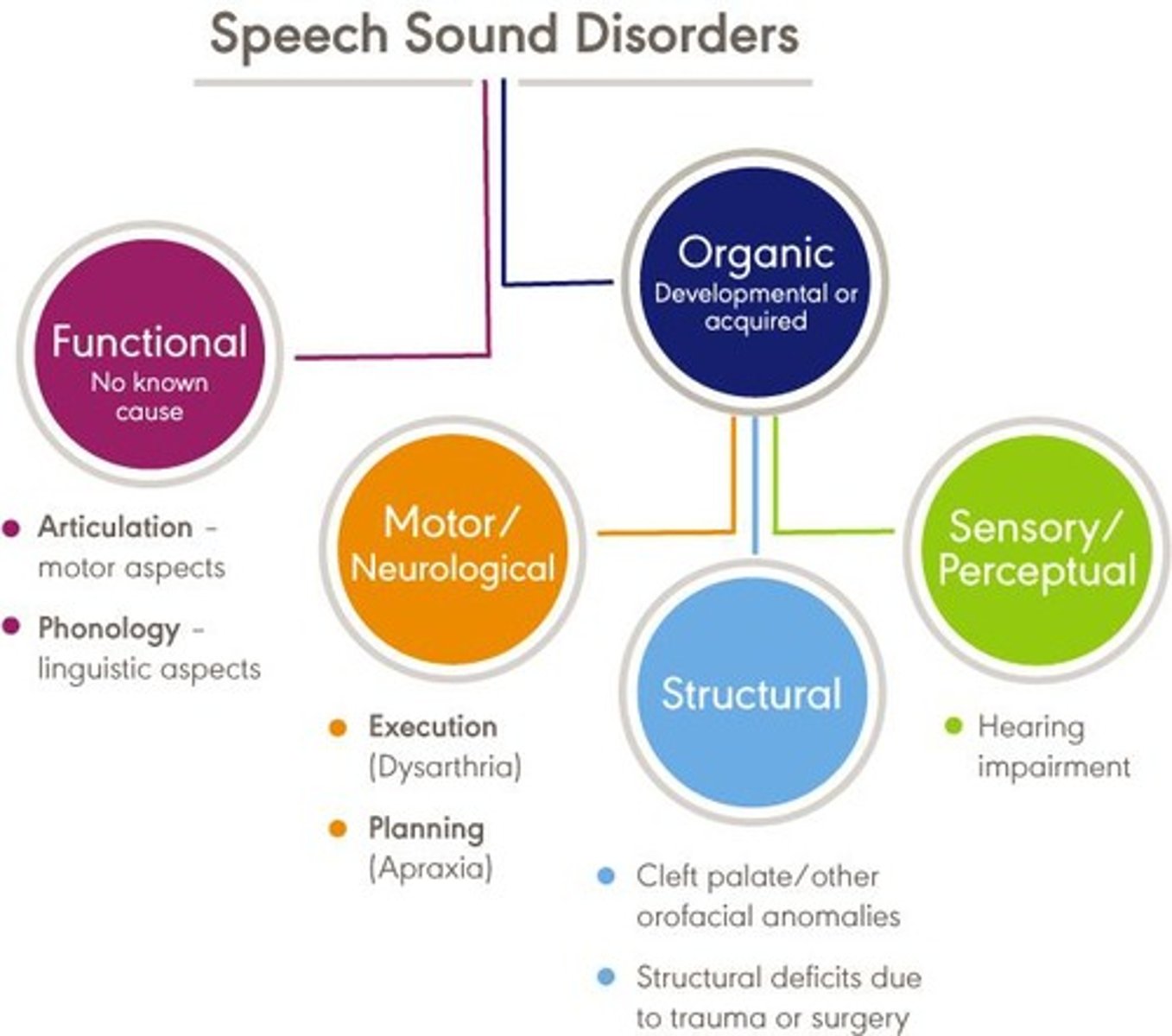
SSDs are difficulties in producing speech sounds correctly, which can be classified as organic or functional.
What causes speech sound disorders?
Causes can be organic (e.g., cleft lip and palate) or functional (unknown physiological cause).
How do we assess speech sound disorders?
Assessment can involve independent analysis (what the child can do) and relational analysis (comparing to adult targets).
What is the International Phonetic Alphabet (IPA)?
The IPA is a system that represents phonemes with symbols, allowing a 1:1 relationship between spelling and sound.
What is a phoneme?
A phoneme is the smallest unit of speech that carries meaning and can change the meaning of a word.
What are the primary articulators in speech production?
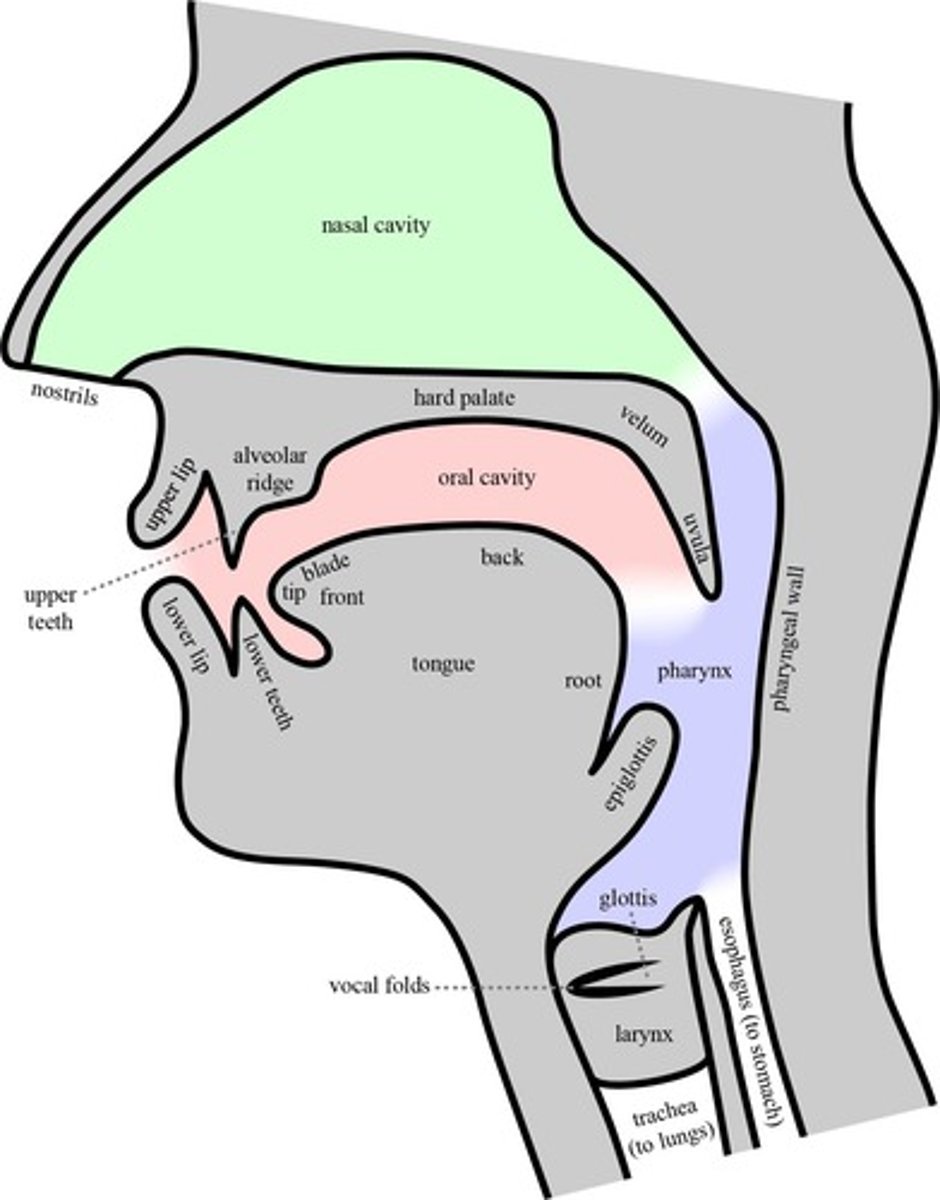
The primary articulators are the lips, tongue, teeth, hard palate, and velum.
What distinguishes vowels from consonants?
Vowels are produced with little constriction in the vocal tract, while consonants involve constriction.
What are the three characteristics used to describe consonants?
Consonants are described by their place of articulation, manner of articulation, and voicing.
What is the place of articulation for the sound /p/?
Bilabial, meaning it is produced using both lips.
What is the manner of articulation for the sound /n/?
Nasal, as it is produced with airflow through the nose.
What does voicing refer to in speech sounds?
Voicing indicates whether the vocal folds vibrate during the production of a sound.
What is an articulation disorder?
An articulation disorder is when a child has difficulty shaping articulators to produce sounds correctly.
What is a phonological disorder?
A phonological disorder involves difficulty understanding and applying the rules for combining speech sounds.
What is the Percent Consonant Correct (PCC) for a mild speech sound disorder?
A PCC of about 85% or higher indicates a mild speech sound disorder.
What are common types of phonological pattern errors?
Common errors include gliding, stopping, and fronting.
What is the difference between organic and functional speech disorders?
Organic disorders have a known physical cause, while functional disorders do not.
What is dysarthria?
Dysarthria is a motor speech disorder caused by weakness of the speech muscles, leading to distorted speech.
What is Childhood Apraxia of Speech (CAS)?
CAS is a motor planning disorder where the brain has difficulty coordinating the movements needed for speech.
What is the role of the tongue in vowel production?
The tongue acts as the primary articulator, shaping the vocal tract to produce different vowel sounds.
What are the characteristics of consonants produced as voiced?
Voiced consonants involve vocal fold vibration during sound production.
What is an example of a bilabial sound?
/b/ is an example of a bilabial sound.
What is an example of a voiceless fricative?
/s/ is an example of a voiceless fricative.
What is the significance of the alveolar ridge?
The alveolar ridge is the most anterior part of the hard palate and is crucial for producing certain speech sounds.
What are the two major approaches to assessing speech sound development?
The two approaches are independent analysis and relational analysis.
What is the purpose of relational analysis in speech assessment?
Relational analysis compares a child's speech to adult targets to identify errors.
What is an example of a substitution error in speech?
Saying /tʌp/ for 'cup' is an example of a substitution error.
What is the impact of speech sound disorders on a child's life?
Speech sound disorders can affect social, cognitive, and academic aspects of a child's life.