6.3 SKELETAL MUSCLE CONTRACTION: (Includes comparison of neuromuscular junction and cholinergic synapse.)
 Call Kai
 Learn
Learn Practice Test
 Spaced Repetition
 Match
Match Flashcards
 Knowt Play
1/22

There's no tags or description
Looks like no tags are added yet.
Name | Mastery | Learn | Test | Matching | Spaced | Call with Kai |
|---|
No analytics yet
Send a link to your students to track their progress
23 Terms
STRIATED:
“Striped”.
Due to arrangement of proteins.
SKELETAL MUSCLE:
Striated or not?
Voluntary or not?
Found where?
Contraction speed?
Fatigue speed?
Striated.
Voluntary.
Attatched to bone via inelastic tendons.
Contracts rapidly.
Fatigues rapidly,
SMOOTHE MUSCLE:
Striated or not?
Voluntary or not?
Found where?
Contraction speed?
Fatigue speed?
Unstriated.
Involuntary.
Found in walls of tubular organs such as arteries and the gut.
Slow contraction.
Slow fatigue.
CARDIAC MUSCLE:
Striated or not?
Striated.
HOW DO MUSCLES ACT?
Muscles act in antagonistic pairs against an incompressible skeleton.
Muscles can only pull.
LABEL AND EXPLAIN THE SKELETAL MUSCLE:
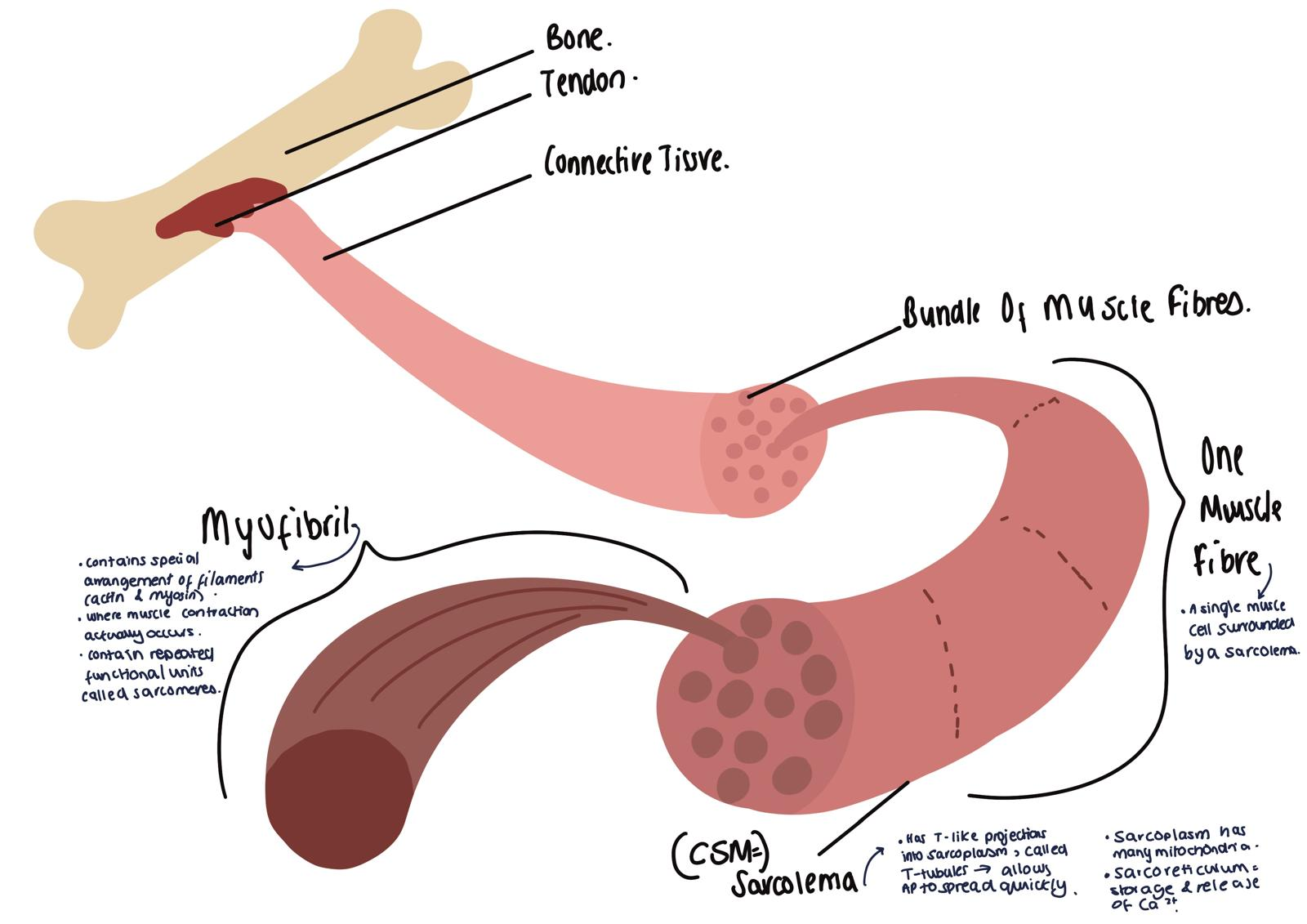
HOW DOES THE MUSCLE PROMOTE FAST AP SPREAD?
Sarcolemma has T-tubules.
LABEL A RELAXED SARCOMERE:
DEFINE A SARCOMERE
Sarcomeres are repeated functional units.
The ends of each sarcomere are marked by Z Lines.
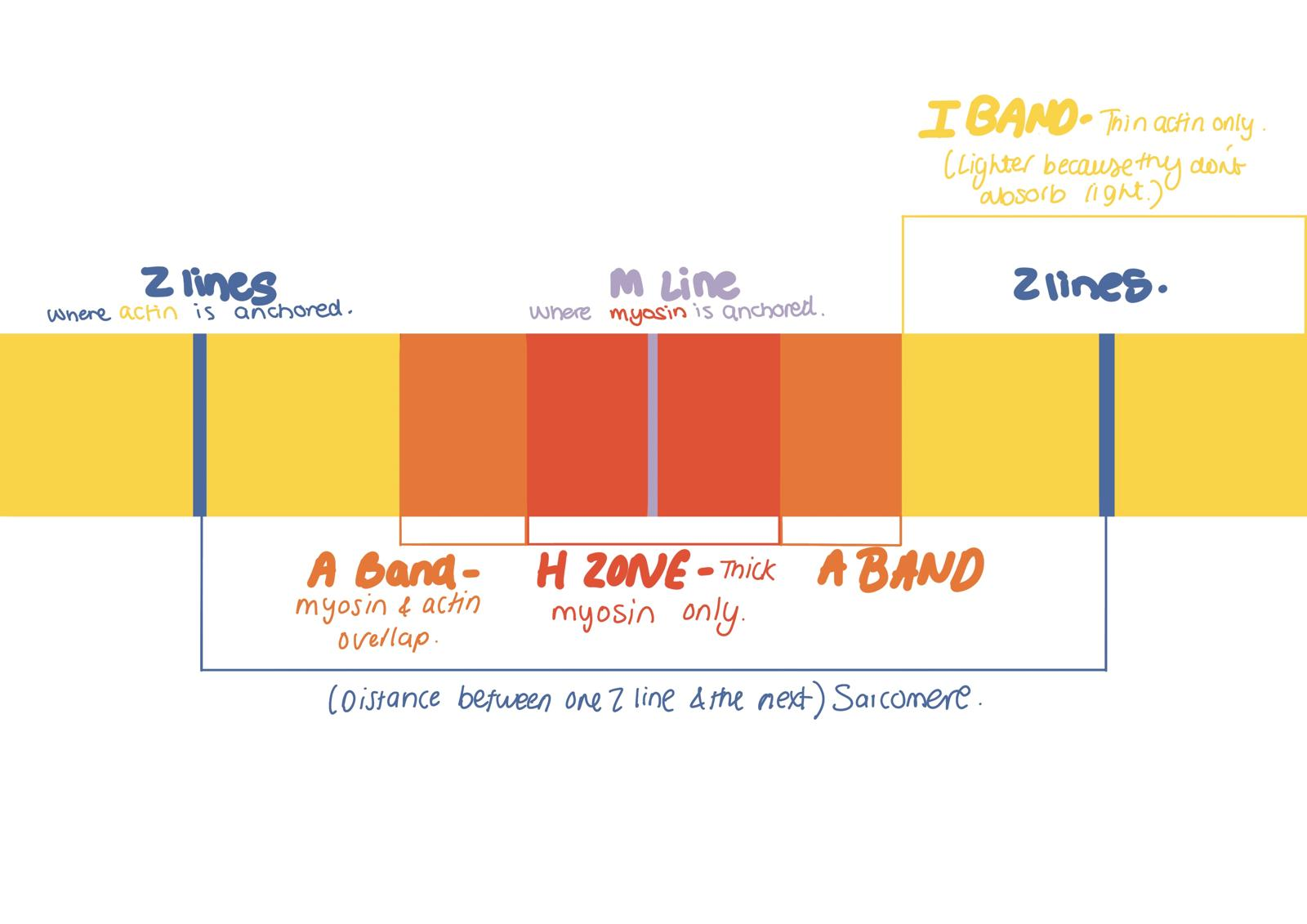
DESCRIBE THE SARCOMERE DURING MUSCLE CONTRACTION:
Contracts and shortens.
Actin filaments pulled over myosin filaments:
A band increases.
H Zone not present.
I Band shorter.
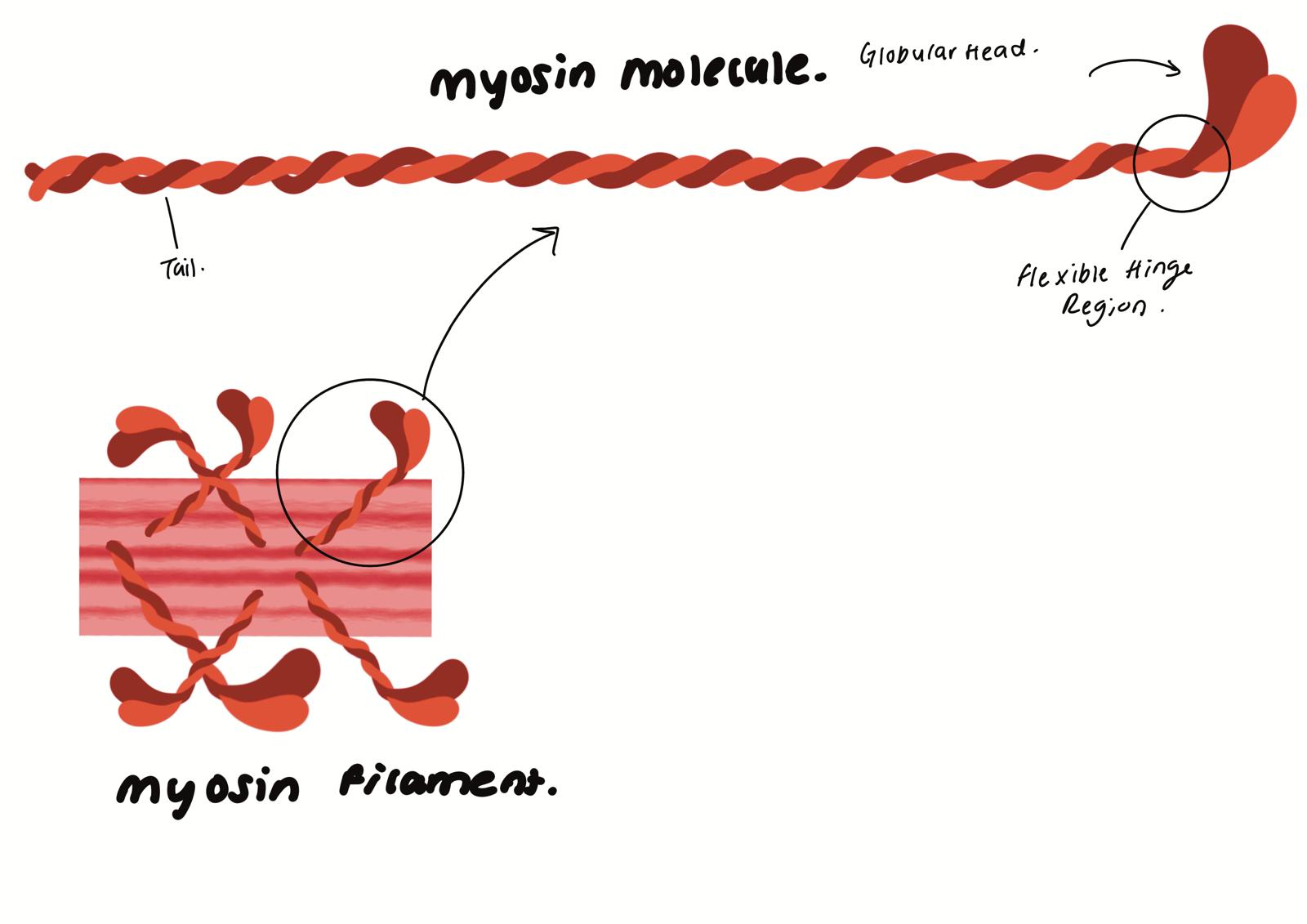
MYOSIN FILAMENTS:
Thick.
Many of many myosin protein molecules.
Tails of myosin molecules specifically shaped to bind to each other and form thick filaments.
Globular head protrudes in all directions to form acto-myosin (cross)bridges (AMB).
Each has a specific shape to bind and form AMB.
ACTIN FILAMENTS:
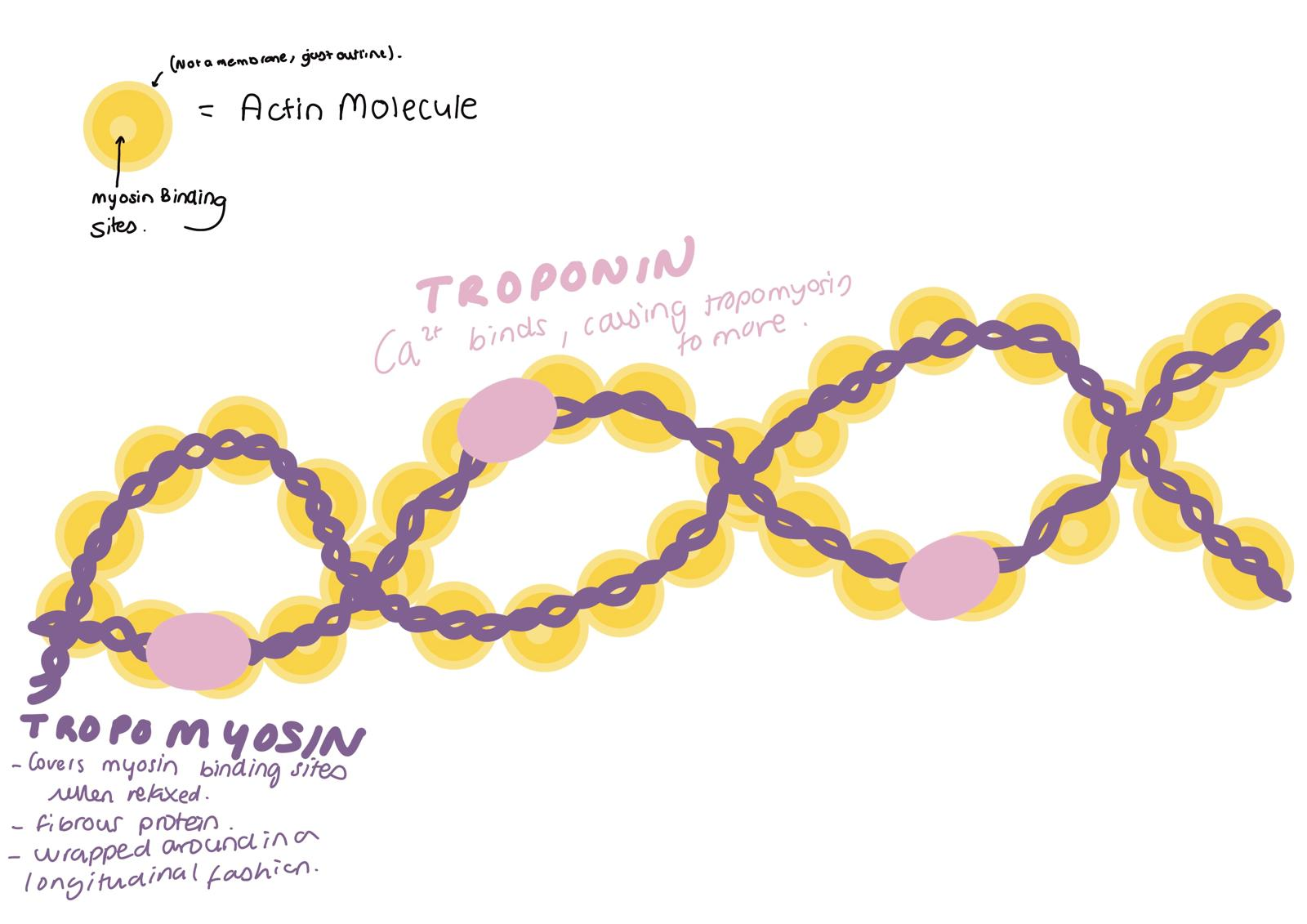
Actin filament made up of 2 helical strands of globular actin proteins that are twisted together.
Filaments associated with tropomyosin and tropinin proteins.
Tropomyosin wrapped around filaments in a longitudinal fashion.
Tropomyosin covers the myosin binding sites.
Troponin where Ca2+ binds to, causing Tropomyosin to move.
WHERE IS CA2+ STORED AND RELEASED FROM IN THE MUSCLE?
ROLE OF CA2+?
Sarcolemma.
Troponin where Ca2+ binds to, causing Tropomyosin to move.
Activates ATPse in myosin molecule heads.
PROCESS OF MUSCLE STIMULATION:
AP reaches a neuromuscular junction and triggers release of (excitatory) ACh from motor neuron terminal.
ACh causes AP in muscle CM (same way it does in PostSN).
AP spreads through muscle fibre via T-tubules.
T-tubules in contact with sarco-reticulum, which has actively absorbed Ca2+ from sarcoplasm.
AP opens Ca2+ channels on sarco-reticulum.
Ca2+ diffuse into sarcoplasm down diffusion gradient.
Ca2+ causes tropomyosin to unblock myosin binding sites.
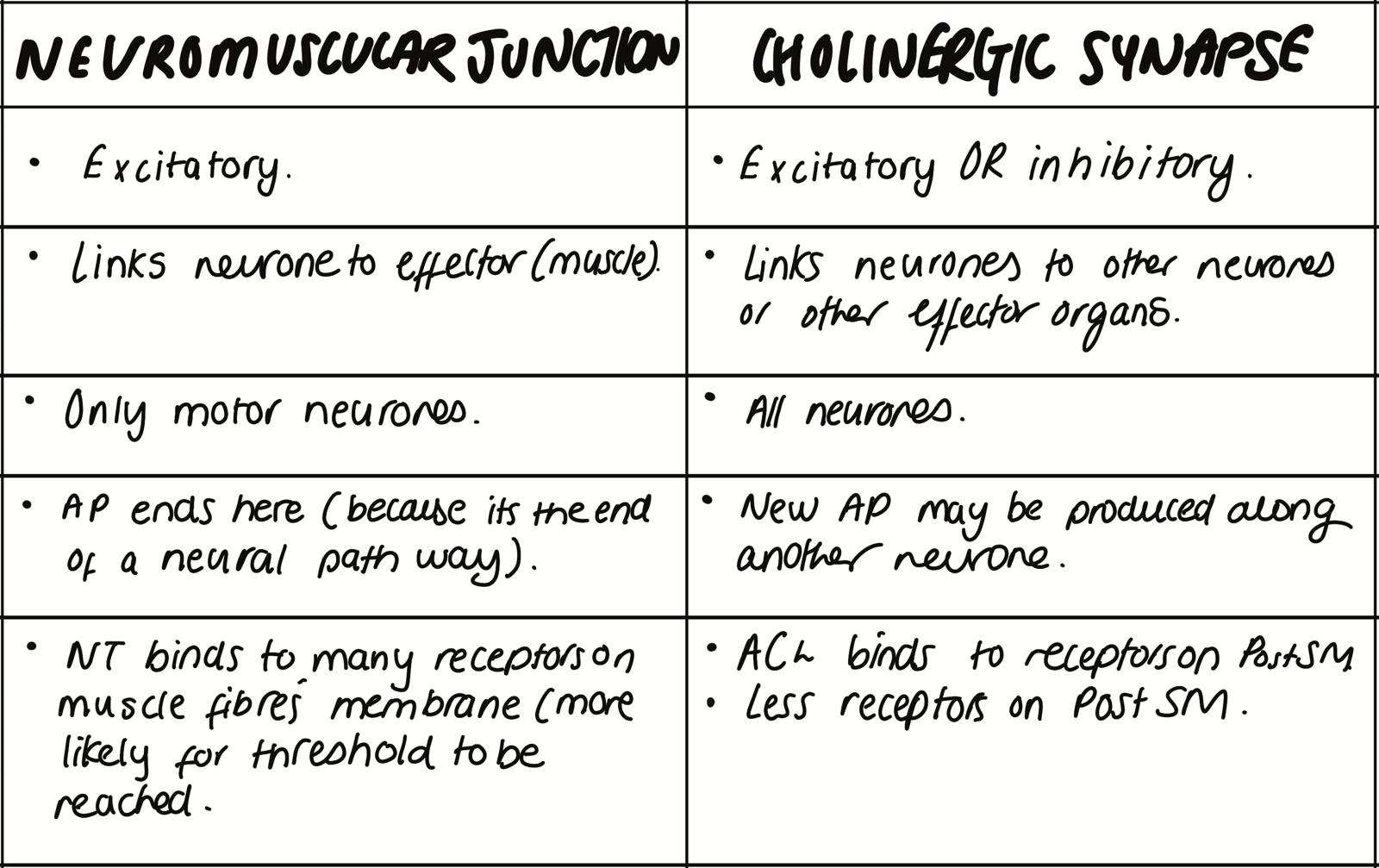
NEUROMUSCULAR JUNCTION AND CHOLINERGIC SYNAPSE SIMILARITIES:
Both have NT that are transported by diffusion.
Both have receptors, and if NT binds to it, there is an influx of NA+.
Both use Na+/K+ pump to repolarise axon.
Both use enzymes to hydrolyse NT.
NEUROMUSCULAR JUNCTION AND CHOLINERGIC SYNAPSE DIFFERENCES:
MUSCLE CONTRACTION:
Myosin heads plus attached ADP+Pi can now bind to actin fil and form AMB.
Power stroke: Myosin heads chance angle, pulling actin fil along.
ADP+Pi released.
New ATP attaches to each myosin head, causing it to detach from actin fil.
Ca2+ activates ATP hydrolase (located in myosin head).
Energy released used to recock myosin head: moves to original position.
Myosin head (has ADP+Pi again) reattaches itself further along actin fil.
Cycle repeated as nervous stimulation continues.
MUSLCE RELAXATION:
When nervous stimulation ceases:
Ca2+ actively transported back into sarco-reticulum.
Allows tropomyosin to block myosin binding sites.
Myosin no longer able to bind, contraction ceases, and muscle relaxes.
WHERE DOES THE ENERGY FOR MUSCLE CONTRACTION COME FROM DURING INTENSE EXERCISE:
WHICH METHOD SUPPLIES THE MOST ENERGY?
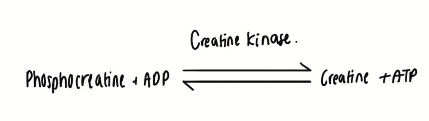
When ATP runs out, it’s quickly resynthesised using phosphate and the energy released from splitting of phosphocreatine (PC) into phosphate and creatine.
Then from glycolysis.
Then oxidative phosphorylation.
PC has the most energy.
PHOSPHOCREATINE:
Hydrolysed to phosphate and creatine.
Stored in muscle.
Reserve supply of phosphate ions.
Cannot supply energy directly to muscle, only used to regenerate ATP.
Store is replenished using phosphate from ATP when muscle is relaxed.
WHAT IS THE TRIGGER FOR A MUSCLE CONTRACTION?
Nerve impulse.
WHAT DETERMINES THE LENGTH OF A MUSLCE CONTRACTION?
How long Ca2+ remains in the sarcoplasm.
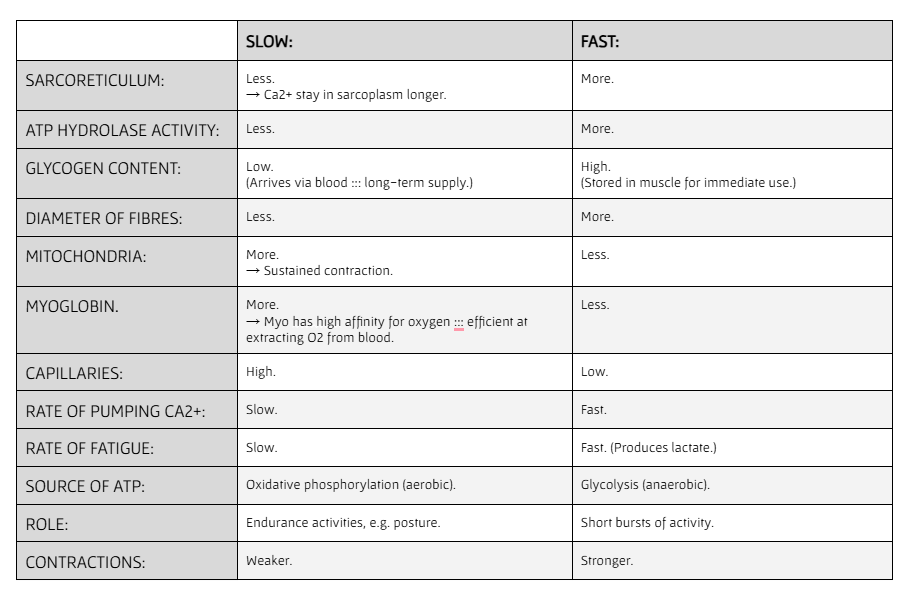
Time differs based on type of skeletal muscle - fast and slow twitch fibres.
PROPORTION OF FAST TO SLOW TWITCH FIBRES:
Genetically determined.
But can be changed with exercise.
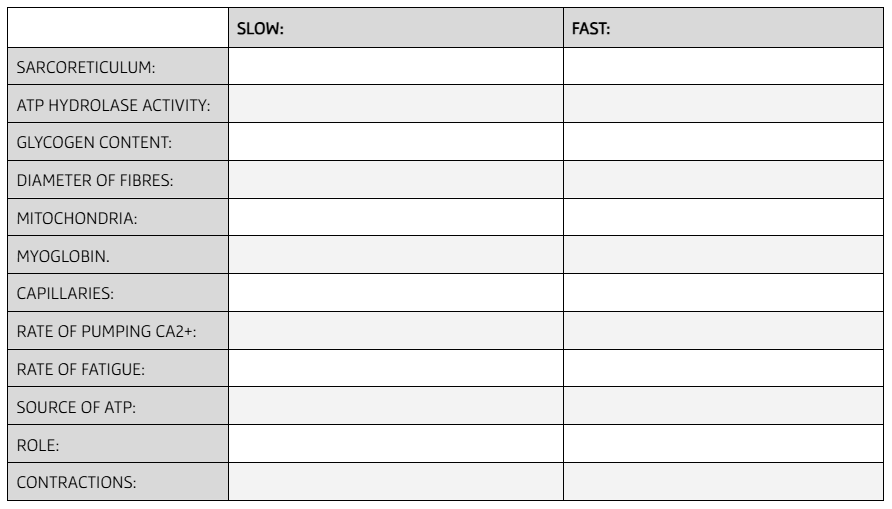
COMPARE SLOW AND FAST TWITCH FIBRES: