West Coast EMT Block 2 Study Guide, West Coast EMT Block #2 Exam, West Coast EMT Block #2 Exam, West Coast EMT Block 2 Exam, West Coast EMT Block 2 Exam
 Call Kai
 Learn
Learn Practice Test
 Spaced Repetition
 Match
Match Flashcards
 Knowt Play
1/679

There's no tags or description
Looks like no tags are added yet.
Name | Mastery | Learn | Test | Matching | Spaced | Call with Kai | Chat |
|---|
No analytics yet
Send a link to your students to track their progress
680 Terms
electrical conduction of the heart
The flow of electrical current causes smooth, coordinated heart contractions; they produce pumping action of the heart
Depolarization
electrical charges on the surface of the muscle cell change from positive to negative
Repolarization
the heart returns to its resting state, and the positive charge is restored to the surface
Where do the electrical impulses begin?
Electrical impulses begin high in the atria in the sinoatrial node, travel to the atrioventricular node and bundle of His, and then move through the Purkinje fibers to the ventricles
Three types of muscle
skeletal, cardiac, smooth
Skeletal muscle
Voluntary muscle/Striated muscle (characteristic stripes): Movement of the body like waving or walking/ Skeletal muscle is attached to the bones of the skeleton
Smooth muscle
Found within blood vessels and intestines
Cardiac muscle
found only within the heart and is able to create and conduct its own electrical impulses
Ligaments
Connect bone to bone
Tendons
Ropelike structures that connect muscles to bones
Cartilage
Smooth connective tissue that covers the ends of bones at mobile joints
Anatomy of lower airway: delivers oxygen to alveoli
Trachea (windpipe): conduit for air entry into the lungs; divides at the carina into two main stem bronchi, right and left
Bronchioles: dilate and constrict as oxygen passes through them
Small bronchioles connect to alveoli: site of oxygen and carbon dioxide exchange
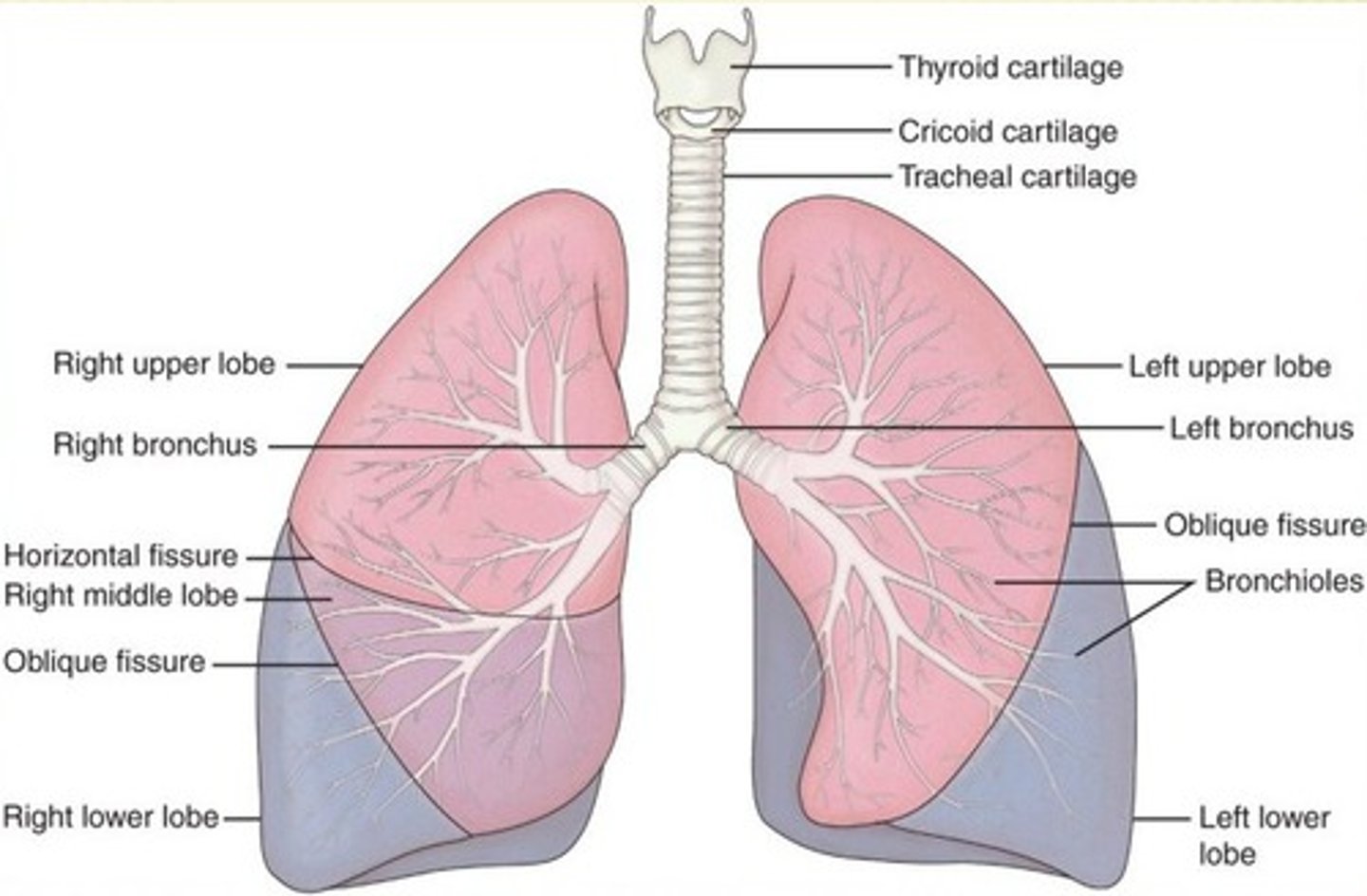
Thyroid cartilage (adam's apple): forms the anterior part of the larynx
Cricoid cartilage: immediately below the thyroid
Cricothyroid membrane
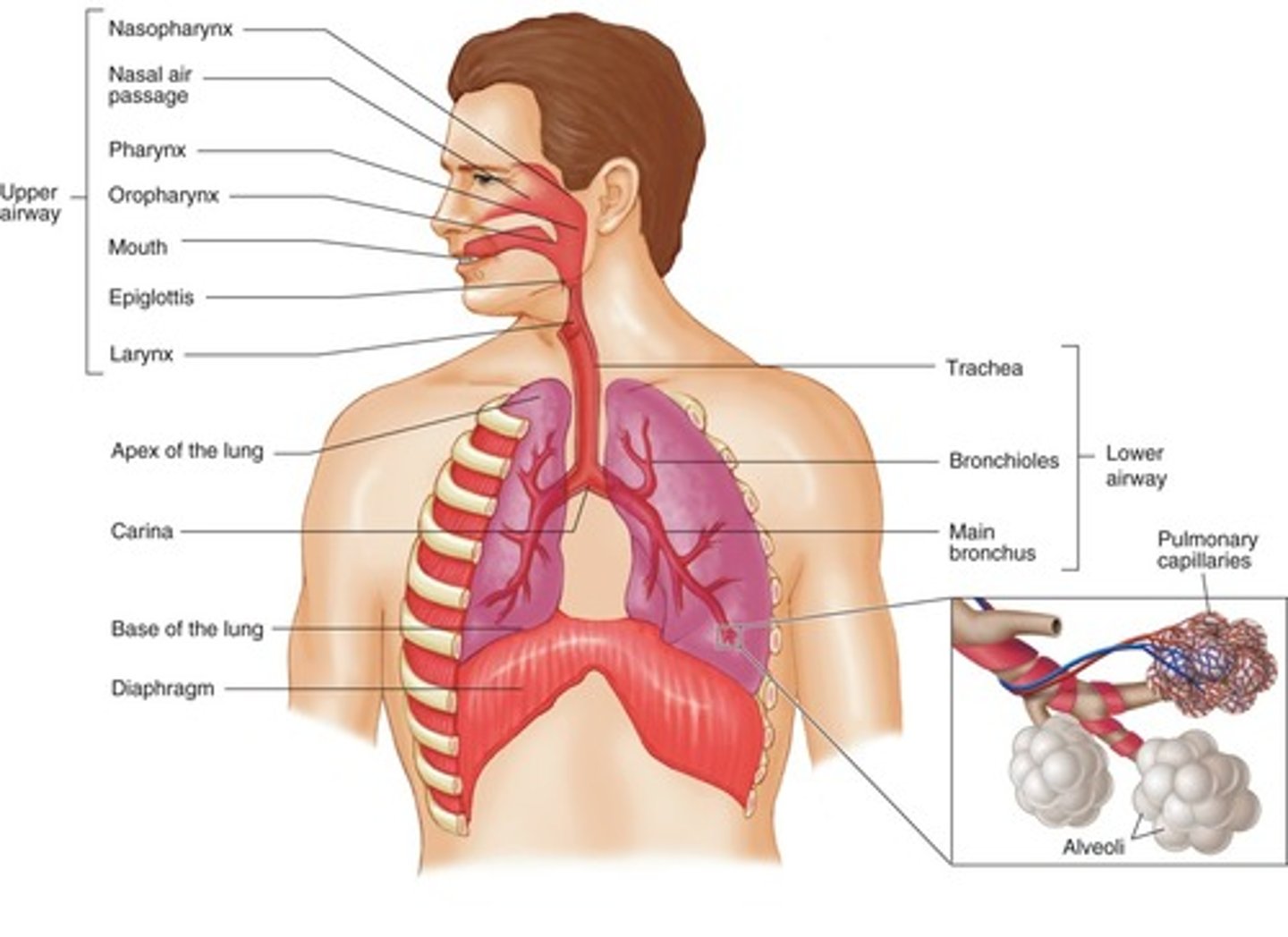
Anatomy of upper airway
Nose, Mouth (Oral Cavity), Jaw (mandible), Tongue, Pharynx, and Larynx (Voice Box)
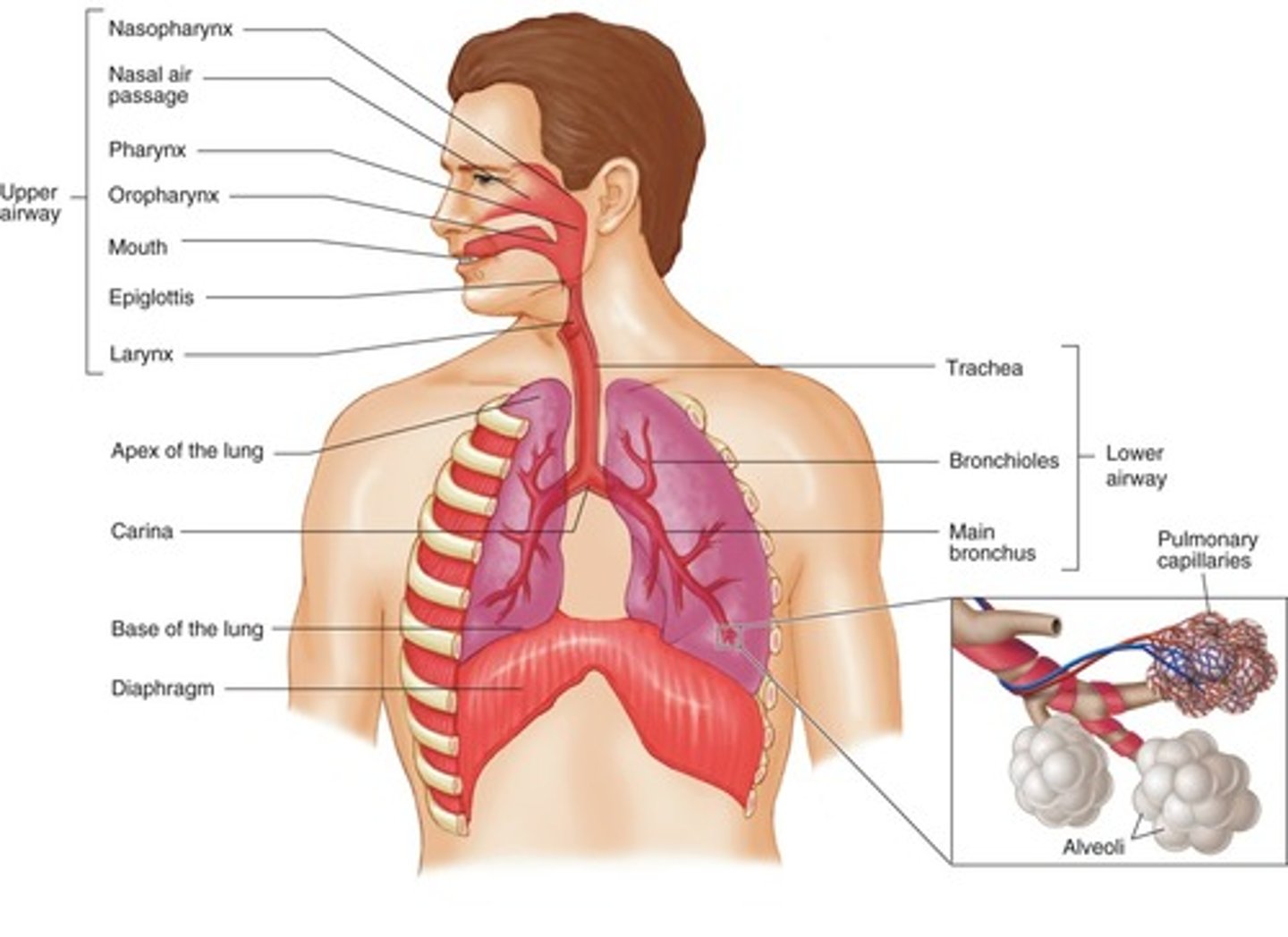
The Larynx
Does not tolerate any foreign or liquid material and any contact will result in a violent episode of coughing
The nose and mouth lead to the?
Oropharynx (throat)
The pharynx is composed of the?
nasopharynx, oropharynx, laryngopharynx
The nostrils lead to the?
Nasopharynx (above the roof of the mouth and soft palate)
The mouth leads to the?
oropharynx
Two passages that are located at the bottom of the pharynx are?
the trachea (windpipe) and the esophagus (carries food to the digestive system)
The two lungs are held in place by
trachea, arteries and veins, pulmonary ligaments
Right lung's lobes
The right lung has upper, middle, and lower lobes
Left lung's lobes
The left lung has upper and lower lobes
Anatomy of the lung
Coronal plane
front and back
Transverse (axial) plane
Top and bottom
Saggital (lateral)
Left and right
Midsagittal (midline)
Left and right (equal halves)
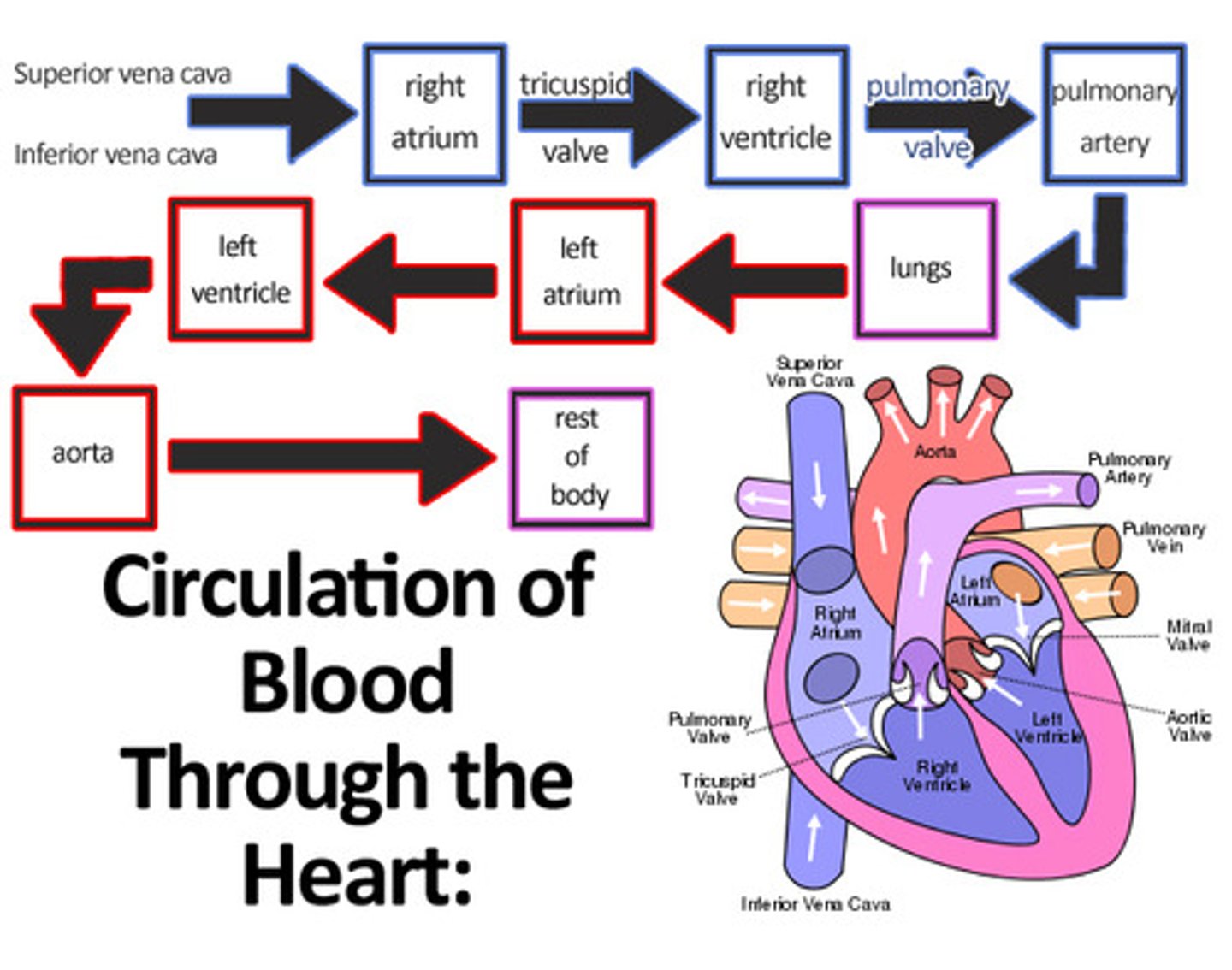
Blood flow through the heart
Super Vena Cava --> Rt atrium --> Tricuspid --> Rt ventricle --> Pulmonic valve --> Lungs --> Lt atrium --> Mitral valve --> Lt ventricle --> aortic valve --> aorta --> Body
The right (slower pressure) side of the heart pumps blood from the body through the lungs
The left (high pressure) side of the heart pumps oxygen-rich blood to the rest of the body
Arteries
carry blood away from the heart
Veins
Blood vessels that carry oxygen-poor blood back to the heart
Central pulses
Carotid artery pulse (at the upper portion of the neck)
Femoral artery pulse (in the groin)
Peripheral pulses
Radial artery pulse (at the wrist at the base of the thumb)
Brachial artery pulse (on the medial aspect of the arm, midway between the elbow and the shoulder)
Posterior tibial artery pulse (posterior to the medial malleolus) - in the inside of the ankle)
Dorsalis pedis artery pulse (on the top of the foot)
White blood cells
Fights infection
Red blood cells (hemoglobin)
transports oxygen
Plasma
Transports carbon dioxide
Plasma (water)
transports wastes and nutrients
Platelets
clotting (coagulation)
Chemicals within the plasma
controls (buffer) pH
Organs in the right upper quadrant (RUQ) of abdomen
Liver, gallbladder, and a portion of the colon
Organs in the left upper quadrant (LUQ) of abdomen
stomach, spleen, and a portion of the colon
Organs in the right lower quadrant (RLQ) of abdomen
contains two portions of the large intestine (cecum and ascending colon); the appendix is attached to the lower cecum
Organs in the left lower quadrant (LLQ) of abdomen
contains the descending and sigmoid portions of the colon
Cardiac output (CO)
the amount of blood moved in 1 minute
HR x SV = CO
Stroke volume (SV)
the amount of blood moved by one beat
Functions of blood
perfusion, transporting oxygen, transporting carbon dioxide, transporting wastes and nutrients, and clotting
Liver
Production of bile
Assists with carbohydrate, protein and fat metabolism of nutrients within the bloodstream
Manufactures proteins for immune regulation and clotting
Detoxification of blood
Elimination of waste
Pancreas
Exocrine: enzymes for protein, carbohydrate and fat breakdown
Endocrine: (islets of Langerhans) produces insulin and glucagon to regulate the amount of glucose in the blood
Bile ducts
Connects the liver to the intestine
The major function of bile is the digestion of fat
Gallbladder
stores and concentrates the bile produced in the liver
urinary system
Eliminates nitrogenous wastes from the body.
Regulates water, electrolyte and acid-base balance of the blood.
Diffusion
Movement of molecules from an area of higher concentration to an area of lower concentration.
Ventilation
the physical act of moving air into and out of the lungs
Oxygenation
the process of loading oxygen molecules onto hemoglobin molecules in the bloodstream
Respiration
the actual exchange of oxygen and carbon dioxide in the alveoli as well as the tissues of the body
Inhalation
The active, muscular part of breathing
The diaphragm and intercostal muscles contract, allowing air to enter the body and travel to the lungs. The chest expands
Thoracic cage expands and air pressure within the thorax decreases, creating a vacuum
When air pressure outside equals air pressure inside, air stops moving. Gases, such as oxygen will move from an area of higher pressure to an area of lower pressure until the pressures are equal.
Activated Charcoal
Action: absorbs toxic substances in digestive tract
Indications: most oral poisonings
Contraindications: decreased LOC; overdose of corrosives; causatics (substances such as acid or an alkali), or petroleum substances
Side effects: nausea, vomiting, constipation, black stools
Dose: adult dose is 1-2 g/kg of body weight (divide weight in lb by 2.2)
Spinal column (total 33 bones)
Cervical spine (first 7)
Thoracic spine (next 12)
Lumbar spine (next 5)
Sacrum (5)
Coccyx (4)
Aspirin (Bayer, Acetylsalicylic or ASA)
Action: anti-inflammatory
Indications: Relief of mild pain, headache, muscle aches; chest pain of cardiac origin
Contraindications: hypersensitivity; pre-existing liver damage; bleeding; asthma (relative)
Dose: Adult dose is 160-325 mg for chewable and tablet
Side effects: nausea, vomiting, stomach pain, bleeding, allergic reaction
MDI medications (Albuterol, Proventil, Ventolin)
Action: stimulates nervous system, causing bronchodilation (increase flow to lungs)
Indications: Asthma/difficulty breathing with wheezing
Contraindications: hypersensitivity, tachycardia, chest pain of cardiac origin
Dose: Adult dose is 1-2 inhalations; wait 5 mins before repeating dose
Side effects: hypertension, tachycardia, anxiety, restlessness
Epinephrine (EpiPen)
Action: stimulates nervous system, causing bronchodilation
Indications: Anaphylactic reaction
Contraindications: chest pain of cardiac origin, hypothermia, hypertension
Dose: 0.3 mg for adult; 0.15 mg for children
Side effects: hypertension, tachycardia, anxiety, restlessness
Naloxone (Narcan, EVZIO, auto-injector)
Action: Reverses respiratory depression secondary to Opioid overdose
Indications: Opiod poisoning
Contraindications: hypersensitivity
Dose: Adult dose is 2 mg Intramuscular or IN
Side effects: nausea, vomiting
Nitroglycerin (Nitrostat, Nitromist)
Action: Dilates blood vessels
Indications: chest pain of cardiac origin
Contraindications: hypertension, use of sildenafil (Viagra) or another treatment for erectile dysfunction
Dose: 0.3-0.4 mg SL; 0.4 mg spray
Side effects: Headache, burning under tongue, hypertension, nausea
Oral glucose
Action: Provides glucose for cellular use
Indications: low blood glucose (hypoglycemia)
Contraindications: decreased LOC, nausea, vomiting
Dose: 1/2-1 tube
Side effects: vomiting, nausea
Acetaminophen (Tylenol)
Action: analgesic and fever reducer
Indications: relief of mild pain or fever, headache, muscle aches
Contraindications: hypersensitivity
Dose: 500-1,000 mg every 4 hours as needed; dose is weight-based for children
Side effects: allergic reaction
Diphenhydramine (Benadryl)
Action: Antihistamine (blocks histamine)
Indications: mild allergic reaction
Contraindications: Asthma, glaucoma, pregnancy, hypertension
Dose: 25-50 mg
Side effects: sleepiness (can stimulate children), dry mouth and throat
Ibuprofen (Advil, Motrin, Nuprin)
Action: nonsteroidal anti-inflammatory that reduces inflammation and fever
Indications: mild pain or fever, headache, muscle aches
Contraindications: hypersensitivity
Dose: adult dose is 200-400 mg every 4-6 hours; dose is weight-based for children
Side effects: nausea, vomiting, stomach pain, bleeding, allergic reactions
Exhalation
diaphragm relaxes (moves up)
The size of the thoracic cage decreases, then air in the lungs is compressed into a smaller space
Air pressure becomes higher than the outside pressure, and the air is pushed out through the trachea
Tidal volume
the amount of air (in mL) that is moved in or out of the lungs during one breath
Residual volume
the air that remains in the lungs after maximal expiration
Minute volume
the volume of air moved through the lungs in 1 minute; calculated by Tidal volume X respiratory rate
Dead space
the portion of the tidal volume that does not reach alveoli and thus does not participate in gas exchange
Metabolism (cellular respiration)
The biochemical processes that result in production of energy from nutrients within the cells.
Respiration
the process of exchanging oxygen and carbon dioxide. Occurs by diffusion, in which a gas moves from an area of greater concentration to an area of lower concentration
External Respiration (pulmonary respiration)
the process of breathing fresh air into the respiratory system and exchanging oxygen and carbon dioxide between the alveoli and the blood in the pulmonary capillaries
Surfactant
A liquid protein substance that coats the alveoli in the lungs, decreases surface tension and keeps the alveoli expanded to make gas exchange easier
A low level in the premature infant contributes to respiratory distress syndrome
anaerobic respiration
Respiration in the absence of oxygen. This produces lactic acid, and can't meet the metabolic demands of the cell
aerobic respiration
Respiration that requires oxygen, where cells convert glucose into energy
Ventilation/Perfusion Ratio and Mismatch
Air and blood flow must be directed to the same place at the same time (ventilation aka air flow, V and perfusion aka blood flow, Q must be matched)
When ventilation is compromised but perfusion continues, blood passes over some alveolar membranes without gas exchange taking place. Carbon dioxide is recirculated within the blood stream, which could lead to hypoxemia
When blood flow is compromised, less oxygen is absorbed in the blood stream and less carbon dioxide is removed
Intrapulmonary shunting
blood entering the lungs from the right side of the heart bypasses the alveoli and returns to the left side of the heart in an unoxygenated state
Respiratory compromise
The inability of the body to move gas effectively.
Epiglottis
A flap of tissue that seals off the windpipe and prevents food from entering.
Pharynx
throat; passageway for food to the esophagus and air to the larynx
Composed of the nasopharynx, oropharynx, and laryngopharynx
nasopharynx
filters out dust and small particles, humidifies air as it enters the body
oropharynx
entrance for respiratory and digestive system
what is in the lower airway
trachea (esophagus and epiglottis), bronchi, bronchioles, alveoli, cricoid cartilage, cricothyroid membrane
what does the Coronary artery supply?
Supplies the heart
What does the Carotid artery supply?
supplies the head
What does the hepatic artery supply?
Supplies the liver
What do the renal arteries supply?
Supplies the kidneys
what do the mesenteric arteries supply?
Supplies the digestive system
what do the Pulmonary arteries supply?
Carrie's oxygen poor blood to the lungs
Snoring breath sounds
These suggest an obstruction or narrowing of the lower airways
Wheezing breath sounds
These suggest an obstruction or narrowing of the lower airways.
Wheezing is a high-pitched whistling sound that is most prominent on expiration.
Crackling breath sounds (rales)
Wet, crackling breath sounds that indicate fluid in the lungs
Rhonci breath sounds
Congested breath sounds that suggest mucus in the lungs
Stridor breath sounds
high-pitched, harsh sound caused by a spasm or swelling of the larynx or an obstruction in the upper airway
Spleen
filters out old red blood cells, produces some white blood cells, and removes pathogens and antigens your body has already attacked and killed
Factors that impair ventilation
blocked airway
impairment of the breathing muscles
obstructed airway (asthma)
chest trauma
change in altitude
change in atmosphere
allergic reaction
impairment of movement of gas in cell membranes
What are the pump failure types of shock?
Cardiogenic shock
Obstructive shock
what are the poor vessel types of shock?
Anaphylactic shock
Psychogenic shock
Neurogenic shock
Septic shock