TRULY Geography carbon and water cycles
 Call Kai
 Learn
Learn Practice Test
 Spaced Repetition
 Match
Match Flashcards
 Knowt Play
1/73

There's no tags or description
Looks like no tags are added yet.
Name | Mastery | Learn | Test | Matching | Spaced | Call with Kai |
|---|
No analytics yet
Send a link to your students to track their progress
74 Terms
system definition and types of system
definition - a group of interacting parts connected by the flows or transfers of energy, material and matter
open - external inputs and outputs of enegry and matter
closed - systems only have energy as input / output all material is contained
isolated - systems not sharing energy or matter with their surroundings e.g. a coconut
cascading - energy and material are transfered from one subsytem to another
Earth’s global systems
atmosphere - interaction of gases
hydrosphere - interaction of water
biosphere - interaction of water
lithosphere - interaction of the crust
components of a system - definition + examples
input - matter moving into a system from the outside e.g. precipitation
output - matter / energy moving outside the system or another system e.g. surface runoff
energy - power or driving force e.g. insolation
stores / components - parts / elements of a system e.g. puddles
flows / transfers - movement of parts within the system
equilibrium definition
a state of balance where inputs and outputs are equal and processes operate to maintain balance.
any disturbance will throw the system into change
feedback loops - positive, definition + example
active mechanisms in systems that maintain / restore equilibrium
positive - amplifies change, self -perpetuating
one change leads to another, change becomes bigger and throws system out of balance
e.g.
ice reflects radiation from the sun, reducing surface warming, as sea temperatures rise, and ice melts, the warming effect is amplified
there is less ice to reflect, causing higher temps and melting more ice
feedback loops - negative, definition + example
negative - ‘checks’ or dampens change - self-regulating
promotes stability and maintains equilibrium
example:
increased photosynthesis in plants and rising global temperatures to grow in new areas e.g. melted permafrost
new vegetation absorbs co2 from the atmosphere, decreasing warming effect
Major stores of freshwater
frozen water in the cryosphere = 68.7%
liquid water in the hydrosphere = 1%
water vapour in the atmosphere = 0.2%
groundwater in the lithosphere = 30.1%
the water cycle - inputs
precipitation - water that falls to the surface of the earth to the atmosphere including rain, snow and hail
do not confuse rainfall with precipitation as there are 3 different types of rainfall
convectional - heating by the sun, warm air rises, condenses at higher altitudes and falls as rain
relief - warm air forced upward from barriers e.g. mountains, causing it to condense at higher altitudes and fall as rain
frontal - warm air rises over cool air, when they meet the warm air rises and condenses at higher altitudes, causing rain
the water cycle - outputs
evapotranspiration - compromised of evaporation and transpiration (plants respiring thorugh their leaves)
streamflow - all water that enters a drainage basin will either leave through the atmosphere of throguh streams which drain the bais
the water cycle flows - infiltration and infiltration capacity
infiltration - water moving from above ground to soil
infiltration capacity - how quickly infiltration occurs e.g. grass and trees create passages for wate rot flow through the surface of the soil
the water cycle flows - percolation and throughflow
percolation - water moves from soil into porous rocks, percolation rate dependant on fractures
throughflow - water moves through soil into streams or rivers, speed dependign on type of soil and spore spaces
water cycle flows - surface runoff and groundwater flow
surface runoff - water flows above the ground as sheetflow or rills
groundwater flow - water moves through rocks
water cycle flows - streamflow and stemflow
streamflow - water moves through established channels
stemflow - flow of water that has been intercepted by plants or trees
water cycle flows - evapotranspiration and sublimation
evapotranspiration - the combination of evaporation and plant transpiration
sublimation - when water changes from a solid into a gas without passing through a liquid stage
water cycle - stores of water
soil water - water in soil utilised by plants
groundwater - store din pore spaces of rock
river channel - stored in rivers
interception - intercepted by plants on branches and leaves before reaching the ground
surface storage - water stored in puddles ponds, lakes etc.
the water balace - definition and formula
water balance is used to express the process of water storage and transfer in a drainage basin system, with the formula:
precipitation = total runoff + evapotranspiration ± (change in) store
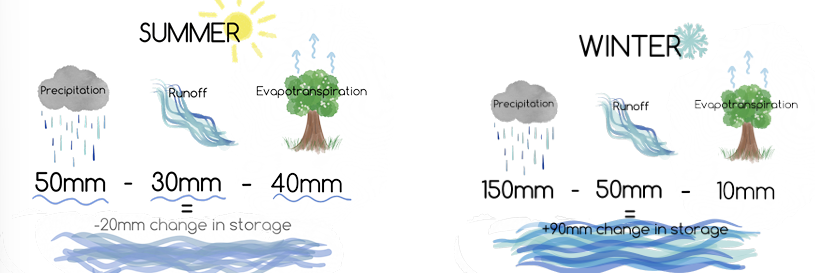
changes in the water cycle - deforestation
less interception by trees, increasing surface runoff
the soil is no longer held together by roots, so soil water storage decreases
there are fewer plants so transpiration decreased
changes in the water cycle - storm events
large amounts of water saturates the ground, increasing the surface runoff
storm events are therefore less effective for recharging water stores than prolonged rainfall
slow rainfall over a period allows water to infiltrate, storms do not allow this, leading to percolation and surface runoff
changes in the water cycle - seasonal changes
spring - more vegetation means more interception
summer - likely to be less rain, making grounds more impermeable
autumn - less vegetation so less interception
winter - frozen ground is often impermeable
changes in the water cycle - agriculture
pastoral farming (livestock) - trampling increases infiltration due to looser soil
drainage ditches increases surface runoff and streamflow
hillside terracing (rice fields) - increases surface water storage and therefore decreases runoff
changes in the water cycle - urbanisation
creating roads and buildings uses impermeable surfaces, reducing infiltration but reducing : surface runoff, reducing lag-time and increasing flood risk
SUDS use grass and soil to reduce impermeable surface in urban areas
soil water budget - definition and diagram
soil water budget shows the balance between inputs and outputs in the water cycle and their impact on soil storage / availability
the water budget is dependant on type, depth and permeability of the soil and bedrock
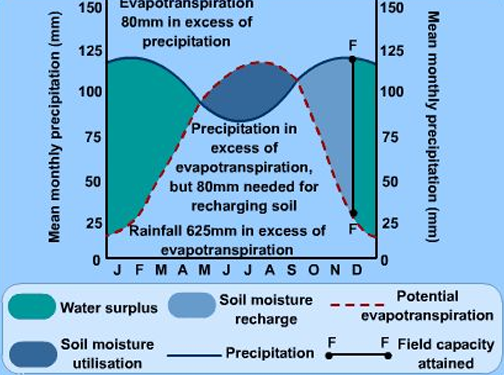
seasonal variation of the soil water budget
autumn - greater unput of precipitation than evapotranspiration due to cooler temp and plant photosynthesising less. soil moisture levels increase and water surplus occurs
winter - potential evapotranspiration is at a minimum due to cold temp, with precipitation continuing to refill soil water stores
spring - potential evapotranspiration increases as temperature rises
summer - hot weather leads to water utilisation of soil water as evapotranspiration peaks and rainfall is minimumm
global scale water cycle - 4 major stores
hydrosphere - 97% of global water and 30% is freshwater groundwater
lithosphere - stored in crust and lower mantle
cryosphere - water that is frozen
atmosphere - water vapour
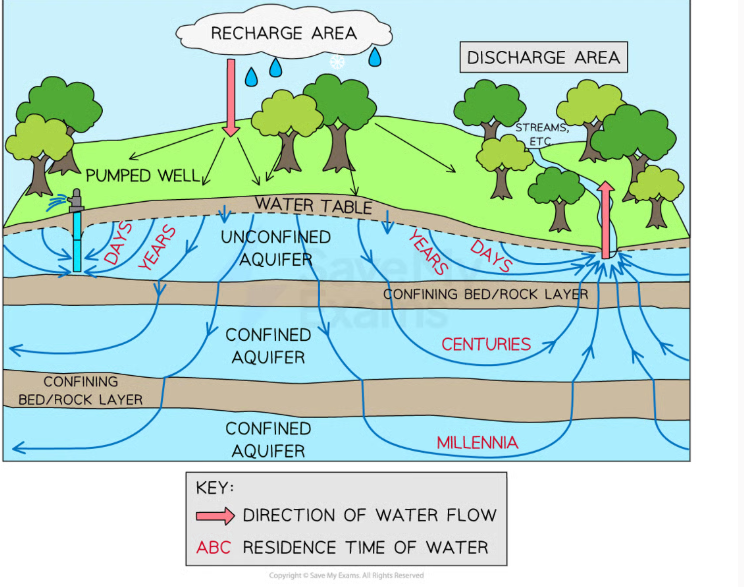
aquifers - definition
underground water stores:
shallow groundwater aquifers - store for 200 years
deeper fossil aquifers - 10,00 years
glaciers - 20-100 years
lakes - 50-100 years
snow and rivers - 2-6 months
soil water - 1-2 months
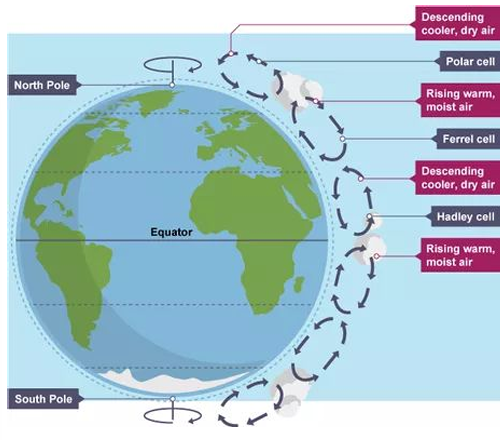
The Inter-Tropical Convergence Zone (ITCZ
main factor in determining cloud formation and rainfall, with different zones of rising and falling air that leads to precipitation through convectional rainfall
this creates a low pressure zone on the eqautor called the ITCZ, which moves during the seasons as the suns position changes, where has Ferral and Hadley cells meet, unstable weather by the jet-stream causes changeable weather e.g. the UK
changes in the water cycle: natural processes
seasons:
less precipitation and increas evapotranspiration in summer
reduced flows in the water cycle and reduced interception in winter
storms - causes sudden increases in rainfall short-term
droughts - cause major stores to be depleted and activities of flows acting to decrease, long-term
cryospheric process - glaciers can melt and shrink casing sea levels to rise
changes in the water cycle: El Nino and El Nina
El Nino - occurs every 2-7 years and causes warm surface water to move eastward toward Sotuh America
L Nina - trade winds strengthen, causing lower temperatures and drier conditions in the US
changes in the water cycle: human impacts
farming
ploughing breaks up the surface
arable farming (crops) increases interception and evapotranspiration
pastoral (animals) compacts soil, reducing infiltration and increasing runoff
land use
deforestation reduces interception and infiltration increase
construction reduces infiltration and evapotranspiration
water abstraction ( removed from stores for human use)
increases in dry seasons and reduces store capacity
can reduce global long-term water stores e.g. aquifers
flood hydrographs: diagram and key components
represents rainfall in a drainage basin of a river and the discharge of the same river at the same time.
discharge - the volume of water passing through the cross-sectional point of the river at one point in time, measured in Cubic Metres Per Second (Cumecs)
rising limb - represents discharge icnrease
falling limb - represents discharge decrease
lag time - time between peak rainfall and peak discharge
baseflow - level of groundwater flow
flood hydrographs: flashy and subdued hydrographs
flashy:
short lag time
steep rising and falling limb
higher flood risk
higher peak discharge
subdued:
long lag time
gradually rising and falling lmb
lower flood risk
lower peak discharge
flood hydrographs: natural factors affecting surface runoff
high rainfall activity - higher discharge potential from rivers and soil to reach its field capacity
Geology - decreased percolation increases throughflow
high drainage density - many tributaries to main river, increasign speed of drainage, decreasing lag time
low temperatures - less evapotranspiration so greater peak discharge
flood hydrographs: human factors affecting surface runoff
urbanisation - more impermeable surfaces, so runoff increased and surface storage / infiltration reduced
pastoral farming - ground tramples so less interception and more surface runoff
deforestation - less interception by trees, increasing surface runoff
transfers in the carbon cycle - photosynthesis
Plants are sequestering carbon and reducing impacts of climate change.
the process of photosynthesis occurs when chlorophyll in the leaves of the plant react with CO2 to create carbohydrate glucose.
formula:
Carbon dioxide + water + light energy → Oxygen + Glucose
transfers in the carbon cycle - respiration
when plants and animals covert oxygen and glucose into energy, creating waste products of water and CO2:
formula
Oxygen + Glucose → CO2 + H2O
transfers in the carbon cycle - combustion and decomposition
combustion - when fossil fuels / organic matter are burnt, they emit CO2 into the atmosphere
decomposition - when living organisms, die, they are broken down by decomposers e.g. bacteria which respire, returning CO2 to the atmosphere
transfers in the carbon cycle - diffusion and weathering / erosion
diffusion - oceans can absorb CO2 from the atmosphere, increasing ocean acidity, making it the largest carbon store
weathering / erosion - rocks eroded / weathered by carbonic acid from from CO2 and rainwater, aiding erosion in rocks, e.g. limestone
transfers in the carbon cycle - burial / compaction
burial and compaction - when shelled marine organisms die, their shell fragments fall on the ocean floor, becoming compacted overtime to form limestone, and can overtime form fossil fuel deposits
transfers in the carbon cycle - carbon sequestration, adv and dis
definition - transfer of carbon from the atmosphere to other stores, being natural artificial e.g. photysnthesis and Carbon Capture and Storage (CCS)
adv:
fitted into existing power stations
caputees 90% of CO2 produced
potential to capture half of world CO2 emissions
dis:
high costs restriction
increased energy demand of power station
may not be space to fit in existing power station
flows of carbon - sere scale
a sequence of plant communities that develop overtime during ecological succession, changing the carbon stores in the area e.g.
steps towards climax:
Bare rock
lichens
small annual plants
grass, shrubs, shade intolerant trees
shade-tolerant trees
temperature deciduous forest
flows of carbon - sere scale, climatic climax
the final stage of there sere where environmental equilibrium is achieved, where the ecosystem is fully developed and stable e.g. woodland in the UK or a rainforest in Brazil
Carbon sink and Carbon store
carbon sink - any store that takes in more carbon than emits e.g. intact tropical rainforest
carbon source - emits more than it stores
Main carbon stores - marine sediments/ sedimentary rocks and oceans
marine sediments / sedimentary rocks - lithosphere, long-term
the largest store, with 66,000-100,000 million billion metric tons of carbon, recycling of this carbon can take millions of years
oceans - hydrosphere, dynamic term
2nd largest store, contains a fraction to the largest, being 38,000 billion metric tonnes, being utilised by marine organisms
Main carbon stores - fossil fuel deposits and soil organic matter
fossil fuel deposits - lithosphere - long term (but now dynamic)
largely rarely change but humans have developed technology to exploit them rapidly
soil organic matter - lithosphere - mid-term
store for over a hundred years, but deforestation, agriculture and land use are affecting this store
Main carbon stores - atmosphere and terrestrial plants
atmosphere - dynamic
human activity increased CO2 levels int he atmosphere by around 40% since the industrial revolution
terrestrial plants - biosphere, mid-term
vulnerable to climate change and deforestation as a result in climate change
information on forests and climate change:
non-tropical forests have seen an increase in carbon sequestration due to conversation of agricultural land and plantations to new forests
forests in industrialised regions are expected to increase by 2050
rate of forest loss has declined, from 9.5 million in 1990 to 5.5 million in 2015
carbon cycle changes over time - natural processes
wildfires - transfer from biosphere to atmosphere as CO2 is released through burning. can have short-term changes but the long term benefit of encouraging plant growth
volcanic acitvity - change from lithosphere to atmosphere, contribute relatively low proportion of CO2, often short-term imapcts
carbon cycle changes over time - human activity
fossil fuel use - combustion changes a long-term carbon sink into a carbon source, increasing the global and personal carbon footprint
deforestation
famring practices - Pastoral farming releases Co2 as animals respire, ploughing can also release Co2
changes in carbon stores - using tech to access fossil fuels
carbon budget definition
the balance between carbon inputs and outputs to a store at any scale, or the balance of exchanges
the enhanced greenhouse effect - definition
the process that is currently causing abnormally high greenhouse gases being produced by humans
important in deciphering between this and the normal greenhouse effect, as that is a natural process
radiating forcing - the difference between incoming solar radiation absorbed by the Earth and the energy radiated back into space
the enhanced greenhouse effect - causes
land use change - 1/10th of carbon release annually e.g. Farming Practices, with 70% being cattle, which produces methane
fertilisers - e.g. rice padi fields, from which methan emissions have increased as a result of increased productivity
deforestration - 20% of all global greehouse emissions, making the land a carbon source rather than a carbon sink
urbanisation - 2% of world’s land mass but accounts for 97% of all human caused co2 emissions
Milankovitch Cycles
Ice core data presents the variations in Earth’s orbit cause periods where we gain greater heating from the sun, increasing global temps rather than greenhouse
this creates a psoitive feedback as heating melts flaciers and increases flows in carbon cycle
the study is not widely agreed on, with only 3% of scientists using this for the main reason for climate change
impact of the carbon cycle on regional climates - tropical rainforests and oceans
tropical rainforests
high rates of photsynethis and transporaiton icnreases humidity, cloud cover and precpitation
deforestation reduces this effect
oceans
warm oceans cause plankton growth, and through plankton chemical prodction, cause clouds to form
warm oceans store less CO2 as carbon sinks
Land drainage in moorland (peatland) areas
an areas of waterlogged, acidic soil and peat which stops oxygen from permeating, making them major stores of CO2
many have been drained by large channels, making them no longer submerging
often turned into farms or plantations, which can increase flood risk
the dry peat degrades easily
as water table lowers, air is able to aid decomposition releasing the stored co2
interrelationships between water and carbon cycle - natural rainforest water and carbon cycle
water cycle:
75% intercepted by trees through stem flow
35% reaches the fround
another 85% used by plants through transpiration
25% evaporates almost immediatly
carbon cycle:
trees suited to warm conditions, promoting photosynthesis
absorb large amounts of oxygen from the atmosphere acting as a carbon sink
interrelationships between water and carbon cycle - deforested rainforest water and carbon cycle
water cycle
q. most reaches the ground immediately due to little runoff
less evapotranspiration so atmosphere is less humid and rain decreases
carbon cycle:
lack of trees so photsynthesis reduced
fires to clear land leads to co2 rleased, making forests a carbon source
relationships between the two cycles
rain over deforested land can cause soil erosion, with it collecting ash into rivers, increasing carbon content in rivers
there is reduced rainfall in the intact forest due to less evapotranspiration in the deforested area, causing drought periods
deforestation in peatland and digging drainage channels reduces water storage, meaning peat matter underwater decomposes quicker, releasing CO2 into the atmosphere
mitigating climate change - mitigation and global intervention
mtigation techniques:
setting targets to reduce emissions of greenhouse gases
using renewable energy
‘capturing’ carbon emissions
global scale
Paris Agreement - aim to limit global temp to 2 degrees above pre-industrial levels
public interacitona nd awareness schemes
mitigating climate change - regional, national, and local
regional
20% reduction in greenhouse gas emissions and 20% renewable energy by 2020
national
legally binding target to reduce GHG emissions by 80% by 2050 with a target of 26% in 2020
local
recycling
being energy wise e.g. smart meter
improving home insulation
Amazon Rainforest - carbon cycle
Emits 1.9 billion tonnes of carbon in a year through decomposition and organic respiration
Holds 17% of global terrestrial vegetation carbon stock
Account for 30-50% of global photosynthesis
Overtime have become less efficient
Stopped being a carbon sink around mid 2010’s,
Amazon Rainforest - water cycle
Annual rainfall of 2300 mm
Produces 1/3rd of its own precipitation in recycling of evapotranspiration -> this is reducing as cleared land means air is less moist = less cloud
Up to half the rainfall may never reach the ground due to interception and re-evaporation, river surfaces, by transpiration on plant leaves
human factors on Amazon rainforest - Mcdonald’s shift to pastoral agriculture
McDonald’s farms on ex-rainforest land contributing to excess methane
Estimated to be 100,000 cattle ranches in the Amazon, contributing to decrease in water retention and lack of supply to indigenous tribes
Pastoral farming soil can only hold 1kg of co2/m2 compared to 4-9kg m2 in natural rainforest soil
human factors on Amazon rainforest - Urbanisation in Manaus
Between 1970 and 2003, the population in Manaus grew by 300k
More population leads to more deforestation, with it being the fastest growing of Brazil’s 10 cities in 200-2010 by far
Rapid urbanisation said to have increased precipitation by 0.8mm per hectare
human factors on Amazon rainforest - water abstraction from Brazil
Pressure on water resources in the Amazon is very low due to low population density and availability of water
For the rest of Brazil, water is needed, so in 2006 2108 million m3 / 3.6% of Brazil's national water was withdrawn from the Amazon
Over ½ used by agriculture and livestock
Domestic and urban used 1/3rd
Physical factors on the amazon rainforest- Rio Negro floods
For over 1 month, Carreiro da Várzea was underwater, effecting 40 areas and 300,000 people
Since the end of 2013, heavy rains pushed Rio Negro to emergency levels
Explained due ot the unexpected change in weather systems meaning more water vapour, consequently, more rain
If they don’t have a record flood, they have a record drought
physical factors affecting the Amazon- Drought increase from 2005 to 2010
Feedback loop: droughts -> fewer trees -> reduced rainfall -> more droughts
Scientists found changes between 2005 and 2010 in the rainforest:
The forest has become more carbon natural
Precipitation anomalies reduced tree growth
Tree mortality was higher
Carbon budget definition
comparing how much carbon is being emitted to what is absorbed or captured
includes carbon emissions from human and natural sources
as well as human and natural sequestration
Carbon sequestration
Natural – carbon removed from the atmosphere, stored in liquid or solid form e.g. rocks in lithosphere, plants in biotsphere and formation of hydrocarbons
Carbon capture and storage (CSS) - technological process of capturing CO2 from industrial sources, being seperated, treated and transported to a long-term
carbon cycle at plant / tree scale
A tree’s wood acts as a carbon store, as wood is about 50% carbon
The transfer of carbon to atmosphere, biosphere and pedosphere takes place through:
Photosynthesis – tree removes CO2 from the atmosphere
Respiration – tree and microbes in the soil, return carbon to the atmosphere as CO2
Decomposition – leaf litter and death of tree also returns carbon to atmosphere and soil
Combustion – wildfires release large quantities of stored carbon
carbon cycle and a sere scale
Sere – a stage in the succession of vegetation in an ecosystem:
Each step of vegetation is a sere
Pioneer species – the start of the sere
Climax communities – the end of growth fo nature and vegetation, in the UK this is normally a deciduous woodland
Sere scale involves various factors which vary over space and time
3 types of carbon cycles in the oceans:
physical pump
biological pump
carbonate pump
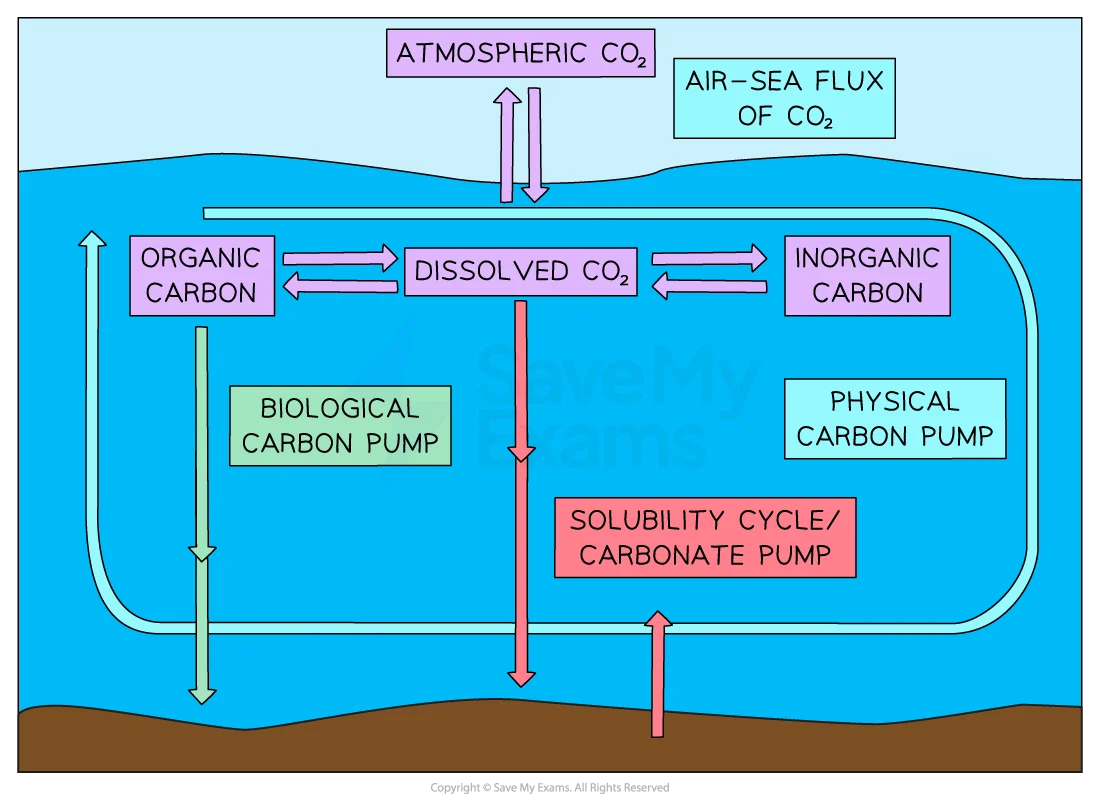
sere carbon cycles in oceans - Physical pump
Most important
CO2 absorbed by the ocean surface through diffusion
Taken from surface to deep ocean stores through downwelling
Cold water absorbs more CO2 so more co2 is absorbed at the poles
Makes the water denser, making it sink, allowing for more diffusion
sere carbon cycles in oceans - biological cycle
Sequesters carbon through photosynthesis by phytoplankton / marine animals, converting CO2 into organic matter
Acts a biologica pump transporting carbon from ocean’s surface to intermediate and deep ocean stores
As they die, the parts of them sink to the bottom, decayign and releasing carbon into deep water stores
sere carbon cycles in oceans - solubility cycle
CO2 absorbed by oceans forms carbonic caid, reacting with hydrogen ions to form bicarbonates and further reactions with carbonates stored in upper oceans
Used for shells / skeletons, with them dying sinking carbon sequested material to the sea bed, overtime becoming rocks like limestone