AQA Biology GCSE - Question errors
 Call Kai
 Learn
Learn Practice Test
 Spaced Repetition
 Match
Match Flashcards
 Knowt Play
1/57

There's no tags or description
Looks like no tags are added yet.
Name | Mastery | Learn | Test | Matching | Spaced | Call with Kai |
|---|
No analytics yet
Send a link to your students to track their progress
58 Terms
Explain how the student could modify the investigation to determine the concentration of the solution inside each egg.
Use five different concentrations of sugar solution in a beakers
Plotting percentage change of mass using a graph
Determine the concentration where the line crosses the zero percentage change line
How mAB are produced
Inject a mouse with the virus to trigger immune responses.
The mouse's immune system will produce antibodies, lymphocytes that are specific to the virus.
Lymphocytes aren't fast-growing, so you will fuse them with tumor cells to produce hybridomas.
Find the hybridoma which makes monoclonal antibodies specific to the virus.
Hybridomas are collected and purified
In a person with CF, cells lining the lungs and digestive system create too much mucus.
The mucus can:
• block the duct leading from the pancreas to the small intestine
• block the tubes leading to the alveoli in the lungs.
Explain why children with CF grow more slowly than children without CF.
Describe how scientists may use stem cells to create healthy lungs that are not rejected by the CF patient.
Take stem cells from bone marrow of patient
Remove faulty gene
Use stem cells to create an embryo
Remove the stem cells from embryo, then allow it to divide into lung cells.
Therapeutic cloning
Remove nucleus from donor egg cell
Take out nucleus from patient's body cell
Then insert this nucleus to the donor egg
Electrically shock the cell, so cell divides into an embryo
Extract stem cell from embryo
Stem cells can differentiate into any type of cell
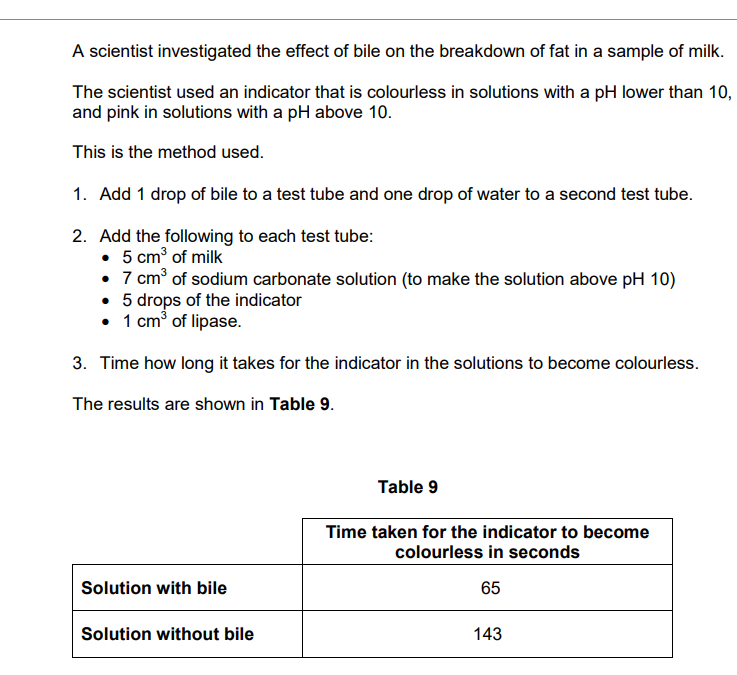
Explain why the indicator in both tubes became colourless.
Lipase breaks down fat into fatty acids.
Fatty acids lower pH, so fatty acids will cause pH to be below 10.
Explain the difference in the results for the two test tubes in Table 9
Bile emulsifies fat,into tiny droplets
Creating a larger surface area for lipase to work on.
Therefore, lipase breaks it down much faster
2020
Describe how the human body:
• prevents pathogens from entering
• defends itself against pathogens inside the body.
See paper
Describe the transport of water through a plant from the roots to the atmosphere.
Water is transported in xylem
Water evaporates from leaves through the stomata
Explain why a person with a leaking heart valve has difficulty exercising.
Describe how small intestine is adapted for efficient absorption
Define the term double circulatory system.
Blood is pumped to the lungs by the right side of the heart and
Blood is pumped to the body by the left side of the heart
Explain why an axolotl may die in water with a low concentration of oxygen
concentration gradient of oxygen is less steep
So less oxygen diffuses into cells
So less aerobic respiration occurs, so less energy is released
So less metabolism
Explain why having only one ventricle makes the circulatory system less efficient than having two ventricles.
Oxygenated and deoxygenated blood mixes
Less oxygen reaches the body cells
Why is placebos used
To avoid the patients thinking they feel better with the drug
Avoid biased results
Explain how the monoclonal antibody works to treat pancreatic cancer/ 4.2.2.3
2020
How are the human lungs adapted for diffusion
Explain the ‘lock and key theory’ of enzyme action.
Enzymes active site with a specific shape.
Only a substrate with a complementary shape can fit into the active site
So when the active site of an enzyme binds to the substrate
It breaks the bonds within substrate to form products(smaller molecules)
Describe how the mAbs and a fluorescent dye could be used to see any Candida albicans pathogens on the slide.
Bind fluorescent dye to mAbs
Put fluorescent mAbs on the slide
MAbs will bind to pathogens and show up under the microscope
Explain how increased phagocytosis of the Candida albicans pathogen will help the patient.
More phagocytes engulf and digest the pathogen
Therefore less damage to cells
2021
Give three uses of energy in respiration
Movemnt
Keeping warm
Active transport
Explain what happens when red blood cells clump together
They block capillaries
So cells can’t respire
2022
What is thick, waxy cuticle on plant surface
Physical defence
Alveoli vs Villi adaptation
Use book
Explain how the monoclonal antibody for HIV helps to prevent a person with HIV developing AIDS
Monoclonal antibody is specific to HIV antigen
Monoclonal antibodies attach to HIV antigens so HIV cannot bind to cell
2023
Blood transport
Photosynthesis practical
2024
Alveoli adaptations
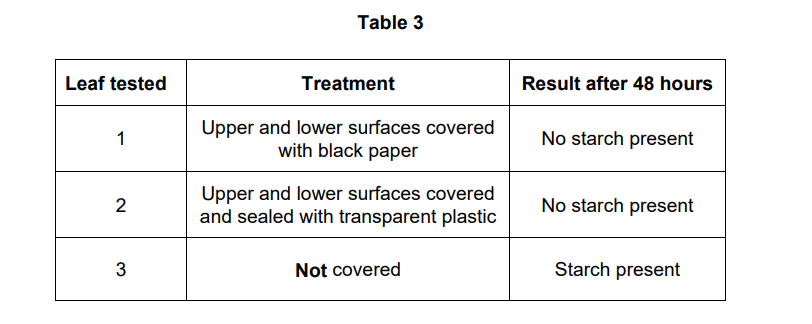
Explain the results for these three leaves
Leaf 1 - No light so no photosynthesis occurs
Leaf 2 - No carbon dioxide so no photosynthesis
Leaf 3 - Light and carbon dioxide present so leaf can photosynthesise
Leaf 1 and 2 - Glucose not made so glucose cannot be converted to starch
Explain the effect of increasing temperature and increasing carbon dioxide concentration on the rate of photosynthesis shown in Figure 7
Increasing temperature while keeping the carbon dioxide concentration constant, increases the rate of photosynthesis
Increasing the temperature increases the kinetic energy of the particles, which increases the number of collisions between the particles.
Increasing carbon dioxide concentration increases the reactants
All rates plateau at a certain point due to another factor being limiting
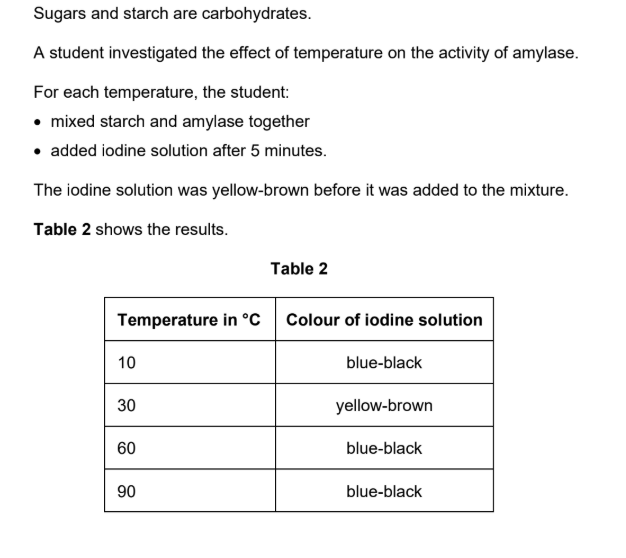
Explain the results at 30 °C and at 90 °C.
Explain why the metabolic rate of a fish is higher when swimming compared with when resting.
More movement, needs more energy
So more respiration occurs for more muscle contractions
Weak topics
Osmosis - mark scheme wording
How are gills adapted to maximised exchange of oxygen between water and blood
Gills have many filaments with lots of lamellae to increase the surface area to volume ratio for faster rate of diffusion.
Good blood supply to maintain a steep concentration gradient.
Countercurrent flow - blood flows opposite direction to water to keep oxygen concentration gradient high.
Lamellae walls are one cell thick - So oxygen has a short diffusion pathway, moving quickly into blood
How are alveoli adapted for diffusion
Large surface area to volume ratio - To maximize the rate of gas exchange
Moist lining
Thin walls - So gases have a short diffusion distance
Good blood supply - Maintain concentration gradient
How is the small intestine adapted for diffusion
Villi and microvilli - Increase the surface area to volume ratio, so gases have a larger space to diffuse
Villi is one cell thick - Short diffusion distance for gases
Good blood supply - Maintain concetration gradient
How is the leaves adapted for diffusion
Gases move by diffusion: carbon dioxide enters the leaf, while oxygen and water vapour leave.
Stomata on the underside of the leaf allow this gas exchange.
Guard cells control the opening and closing of stomata to reduce water loss.
Air spaces increase the surface area for efficient gas exchange.
Bile
Bile neutralises stomach acid, creating an alkaline environment in the small intestine, which provides the optimum pH for enzymes to work effectively.
Bile emulsifies fats into small droplets, increasing the surface area of fat for lipase, which speeds up the rate at which lipase can break down lipids into fatty acids and glycerol.
Lungs - Basic pathway of air
Air enters the lungs through the trachea.
The trachea is supported by rings of cartilage, which prevent it from collapsing when you inhale.
The trachea splits into two bronchi, one going to each lung.
The bronchi divide into smaller tubes called bronchioles.
Bronchioles end in tiny air sacs called alveoli.
Alveoli – site of gas exchange
Gas exchange happens in the alveoli.
Oxygen diffuses from the air in the alveoli into the blood.
Carbon dioxide diffuses from the blood into the alveoli to be exhaled.
Heart organisation - Also diagrams
Plant cell organisation
Measles
Cause: Virus
Spread: Sneezes or Coughes
Symptoms: Red skin rash and fever.
Treatment: Vaccine
HIV
Cause: Virus
Spread: Sexual contact or exchanging bodily fluids.
Symptoms: Flu-like symptoms, attacks lymph nodes and immune cells.
Treatment: Antibiotics.
Prevention: Condoms
TMV
Cause: Plant Virus
Spread: Contact or contaminated tools
Symptoms: A distinct mosaic pattern visible on leaves, discolouration of leaf limiting photosynthesis and stunting growth.
Management: Using resistant plant varieties, proper sanitation of tools, removing and destroying infected plants.
Rose Black Spot
Cause: Fungus
Symptoms: Black/purple dots on leaves.
Spread: In water and wind.
Treatment: Fungicides or removing infected leaves.
Malaria
Cause: Protist, mosquito is the vector
Symptoms: Repeating fever that can be fatal.
Spread: Infected mosquito bite
Treatment: Mosquito nets and insecticides.
Salmonella
Cause: Bacteria
Symptoms: Fever, vomitting
Spread: Eating contaminated food
Treatment: Vaccination
Gonorrhoea
Cause: Bacteria
Symptoms: Thick yellow discharge, pain when urinating
Spread: Sexual Contacts
Treatment: Antibiotics
Prevention: Condoms, regular screening.
Clinical Trials
Preclinical Trials
Test on cells, tissues, and live animals.
Assess toxicity, dosage, and efficacy.
Clinical Trials
Phase 1: Test on healthy volunteers & patients (low doses).
Monitor for safety and side effects.
Phase 2 & 3: Find optimum dosage and confirm efficacy.
Double-Blind Trials
Patients randomly assigned to drug or placebo groups.
Neither doctor nor patient knows who receives the real drug.
Peer Review
Ensures accuracy and prevents false claims before publication.
How monoclonal antibodies work
Monoclonal antibodies are identical antibodies that target a specific antigen.
They bind to specific antigens on target cells.
They can be used to bind to cancer cells.
They can carry drugs, toxins or radioactive substances to target cells.
This allows targeted treatment, destroying specific cells.
Also
Topic 4
Required practicals -
Metric converisions
Read all 8 years and memorise