C2.2 neural signalling
 Call Kai
 Learn
Learn Practice Test
 Spaced Repetition
 Match
Match Flashcards
 Knowt Play
1/23

There's no tags or description
Looks like no tags are added yet.
Name | Mastery | Learn | Test | Matching | Spaced | Call with Kai |
|---|
No analytics yet
Send a link to your students to track their progress
24 Terms
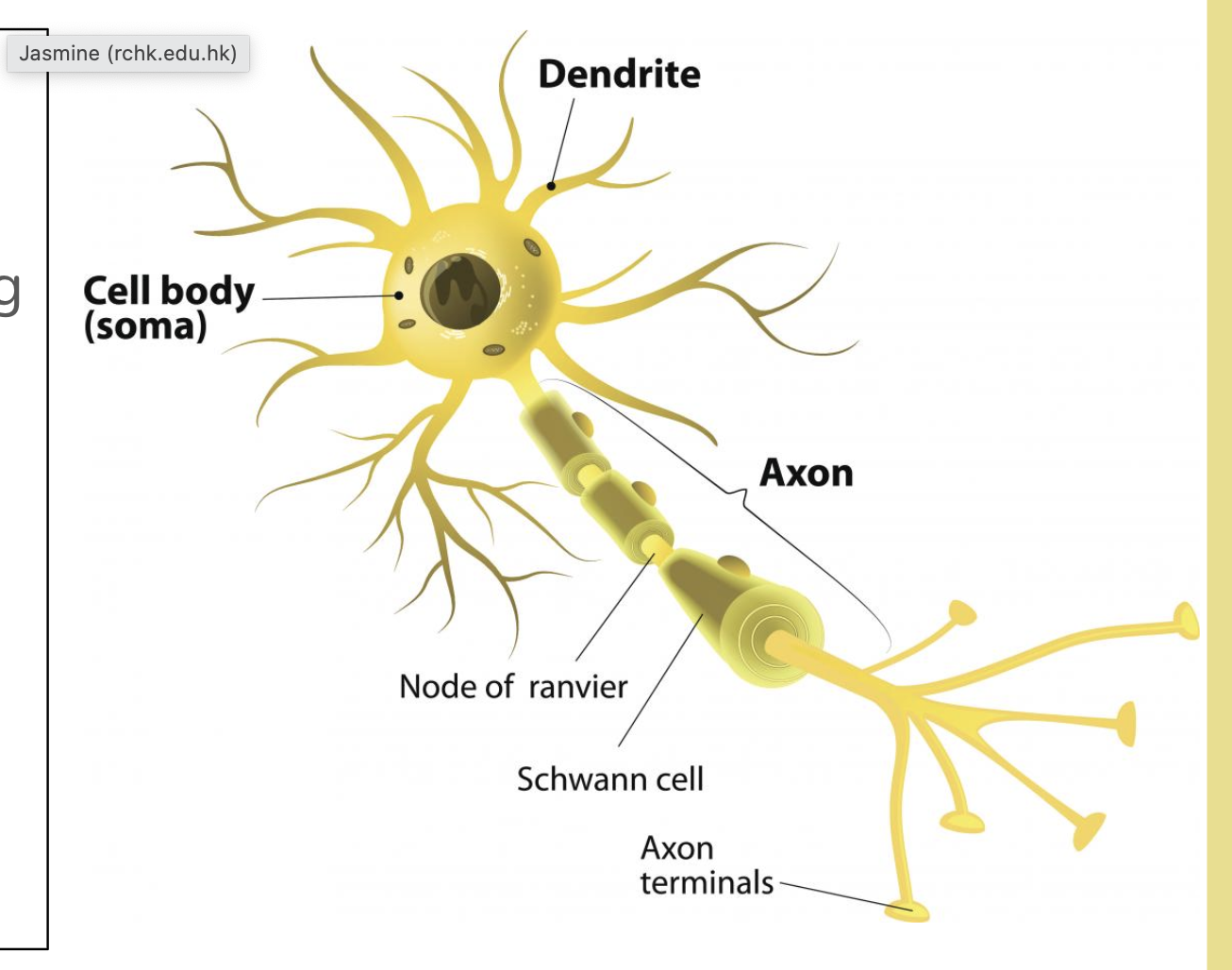
neuron
cell body - cytoplasm&nucleus , elongated nerve fibre- conduct electrical impluse
dendrities - shorter fibres, projecting from cell body
nucleus
schwann cell
node of ranvier
axon terminal
Different Types of Neuon
Motor Neuron
Short Dendrones
Long Axons
Sensory Neuron
Long Axon
Short Dendrones
Middle Cell Body
Relay Neuron
Short Dendrones
Short Axon
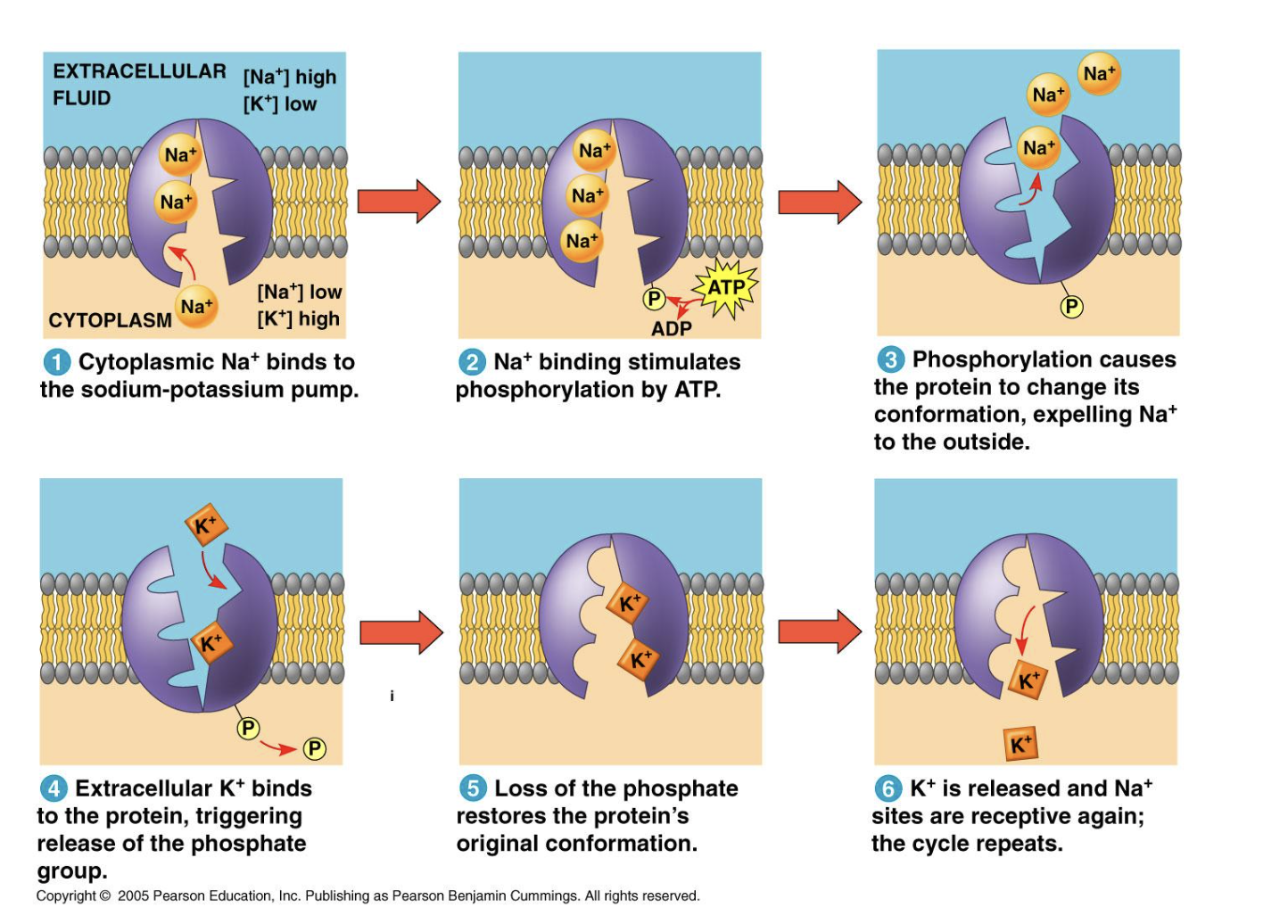
sodium potassium pump
Na+ binds to the sodium potassium pump → stimulates phosphorylation by ATP → Causes protein to change its conformation → expels Na+
Extracellular K+ binds to protein → triggers release of phosphate group → restores protein original conformation → K+ released, Na+ sites is receptive again → cycle repeats
Nerve impulses as action potentials that are propagated along nerve fibres
Membrane potential is the voltage inside the neuron relative to the outside
When the membrane potential is negative, we describe the membrane as polarized
Depolarization: the membrane potential becomes positive
Repolarization: the restoration of a negative membrane potential
depolarization & repolarization
During depolarization Na+ diffuses into the cell
making the membrane potential positive
During repolarization K+ diffuses out of the cell
restoring a negative membrane potential

Resting Potential ( Also known as: Polarization)
This is when the neuron is not stimulated. The potential difference is -70mV
Sodium-potassium pump actively pumps sodium ions out of the axon, whilst potassium ions can diffuse back in
Action potential (Also known as: Depolarization ) → Na IN
Stimulus had reached to threshold, this activate the neuron.
Sodium- potassium pump is turned off
Sodium ion channels open, this cause an influx of sodium ions back to the axon
This reverse the potential difference to +40mV
Repolarization → K OUT
Potassium channels open.
Sodium channels close, sodium-potassium pumps closed
Potassium ions diffuse out of the neuron down the concentration gradient
Axon is negatively charged again
Hyperpolarization
The potential difference is now more negative than -70mV
No nerve impulses can be fired before the neuron returns to resting potential.
Ensuring electrical impulse will only pass in one direction
→ The sodium-potassium pump return the cell to its resting potential, prepared for a new action potential.
saltatory conduction → Increase nerve impluse
The Schwann cell produced myelinated sheath and contains fatty substances → wrap axon with it
Insulate electrical impulses
As only the node of Ranvier is the site of depolarization and the electrical impulse will jump from node to node.
By doing so, this speeds up the electrical conduction along a neuron
This electrical conductivity is called saltatory propagation
factors affecting speed of impulse
1) Temperature
The higher the temperature, the faster the speed
Warm-blooded animals have faster responses than cold-blooded ones
2) Axon diameter
The larger the diameter, the faster the speed ( less resistance )
Marine invertebrates, which live at temperatures close to 0°C, have developed thick axons to speed up their responses.
3) Schwann cells
The Schwann cell is made of a fatty substance called the myelinated sheath.
It is used to insulate electrical impulses
By doing so, this speeds up the electrical conduction along a neuron
Action Potential
Signal from pre-synaptic neuron causes some Na+ to enter the post-synaptic neuron
If threshold potential is reached, voltage-gated sodium channels open, causing an influx of sodium ions
Membrane potential becomes positive (depolarization)
Ion movements from the depolarised section of the nerve fibre depolarize the next part of the fibre
At the peak of the action potential, voltage-gated sodium channels close and voltage-gated potassium channels open, causing an efflux (moving out) of potassium ions
A negative membrane potential is restored (repolarization)
The sodium-potassium pump restores membrane potential by re-establishing the concentration gradients of potassium and sodium ions
There is a refractory period after depolarization, where the membrane cannot immediately depolarize again. This ensures that action potentials do not propagate backwards along the neuron.
Propagation of nerve impulses as a result of local current
An action potential in one part of the axon triggers an action potential in the next part, called propagation of the nerve impulse.
Na+ ions diffuse from a region with an action potential to the next region that is still at the resting potential.
Diffusion of Na+ ions inside the membrane causes local currents.
Local Current:
voltage gated sodium channel opens
Diffusion of Na+ ions
It changes the voltage across the membrane from the resting potential (-70mV) to the threshold potential (-50mV), causing an action potential.
synapse
A signal can only pass across a synapse in one direction - from the presynaptic neuron to the postsynaptic neuron
This is the gap between two neurons.
The messenger is in chemical form called neurotransmitter.
Synapse - neurotransmitter
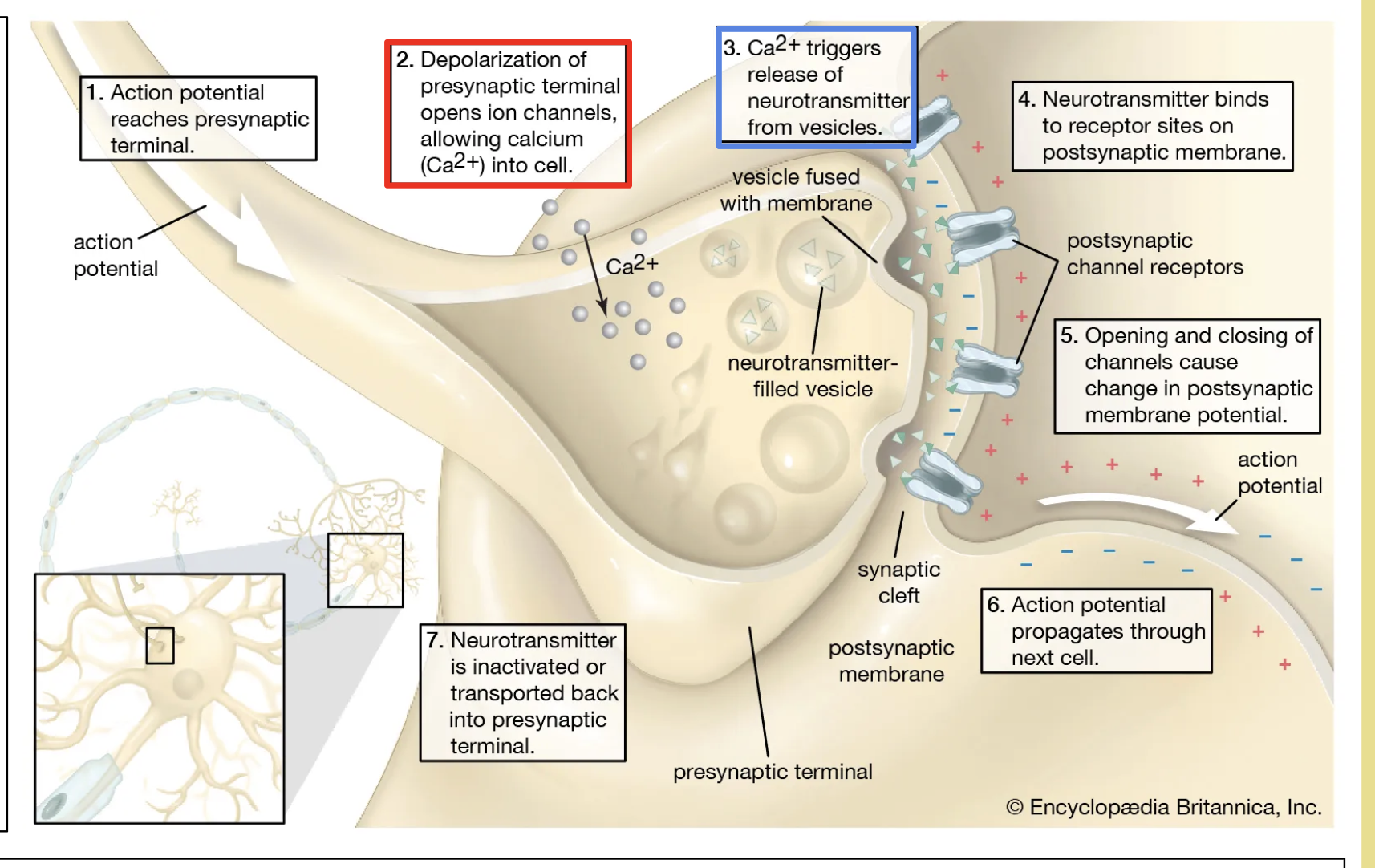
An electrical impulse arrived at the end of the presynaptic neuron. → Depolarisation of presynaptic terminal→ opens calcium ion channel → influx of calcium
Calcium trigger release of neurotransmitters from vesicles
A neurotransmitter is released to the synapse by exocytosis
Neurotransmitters diffuse across the synaptic
Neurotransmitter reached and binds to the postsynaptic receptor
This will cause the sodium ion channel to open, which depolarizes the postsynaptic neuron and can generate a new electrical impulse
excitatory and inhibitory channels
excitatory:
neuroreceptors that are sodium (Na+) channels
channels open, positive ions diffuse in, causing a depolarization
excitatory postsynaptic potential (EPSP) -stimulate an action potential
acetylcholine, glutamate.
inhibitory
neurotransmitter that are chloride(Cl-) chanels
channel open - negative ion diffuse in - hyperpolarization
inhibitory postsynaptic potential - supress action potential
impluse in one neuron inhibit the impluse in the next
GABA
acetylcholine - neurotransmitter
exist in many synapse - inculding neuromusular junctions
break down ACh in synaptic cleft
Ch ( choline) - absorb in presynaptic neuron - regenerate ACh

Effects of exogenous chemicals on synaptic transmission
Exogenous chemicals: Any chemical substance that alters the physiological state of a living organism.
There are 2 types of psychoactive drugs:
Excitatory: Cocaine
Inhibitory: Such as alcohol, THC
Drugs can affect the synapses in the following ways:
Mimic the neurotransmitter and act as a competitive inhibitor → neonicotinoids & acetylcholine
Prevent the breakdown or re-uptake of neurotransmitter. Therefore, constantly activate the receptor → cocaine
Prevent the release of neurotransmitter → GABA
block synaptic transmission: neonicotinoids → blocks acetylcholine
promote synaptic transmission: cocaine → blocks dopamine reuptake
→ Both are excitatory
Neonicotinoids → Effects of exogenous chemicals on synaptic transmission
Normal Neurotransmitter:
acetylcholinsterase break down acetylcholine
Prevent overstimulation & blockage of acetylcholine receptor
Neonicotinoids Toxicity:
Neonicotinoid pesticides bind to acetylcholine receptors in the post-synaptic membranes (of cholinergic synapses in insects)
Acetylcholinesterase cannot break down neonicotinoids → blockage of acetylcholine receptor
Therefore blocking the synaptic transmission, this ultimately kills the insect.
Honeybees are killed along with insect pest that are the intended target of neonicotinoids
how cocaine works
bind to dopamine reuptake receptor → inhibit reuptake of dopamine
dopamine accumulation in synaptic cleft
Increase the likelihood to Parkinson disease because the dopamine receptors loses the sensitivity to dopamine
This also explains why cocaine users will need to increase dosage
inhibitory neurotransmitter - GABA
The binding of GABA opens ligand-gated Cl- channels
This makes the postsynaptic membrane potential more negative (hyperpolarized)
This hyperpolarization makes it harder for the postsynaptic neuron to reach threshold potential, therefore inhibiting nerve impulses
Summation of the effects of excitatory and inhibitory neurotransmitters in a postsynaptic neuron
The sum of the excitatory and inhibitory potentials
Summation combines the effects of excitatory and inhibitory potentials to determine whether the postsynaptic neuron will fire
This is a result of the levels of inhibitory and excitatory neurotransmitters released into the synaptic cleft influencing the postsynaptic membrane potential
Perception of pain by neurons with free nerve endings in the skin
The impulse from the sensory neuron travels to the CNS (central nervous system)
Sensory regions of the cerebral cortex (brain) enable us to ‘feel’ the sensation of pain
The prefrontal cortex allows us to evaluate the situation
Protective reflex reactions, like retracting our hand from a hot surface, do not involve the brain [spinal reflex arc]
Consciousness as a property that emerges from the interaction of individual neurons in the brain
Consciousness is broadly defined as awareness.
It is an example of an emergent property, as a single neuron does not have awareness, consciousness arises from the interaction of many individual neurons*.