Bio part 8
 Call Kai
 Learn
Learn Practice Test
 Spaced Repetition
 Match
Match Flashcards
 Knowt Play
1/46

There's no tags or description
Looks like no tags are added yet.
Name | Mastery | Learn | Test | Matching | Spaced | Call with Kai |
|---|
No analytics yet
Send a link to your students to track their progress
47 Terms
What are the basic requirements that organisms need for survival?
Intake of nutrients
Exchange of gases
Expel waste
Move materials
How these requirements are achieved is very different related to the environment in which they live
MEEI
Why do organisms need to intake nutrients?
The sugars needed for cellular respiration and the production of energy-carbs
The proteins essential for building and repairing tissue, regulating body functions, and providing energy and heat
The fats used to build and maintain cell members; maintain body temperature by providing insulation; cushion organs and bones; aid in absorption of fat-soluble vitamins
How do organisms actually absorb macromolecules like proteins, carbs/sugars, and fats?
They must make them into the smallest units possible.
Sugars (carbohydrates) are absorbed as a monosaccharide such as glucose, galactose + fructose, all which are C6H12O6
Proteins are found as amino acids
Fats are found as triglycerides (tri for 3), glycerol backbone with 3 fatty acid chains
know diagram vaguely
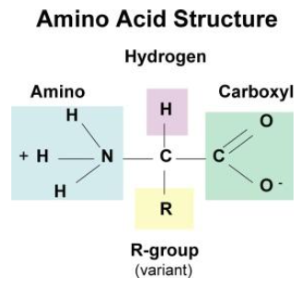
How do organisms make macromolecules into the smallest units possible?
Diffusion
Digestion
What is diffusion in digestion?
The movement of these materials is from an area of high concentration to an area of low concentration.
Organisms that rely on diffusion have a high surface area to volume ratio (they’re smaller-like in the diagram)- This ensures that there is a high rate of diffusion so that the nutrients can get to all parts quickly and that waste is also quickly removed.
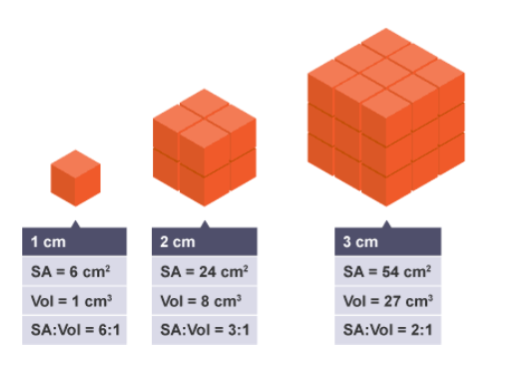
What is digestion? What are methods of digestion?
Physical Digestion which is the mechanical action occurring in the mouth and a muscular organ such as the stomach or gizzard. Through the action of grinding of muscular contractions, the food is broken into smaller units.- how digestion starts
Chemical Digestion which is the action of chemicals such as acid and enzymes to break the food units into the single units for absorption. Chemical digestion can occur in the vacuoles of cells using lysosomes or in specialized organs such as the stomach. - what happens the most in the entire digestive process
What is digestion usually applied to? What happens during this process/what is it?
The term digestion is usually applied to the chemical breakdown of food by the process of hydrolysis.
During hydrolysis, a water molecule is added at the point where a link in a more complex molecule is being broken. - when macromolecules are being broken down into simpler forms with water
Hydrolysis can occur spontaneously at a very slow rate, but it is immediately speeded up by enzymes.
What are enzymes- include where made, why important, and what happens when used
Enzymes are biological catalysis which are manufactured in the ribosomes of the cell.
Enzymes are protein molecules that have the ability to speed up the chemical reactions that occur in the body.
It is important that these reactions are sped up, otherwise they would proceed too slowly for cells to remain alive.
Enzymes remain unchanged when they are used
How do enzymes function/work? -check
An enzyme works by attaching itself to the reactants of substrates (the specific molecule an enzyme acts upon-eg. protein, carb, etc.).
The area of the enzyme that the substrate binds to is called the active site.
The active site of the enzyme must be well matched with the surface of the substrate, like a piece of a puzzle.
Once the substrate enters the active site on the enzyme, the enzyme modifies itself so that they fit together more effectively. - This modification process is known as the induced fit model. (previously called the lock and key model)
Once the enzyme and the substrate are attached, they are called the enzyme-substrate complex.
The enzyme works to dismantle the substrate into smaller molecules which are then released from the enzyme.
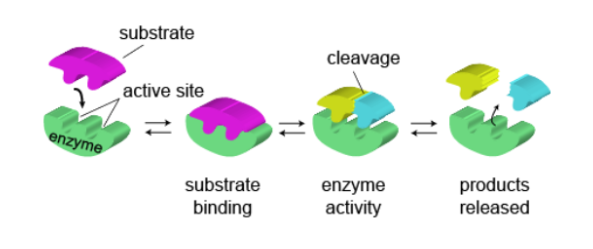
What are the 3 types of enzymes used in digestion? How r they made + released?
Carbohydrases: break down disaccharides, polysaccharides, and complex starches.
Lipases: break down fats
Proteinases: break down proteins
These enzymes are formed by secretory cells and then secreted into the digestive tract.
For the following enzymes: Salivary amylase, pepsin, lipase, pancreatic amylase, pancreatic lipase, trypsin- various forms, tripeptidase, maltase, sucrase and lactase, describe:
The place the enzyme acts, their substrate, the products they create (after binding) and the origin of the enzyme
Enzyme | Place where the enzyme acts | Substrate | Products | Origin of enzyme |
Salivary amylase | Mouth | Starch | Maltose | Salivary glands |
Pepsin | Stomach | Protein | Peptides (smaller protein chains) | Stomach glands |
Lipase | Small intestine | Fats | Glycerol and fatty acids | pancreas |
Pancreatic amylase | Small intestine | Starch | Maltose | pancreas |
Pancreatic lipase | Small intestine | Fat | Glycerol and fatty acids | pancreas |
Trypsin – various forms | Small intestine | Peptides | Smaller peptides | pancreas |
Tripeptidase | Small intestine | Small peptides (tripeptides) | Amino acids | Glands in wall of small intestine |
Maltase | Small intestine | maltose | Glucose and glucose (because it works on the disaccharides- means there are 2 units in it)- thats what a maltose sugar is | Glands in wall of small intestine |
Sucrase | Small intestine | Sucrose | Glucose and fructose (sugar in fruits) | Glands in wall of small intestine |
Lactase | Small intestine | Lactose | Glucose and galactose (sugar in lactose-so need lactase enzyme) | Glands in wall of small intestine |
How + where specifically in the body does chemical digestion happen?
Begins in the mouth where amylase breaks down starch to smaller disaccharide sugar molecules.
In the stomach, gastric juices contain HCl (hydrochloric acid) and pepsin which work to break down protein. Starch digestion continues due to the amylase swallowed until the pH becomes too low. Pepsin functions well between pH of 1 to 2.
Thick, liquid chyme passes into the small intestine. Pancreatic secretions are alkaline and neutralize the acidity of the chyme. Enzymes from the liver, pancreas and lining of the small intestine are secreted into the duodenum to complete the chemical digestion.
How do cells obtain energy? What conditions do organisms need as a result of this? What challenges do organisms face in this process? What is this oxygen used for + where does this process occur?
Cells obtain energy through a chemical reaction called oxidation, in which organic compounds are broken down by oxygen.
Although a small amount of energy can be obtained in anaerobic conditions (lack of oxygen), most organisms must live in an environment that provides them with an adequate amount of oxygen.
The challenge for an organism is being able to deliver the proper amount of oxygen to meet their energy needs. As an organism increases in size, more oxygen is needed.
The oxygen is needed for the process of cellular respiration which occurs in the mitochondria of the cell.
What is the chemical formula for cellular respiration?
Oxygen + Monosaccharide (usually glucose) → Carbon dioxide + Water + ATP (add chemical formula too)
C6H12O6 + 6 O2 —> 6 CO2 + Energy (ATP)
What is ATP and what does it stand for?
ATP or adenosine triphosphate is the molecule which releases energy.
What is challenge faced by an organism in terms of gaas exchange?
Another challenge for an organism is to expel the carbon dioxide before it reaches toxic levels.
What is the most important process in gas exchange? Describe this process (include what it’s driving force is).
Diffusion is the most important process in the exchange of oxygen and carbon dioxide (gas exchange)
Diffusion is a passive movement of molecules from areas of high concentration to low concentration.
The driving force for diffusion is the concentration gradient; the difference in the amount of particles on either side of a membrane such as the cell membrane.
What is the criteria that needs to be met in order for diffusion to occur efficiently?
Membranes must be thin; one cell thick
Membranes must be moist so that the pores are open
The surface area must be large compared to the volume to maximize diffusion. As the surface area to volume ratio decreases, the rate of diffusion slows. If the organism is too large for diffusion to be effective then specialized systems are required.
TMS
SMT
What determines how gas exchange occurs?- include how much O2 in aquatic vs terrestrial environments
How the gas exchange occurs is dependent on the environment in which the organism lives
Aquatic environments have 0.5% O2
Terrestrial environments have 21% O2
Give an example of single celled organisms and explain their repsiratory processes
Eg. Protists
Use diffusion directly across their cell membrane.
Must live in an aquatic environment for this to happen effectively
When too large for efficient diffusion, division occurs
Give an example of simple animals and explain their respiratory processes
Ex. Sponges, Jellyfish, Anenomes
Diffusion at the cellular level across the cell membranes
Give an example of more complex animals and explain their respiratory processes- explain using a diagram
Eg. Worms like an earthworm
Diffusion across the skin
Have blood vessels to absorb the oxygen and carry it to the cells and deliver carbon dioxide back to the skin
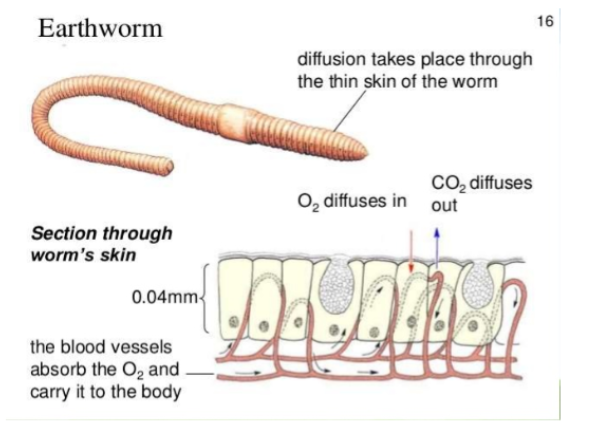
Describe the respiratory processes of molluscs/arthropods (part of more complex animals)
If Aquatic – use gills: structures which extract oxygen from water as it flows over the surfaces
Gills are poorly adapted for land- Exposing the large surface area of the respiratory membranes to air causes too much evaporation. If the gills dry out, gas exchange cannot occur.
If Terrestrial – use lungs and/or sacs: Paired organs consisting of branching passage ways into which air is drawn and elastic sacs for gas exchange
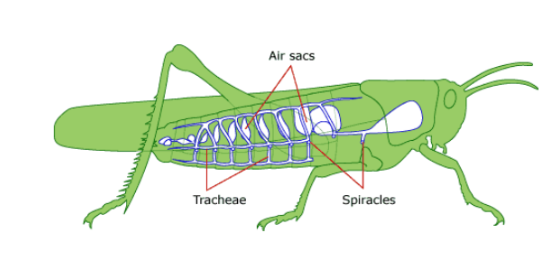
Ex. Insects:
Opening in the side of the body called spiracles allow oxygen to enter a system of tubes called the trachea. The trachea deliver oxygen to air sacs which are in direct contact with the body cells for diffusion. Carbon dioxide enters the air sacs, trachea and exits the body through the spiracles. Muscular actions of the body act as the pump to draw air in and push it out.
Describe the respiratory processes of chordates (part of more complex animals)
If Aquatic – gills
Ex. Fish
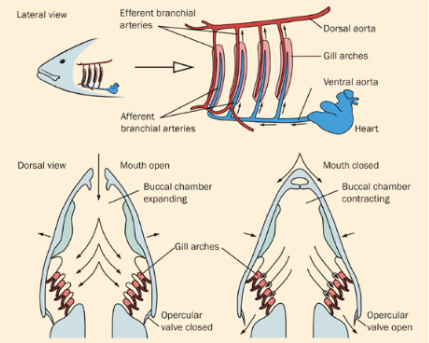
This is called a flow-through system (general term that happens not specific to chordates)- one opening in different opening out
When the fish opens its mouth water is taken in.
Closing of the mouth triggers muscles of the pharynx to pump the water to the gills.
The bony gill cover, called the operculum, opens to allow the water to exit.
The gills are many layers of filaments over and between which the water is forced.
Each filament has a blood supply to absorb oxygen and release carbon dioxide
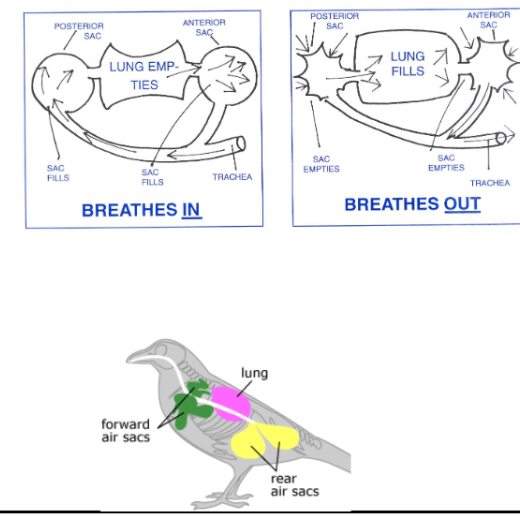
If Terrestrial – lungs
This is called an in and out system.- inhale thru one area then exhale thru the same area
Ex. Birds, mammals, humans
Use air sacs and lungs to help provide the tremendous amount of oxygen needed for flight
Air sacs extend off the lungs
Air moves into the air sacs during inhalation then is transferred to the lungs during exhalation
Allows lungs to be filled to great volumes
What is the circulatory system needed for? What does it do? What is something it helps with?
The circulatory system is needed to transport substances around the body.
It moves nutrients from the intestines to the body cells, moves oxygen from the lungs and delivers it to the cells, and carries metabolic waste (from the making of energy) from the body tissues to the organs of excretion.
The circulatory system also helps to regulate the body's temperature and transport the disease-fighting white cells to where they are needed in the body.
When is a circulatory system necessary in organisms?
A circulatory system is only needed when the body’s volume becomes too large when compared to the surface area (surface area to volume ratio becomes too small) for diffusion to be an effective method of nutrient and gas movement/distribution - basically body is too big so needs a new way of transport
What organisms do not require a circulatory system?
There is not specialized circulatory system needed for anything that simple diffusion can work on
Eg:
Protists
Porifera
Cnidaria
Platyhelminthes
Nematodes
What are the 3 main features of the circulatory system?
A fluid- blood and everything in it (red+ white blood cells, platelets, and plasma)
Tubes and Vessels- includes veins, arteries and capillaries
Pump (the heart)
A fluid- describe it and everything it consists of- vaguely know diagram
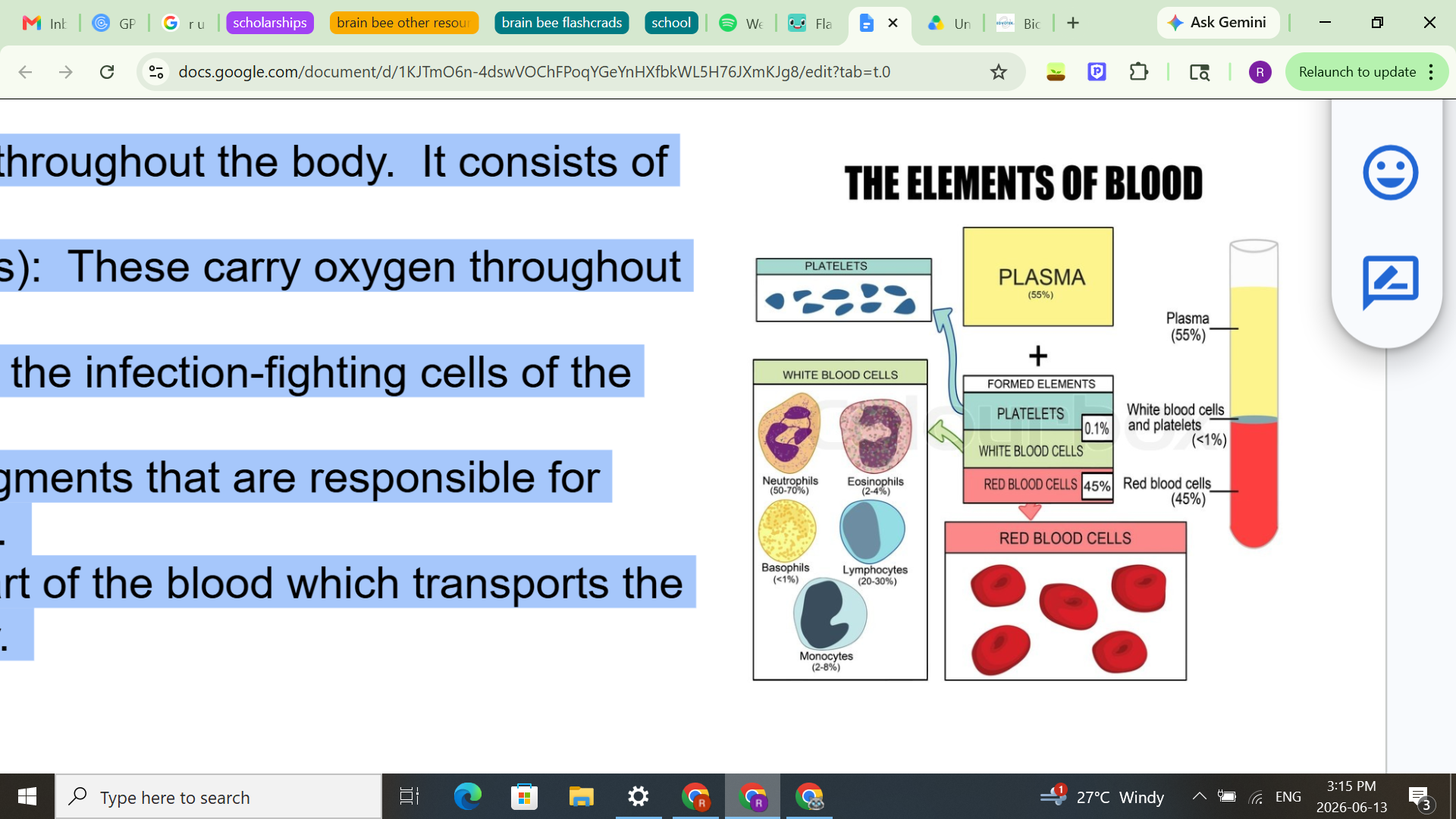
Blood is the fluid that is circulated throughout the body. It consists of four (4) components.
Red blood cells (Erythrocytes): These carry oxygen throughout the body.
White blood cells: These are the infection-fighting cells of the body.
Platelets: These are cell fragments that are responsible for initiating the clotting process.
Plasma: This is the liquid part of the blood which transports the various cells. Primarily water.
Describe the function of tubes and vessels
These form a network throughout the body to transport the nutrients, gases, and wastes to where they are needed.
Describe arteries
These are thick walled, muscular tubes that carry blood away from the heart.
Describe veins
These are less muscular and larger in diameter than arteries.
They carry blood toward the heart.
Valves to help move blood.- have valves due to lack of muscles in them
Describe capillaries
These are tiny blood vessels with very thin walls.
Red blood cells must move through these tubes one at a time. - This allows substances to diffuse between the blood and other fluids and tissues.
Every part of the body is supplied with blood by a network of capillaries.
Describe the pump
Muscular contractions provide the force that moves the blood through the tubes.
This action may be achieved by contracting and relaxing body muscle to squeeze the fluid through the tubes or it may be achieved by a specialized organ through which the fluid moves.
This organ (the heart), consists of a number of chambers; the atria and the ventricles which contract and relax, forcing the fluid to move through the body with varying amounts of pressure.
The atria collect blood from the body and pass it into the ventricles.
The ventricles pump the blood to the body cells.
The blood from the body is low in oxygen (deoxygenated)-low oxygen high co2 and is pumped to the lungs- to get oxygenated.
The blood from the lungs is high in oxygen (oxygenated) and is pumped back to the body cells.- to give them oxygen
What are the 2 types of circulatory systems
Open
Closed
Describe an open circulatory system- give examples of animals who have this
The blood is dumped into the body cavity from the end of the arteries. The fluids eventually flow into the veins as the pressure increases in the body cavity.
Examples molluscs, arthropods (spiders), insects
Describe a closed circulatory system- give examples of animals who have this
All of the blood vessels are connected, keeping the fluid inside the tubes- blood doesn’t pool in body cavity
Three types:
Single circulation
Double circulation- 3 chambered heart
Double circulation- 4 chambered heart
Examples: Humans
Single circulation
This involves a simple pump- usually one atrium and one ventricle
Can be/include aortic arches which are enlarged vessels with additional muscle like in worms or a two chambered heart which has one atrium and one ventricle like in fish
Double circulation- Three Chambered Heart
The blood goes thru the pump twice:
To the body is called the systemic circulation
To the gas exchange surface is called the pulmonary circulation
Oxygen rich blood from the lungs goes to the left atrium. Oxygen poor blood from the body goes into the right atrium. Both atria empty into one common ventricle- There is mixing of the blood.
Example: frogs (amphibians), reptiles, etc.
Double circulation- Four Chambered Heart
The oxygenated blood in the left atrium is pumped into the left ventricle then out to the body.
The deoxygenated blood in the right atrium pumps into the right ventricle then out to the lungs.
The two sides of the heart are completely separate. There is no mixing of the blood.
Example: Humans (chordates)
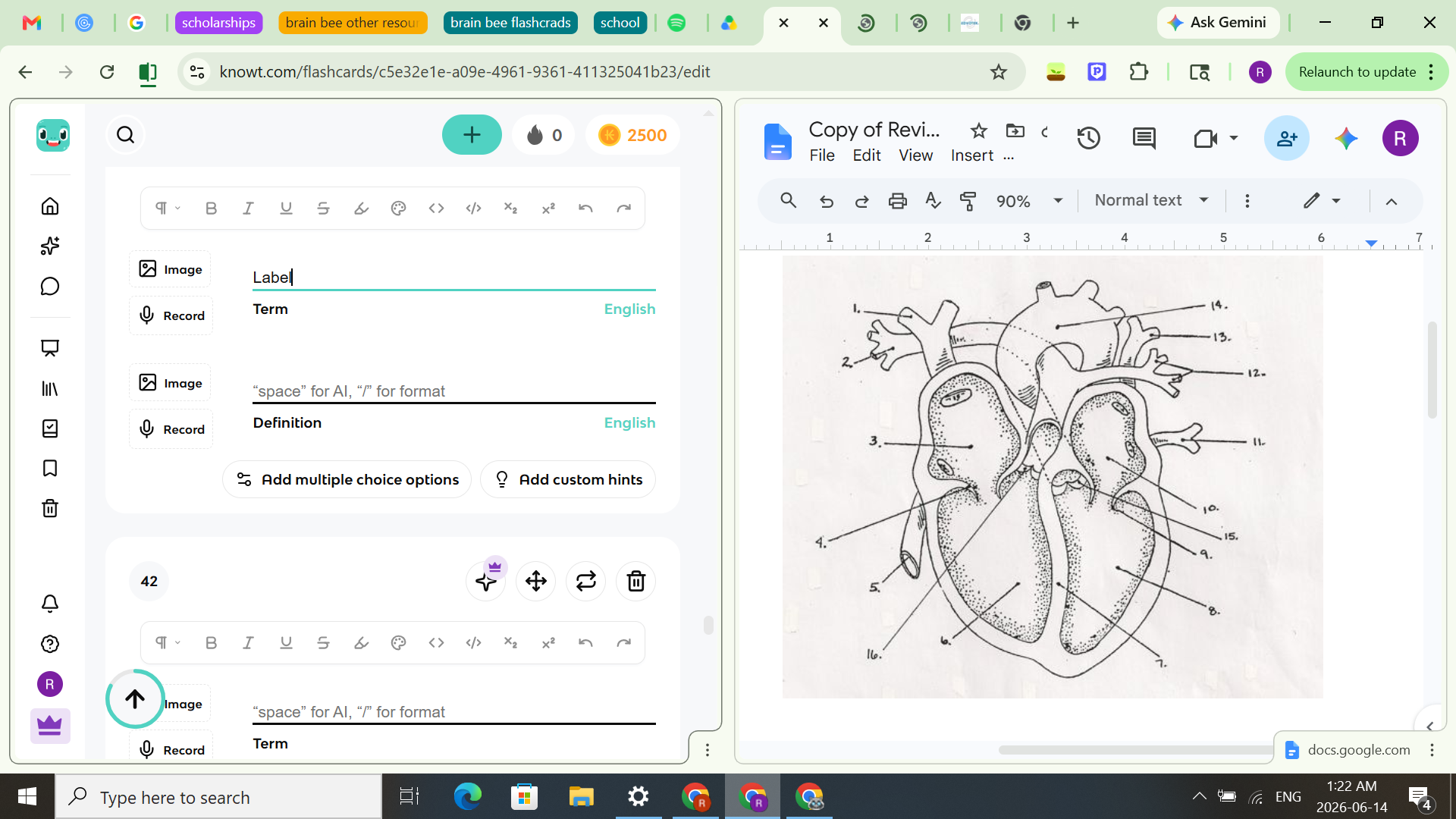
Label
Superior vena cava
Right pulmonary artery
Right atrium
Tricuspid valve
Inferior vena cava
Right ventricle
Septum
Left ventricle
Mitral (bicuspid) valve
Left atrium
Left pulmonary veins
Left pulmonary artery
Pulmonary trunk
Describe the functions of the following parts of the heart:
Superior vena cava
Right pulmonary artery
Right atrium
Tricuspid valve
Inferior vena cava
Right ventricle
Septum
Left ventricle
Mitral (bicuspid) valve
Left atrium
Left pulmonary veins
Left pulmonary artery
Pulmonary trunk
Superior vena cava | Brings deoxygenated blood from the upper body into the heart |
Right pulmonary artery | Carries deoxygenated blood from the heart towards the lungs |
Right atrium | Receives deoxygenated blood from the body |
Tricuspid valve | Control the flow of blood from the right atrium to right ventricle |
Inferior vena cava | Carries deoxygenated blood from the lower body to the heart |
Right ventricle | Pumps deoxygenated blood to the lungs |
Septum | Thick muscular wall separating the right and left ventricles |
Left ventricle | Pumps oxygenated blood to the whole body |
Mitral (bicuspid) valve | Controls the flow of blood from the left atrium to the left ventricle |
Left atrium | Receives oxygen-rich blood from the lungs |
Left pulmonary veins | Carries oxygenated blood from the left lung into the left atrium |
Left pulmonary artery | Carries deoxygenated blood from the heart towards the left lung |
Pulmonary trunk | Carries deoxygenated blood from the right ventricle to the lungs |
Aorta | Pumps oxygen-rich blood from the left ventricle into the circulatory system |
Aortic valve | Allows oxygen-rich blood to flow into the body while preventing blood from leaking backwards into the heart |
Pulmonary valve | Controls the flow of oxygen-poor blood from the right ventricle into the pulmonary artery |
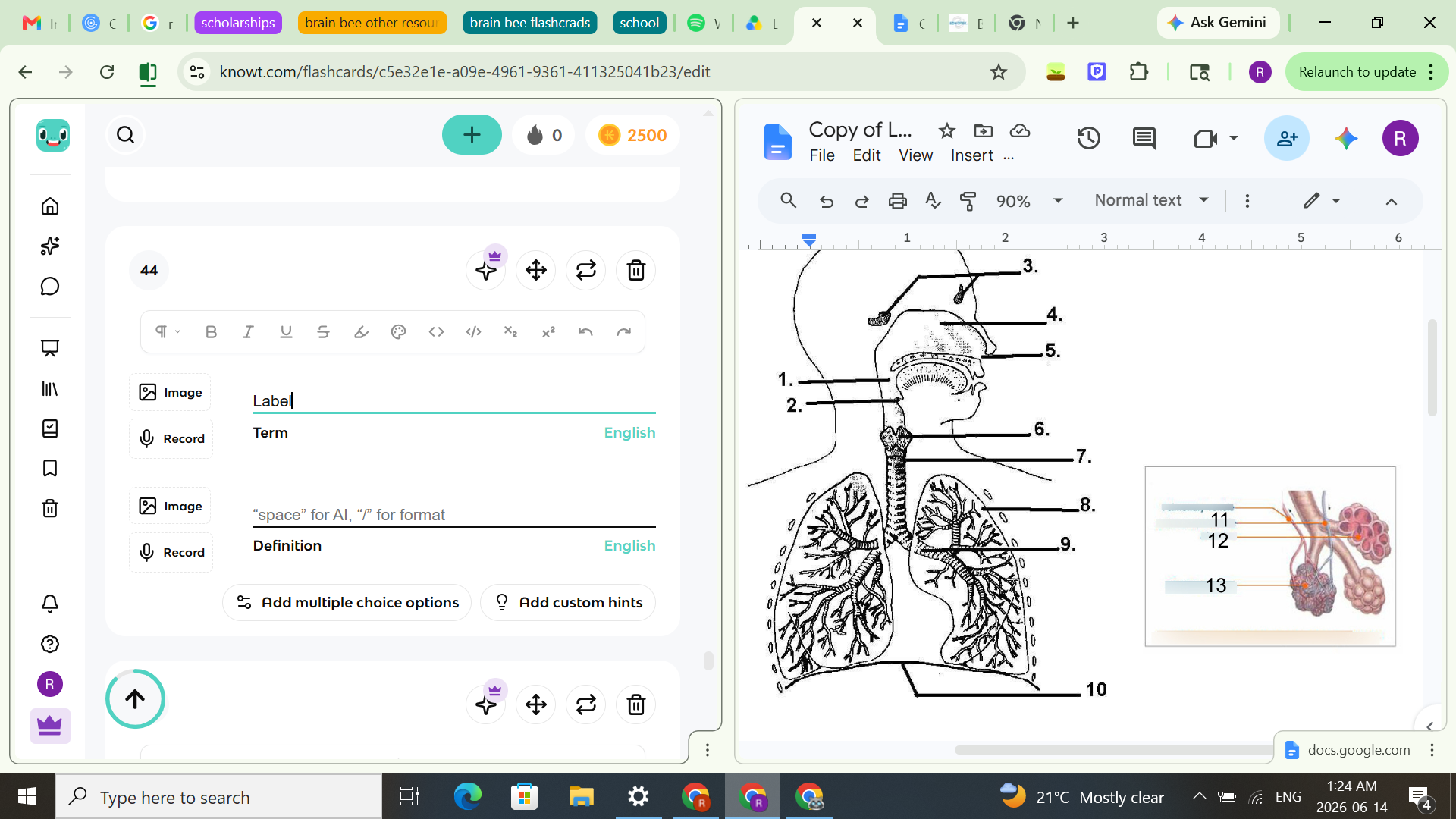
Label
Pharynx
Epiglottis
Sinuses
Nasal cavity
Oral cavity
Larynx/voice box
Trachea
Lungs
Bronchus
Diaphragm
Pulmonary artery
Alveoli
Alveolar sac
Describe the roles of the following:
Pharynx
Epiglottis
Sinuses
Nasal cavity
Oral cavity
Larynx/voice box
Trachea
Lungs
Bronchus
Diaphragm
Pulmonary artery
Alveoli
Alveolar sac
Pharynx | Gets the air to your lungs |
Epiglottus | Folds backwards to protect the larynx entrances to prevent the entry of food and liquids |
Sinuses | Like the body’s built in-humidifier -> transforms cold dry air into warmer and wetter air that is good for the body |
Nasal Cavity | Warms and humidifies air |
Oral Cavity | Alternate passageway for the air to enter through |
Larynx/voice box | Air passes through causing vibrations, allowing us to make noise |
Trachea | Transports air to and from the lungs |
Lungs | Transfers oxygen from the air to the blood and releases carbon dioxide from the blood to the air |
Bronchus | Passageways that carry air to and from the lungs |
Diaphragm | Expands and decreases to move lungs up and down |
Pulmonary Artery | Low oxygen, high carbon dioxide blood comes from the heart (right ventricle) to the lungs to gain oxygen and expel CO2 |
Alveoli | Site of gas exchange |
Alveolar Sac | Where the lungs and blood exchange oxygen and carbon dioxide (gas exchange) |
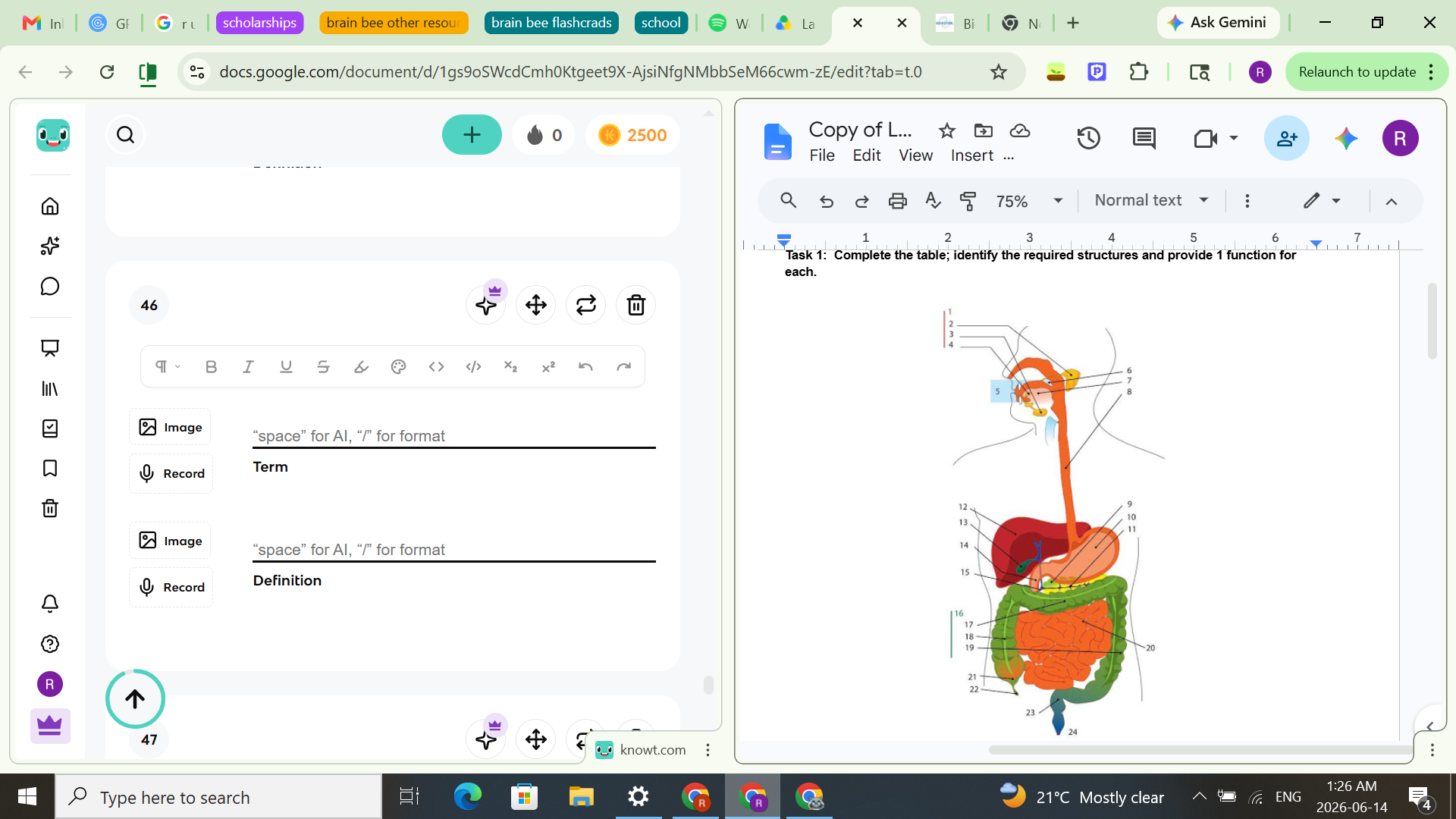
Label
Salivary glands
Palate
Tongue
Esophagus
Pancreas
Stomach
Liver
Gallbladder
Duodenum
Transverse colon-large intestine
Ascending colon- large
Descending colon- large
Jejunum- small intestine
Cecum
Appendix
Rectum
Anus
Describe the roles of the following:
Salivary glands
Palate
Tongue
Esophagus
Pancreas
Stomach
Liver
Gallbladder
Duodenum
Transverse colon-large intestine
Ascending colon- large
Descending colon- large
Jejunum- small intestine
Cecum
Appendix
Rectum
Anus
Salivary glands |
|
Palate |
|
Tongue |
|
Esophagus |
|
Pancreas |
|
Stomach |
|
Liver |
|
Gallbladder |
|
Dudoenum |
|
Transverse colon- large intestine |
|
Ascending colon |
|
Descending colon- until here is large intestine |
|
Jejunum- small intestine |
|
Cecum |
|
Appendix |
|
Rectum |
|
Anus |
|