A1.2 Nucleic Acids
 Call Kai
 Learn
Learn Practice Test
 Spaced Repetition
 Match
Match Flashcards
 Knowt Play
1/27

There's no tags or description
Looks like no tags are added yet.
Name | Mastery | Learn | Test | Matching | Spaced | Call with Kai |
|---|
No analytics yet
Send a link to your students to track their progress
28 Terms
How is DNA evidence of common ancestry
DNA is universal to all living organisms
What are the components of a nucleotide
Phosphate group
Five-carbon monosaccharide (pentose sugar)
nitrogenous base
How are nucleotides bonded together and why
3’ carbon is covalently bonded to phosphate group of next nucleotide (phosphodiester bond).
sugar phosphate bonding makes a continous chain of covalently bonded atoms in each strand of DNA or RNA nucleotides
This bond is a result of condensation reactions.
Covalent bonds are relatively strong and thus a nucleic acid polymer made of nucleotides is quite stable.
What are the nitrogenous bases in DNA and the number of H bonds formed
Adenine - Thymine (2 hydrogen bonds)
Cytosine - Guanine (3 hydrogen bonds)
What are the nitrogenous bases in RNA and the number of H bonds formed
Adenine - Uracil (2 bonds)
Cytosine - Guanine (3 bonds)
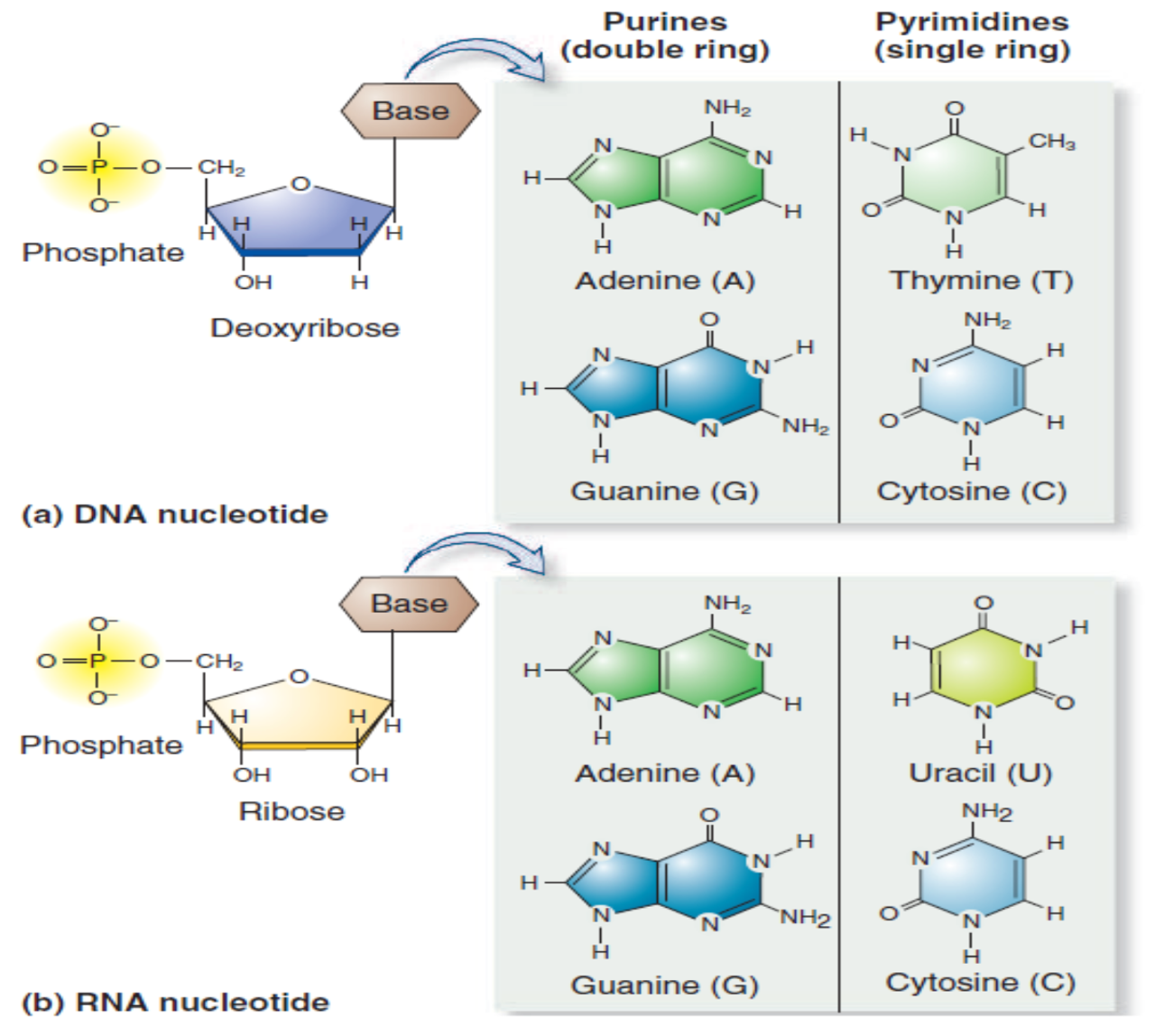
Which nucleotides are purines
Adenine and guanine
Which nucleotides are pyrimidines
Thymine/Uracil and cytosine
Draw the nucleotide bases
Are DNA and RNA nucleotides identical
No. Nucleotides in RNA contain ribose, nucleotides in DNA contain deoxyribose.
Uracil only occurs in RNA
Thymine only occurs in DNA
How many different nucleotides are there in total
8
4 DNA, 4 RNA
Draw a RNA nucleotide
Students should be able to draw and recognize diagrams of the structure of single nucleotides and RNA polymers.
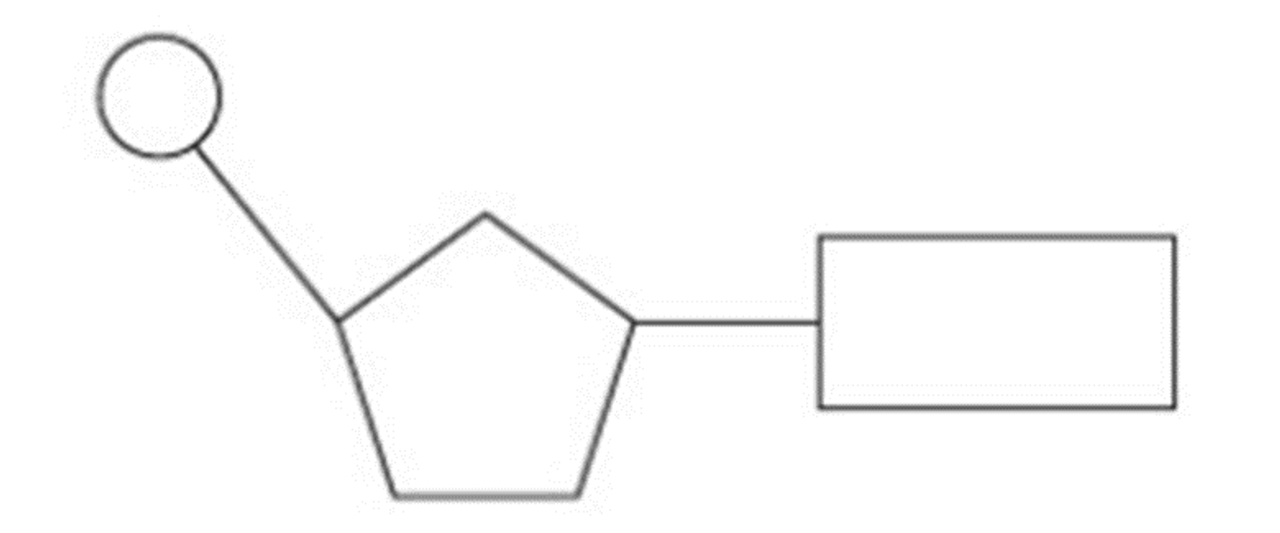
Draw DNA as a double helix
In diagrams of DNA structure, students should draw the two strands antiparallel, but are not required to draw the helical shape.
Students should show adenine (A) paired with thymine (T), and guanine (G) paired with cytosine (C).
Students are not required to memorize the relative lengths of the purine and pyrimidine bases, or the numbers of hydrogen bonds.
Marking Rubric
sugar, phosphate and base linked correctly to form at least one nucleotide
ignore labelling of the subunits of the nucleotide. Carbon atoms in deoxyribose do not have to be numbered but the phosphate should be linked to C5 and the base to C1. Shapes other than circles and rectangles could be used for the phosphate and base.
deoxyribose, phosphate and named base labelled at least once
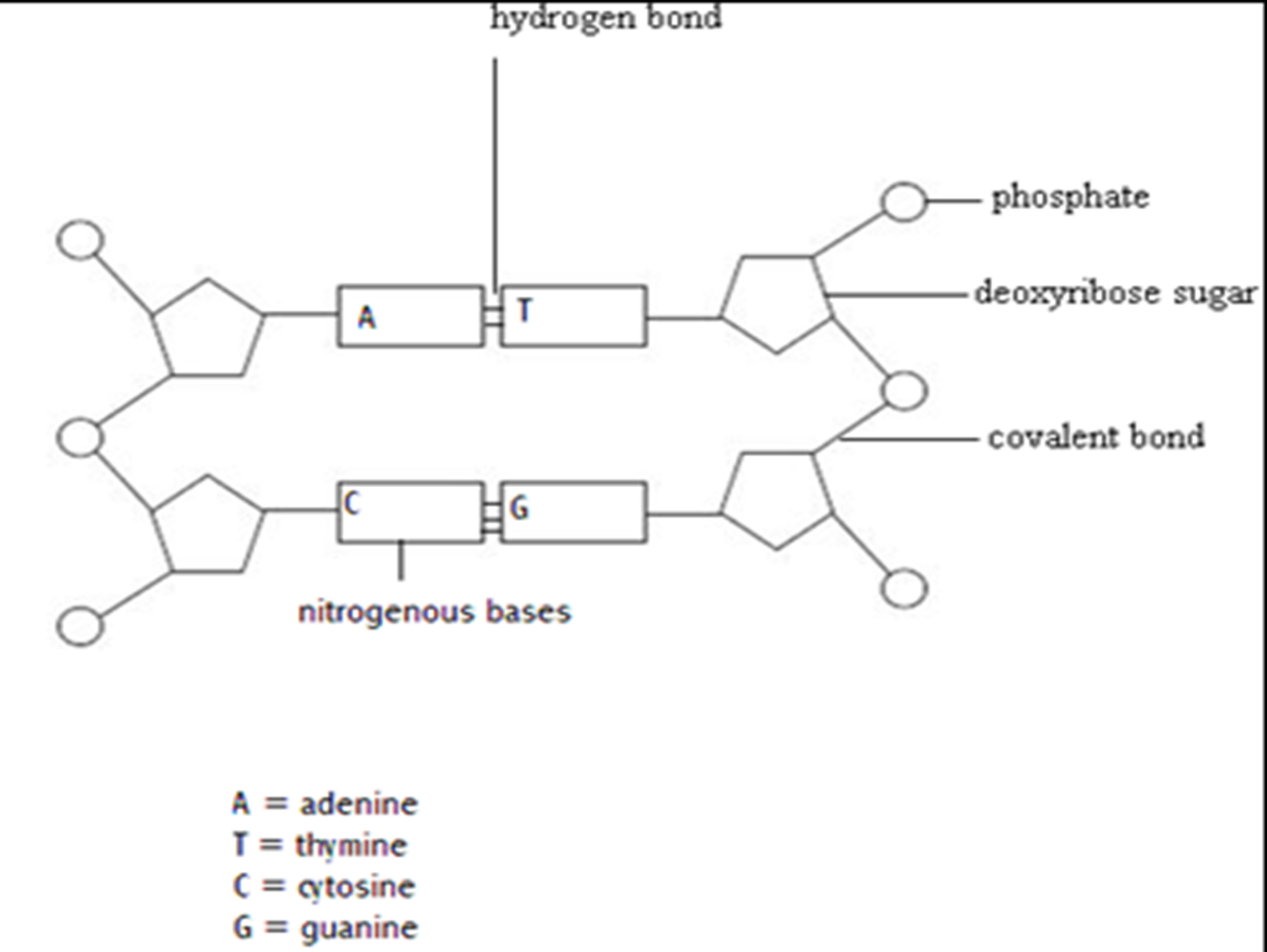
adenine paired with thymine and cytosine paired with guanine
Full names of all four bases are required, but not relative sizes of the purine and pyrimidine bases.
two antiparallel chains of nucleotides linked by hydrogen bonds with all sugar-phosphate bonds in correct position
a bond should connect the C3 of deoxyribose on one nucleotide to the phosphate on the adjacent nucleotide. Two nucleotides in each strand is sufficient.
this picture uses solid lines to draw hydrogen bonds. Try NOT to do that, use dotted lines instead.
Difference in structure, location, and length of DNA and RNA
DNA | RNA |
|---|---|
Double stranded | Single stranded |
Consists of two polynucleotide strands of complementary base pairs in the form of a double helix | Consists of single strands in three functional forms - mRNA, tRNA, rRNA |
Deoxyribose as sugar | Ribose as sugar |
Thymine instead of uracil | Uracil instead of thymine |
Occurs in the nucleus | Occurs in the nucleus and cytoplasm, particularly in ribosomes |
Very long strands, usually several million nucleotides | Relatively short strands, 100-several thousand nucleotides |
Common Mistake
Must be careful when explaining the difference in location of DNA and RNA
RNA can occur in the nucleus (its synthesised there), but most of the time it will be found in the cytoplasm with the ribosomes -> it is false that RNA only appear in the cytoplasm
Why is DNA called antiparallel
Because the two strands are upside down in comparison to each other, but parallel, they are said to be antiparallel to each other.
Examples of nucleic acids
DNA
messenger RNA
transfer RNA
ribosomal RNA
Adenosine Triphosphate
Importance of complementary base pairing
Complementary base pairing is important for DNA replication.
based on hydrogen bonding, where adenine and thymine only form H bonds with each other, and likewise for cytosine and guanine
During DNA replication, both sides of the original DNA are used as a template.
After DNA has been unzipped (opened up into two single strands), the free-floating individual nucleotides in solution will begin pairing with the unmatched nucleotides.
An exact copy of the original molecule can be made.
Diversity of possible DNA sequences
Explain that diversity by any length of DNA molecule and any base sequence is possible. (using P&C)
Emphasize the enormous capacity of DNA for storing data with great economy.
Start codon
TAC (DNA)
AUG (mRNA)
Stop codons
ATT, ATC, ACT (DNA)
UAA, UAG, UGA (mRNA)
Importance of directionality
When RNA or DNA is formed, one nucleotide at a time is added to the molecule.
The nucleotide is not added at a random spot: it is added as the next nucleotide in a growing chain.
As all nucleotides have a phosphate group, pentose sugar and nitrogenous base, you can trace this formation by looking for the first nucleotide in the sequence.
That first nucleotide will always be the 5' end of the strand.
This is important when a new nucleic acid strand is formed.
When DNA replicates, the two strands separate from each other in a particular area, and each separated strand acts as a template for a new strand to be formed.
A new strand will always begin with the 5'-end nucleotide first.
Similarly, transcription synthesises the 5’ end of RNA first
Translation starts from the 5’ end of the RNA
How does purine to pyrimidine bonding contribute to the stability of the DNA helix
Pyrimidines are smaller as they contain a single-ring structure, whereas purines are larger as they contain a double-ring structure.
When bonding the two strands of DNA together to make the double helix, a purine is always bonded to a pyrimidine.
Adenine-thymine (A-T) and cytosine-guanine (C-G) pairs have equal length, so the DNA helix has the same three-dimensional structure regardless of the base sequence
What is the structure of a nucleosome
A DNA molecule wrapped around a core of eight histone proteins (an octamer) held together by an additional histone protein attached to linker DNA.
*linker DNA is the DNA that extends from one nucleosome to the next is called linker DNA.
What is the function of nucleosomes
Nucleosomes help to supercoil chromosomes.
Its function is to regulate gene expression - DNA bound to histones cannot be transcribed
Do prokaryotes have nucleosomes
No
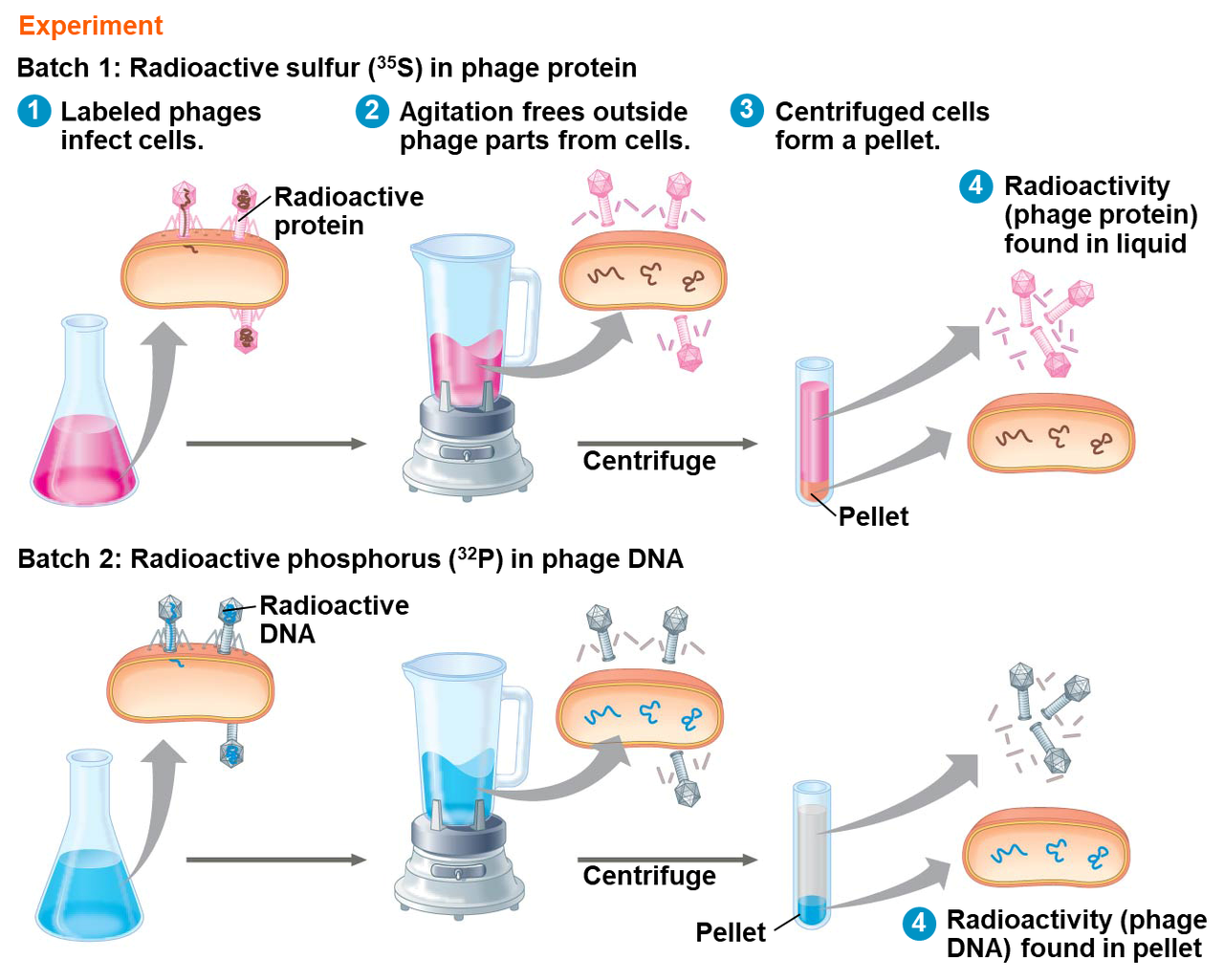
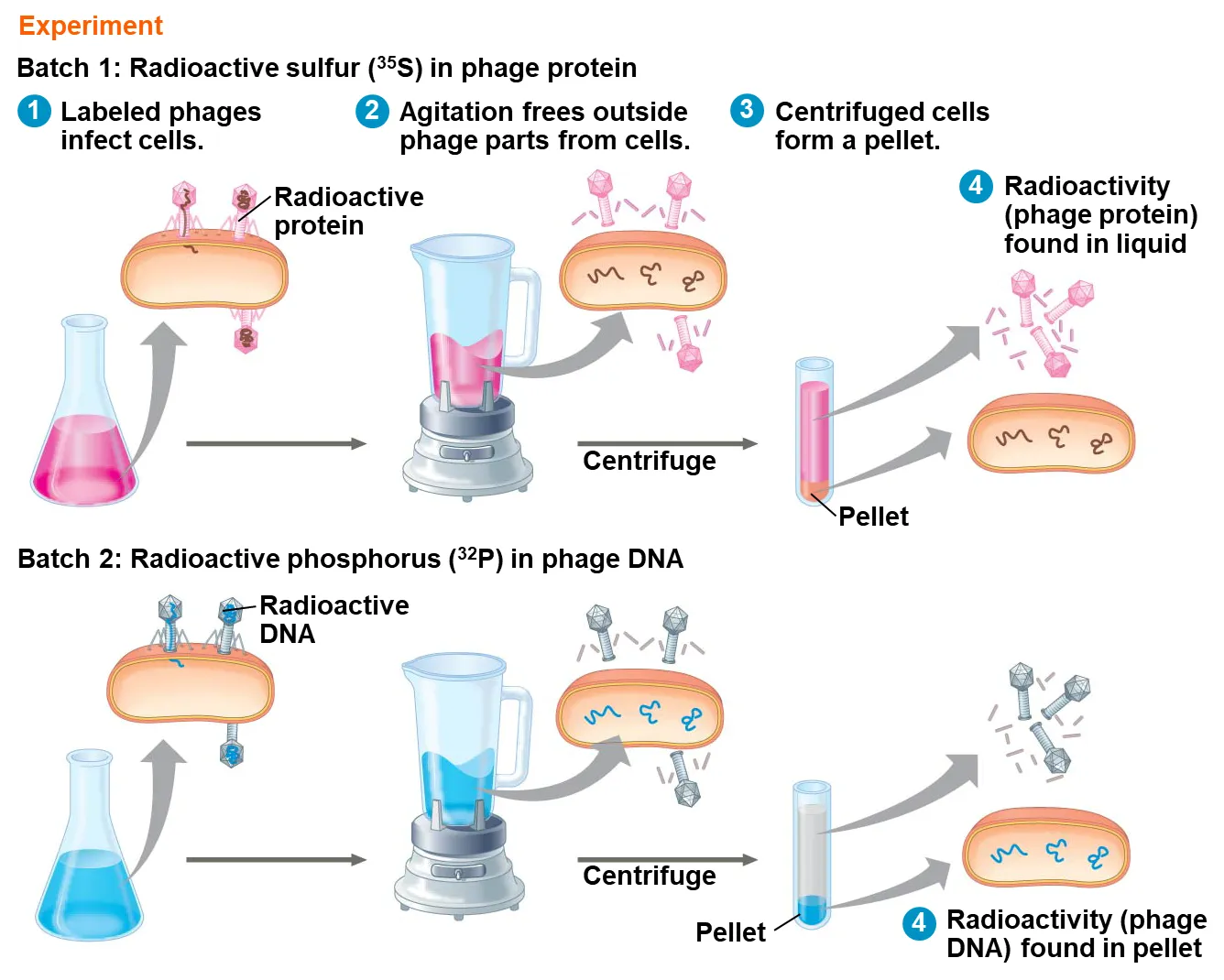
What is the hershey-chase experiment and its conclusions.
Radioisotopes of phosphorous (phosphorous 32) and sulfur (sulfur 35) were used.
Bacteriophages were grown in separate solutions of these radioisotopes.
The phosphorous was detected in the DNA of the virus.
The sulfur was detected in the protein outer coat of the virus, as DNA does not contain sulfur. Two of the 20 amino acids contain sulfur.
The e coli infected with the phosphorous 32 bacteriophage had radioactivity, which indicated DNA.
The e coli infected with sulfur 35 had no radioactivity.
This led to the conclusion that DNA, not protein, is the genetic material.
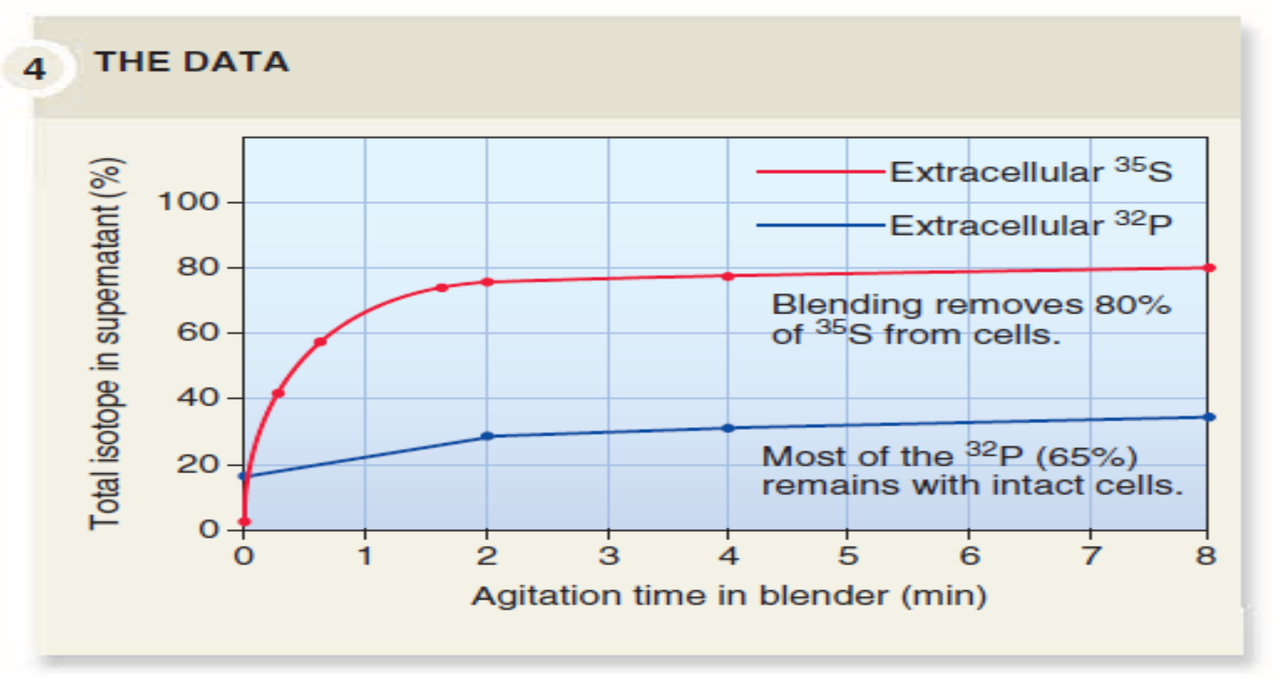
Identify the curves from the hershey-chase experiment
This is a possible MCQ question where they ask you to identify the curves. Take not that there will not be a 100% or 0% result, but there will be a noticeable difference between the sulfur and phosphorus curves.
What is Chargaff’s rule
DNA contains the same number of adenine as thymine nucleotides, as well as the same number of guanine and cytosine nucleotides.
What is chargaff’s experiment and its results
From the results for the DNA Chargaff extracted from the thymus gland of a calf, there is almost the same ratio of adenine to thymine, and also the same ratio of guanine to cytosine.
This showed that the tetranucleotide theory is false.
The tetranucleotide theory, if correct, would have resulted in the proportion of all of the nitrogenous bases being equal, in other words, the same quantities of A, T, C and G.
The data did not show equal proportions of all four bases, and thus the tetranucleotide idea was falsified.