social determinants of health - 23
 Call Kai
 Learn
Learn Practice Test
 Spaced Repetition
 Match
Match Flashcards
 Knowt Play
1/10

There's no tags or description
Looks like no tags are added yet.
Name | Mastery | Learn | Test | Matching | Spaced | Call with Kai |
|---|
No analytics yet
Send a link to your students to track their progress
11 Terms
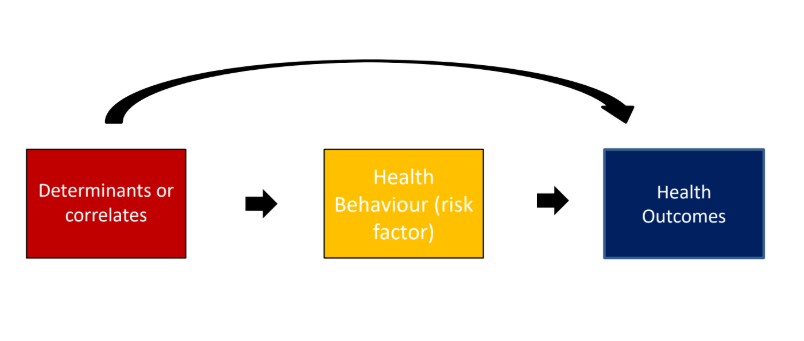
what are determinants
most appropriately defined as causal
factors, and variations in these factors are followed
systematically by variations in a behaviour.
what are correlates
factors associated with a behaviour but the
relationships are not necessary causal
what is the Relationship between determinants, health behaviours
and health outcomes
What does social determinants of health mean?
• Circumstances in which people are born, grow up, live, work
and age.
• These circumstances shape a set of socioeconomic positions
within hierarchies of power, prestige and access to resources.
• Several structural mechanisms are responsible for creating the
differential social positions of individuals
– governance,
– education systems,
– labour market structures,
– welfare policies.
what is health inequality
occurs when there are
differences in experiences or outcomes
between different populations
what is health inequity
attribute these differences to
systematic disadvantages that are potentially
remediable and considered to be unequal and
unfair
what are four examples of health inequities between countries
• the infant mortality rate (the risk of a baby dying between
birth and one year of age) is 2 per 1000 live births in Iceland
and over 120 per 1000 live births in Mozambique.
• the lifetime risk of maternal death during or shortly after
pregnancy is only 1 in 17, 400 in Sweden but it is 1 in 8 in
Afghanistan.
• in Bolivia, babies born to women with no education have
infant mortality greater than 100 per 1000 live births, while
the infant mortality rate of babies born to mothers with at
least secondary education is under 40 per 1000 live births.
• life expectancy at birth among indigenous Australians is
substantially lower (59.4 for males and 64.8 for females) than
that of non-indigenous Australians (76.6 for males 82.0, for
females).
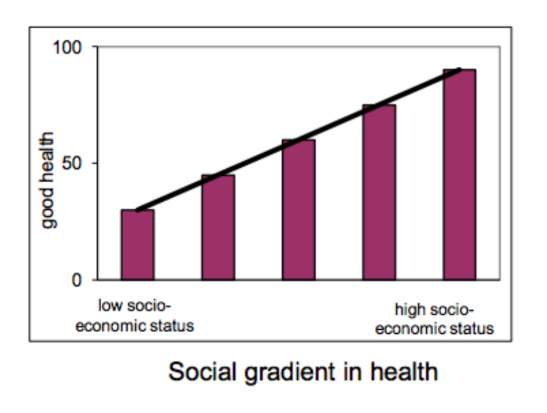
what are the key concepts of a social gradient
• Between countries, the poorest of the poor, around the
world, have the worst health.
• Within countries, the evidence shows that in general the
lower an individual’s socioeconomic position the worse their
health.
• There is a social gradient in health that runs from top to
bottom of the socioeconomic spectrum.
• This is a global phenomenon, seen in low, middle and high
income countries.
• The social gradient in health means that health inequities
affect everyone.
what is the whitehall 1 study
• The Whitehall I Study, a prospective cohort study of male civil
servants (government workers), was set up in 1967 to
investigate the causes of heart disease and other chronic
illnesses.
• Researchers expected to find the highest risk of death from
heart disease among men in the highest status jobs
(Administrator or Manager)
what is the whitehall 2 study
• Followed ~10,000 non-industrial civil servants (men and
women) in London, England aged between 35 and 55 from
1985 onward
• Have shown that low job status is not only related to a higher
risk of heart disease:
– Chronic diseases(e.g., some cancers)
– Mental health (e.g., depression, suicide)
– sickness absence from work
– Overall health (e.g., self-reported health)
what do income and income distributions effect
• Shapes overall living conditions
• Food Security
• Affects psychological functioning
• Influences health-related behaviours
- Quality of diet
- Extent of physical activity
- Tobacco use
- Excessive alcohol use