EM 2 Measuring EM
 Call Kai
 Learn
Learn Practice Test
 Spaced Repetition
 Match
Match Flashcards
 Knowt Play
1/33

Earn XP
Description and Tags
Measuring EM Notes
Name | Mastery | Learn | Test | Matching | Spaced | Call with Kai |
|---|
No analytics yet
Send a link to your students to track their progress
34 Terms
What is the principle behind measuring eye movements by direct viewing?
Tracks a visible landmark on the eye (e.g., limbus) as the eye rotates
Converts rotational movement → linear displacement of the landmark
What is the detection threshold and accuracy of direct viewing for eye movements?
Detects movements of about 1°–2°
Equivalent to ~2–3 prism diopters
Limited sensitivity → not useful for very small movements
How are eye movements quantified in direct viewing methods?
Measure linear movement of a landmark (e.g., limbus)
As the eye rotates, the landmark shifts position
Movement is estimated visually, not instrument-based
What is the mechanism and main advantage of videocamera-based eye tracking?
Uses real-time video imaging of the eye
Typically tracks the pupil center (± first Purkinje image)
Data can be analyzed computationally → higher precision & automation
How is the eye visualized in videocamera eye tracking systems?
Eye is illuminated with infrared (IR) light
Allows clear pupil detection without visible light interference
What is the resolution and accuracy of videocamera eye-tracking methods?
Resolution ≈ 15 minutes of arc (~0.25°)
Much more sensitive than direct viewing
What are common videocamera eye-tracking systems or examples?
ISCAN, ASL, SMI, Arrington, Tobii
All track pupil center (± corneal reflection/Purkinje image)
What is the mechanism of photoelectric eye movement recording (e.g., Visagraph)?
Uses a photocell to detect light intensity
Eye illuminated with infrared light (not visible to subject)
Measures reflected light changes as eye moves
Tracks limbus position
What is the resolution and accuracy of photoelectric eye movement methods?
Resolution < 5 minutes of arc
More precise than videocameras (~15 min arc) and direct viewing
What are the key features and advantages of photoelectric (Visagraph) eye tracking?
High sensitivity (small eye movements detected)
Uses infrared illumination → subject unaware
Objective measurement via light detection (photocell)
Tracks limbus rather than pupil center
What is the mechanism of ENG/EOG (electronystagmography/electrooculography)?
Eye behaves like a dipole:
Cornea = positive, retina = negative
Electrodes placed at outer canthi + reference (between eyes)
As eye rotates → change in electrical potential detected
What are the key advantages and capabilities of ENG/EOG?
Measures large eye movements (up to ±30°)
Detects horizontal + vertical movements
Works with eyes open AND closed
What are the limitations and resolution of ENG/EOG?
Resolution ≈ 1° (poor precision)
Electrodes pick up facial/blink muscle activity (noise/artifact)
Less accurate than optical methods
How are electrodes arranged in ENG/EOG and what do they detect?
Electrodes at lateral canthi + central reference electrode
Detect voltage differences as cornea moves closer/fartherElectrodes at lateral canthi + central reference electrode
Detect voltage differences as cornea moves closer/farther
Signal reflects eye position via bioelectric potential changes
Signal reflects eye position via bioelectric potential changes
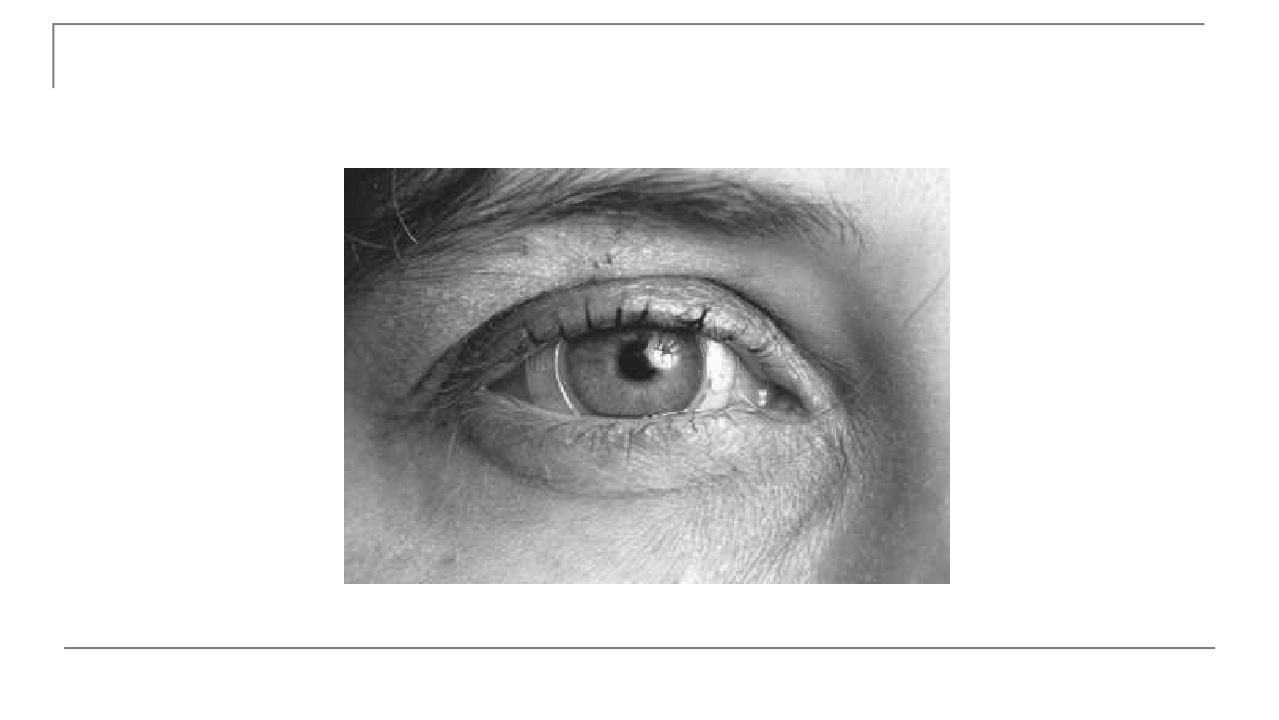
What is the mechanism of the scleral search coil method for measuring eye movements?
Subject placed in a magnetic field
Wears a contact lens (silicone annulus) with embedded wire coil
Eye movement → coil moves → voltage induced
Voltage ∝ sine of angle between coil plane and magnetic field
Signal reflects precise eye position
What is the accuracy and role of the scleral search coil method?
Detects seconds of arc (extremely high resolution)
Most accurate / gold standard for eye movement research
What are the advantages and limitations of the scleral search coil method?
Advantages:
Highest precision available
Detects very small eye movements
Limitations:
Invasive/uncomfortable (contact lens coil)
Coil may slip at large gaze angles
Why are continuous recording methods ideal for eye movements, and which systems use them?
Eye movements are continuous in nature
Some devices produce continuous (analog) signals
Examples: Search coil, EOG, limbal trackers
Can be recorded with a strip recorder or digitized later
What is the difference between analog and digital eye movement recordings?
Analog: continuous signal (true eye movement over time)
Digital: sampled at discrete time points
Digital may miss information between samples
What are key limitations of video-based (sampled) eye tracking?
No info between frames (temporal gaps)
High-frequency eye movements may be missed
Can cause aliasing if movement frequency > sampling rate
Why are eye movements important in reading?
Reading is one of the most eye movement–demanding tasks
Critical in early education (learning to read)
Inefficient eye movements → impair academic & vocational performance
What did Javal (1879) discover about eye movements in reading?
Eyes move in discrete jumps (saccades)
Fixation pattern: jerk from word to word, not smooth motion
Reading = saccades + fixations, not continuous flow
What factors increase the number of fixations during reading?
Increased difficulty of text
Poor reading ability
→ More fixations = slower, less efficient reading
How does word size influence fixation patterns in reading?
Larger words → more likely to be fixated
Smaller words are often skipped
What are interfixation movements (saccades) and their role in reading?
Rapid eye movements between fixations
Move eyes across text (word-to-word)
No visual processing during movement
What is the typical magnitude of saccades in reading?
~1.5° (range: 0.5–4°)
≈ 8 characters (range: 1–18)
Includes spaces + punctuation
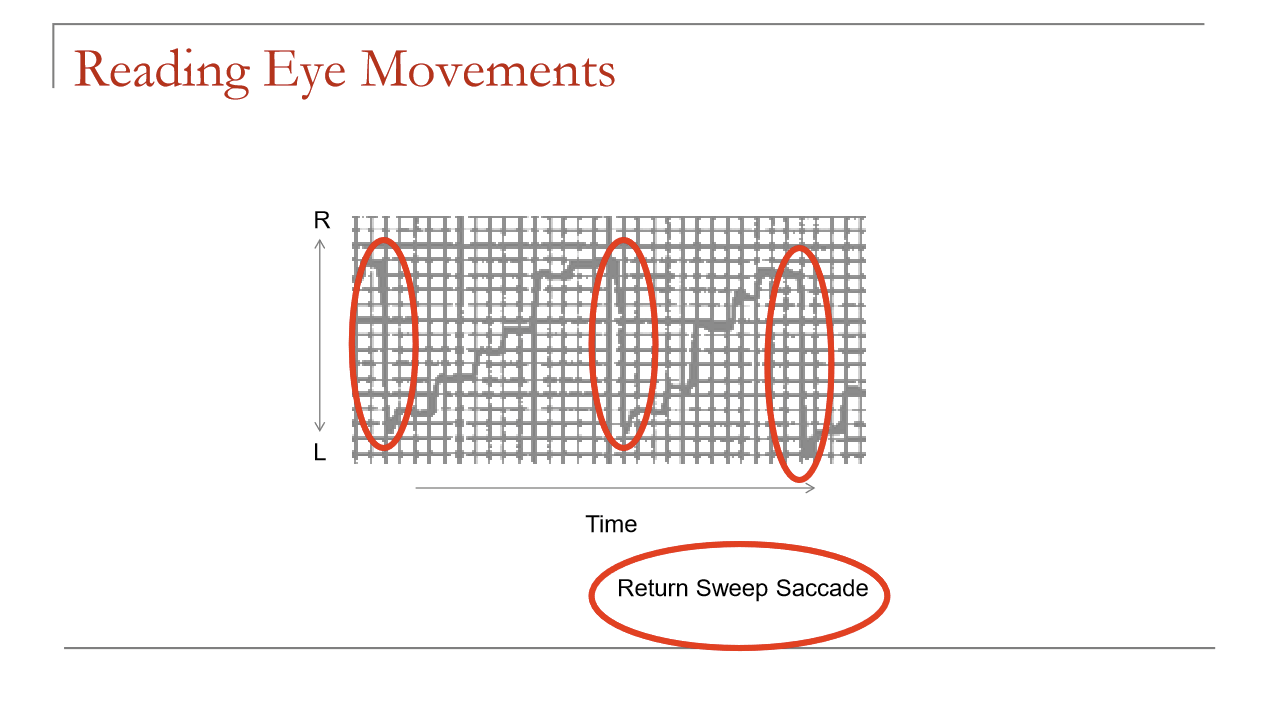
What is a return-sweep saccade in reading?
A large saccade from right → left
Moves eyes from end of one line → beginning of next line
Starts ~6 characters before the end of a line
Lands around the ~6th character of the next line
Rarely lands exactly at margins → involves systematic undershoot
What is a key accuracy feature of return-sweep saccades?
Often undershoot the intended target
Requires corrective saccades to reach optimal fixation
Reflects limits in long-range saccadic accuracy
How much of total reading time is spent on eye movements?
≤ 10% of total reading time
Majority of time spent during fixations (processing), not movement
What is the average span of recognition in reading?
Amount of text processed per fixation
Defines how many words/characters can be perceived at once
What is fixation duration and what factors affect it?
Time eye remains on a word (~225 ms average)
Text dependent:
Shorter for easy text
Longer for difficult text
What is reading rate and how is it measured?
Reading rate = words read per unit time
Typically measured in words per minute (wpm)
What is the typical reading rate for average vs. exceptional readers?
Average college student: ~200–350 wpm
Exceptional readers: up to ~1000 wpm
What is the limitation of “speed reading” claims?
Claims: 2000–10,000 wpm
Achieved by skimming (very few fixations, e.g., ~1 per line)
Results in poor comprehension → not true effective reading