religion midterm 2202
0.0(0)
Studied by 12 people Call Kai
 Learn
Learn Practice Test
 Spaced Repetition
 Match
Match Flashcards
 Knowt Play
Card Sorting
1/76

Earn XP
Description and Tags
Last updated 9:15 PM on 12/14/22
Name | Mastery | Learn | Test | Matching | Spaced | Call with Kai |
|---|
No analytics yet
Send a link to your students to track their progress
77 Terms
1
New cards
Life has no meaning or purpose. You are born alone and you will die alone and there is nothing of real significance between those two events.
nihilism
2
New cards
The idea that is a purpose or direction to the universe. (Maat, Dharma)
teleology
3
New cards
Seeking to separate religion from everyday life. Distinction between the sacred and the profane.
secularism
4
New cards
The belief that the only reality is that which is empirically observable.
materialism
5
New cards
Time spent engaging with the great mysteries of our existence.
sacred time
6
New cards
Time spent dealing with more mundane day to day realities of our lives.
profane time /secular time
7
New cards
Sacred ritual allows us to transcend time and space in order to participate in the pivotal events of the religion.
transcendant reality
8
New cards
what it means for something to be sacred
\-sacred=great mysteries
\-ex. relating to God, Holy, prayer
\-any time spent involving something religious-from a relgious world view, all time is sacred
\-ex. relating to God, Holy, prayer
\-any time spent involving something religious-from a relgious world view, all time is sacred
9
New cards
what it means for something to be secular
\-secular=mundane realities, worldly
\-ex. shopping, watching a movie
\-regular day to day basis activities
\-from a practical standpoint, we draw a distinction between sacred and profane time
\-ex. shopping, watching a movie
\-regular day to day basis activities
\-from a practical standpoint, we draw a distinction between sacred and profane time
10
New cards
essay - regarding how and why we study world religions - what is needed before studying and what would that look like practically
\-It is possible that by studying other religions, we gain a deeper understanding and appreciation for our own faith.
\-Also helps promote solidarity. By understanding one another better, we are working to remove stereotypes and better communications.
\-From a catholic standpoint, the Catholic church teaches that it contains in itself the Divine Revelation. Therefore, it would seem that from a Catholic standpoint there would be nothing gained by studying any religions outside of itself.
\-We need an open mind in order to gain understanding of other religions, which also means gaining knowledge about other religions and creating friendships instead of rejecting them.
\-Also helps promote solidarity. By understanding one another better, we are working to remove stereotypes and better communications.
\-From a catholic standpoint, the Catholic church teaches that it contains in itself the Divine Revelation. Therefore, it would seem that from a Catholic standpoint there would be nothing gained by studying any religions outside of itself.
\-We need an open mind in order to gain understanding of other religions, which also means gaining knowledge about other religions and creating friendships instead of rejecting them.
11
New cards
two types
petitionary (to ask from a God) and communion (to aqcuire the higher consciousness of God)
12
New cards
the ultimate transcendent reality, "being," itself (everything is this)
Brahman
13
New cards
the caste system
1. brahmins
2. kshtriyas
3. vaishyas
4. shudras
5. dalits
14
New cards
religious teachers and priests (religious authority)
brahmin
15
New cards
kings and knights (political authority)
kshtriya
16
New cards
merchants, artisans (economic authority)
vaishya
17
New cards
skilled laborers
shudra
18
New cards
the "outcastes" or untouchables
dalits
19
New cards
the world as we experience it - purely an illusion
maya
20
New cards
the cycle of birth and rebirth into maya due to karma
samsara
21
New cards
liberation from samsara
moksha
22
New cards
the "self" which is capable of witnessing and experiencing phenomena
atman
23
New cards
social hierarchy in Hinduism - it serves socioeconomic purpose as a division of labor. It also serves spiritual purpose as different steps on the ladder lead to moksha
caste system
24
New cards
stilling your mind to remove distractions - includes mandala, mantra (words), and mudra (motions)
meditation
25
New cards
an image used to focus on and still the mind
mandala
26
New cards
a word or syllable used to call attention back to the present moment (ohm)
mantra
27
New cards
hand gestures meant to represent or connect with divinity
mudra
28
New cards
what is a murti
\-an image of divine mercy-Not the god but a representation of the god-
They can be ANTROPOMORPHIC: constructed to incite fear (usually in more remote areas) or peace (in cities and homes)
\-They can be aniconic, such as the linga (which represents Shiva)
They can be ANTROPOMORPHIC: constructed to incite fear (usually in more remote areas) or peace (in cities and homes)
\-They can be aniconic, such as the linga (which represents Shiva)
29
New cards
what is liberation like in Hinduism
\-moksha-this is achieved when one eliminates all karmic attachments and realizes fully that Atman is Brahman
\-when this is achieved, Maya then disappears and a person ceases to be reincarnated as the person exists in an enteral state of oneness with an reality
\-when this is achieved, Maya then disappears and a person ceases to be reincarnated as the person exists in an enteral state of oneness with an reality
30
New cards
what is dharma in hinduism
one's personal duties according to your caste; following one's dharma allows for rebirth into a better life
31
New cards
describe the Puja
\-can be done in homes or more elaborate temples
\-first the deity is invited as a guest, the devotee hosts and takes care of the deity as an honored guest, hymns and foods were offered to the deity after an expression of love and respect the host bid farewell to the deity
\-first the deity is invited as a guest, the devotee hosts and takes care of the deity as an honored guest, hymns and foods were offered to the deity after an expression of love and respect the host bid farewell to the deity
32
New cards
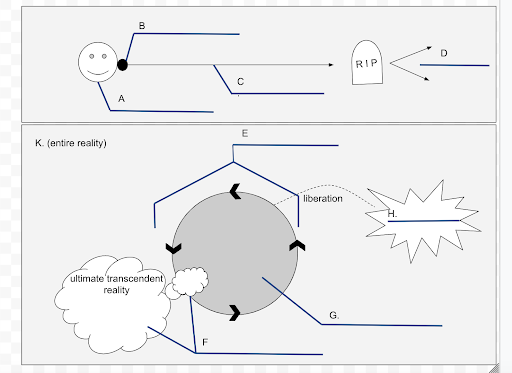
\
a. God
b. Point of creation
c. Creation itself
d. After life
e. samsara
f. Brahman
g. Maya
h. Moksha
b. Point of creation
c. Creation itself
d. After life
e. samsara
f. Brahman
g. Maya
h. Moksha
33
New cards
rejecting the concept of a self; what we view as a permanent self is actually simply an association born out of desire and dependent origination
anatman
34
New cards
the official founder of Buddhism
siddhartha guatama
35
New cards
a smaller sect of Buddhism, means "way of the elders," acknowledges only the historical Buddha but does not worship him, focuses on the pursuit of enlightenment
theravada buddhism
36
New cards
larger sect of Buddhism that means "the great vehicle," encourages the possibility of all beings to become Buddhas, countless Buddhas exist and often prayed to like a god, Bodhisattva ideal
mahyana
37
New cards
a being who aspires to become a Buddha
bodhisattva
38
New cards
an enlightened being
buddha
39
New cards
the three paths in the 8 fold path
the path of wisdom, the path of conduct, the path of mental development
40
New cards
the path of widom
\
1)**Right View:** to grasp the impermanent and imperfect nature of worldly objects/ideas and understand karma and suffering
2)**Right Intention:** a commitment to ethical and mental self-improvement through renunciation, loving kindness, and compassion
1)**Right View:** to grasp the impermanent and imperfect nature of worldly objects/ideas and understand karma and suffering
2)**Right Intention:** a commitment to ethical and mental self-improvement through renunciation, loving kindness, and compassion
41
New cards
the path of conduct
3. right speech: no lying, slander, harsh words, or gossip
4. right action: no stealing, no taking life, no sexual misconduct, no intoxication
5. right livelihood: no weapons dealing, no dealing in living beings \*cattle, men, or slaves), no working in meat production, no dealing in intoxicants
42
New cards
the path of mental development
6. right effort: to never stop trying to reach enlightenment
7. right mindfulness: to be fully present in each moment and aware of the feelings of others
8. right concetration: all mental facilities are unifed and directed towards compassion
43
New cards
the four noble truths
1\.Life is suffering
2\.The cause of suffering is desire
3\.In order to extinguish suffering, you must extinguish desire
4\.In order to extinguish desire, follow the Eightfold Path
2\.The cause of suffering is desire
3\.In order to extinguish suffering, you must extinguish desire
4\.In order to extinguish desire, follow the Eightfold Path
44
New cards
similarities of buddhism and catholicism
\-Avalokiteshvara and Mary both regarded as motherly figures
\-Eightfold path and 10 commandments give example of good moral code
\-Eightfold path and 10 commandments give example of good moral code
45
New cards
differences of buddhism and catholicism
\-Linear versus cyclical time flow \n -Multiple Buddhas versus one God \n -Reincarnation versus one life
46
New cards
Regarding destinations after death in an Eastern Religion vs. a Western Religion and how one's actions impact that. (\*Tip basically be able to understand the graphic organizer for Western View of Time vs. Eastern and how actions affect that.)
Eastern: karma, reincarnated until enlightenment is reached Western: live one good life in hopes to go to heaven, one chance
47
New cards
the first five books of the Bible
torah
48
New cards
the full Jewish scriptures
tanakh
49
New cards
a book of rabbinical commentaries on the Torah
talmud
50
New cards
records of actual rabbinical debates from the first and second centuries
mishna
51
New cards
commentaries and analysis of the Mishna given by future generations of rabbis
gemara
52
New cards
believes that the Torah is a direct revelation from God and the Mosaic law must be followed exactly as it is written
orthodox judaism
53
New cards
believes that the law is divinely inspired but was written for a particular people in a particular time of history; must be interpreted in light of the current events
conservative judaism
54
New cards
more interested in upholding the values and ethics of Jewish culture than interpreting the law
reform judaism
55
New cards
similar to the bible (last judgement, virgin birth of Jesus, some similar Old Testament stories) Different in others (no crucifixion, no Trinity, different details about several stories in the Christian Bible)
qur'an
56
New cards
narrations containing the words and actions of the prophet Muhammad
hadith
57
New cards
specific parts of Hadith that describe the ways Muhammad would pray and provide a model for muslims to follow
sunnah
58
New cards
synthesis of the Quran and sunnah (the cultural application of the law)
sharia law
59
New cards
first pillar of islam
Pillar 1 Shahadah- The CreedThe shahadah is the statement of Islam "There is no God but Allah, and Muhammad is the messenger of Allah."Sincerely reciting this 'makes' one a muslim
60
New cards
second pillar of islam
Pillar 2 Salat- Daily PrayerAll muslims must pray 5 times a day. Most days this is done privately, but on Fridays Muslims gather for community prayer led by an imem (a locally appointed prayer leader for the congregation)
61
New cards
third pillar of islam
Pillar 3 Zakat- Charity2.5% of ones annual wealth are given to the poor, the needy. If a person does not have much money, then they should compensate for it in different ways, such as good deeds and good behavior towards others.
62
New cards
fourth pillar of islam
Pillar 4 The Hajj- Pilgrimage
63
New cards
fifth pillar of islam
Pillar 5 Ramadan- Fasting
64
New cards
holy scripture of christinaity
the bible
65
New cards
holy scripture of islam
qur'an
66
New cards
holy scripture of judaism
torah, tanakh
67
New cards
major beliefs of islam
refer to God as Allah, and believe that Muhammad is a profit. They beleive that their holy book, the Quran, contains Allah's full revelation as revealed to Muhammad and that the Bible was originally true until human authors corrupted it. Allah's will is absolute.
68
New cards
major beliefs of catholicism
God is revealed perfectly through a person, not a book. God is a communion of persons, a divine Trinity. We are liturgically focused instead of legally focused
69
New cards
major beliefs of orthodox jews
\-Believes that the Torah is a divine revelation from God and the Mosaic law must be followed exactly as it is written
\-Firmly believe in the afterlife and resurrection of the dead
\-Firmly believe in the afterlife and resurrection of the dead
70
New cards
major beliefs of reform jews
\-Believes that the Torah is a human invention. More interested in upholding the values and ethics of Jewish culture than in interpreting the law. Same reform Jews may be devout practitioners of the law, they just don't think every Jew needs to be-Generally do not believe in a resurrection and many do not believe in an afterlife
71
New cards
major beliefs of conservative jews
\-Believes that the law is divinely inspiring but was written for a particular people in a particular time of history. Therefore, the law must be interpreted in light of the current times and (word I can't read)
\-Most believe in an afterlife but not resurrection
\-Most believe in an afterlife but not resurrection
72
New cards
Regarding the Tanakh + Talmud and the Quran + Hadith as authoritative writings. How does that work and what is its purpose.
\-Tanakh=old testament, most important part is the Torah (first five books of the Bible) contains 613 laws that Jews must follow \n -talmud: a book of rabbincal commentaries on the torah (has two parts - mishna and gemara) \n -qur'an: contains some violent details in some places but urges mercy and tolerance in many others, especially toward "people of the Book" (couldn't read my handwriting much here, this could be wrong) \n -Hadith: narrations containing the words and actions of the prophet Muhammad
73
New cards
fasting in islam and catholicism
Fasting in Islam: Ramadan
* Fasting during the time is obligatory on every Muslim adult there are exceptions for those who are sick or their period, but they must make it up later on in the year
* Children begin to fast (and to observe the prayer)
Fasting in Catholicism:
* Fasting during Lent
* Fasting during the time is obligatory on every Muslim adult there are exceptions for those who are sick or their period, but they must make it up later on in the year
* Children begin to fast (and to observe the prayer)
Fasting in Catholicism:
* Fasting during Lent
74
New cards
five patriarch
jerusalemt, antioch, alexandria, rome and constantinople
75
New cards
schism
rome (west) and constantinople (east) became politcally and culturally different
76
New cards
protestant reformation
* Martin Luther: 95 Thesis and Lutheranism
* John Calvin: Predestination, Simplicity, and Calvinism
* Henry 8th: Annulment and Anglican Church/Episcopalian
* John Calvin: Predestination, Simplicity, and Calvinism
* Henry 8th: Annulment and Anglican Church/Episcopalian
77
New cards
sola scriptura
-Many different religions have different views of scriptural interpretation-Luther rejects the idea of scripture alone-develops a seperatist mentality