Financial Accounting Chapter 1 John Wild
 Call Kai
 Learn
Learn Practice Test
 Spaced Repetition
 Match
Match Flashcards
 Knowt Play
1/55

There's no tags or description
Looks like no tags are added yet.
Name | Mastery | Learn | Test | Matching | Spaced | Call with Kai |
|---|
No analytics yet
Send a link to your students to track their progress
56 Terms
Accounting
is an information and measurement system that identifies, records, and communicates information about and organization's business activities
record keeping/ bookkeeping
the recording of transactions and events
accounting is called the ?
the language of business because it communicates data that help people make better decisions
External Users
do not directly run the organization and have limited access to its accounting information
Financial accounting
The field of accounting that focuses on providing information for external decision makers.
general-purpose financial statements
refers to the broad range of purposes for which external users rely on these statements
Examples of external users
Lenders(creditors), shareholders, board of directors, external (independent auditors), non-executive employees and labor unions, regulators, voters, legislators, government officials, contributors, suppliers, and customers
internal users
directly manage and operate the organization
Managerial Accounting
serves the decision making needs of internal users
Examples of Internal users
Research and development managers
Purchasing managers
Human resource managers
Production managers
Distribution managers
Marketing managers
Service managers
Ethics
are beliefs that separate right from wrong. They are accepted standards of good and bad behavior. identifying the ethical path is a course of action that avoids casting doubt on one's decisions.
Fraud Triangle
opportunity- a person must be able to commit fraud with a low risk of getting caught , pressure- a person must feel pressure or have incentive to commit fraud, rationalization- a person justifies fraud or does not see its criminal nature.
Internal Control
are procedures to protect assets, ensure reliable accounting, promote efficiency, and uphold company policies, physical controls(locks), and independent reviews.
Sarbanes-Oxley Act
GAAP (generally accepted accounting practices)
The standard guidelines used in financial accounting. Aims to make information relevant, reliable, and comparable.
SEC
U.S. government agency that has the legal authority to set GAAP. The SEC oversees proper use of GAAP by companies that raise money from the public through the issuance of stock and debt. The SEC has largely given the task of setting U.S GAAP to the Financial Accounting Standards Board.
FASB (Financial Accounting Standards Board)
sets accounting standards in the U.S.
IASB (International Accounting Standards Board)
Group that identifies preferred accounting practices & encourages global acceptance; issues IFRS
conceptual framework
A written framework to guide the development, preparation, and interpretation of financial accounting information. Consists of objectives, qualitative characteristics, elements, and recognition and measurement.
Objective of Conceptual Framework
... to provide info about the entity that is useful to investors or lenders/creditors
Qualitative Characteristics of conceptual framework
To require information that has Relevance and Faithful representation
elements of conceptual framework
to define elements in financial statement
Recognition and Measurement
to set criteria for an item to be recognized as an element; and how to measure it.
What are the four Accounting principles?
-Measurement principle (cost principle)
-Revenue recognition principle
-Expense recognition principle (matching principle)
- Full disclosure principle
Measurement Principle (Cost Principle)
Accounting information is based on actual cost. Cost is measured on a cash or equal-to-cash basis. cash value of what was giving up or received.
Revenue Recognition Principle
revenue is recognized when goods or services are provided to customers and at the amount expected to be received from the customer
Expense recognition principle (matching principle)
A company records the expenses it incurred to generate the revenue reported.
Full Disclosure Principle
A company reports the details behind financial statements that would impact users' decisions. Those disclosures are often in footnotes to the statements.
Recognize
Means to record
Revenue
is the amount received from selling products or services.
What are the four accounting assumptions?
going concern, monetary unit, time period, business entity
Going Concern Assumption
Accounting information presumes that the business will continue operating instead of being closed or sold. This means, for example, that property is reported at cost instead of liquidation value.
Monetary Unit Assumption
Transactions and events are expressed in monetary, or money, units. Examples of monetary units are the U.S. dollar and the Mexican peso
Time Period Assumption
The life of a company can be divided into time periods, such as months and years, and useful reports can be prepared for those periods.
Business Entity Assumption
A business is accounted for separately from other business entities and its owner.
Cost Benefit Constraint
Says that information disclosed by and entity must have benefits to the user that are greater than the costs of providing it
Materiality
Ability of information to influence decisions.
Describe the four Common Business Entities.
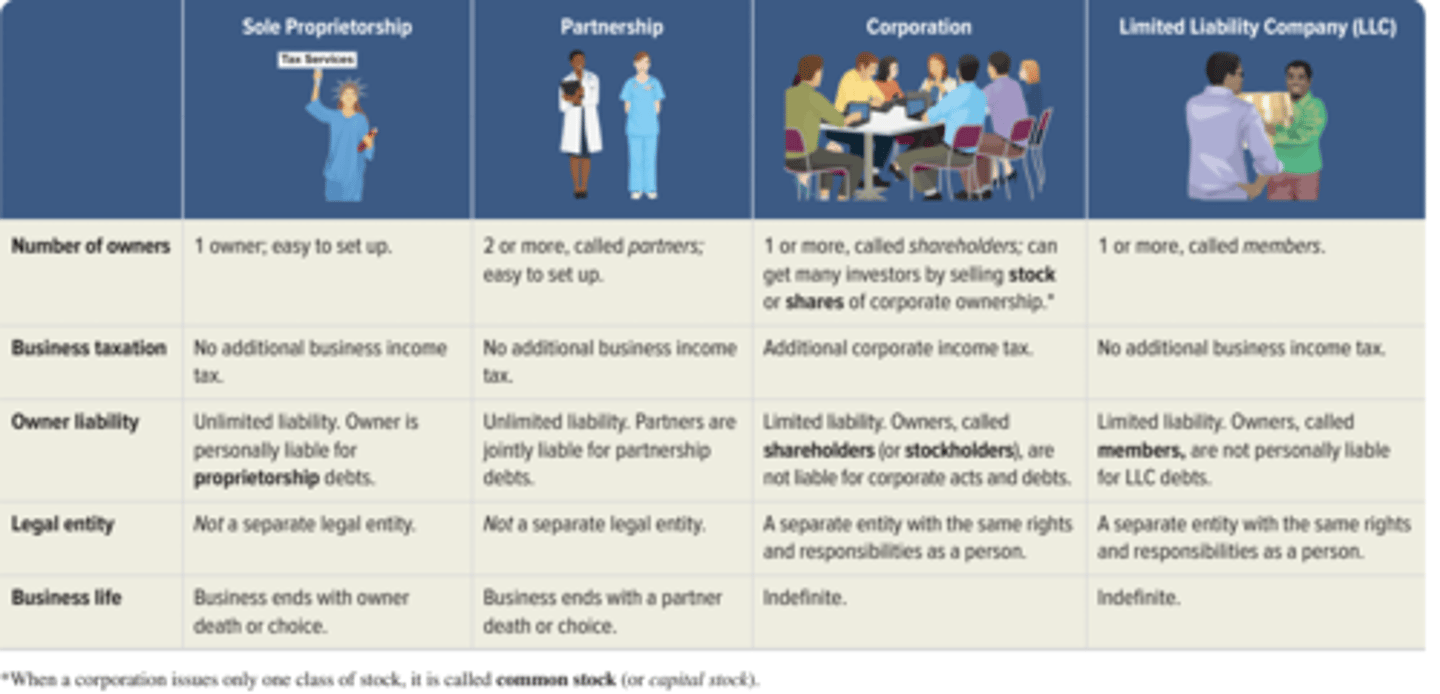
What is the order in which Financial Statements are prepared?
Income statement, Statement of retained earnings, Balance sheet, Statement of cash flows
Income statement
Describes a company's revenues and expenses and computes net income or loss over a period of time. Revenues-Expenses=Net Income
Statement of Retained Earnings
explains changes in retained earnings from net incomes (or loss) and any dividends over a period of time. Beg retained earnings + Net income- Dividends=End Retained Earnings
Balance Sheet
Describes a company's financial position (Types and amounts of assets, liabilities, and equity) at a point in time. Assets=Liabilities + Equity
Statement of cash flows
Identifies cash inflows (receipts) and cash outflows (payments over a period of time. Operating activities-
investing activities-involve buying and selling assets such as land and equipment that held for long term use( typically more than one year)
Financing activities-include long-term borrowing and repaying of cash from lenders and the cash investments from, and dividends to, shareholders.
Net Income
Occurs when revenues exceed expenses
Net Loss
Occurs when expenses exceeds revenues
Shareholder's investments and dividends
are not part of income
Four areas on financial statement analysis
liquidity and efficiency, solvency, profitability, market prospects
Return on Assets / Return on Invetment
Profitability measure that helps evaluate if management is effectively using assets to generate net income.
Net income/Average Total assets
Asset
Resources a company owns or controls that are expected to yield future benefits
Liabilities
Creditors' claims on assets. These are obligations to provide
assets, products, or services to others.
Equity
Shareholders' claim on assets. It consists of:
+ Common Stock- reflects inflows of cash and other net assets from shareholders in exchange for stock.
-Dividends-are outflows of cash and other assets to shareholders that reduce equity
+Revenues- increase equity(via net income) from sales of products and services to customers; examples are sales of products, consulting services provided, facilities rented to others, and commissions from services.
-Expenses decrease equity(via net income) from cost of providing products and services to customers; example are cost of employee time, use of supplies, advertising, utilities, and insurance fees.
Receivable
is an asset that promises a future inflow of
resources.
payable
is a liability that promises a future outflow
of resources
External Transactions
are exchanges of value between two entities, which cause changes in the accounting equation.
Internal transactions
are exchanges within an entity, which may or may not affect the accounting equation
Events
happenings that affect the accounting equation and are reliably measured. They include business events such as changes in the market value of certain assets and liabilities and natural events such as fires that destroy assets and create losses.