3.1.1 f-h
 Call Kai
 Learn
Learn Practice Test
 Spaced Repetition
 Match
Match Flashcards
 Knowt Play
1/22

There's no tags or description
Looks like no tags are added yet.
Name | Mastery | Learn | Test | Matching | Spaced | Call with Kai |
|---|
No analytics yet
Send a link to your students to track their progress
23 Terms
(f) Define the term ‘exoskeleton’.
external skeleton of some organisms
(f) Define the term ‘spiracle’.
Small openings along the thorax and abdomen of an insect that open and close to control the amount of air moving in and out of gas exchange system and the level of water loss from the exchange surfaces.
(f) Define the term ‘tracheae’.
The large tubes of the tracheal system, held open by rings of chitin.
(f) Define the term ‘tracheoles’.
The smallest tubes of the tracheal system, supplies air to each cell.
Cells often surround them so oxygen is effectively delivered into the centre of the cell.
(f) Define the term ‘tracheal fluid’.
Fluid found at the end of the tracheoles in insects that helps control the surface area for gas exchange and water loss.
(f) Outline the structure of insect gas exchange system and describe the way oxygen reaches the body cells.
Spiracles open allowing gases to enter. Branching network allows diffusion of oxygen and carbon dioxide directly to/ from cells.
(f) Explain why insects will tend to keep spiracles closed when oxygen demands are very low.
To reduce water loss
(f) Describe the adaptations that insects with very high energy demands have to increase the efficiency of their gas exchange system.
large SA - lots of branching and vast numbers of tracheoles
short diffusion distance - tracheoles very small and in between cells - every cell very close to a tracheole
conc. grad. maintained by the use of oxygen within cells
(f) Describe how activity changes the volume of tracheal fluid in the tracheoles, and explain the value of this occurring.
As activity increases, anaerobic respiration takes place due to lack of oxygen. The lactic acid produced causes water to leave the tracheal fluid by osmosis, reducing its volume and leaving a larger gas exchange surface available for diffusion.
(f) Describe adaptations that insects with very high energy demands have to increase the efficiency of their gas exchange system.
Large insects use abdominal pumping to move air in/out.
When active, muscular movements of the thorax and abdomen ventilate tracheal system and force air in and out of the air sacs.
(f) Describe the advantages, challenges faced by gas exchange system operating in water rather than air.
no water loss issues
water supports and separates structures so no need for cartilage or chitin.
lower percentage of oxygen in water
water much denser so requires lots of energy to change direction hence a one-way system for fish
(f) Define the term ‘operculum’.
The bony flap covering the gills of bony fish. Part of thee mechanism that maintains a constant flow of water over the gas exchange surfaces.
(f) Define the term ‘ buccal cavity’.
The space behind the mouth.
(f) Define the term ‘opercular valve’.
The flap that allows the operculum to be moved outwards whilst keeping it closed.
(f) Define the term ‘gill arch’.
A bony structure that supports the gill filaments
(f) Define the term ‘gill filament’.
A thin projection from the gill arch creating a large surface area.
(f) Define the term ‘gill plate/ gill lamellae’.
Raised plates on the surface of gill filaments which in total create a large surface area for gas exchange
(f) Label and annotate a diagram showing the features of the gas exchange surface.
(f) Describe the mechanism of ventilation in bony fish.
Inspiration:
mouth open and floor of buccal cavity lowered
expansion of buccal cavity reduces pressure causing water to enter via mouth (buccal pressure pump)
opercular valve closed and operculum moved outwards
expansion of opercular cavity reduces pressure causing some water to flow over gills into opercular cavity (opercular pressure pump)
Expiration:
mouth close and floor of buccal cavity raised
compression of buccal cavity increases pressure causing water to flow over gills into opercular cavity (buccal pressure pump)
opercular valve opens and operculum moved inwards
compression of opercular cavity increases pressure causing water to flow out of opercular cavity (opercular pressure pump)
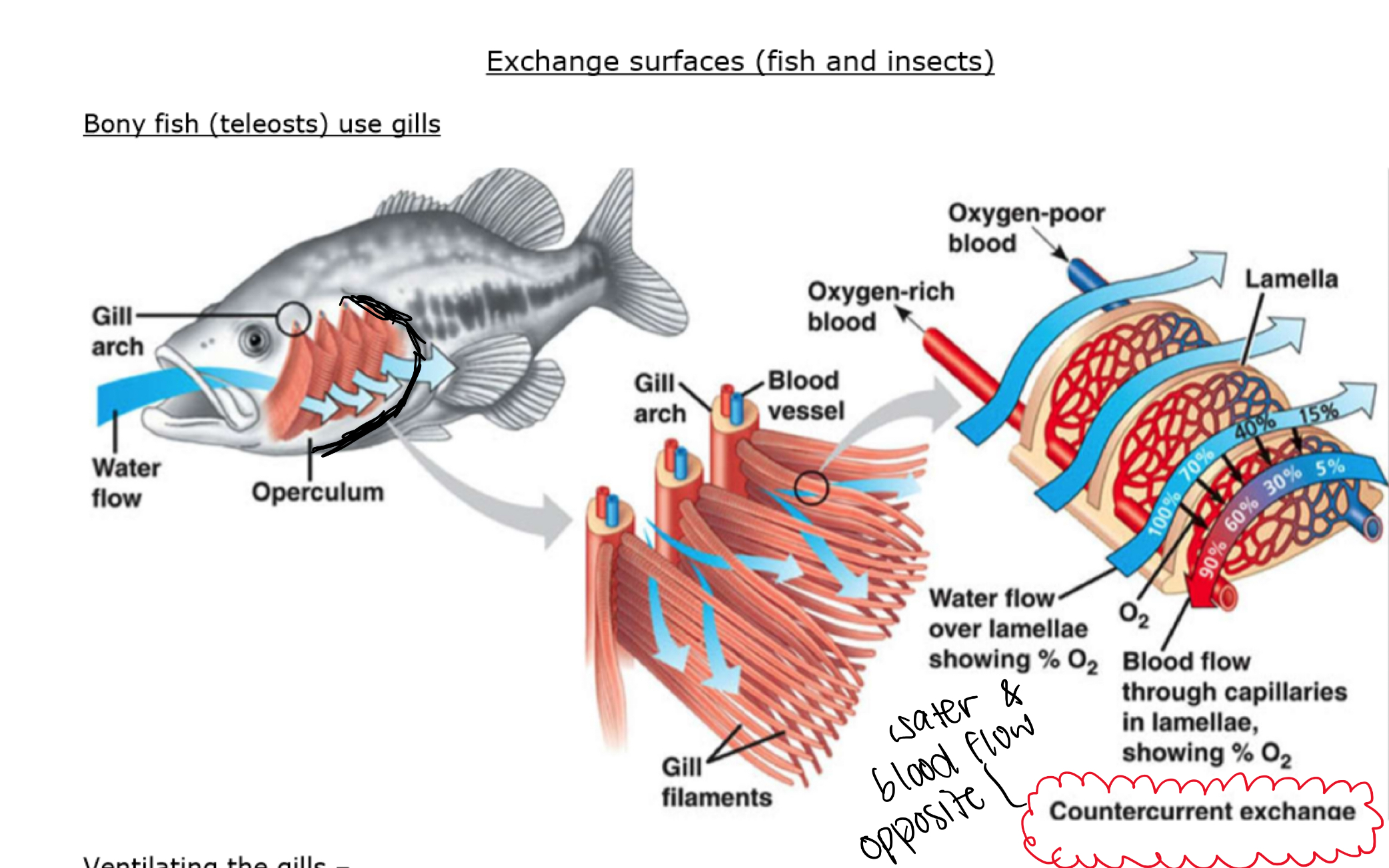
(f) Describe the adaptations that make the bony fish gas exchange exchange system an efficient exchange surface.
gill filaments and lamellae maximise surface area for gas exchange
lamellae are very thin and have capillaries to reduce diffusion distance
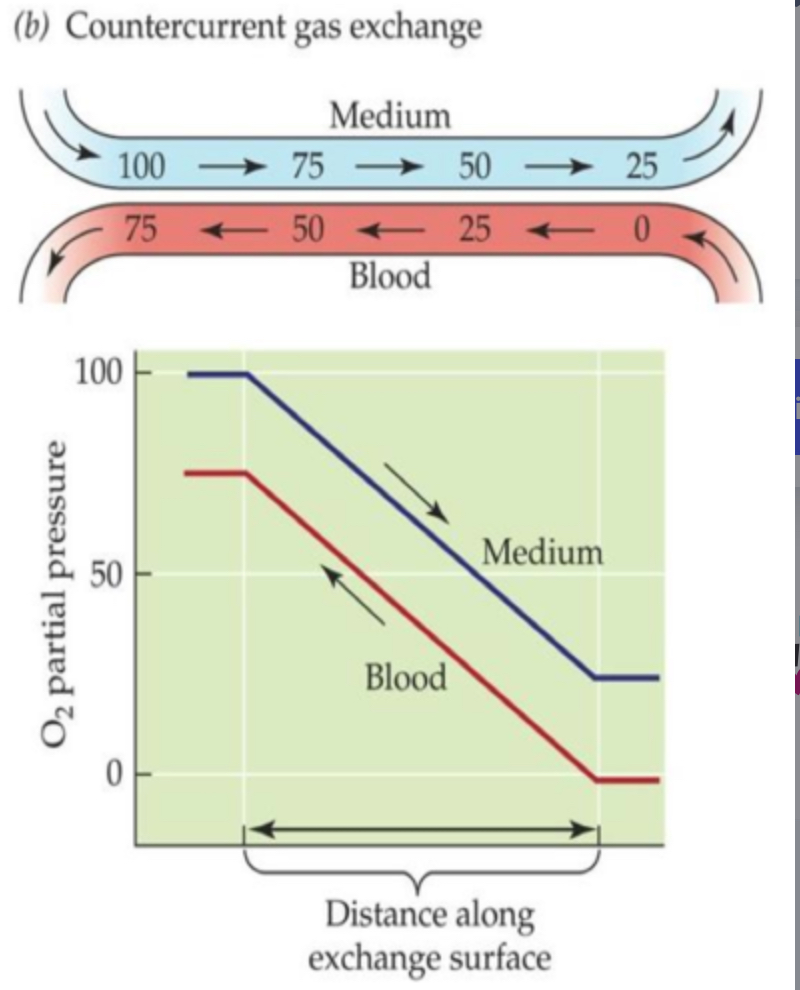
large conc. differences due to flow of water replacing deoxygenated water and flow of blood replacing oxygenated blood in a countercurrent system
(f) Define the term ‘countercurrent exchange system’.
a system for exchanging materials or heat when the two different components flow in opposite directions past each other
(f) Define the term ‘parallel exchange system’.
a system for exchange between fluids where the two fluids run in adjacent tubes in the same direction.
(f) Draw a diagram to show how a much higher oxygen saturation of the blood can be achieved by a countercurrent exchange system as compared to a parallel exchange system.