chem 4
 Call Kai
 Learn
Learn Practice Test
 Spaced Repetition
 Match
Match Flashcards
 Knowt Play
1/186

There's no tags or description
Looks like no tags are added yet.
Name | Mastery | Learn | Test | Matching | Spaced | Call with Kai |
|---|
No analytics yet
Send a link to your students to track their progress
187 Terms
what kind of ploymer is non biodegrable
addi=tion
formal charge formula
valence electrons - (bonded electon/2 + non bondeded electron)
types pf chromatography
colomn
paper
thin layer- al plate with sio2 coating
chromatography
technique used to seperate components of a mixture base don their relatibe attraction invlving intermoleculat forces to mobile ans stationary points
components of chromatography
mobile phase
stationary phase mobi
mobile phse
solvent or gas that moves through the stationary phase caryiing sample components
stationary phase
solid or liquid medium through which the sample components are seperated based on their interactions
principples of seperaton
movement of components in the mobile phase is controlled by the significance of their interactions with mobile/ stationary phse
bc differences in factos such as solubility of certai components in the mobile phase and strength of affinities for the stationary phse - changes speed of components and hence seperation
these affinities involve IMF `
heat
form of energy which is transformed as a result of adifferrence in temperature annd produces an increase in disorder of the behaviour of the particles. inc in avg ke
enthalpy
heat content of substance
internal energy in reaction s
abs vakue for enthalpy of reactants and products cannot be known but you can measure their difference
open
closed
iso system
open - mass and enegy change
closed - energy only
iso - no exchange
factoes o temperature
mass
amt of heat added
nature of substance
specific heat capicity
amt of energy needed to inc unit mass temp by 1k or 1c
exo and endo energy profile
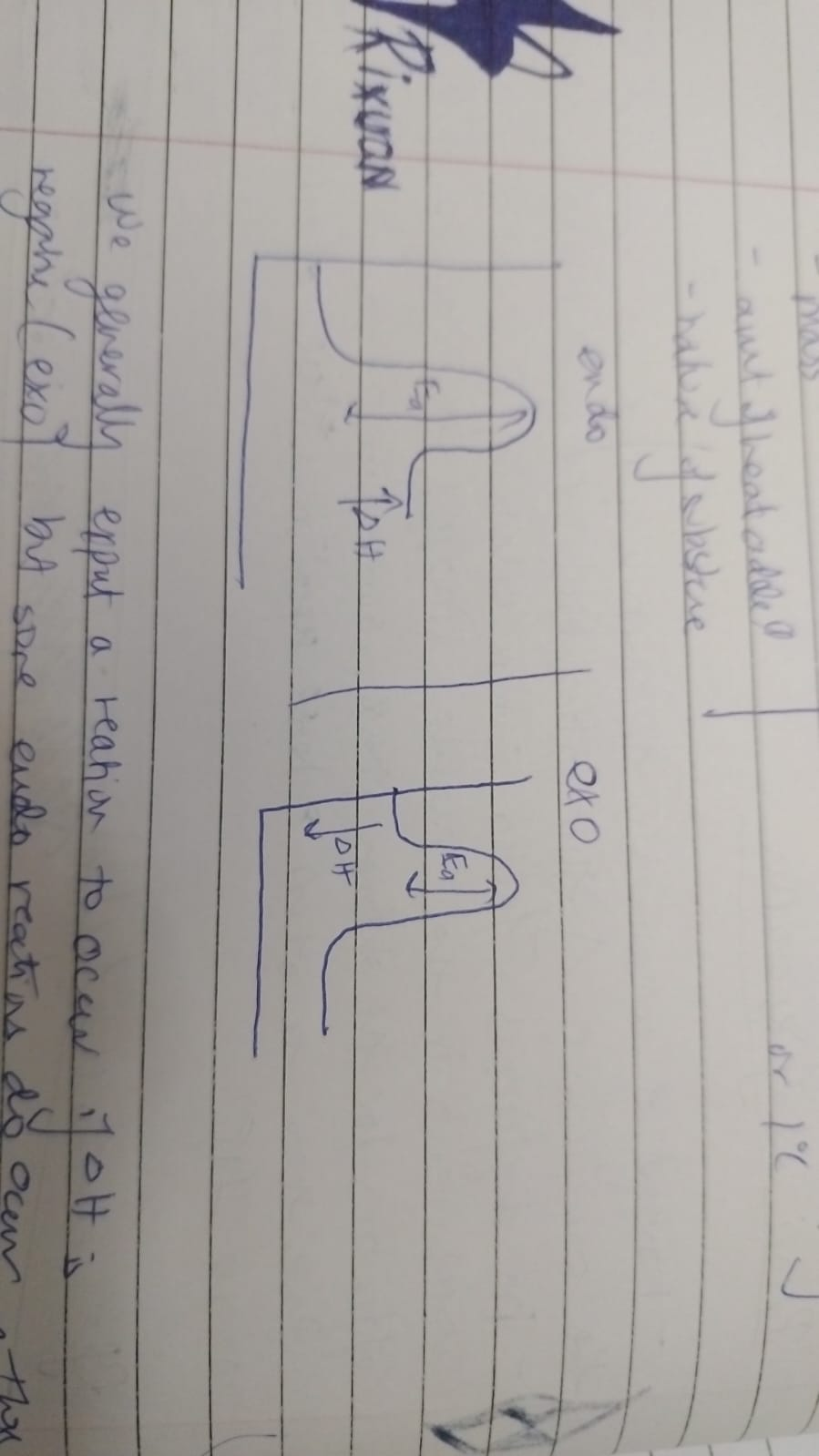
is a reaction normally endo or exo
normally exo but if entropy is large it can be endo s
standrad enthalpy change = delta h 0
heat transderred at a constant preassure under standard conditions and states. can be determined from the change in temp of a pur substance
standard contopns not stp
t = 298k
p = 101.325 kPa
conc = 1mol/dm3
all substance in standard states ( pure substance_
c of water
4.18 J/kg
delta h formula energy
Q/n = energy/no of moles = J/mol
enthalpy of combustion delta h c
always negative
delta h c formula
enthalpy of combustion
consider situation ethanol is being used to ehat water
mc delta t/ n
m of water
c of water
delta t of water
n of ethanol
alcohol + excess o2 → co2 + h2o - delta h comvustion
reasons for diff in delta h experimental and lit
heat lost to surroundng
combustion may not be complete
ot underr std sonditions
delta h of reactions in solution
carry out reaction in an isolated system such as polystyrebe cup or styrofoam
heat released or absorbed by reaction can me measured byt he change in temp of wate r
largest source of error is heat lost to env
delta h = -mc delta t/ n limiting
assumptions of delta h
soln is very dilute - vol of solute= vol of water/solvent
density of water = 1g/cm3
no heat loss from syet,
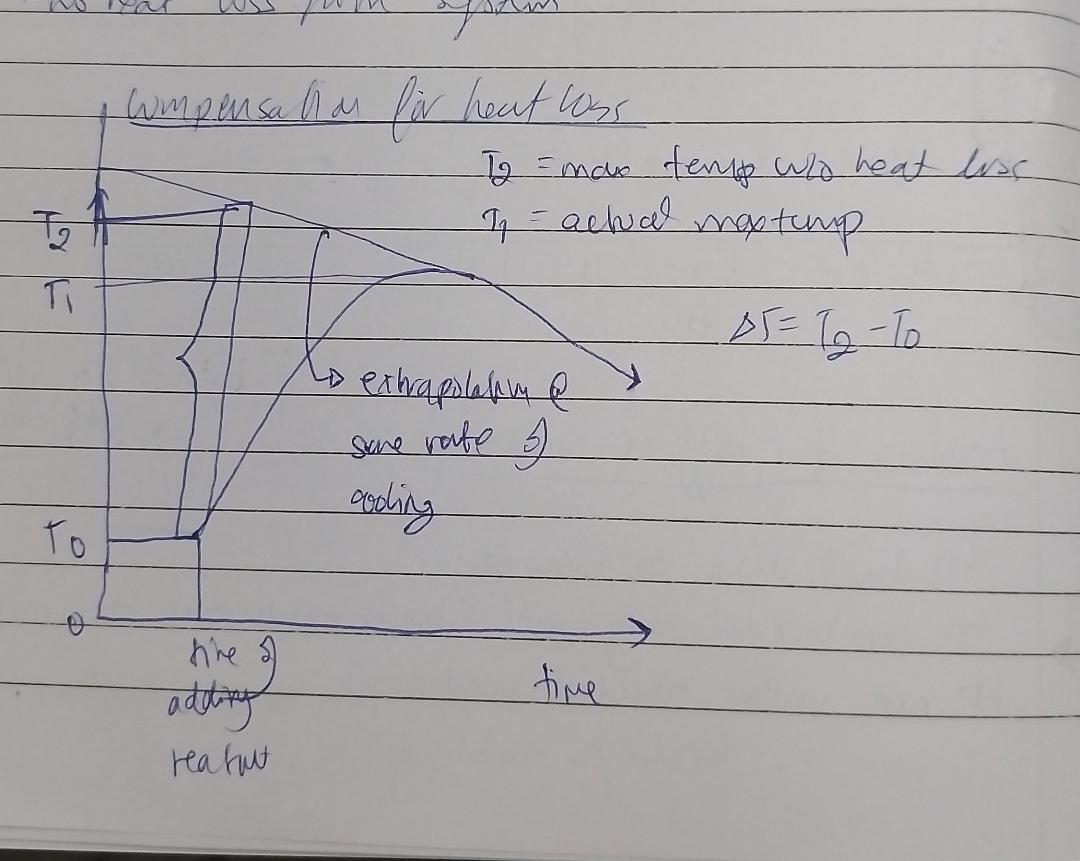
compensation for heatloss diagram
when it goes up thats whe reactant was added
if you extrapolate the decreasing gradient part of the curve back, at the time when reactant was added youll find the theoretical max temp vs t1 which is the actual max
delta t = t2 - t1
enthalpy of formation `
the energy change (absorbed or released) when one mole of a substance is formed from its constituent elements in their most stable, standard states under standard conditions
enthalpy of formation formula
sum of delta hf of products - sum of delta hf od reactants
delta hf for an element value
0
enthalpy of formation is for 1 mol
how to find hess law diagram
they will give main reaction eqn + 1 formation
add those 2 and cancel same stuff on opp sides
that is the bottom part of triangle + whatever else you need to satisfy all the formations
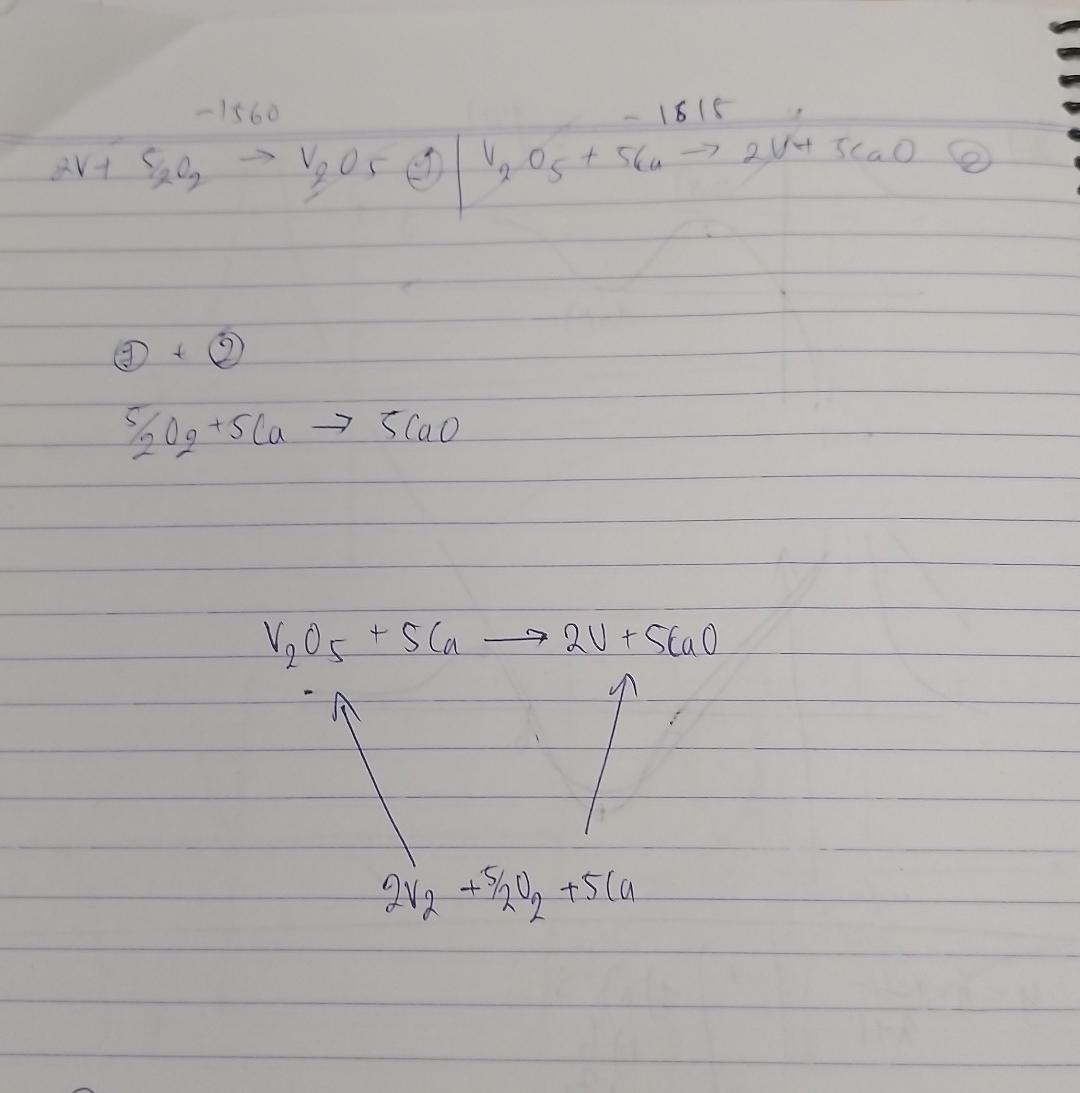
only multiply enthalpy by num of moles for combustion not formation
entropy unit
J/K mol
entropy
measure of distribution or dispersal of matter/energy in the system the more ways it can be distributed the higher the entropy. gas > liq > solid
spontanelosu reaction
spontaneous when it moved towards either completion or eq under a given set of contitions without external invervention. delta s is positve
non spontaneous reaction
reactions that dont take place under a given set of condiitons
factors of entropy
state = gas> liq> solid
no of particles - doubling particles doubles entropy
perfect ordered sold crystal entropy
0
entrppy and spontaneity relationship
delta s tot > 0 = spontaneous
delta s tot = 0 equilibrium
delta s tot < 0 non spontaneous
how to find temo where reaction becomes spontaneous/ non
delta g = 0 = delta h + Tdelta s
delta s 0 equation
sum of all n x s of products - sum of all n x s of reactants
n = no of oles
s = enthalpy
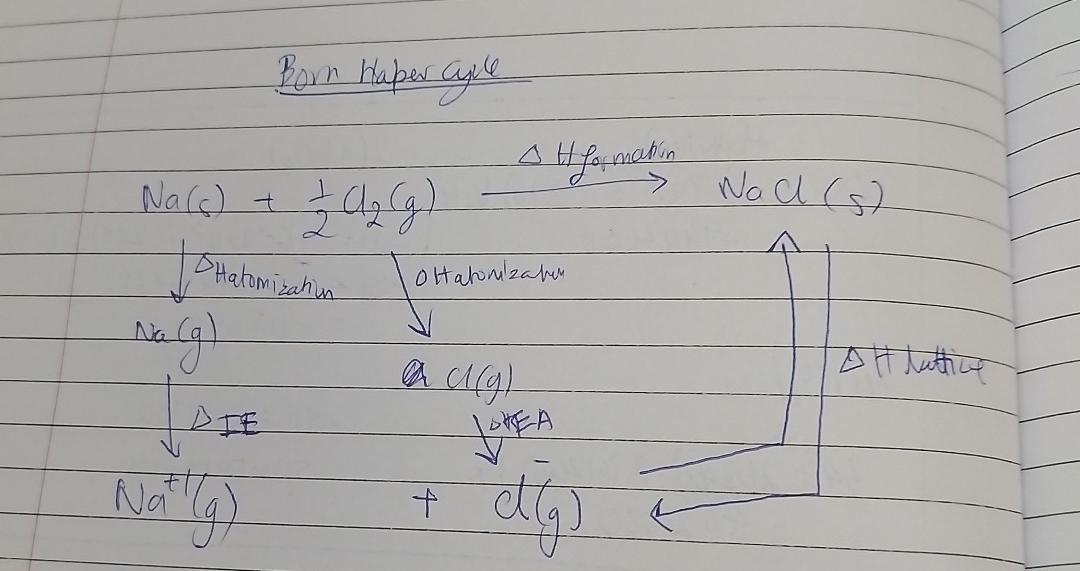
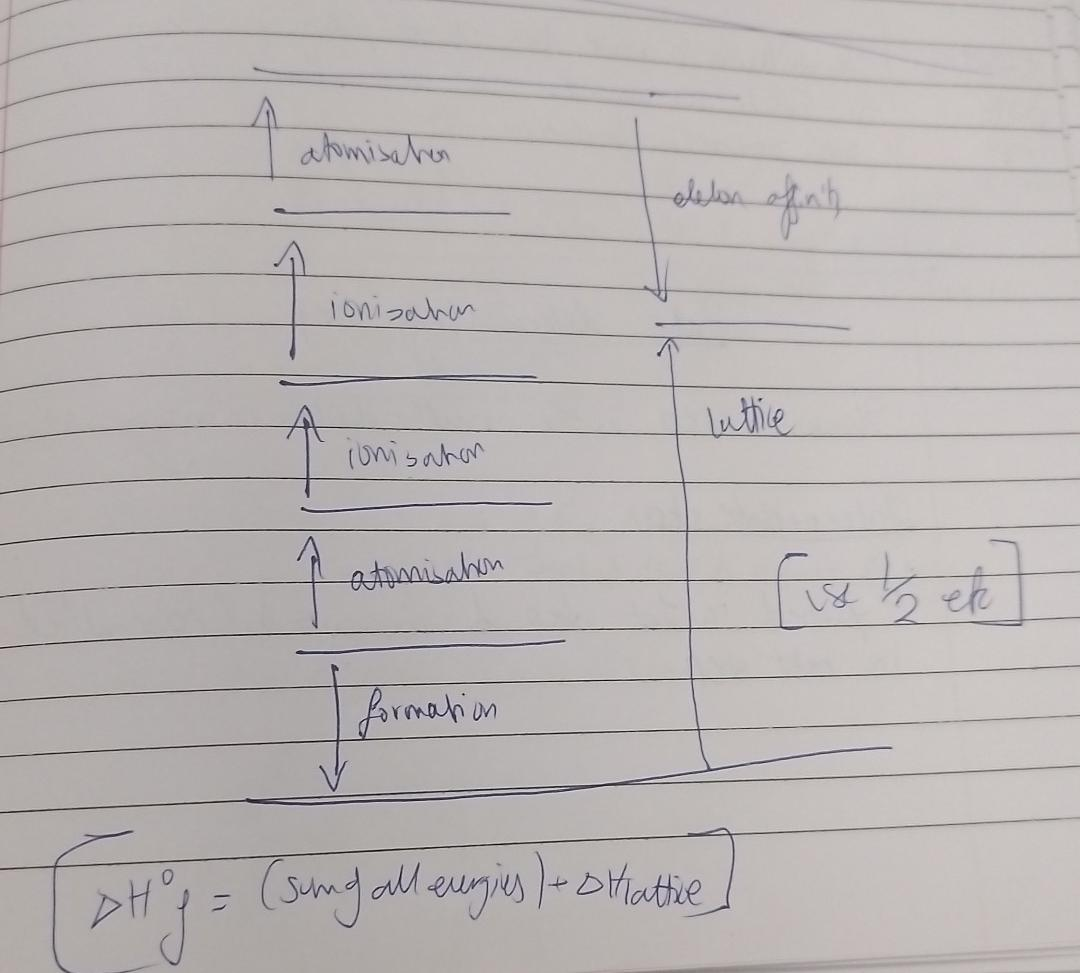
lattice enthalpy
enthalpy of a solid lattice - nacl→ na + cl2
borne haber cycle
delta hf + delta h lattice = delta h atomazitaion all + delta h ie all + delta h ea
ea = electron affinity
why would theoretical delta h and exp be diff
preence of ionic / covalent nature leaidng to higher delta h
binding triangle
are covantnt bonds lattice
no
cimbustion is redox
specific energy of a fuel formula
enenrgy/ mass
enthalpy formula energy and moles
energy/moles
rate of reaction
change in conc of a particular reactant/ product pre unit time
rvg rate of reaction formula
mod ( change in conc/ change in time)
how to find taye of reaction from graph
initial rate = tangent at initial
avg rate - final to initial line
instantaneous - tangent at point
collision theory
colliisons of particles must have suffieinent energ ymore than ea - energgt used to break binds in reactants - not individial particles energy but energy of the collison
and correct orientation - collision geometry - atoms come in direct contact and form chem bonds of products
why does reaction place even tho theres low % of sucessful collisions
high no of collisons/ second fa
factors affecting ror
preassure
conc
temp
surface area
catalyst
delta h 0
std enthalpy change
enthalpy of reaction
enthalpy change wen reactants in the stoicometric eqution give producsts under standard conditions
enthalpy of formation
when 1 mol of compound is formed from elements in std condition
enthalpy of combustion
when 1 mol of substance combusts
alw exo
enthalpy of neutralization
when 1 mol of water is formed by reacting an acid and alkalai under std condition a
avg bond energy
eergy needed to break 1 mol of monds in a gaseous molecule averaged over simmilar compounds
simplify eqn so only 1 mol is reacting
avg bind eneergy formula
total bond dissociation energy/ no of bonds
delta h 0 formula
ehthalpy change for bonds broken+ enthalpy change for bonds formed
for hess law eqns what sums equal what
clockwise = anticlockwuse
enthalpy of reaction formula
sum of delta h compubstion reactants - sum of delta h combustion products
born haber sycle endo and exo`
up is endo
down is exo
1st e affinity
std enthalpy change when 1 mol of gaseous atons is convetered to 1 mol of gaseous ions each w a -1 charge
endo exo or neutral
2nd e affinity
-1 to -2
endo
atomisation
splitting of cl2
atomization refers to the process of breaking down a substance (element or compound) into its individual constituent atoms in the gaseous phase. [1, 2]
delta h f eqn born haber cycle
delta h atomizatoin + delta h ie + delta h ea - delta h latice
reaction mechanism
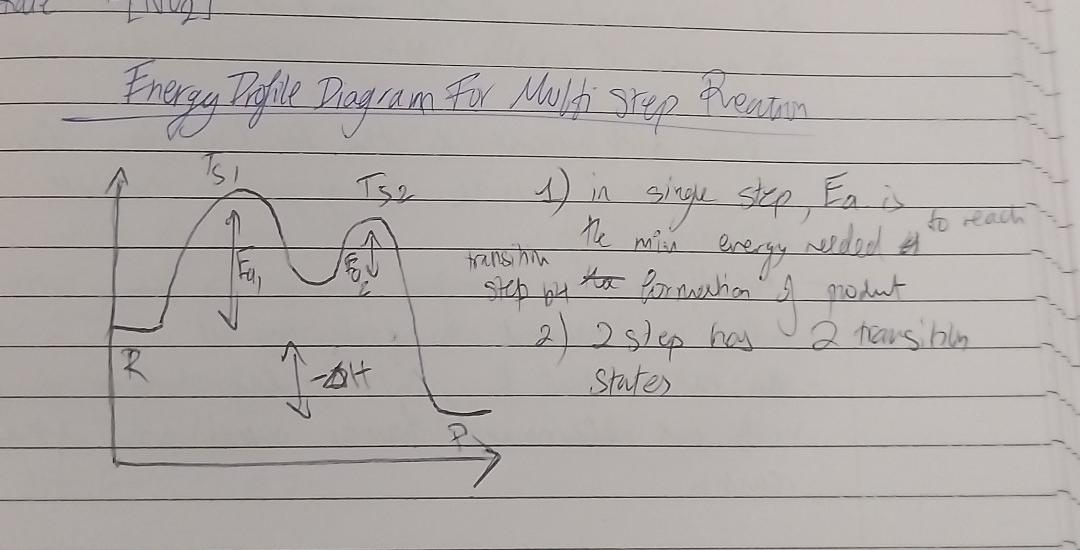
series of elementaey steps by whcih a chemical reaction occurs. more than 1 step is a multistep reactioj
molecularity
number of species involved in an elementary step
uni molecular
bi molecular
termolecular
why is termolecular rare
3 particles r very unlikely to collide w eachother at the same time and in the correct orientation
rate determining step
slowest step
intermediate step
formed in 1st step and consumed in next step
rate proportiona to what `
conc of reactants
rate equarion
k[a][b] = rate
energy profile for multi step reaction
overall ea is the highest state - reactants stare
slow step is step w highest ea
what do rate eqns depend on
mechanism of the reaction and only can be determined experimentally
order of reaction
the exponent to which the conc of the reactant can describe the number of particles taking part in the rate determinig step
order w respect to reactant can desctibe the number of particles paking part in the rate determing step
overall reaction oderr
sum of orders w respect to reach reactant
rate law eqn
rate = k [A]^m[B}^n
m and n are experimentally found - mole ration
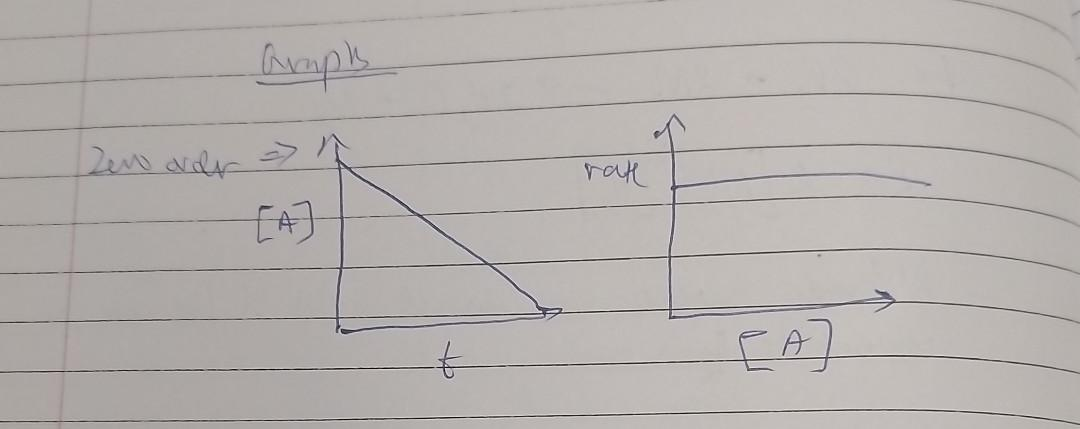
zero order rate and unit
rate = [A]
mol/dm³se
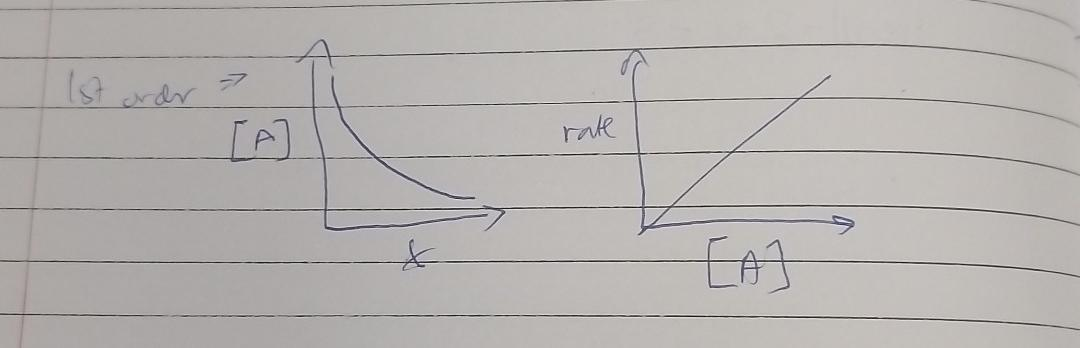
1st order rate and unit
rate = k[a]
mol/dm³s/mol/dm³= 1/s
2nd order rate and unit
mol/dm³s/(mol/dm³)² = dm³/mol s
3rd order unit
mol/dm³s/(mol/dm³)³ = dm^6/mol²s
zero order conc vs time and rate vs conc graph
first order conc vs time and rate vs conc graph
second order conc vs time and rate vs conc graph
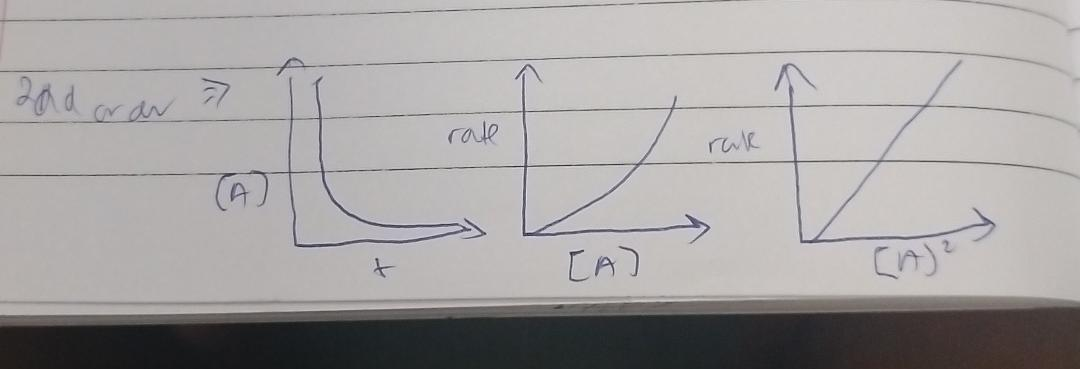
hwo to find order from table
when a doubles and rate also doubles
order = multiplication factor of rate a/ multiplication factor of conc
what to do when both rates change
you alr have oder of a from b4
divide multiplier of rate by a order
then divide that value by 2 to get b value
when it asks to describe bodn what to talk abt
type pi or sigma
hybrdizatio
axial or lateral
why would structure not be accepted
formal charge why ou
why would molecule not have resonance structure
no way to draw lewis structue w fc equally close to 0
lp and bp try to minimisr replusion
why does more braching mean lower boiling point
smaller sa
weaker ldf needs less force to overcome
hybridization is from number of ed lp and bp
wh
what to sau when it says predict and explain bond angle
angle
no of ed e
electron mobility in graphene
nore bcs nor impeded by layers
how does sp2 inc melt
partial, stronger double bond character
arhenneus equation
uses temp dependance of the rate constant to determine activation energy
take sinto account frequency of collision s with proper orientations