From Bench to Bedside – Recent Advances in Drug Delivery to Cancer
 Call Kai
 Learn
Learn Practice Test
 Spaced Repetition
 Match
Match Flashcards
 Knowt Play
1/20

There's no tags or description
Looks like no tags are added yet.
Name | Mastery | Learn | Test | Matching | Spaced | Call with Kai |
|---|
No analytics yet
Send a link to your students to track their progress
21 Terms
What is paclitaxel’s mechanism of action?
It stabilises microtubules, preventing depolymerisation → cell cycle arrest.
Why is Cremophor EL used in paclitaxel formulations?
Paclitaxel is water‑insoluble; CrEL solubilises it.
What major issue is associated with Cremophor EL?
Severe anaphylactic hypersensitivity reactions (up to 35% without pre‑medication).
What is nab‑paclitaxel (Abraxane)?
A solvent‑free, albumin‑bound nanoparticle formulation of paclitaxel.
Why does albumin bind paclitaxel effectively?
Albumin contains hydrophobic pockets that bind hydrophobic drugs.
What receptor mediates nab‑paclitaxel transcytosis?
gp60 on endothelial cells → activates caveolin‑1.
What is the EPR effect?
(Enhanced permeability and retention) Tumour vasculature is leaky and has poor lymphatic drainage → nanoparticles accumulate passively.
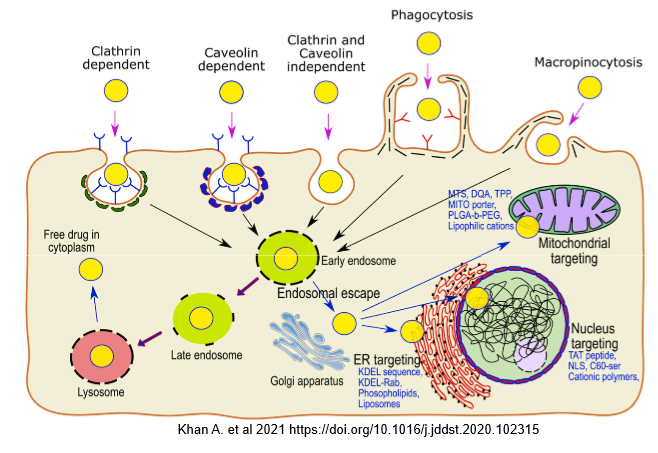
What is clathrin‑mediated endocytosis?
Receptor‑mediated uptake via ~100 nm clathrin‑coated vesicles that internalize nanoparticles into the early endosome. These vesicles later fuse with endosomes for sorting.
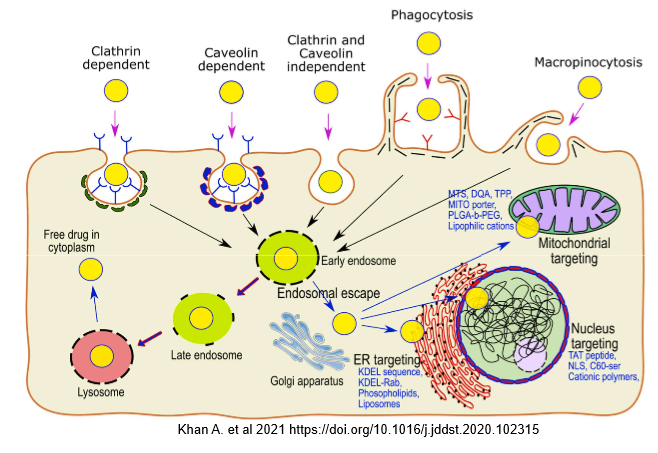
What is caveolin‑mediated endocytosis?
Uptake via 50–80 nm caveolae (small flask-shaped invaginations rich in cholesterol and sphingolipids) that bypass lysosomes avoiding degradation.
What is clathrin‑/caveolin‑independent uptake?
Uptake via small dynamic membrane domains; avoids degradation.
How does PEGylation affect phagocytosis?
Reduces opsonisation, helping nanoparticles evade immune clearance.
Why is the transferrin receptor (TfR) a good cancer target?
Cancer cells overexpress TfR due to high iron demand.
What is a Nuclear Localization Signal (NLS)?
A short amino acid sequence directing molecules into the nucleus.
What is TPP (Triphenylphosphonium) used for?
Mitochondrial targeting due to its lipophilic cationic nature. so can exploit the high membrane potential
How does TPP (Triphenylphosphonium) achieve mitochondrial targeting?
Its lipophilic cationic nature allows accumulation driven by the negative mitochondrial membrane potential, enabling selective mitochondrial delivery.
How does gp60–caveolin‑1 signalling enhance nab‑paclitaxel tumour penetration?
Albumin binds gp60, activating caveolin‑1, which triggers caveolae formation → enhanced transcytosis across endothelial cells.
Why is caveolin‑mediated uptake advantageous for organelle targeting?
It bypasses lysosomal degradation, allowing nanoparticles to reach the Golgi or ER, improving intracellular delivery efficiency.
What is the main limitation of clathrin‑mediated endocytosis for nanomedicine?
Cargo is trafficked to lysosomes, where many nanoparticles undergo enzymatic degradation, reducing bioavailability.
Why is endosomal escape critical for gene delivery systems like SGT‑53?
Without escape, genetic cargo becomes trapped in endosomes → lysosomes, preventing nuclear delivery of p53 cDNA.
Why is the nuclear pore complex a major barrier for nanomedicine?
it restricts passive diffusion to <10 nm, meaning most nanoparticles require NLS peptides or active transport mechanisms.
What makes disulfide linkers suitable for redox‑responsive nanomedicine?
Tumours have high intracellular GSH, which reduces disulfide bonds → drug release. This exploits tumour‑specific redox imbalance.