T6 - IE2 - Oncology - Elsaid - Growth Factor Receptors & Soluble Tyrosine Kinases
 Call Kai
 Learn
Learn Practice Test
 Spaced Repetition
 Match
Match Flashcards
 Knowt Play
1/151

There's no tags or description
Looks like no tags are added yet.
Name | Mastery | Learn | Test | Matching | Spaced | Call with Kai |
|---|
No analytics yet
Send a link to your students to track their progress
152 Terms
HER
human epidermal receptors
HER (human epidermal receptors) are also known as...
ErbB and EGFR
EGFR
epidermal growth factor receptor
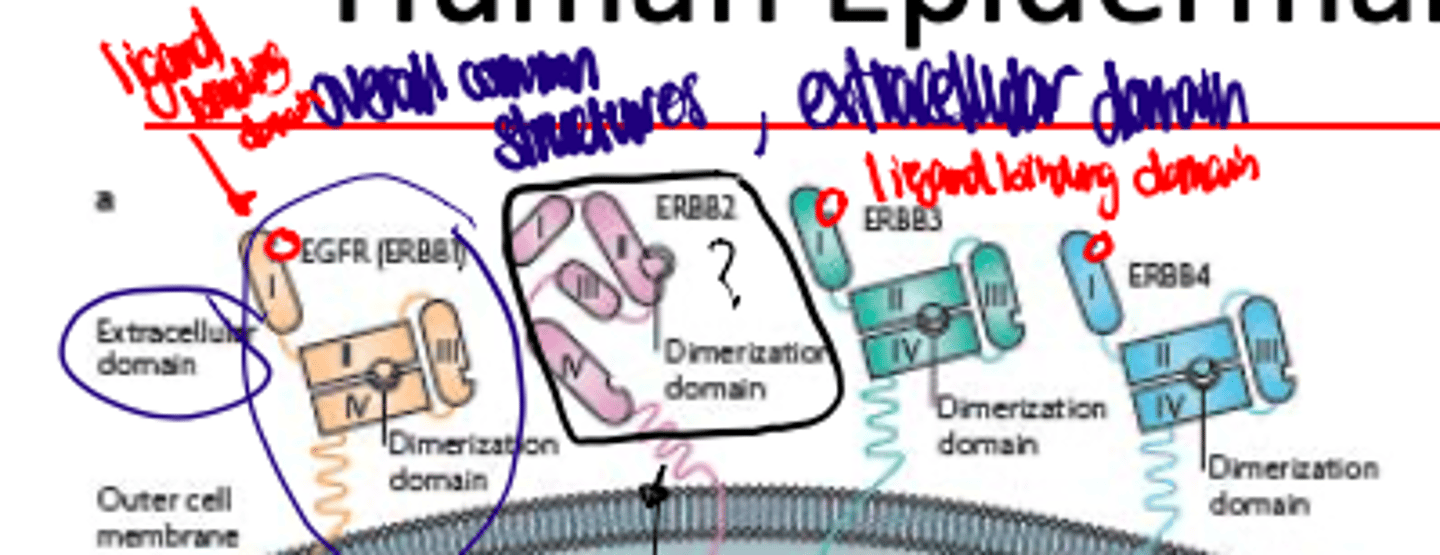
Human Epidermal Receptors (HER): 4 structurally related receptors
ErbB1 (EGFR, Her1)
ErbB2 (Her2; Neu)
ErbB3
ErbB4
Human Epidermal Receptors (HER): most have an extracellular domain containing ligand binding domain and dimerization domain with the exception of _______ (which has no dimerization domain)
- (exception of) ERbB2
ERbB2 does not have a dimerization domain
Human Epidermal Receptors (HER): most have an extracellular domain containing __________ binding domain and ___________ domain
- ligand (binding domain)
- dimerization (domain)
Human Epidermal Receptors (HER): extracellular domain figure
Note that ERBB2 does not have a dimerization domain
Human Epidermal Receptors (HER): intracellular domain is a _____________ _______ domain (except for ErBB3)
- tyrosine kinase (domain) [except for ErBB3]
i.e., ErbB1, ErbB2, and ErbB4 are tyrosine kinases
Human Epidermal Receptors (HER): intracellular domain is a tyrosine kinase domain. EXCEPT for ___________
- (EXCEPT for) ErbB3
Human Epidermal Receptors (HER): ErbB2 has ____ _________ binding domain for activation.
Dimerization comes together for activation
- no ligand (binding domain for activation)
Thus, ErbB2 ALWAYs has an open conformation and does not require a ligand like the other ErbBs
Human Epidermal Receptors (HER): Dimerization comes together for ____________
Once the dimer forms, tyrosine kinase starts _____________ process and causes the __________ __________ pathway
- (comes together for) activation
- (tyrosine kinase starts) phosphorylation (process)
- signal transduction (pathway)
Human Epidermal Receptors (HER): ErbB2 always has an ________ __________ because it does not have a ligand binding domain
- (always has an) open conformation
Human Epidermal Receptors (HER): ErbB3 is always a _____________, whereas ErbB1, ErbB2 and ErbB4 can also be a homodimer
- (always a) heterodimer
i.e., ErbB3 forms a dimer but it will be a mix of ErbB3/ErbB1, ErbB3/ErbB2, ErbB3/ErbB4 but never ErbB3/ErbB3 whereas the others can form this homodimer
Human Epidermal Receptors (HER): ErbB3 is ALWAYS a HETERODIMER
But the other human epidermal receptors can form ___________
- (can form) homodimers
such as ErbB1/ErbB1 or ErbB4/ErbB4 etc.
Human Epidermal Receptors (HER): ErbB3 is ALWAYS a HETERODIMER because it does NOT have a _________ ________
- (because it does not have a) tyrosine kinase
Must depend on another tyrosine kinase in order for it signal, transduction pathway downstream
Human Epidermal Receptors (HER): cancers cannot rely on homodimers ________ so they also form _____________
- (homodimers) alone
- (form) heterodimer
Drug resistance may occur against Her/ErbBs because the drug may be ________ to one ErbB, but since they can form __________ it only targets half
- specific (to on ErbB)
- heterodimers (it only targets half)
Drug resistance may occur against Her/ErbBs because the drug may be specific to ____ ErbB, but since they can form heterodimers it only targets _______
- (drug may be specific to) one (ErbB)
- (only targets) half
Do all ErbB receptors have ligands and what are these?
More than 1 ligand bind to each receptor, usually its around 5-6. Can't really target ligands in cancer so the target must be a receptor such as the extracellular domain or protein kinase domain
ErbB receptor: there is usually ________ than 1 ligand that bind to each receptor, usually its around ___-_____
- more (than 1 ligand)
- (usually its around) 5-6
Thus, in cancer we do not target ligands, we have to target the receptor such as the extracellular domain or protein kinase receptor
ErbB receptor: there is usually around 5-6 ligands that bind to a receptor
Thus, in cancer instead of targeting the ligand, a _______ _______ receptor or ________ _______ receptor is targeted
- extracellular domain (receptor)
- protein kinase (receptor)
EGF
epidermal growth factor
EPG
epigen
TGF
transforming growth factor α
AR
amphiregulin
BTC
betacellulin
HB-EGF
heparin-binding epidermal growth factor
EPR
epiregulin
Nrg-1/2/3/4
neuregulin-1/2/3/4
Extracellular domains I and III are _______ _______ domains
- (Extracellular domains I and III are) ligand binding
Domain II is the __________ domain
- (Domain II is the) dimerization (domain)
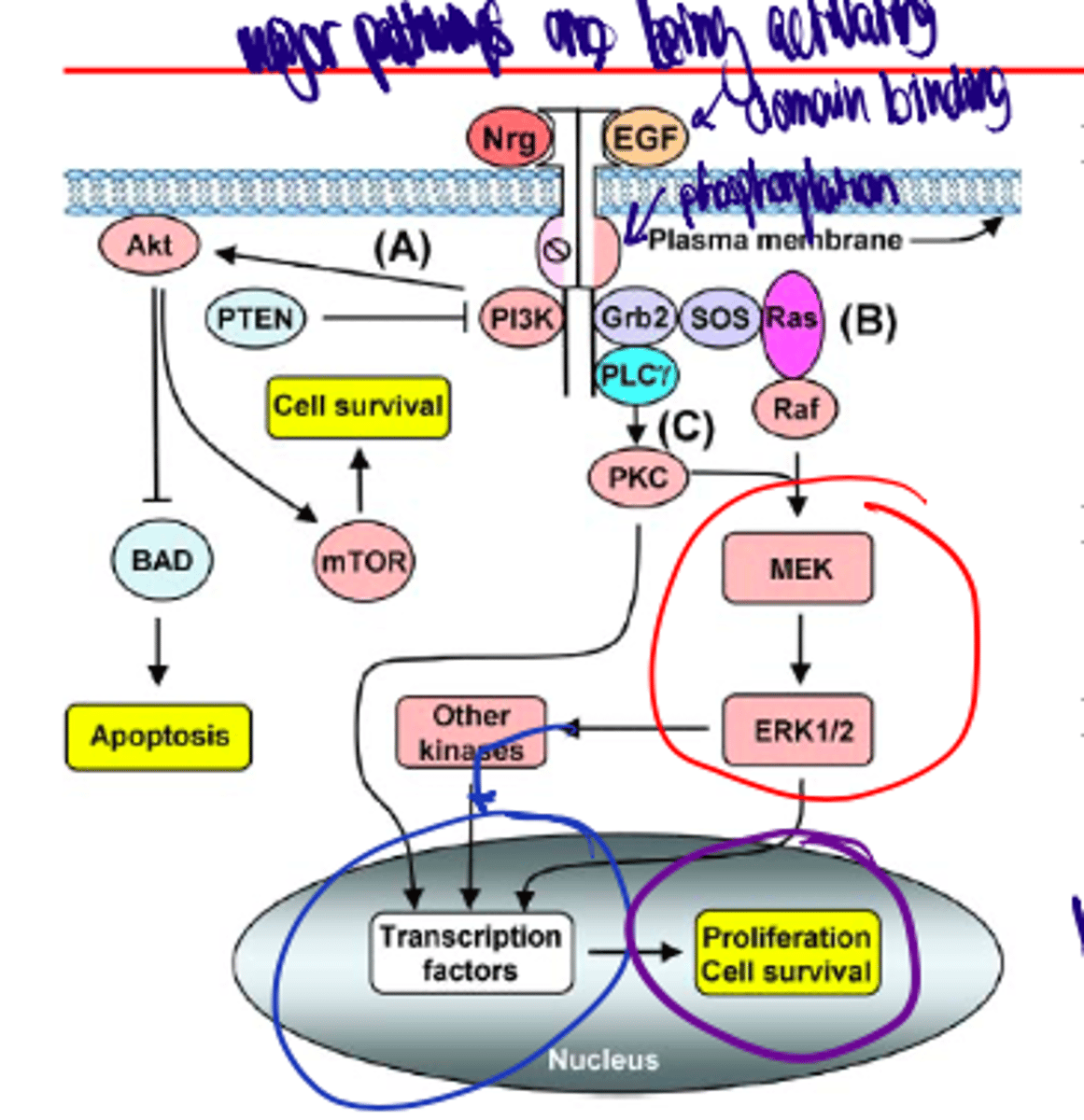
Signaling pathway as a result of HER activation
PI3K/AKT Pathway
MEK/ERK pathway
PLC gamma and PKC pathway
Signaling pathway as a result of HER activation figure
In cancer there is more activation than ONLY EGFs, inhibiting one part of the pathway may cause a ____-___________ to other parts of the pathway to keep the uncontrolled growth
- re-direction (to other parts of the pathway)
i..e, blocking PI3K/AKT can re-direct to more MEK/ERK pathway or PLC gamma and PKC pathway (blocking one may lead to more use of another)
Signaling pathway as a result of HER activation: PI3K/AKT pathway activates the ______ pathway that results in cell survival and inhibits apoptosis pathway
- (activates the) mTOR (pathway)
Signaling pathway as a result of HER activation: PI3K/AKT pathway activates the mTOR pathway that results in cell _________ and inhibits __________ pathway
- (results in cell) survival
- (inhibits) apoptosis
Signaling pathway as a result of HER activation: MEK/ERK pathway results in ______ proliferation
- cell (proliferation)
similar to PLC gamma and PKC pathway results in cell proliferation
Signaling pathway as a result of HER activation: PLC gamma and PKC pathway results in ______ ____________
- (results in) cell proliferation
similar to MEK/ERK pathway
Signaling pathway as a result of HER activation: ____/______, ____ ______ and ______ pathways all results in cell proliferation
- MEK/ERK
- PLC gamma
- PK (pathways)
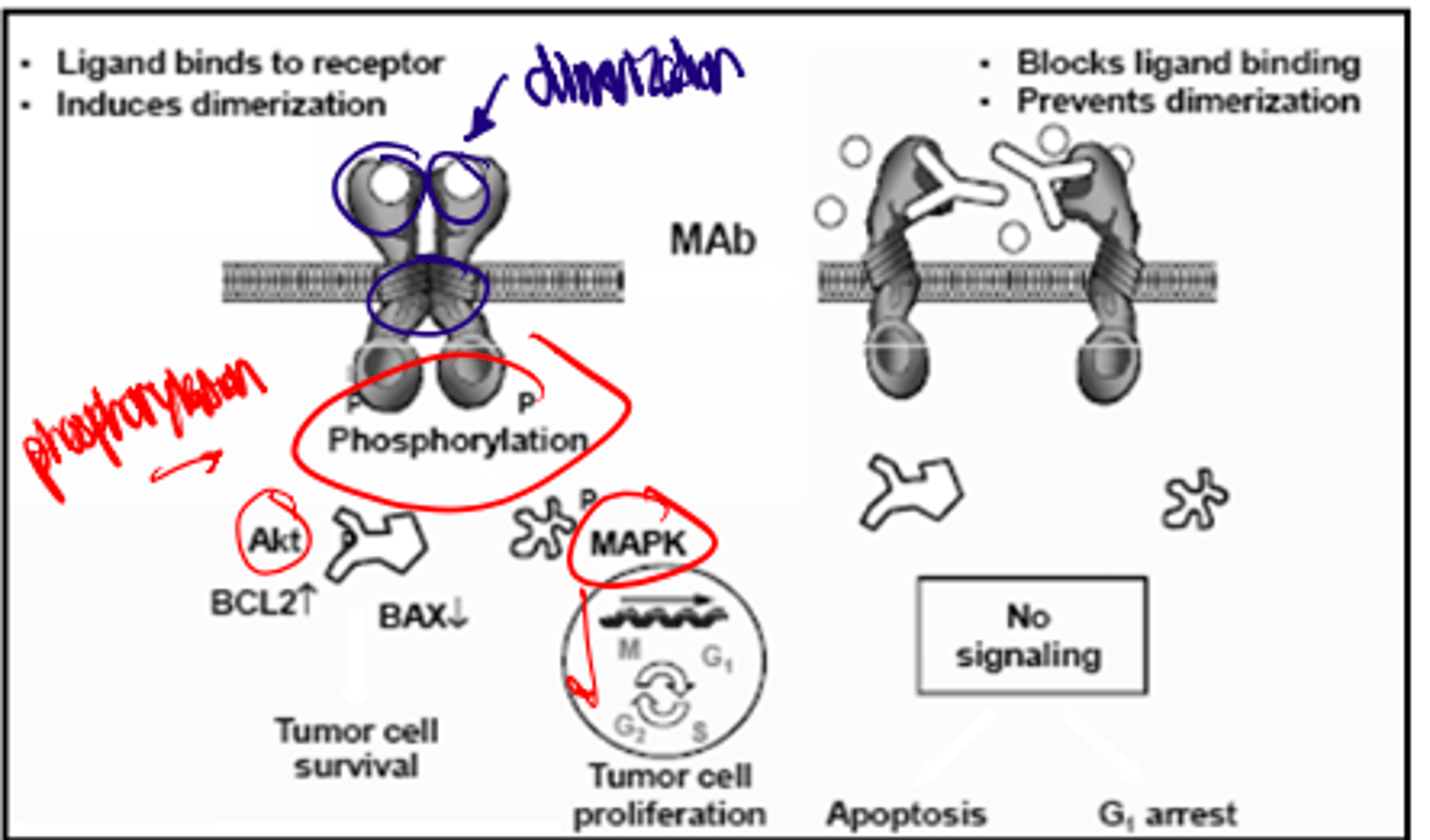
Pharmacological approaches to inhibit signaling through Her family: one potential approach is to generate ___________ ________ (_____) against the ligand binding domain of the Her family or other extracellular domains
- monoclonal antibodies (Mabs)
Pharmacological approaches to inhibit signaling through Her family: one potential approach is to generate monoclonal antibodies (Mabs) against the ________ binding domain of the Her family or ______ _______ domains
- (against the) ligand (binding domain of the Her family)
- other extracellular (domains)
Pharmacological approaches to inhibit signaling through Her family: binding of the Mab to the extracellular domain result in blocking _______ ______ and prevention of ________
This leads to ____ _________
- (blocking) ligand biding
- (prevention of) dimerization
- (leads to) no signaling
No signaling leads to apoptosis and G1 arrest
Pharmacological approaches to inhibit signaling through Her family: it is use of a biologic such as a Mab to be _____ ________
- (as a Mab to be) very specific
i.e., it only targets Her1, Her2 etc.
Pharmacological approaches to inhibit signaling through Her family: Mabs / antibodies prevent dimerization usually through _______ ______ and _______________
- (usually through) sheer size
- (and) conformation
Pharmacological approaches to inhibit signaling through Her family: Mab mechanism figure
Note: left shows normal function
Right shows Mab function and NO signaling
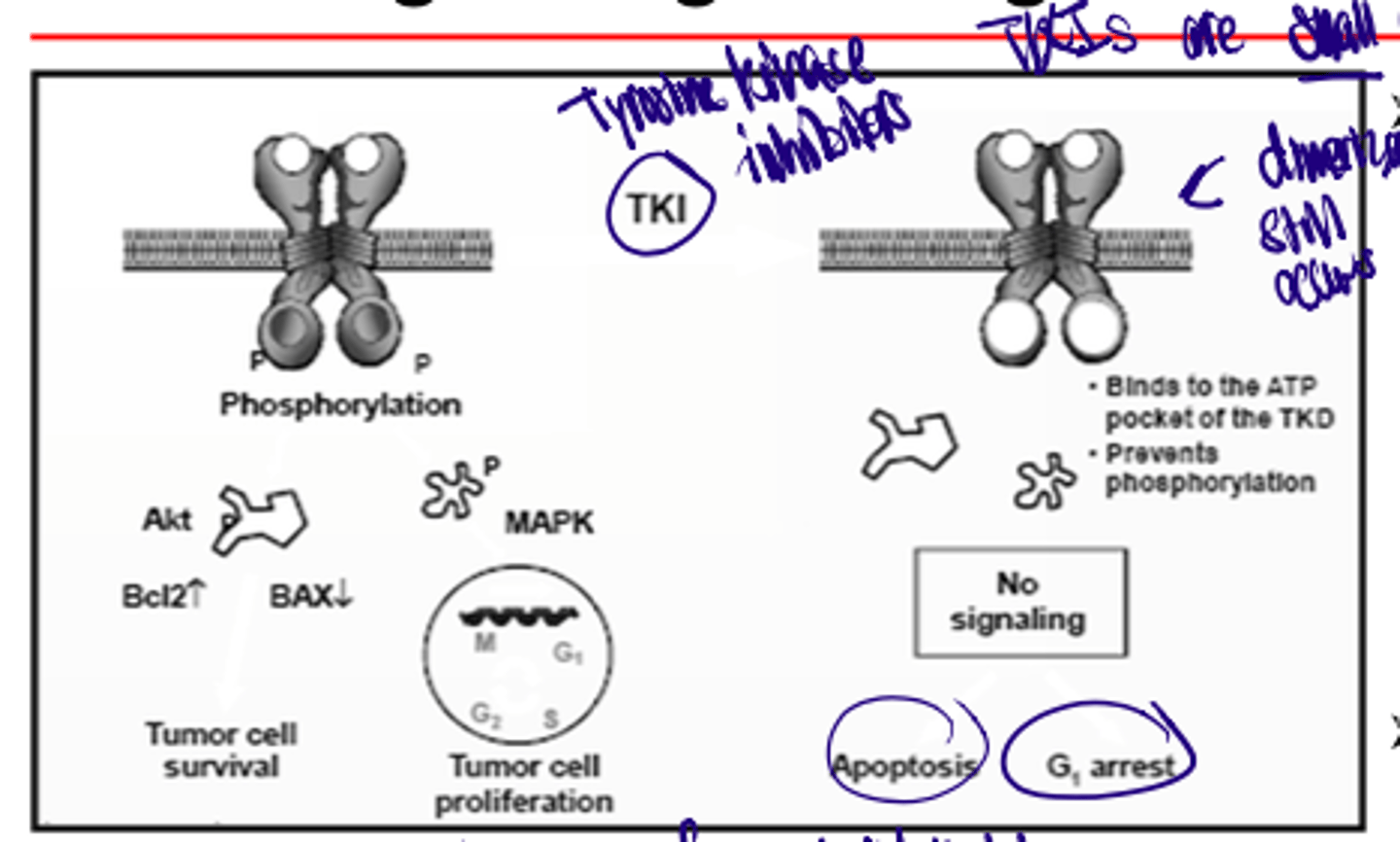
Pharmacological approaches to inhibit signaling through Her family: another potential approach is to have a _______ ________ that binds to the ATP pocket in the intracellular kinase domain and prevents transphosphorylation of the intracellular domain
- small molecule (that binds to the ATP pocket)
These small molecules are tyrosine kinase inhibitors (TKIs)
Pharmacological approaches to inhibit signaling through Her family: another potential approach is to have a small molecule (___________ ______ ________; _______) that binds to the ATP pocket in the intracellular kinase domain and prevents transphosphorylation of the intracellular domain
- tyrosine kinase inhibitors
- TKI
Pharmacological approaches to inhibit signaling through Her family: another potential approach is to have a small molecule (tyrosine kinase inhibitors; TKI) that binds to the _____ pocket in the ________ kinase domain and prevents _______________ of the intracellular domain
- (binds to the) ATP (pocket)
- intracellular (kinase domain)
- (prevents) transphosphorylation
Pharmacological approaches to inhibit signaling through Her family: another potential approach is to have a small molecule (tyrosine kinase inhibitors; TKI)
The ligand _____ ____ to the intracellular domain and dimerization _____ _____ place. However, in the presence of TKI, no signal pathway activation will take place
- sill binds (to the intracellular domain)
- (dimerization) still takes (place)
Pharmacological approaches to inhibit signaling through Her family: another potential approach is to have a small molecule (tyrosine kinase inhibitors; TKI)
The ligand still binds to the intracellular domain and dimerization still takes place. However, in the presence of TKI, ____ _______ __________ ________ will take place
- no signal pathway activation (will take place)
No signal pathway activation will result in G1 arrest and apoptosis
Pharmacological approaches to inhibit signaling through Her family: TKIs will inhibit enzymes from ____________ but ______ prevent dimerization process from occurring
- (will inhibit enzymes from) phosphorylating
- NOT (prevent dimerization)
Pharmacological approaches to inhibit signaling through Her family: TKI MOA figure
Left: normal cancer function
Right: TKI, note that dimerization and ligand binding still takes place but there is NO SIGNALING
EGFR inhibitors - TKIs
-tinib
First generation
- Eroltinib
- Gefitinib
Second generation
- Afatinib
EGFR inhibitors - monoclonal antibodies against EGFR
Cetuximab
Panitumumab
EGFR inhibitors - first generation TKIs
Eroltinib
Gefitinib
EGFR inhibitors - first generation TKIs (Eroltinib and Gefitinib) had issues due to _______________
- (issues due to) resistance
The majority of EGFR inhibitors target _________ / _________
- (majority of EGFR inhibitors target) ErbB1 / Her1
exception is Afatinib
Afatinib is a one of the rare EGFR inhibitors that inhibits __________ __/__/__/__
- (inhibits) ErbB 1/2/3/4
EGFR inhibitors - second generation (Afatinib): Afatinib has __________ __________ and targets _______ than just ErbB1
- (Afatinib has) irreversible inhibition
- (targets) more (than just Erbb1)
i.e., targets ErbB 1/2/3/4
EGFR inhibitors - second generation
Afatinib
EGFR inhibitors - second generation (Afatinib) is good to use when ________________ occurs
- (when) resistance (occurs)
Eventually all cancers will be _____________ to a drug
- resistant (to a drug)
But we want to know when the most optimal time it would be to use certain drugs
Types of mutations and consequences that can happen in the EGFR: approximately ___-___% of Non-small cell lung cancer (NSCLC) have overexpression of EGFR
- 40-85(% of Non-small cell lung cancer)
NSCLC
non-small cell lung cancer
Types of mutations and consequences that can happen in the EGFR: approximately 40-85% of Non-small cell lung cancer (NSCLC) have _____________ of EGFR
- overexpression (of EGFR)
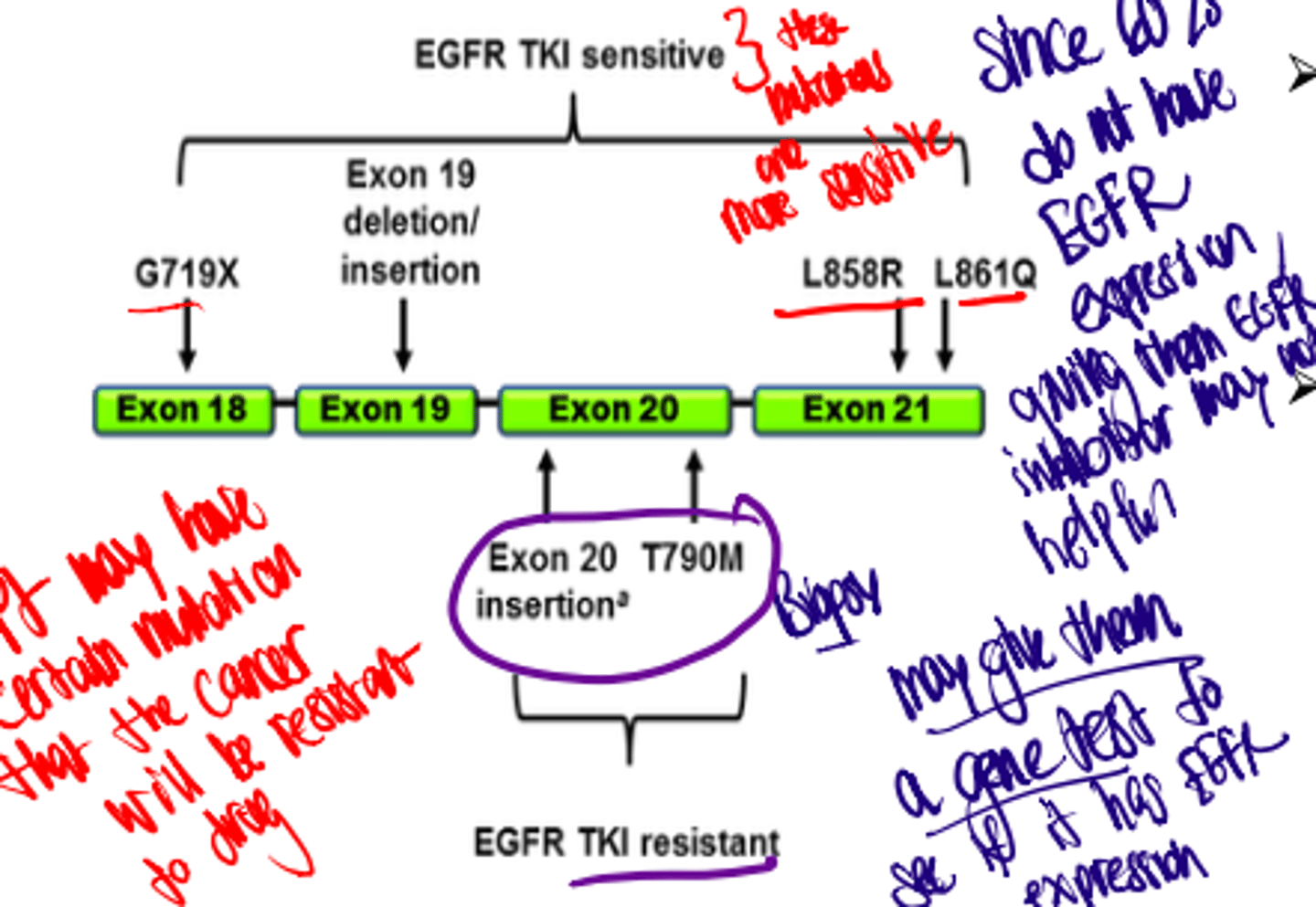
EGFR mutations are common in NSCLC and these mutations can render cancer MORE sensitive towards EGFR small molecule TKI (better than chemotherapy) or RESISTANT to TKI
Types of mutations and consequences that can happen in the EGFR: EGFR mutations are common in NSCLC and these mutations can render cancer _______ _________ towards EGFR small molecule TKI (better than chemotherapy) or __________ to TKI
- MORE sensitive
- RESISTANT (to TKI)
Types of mutations and consequences that can happen in the EGFR: since 40-85% (or roughly 60%) do not have EGFR expression for NSCLC, then giving the patient a EGFR inhibitor will ______ ____ _______
- (will) not be helpful
Usually for these patients we give them a gene test to see if they have the appropriate EGFR expression
Types of mutations and consequences that can happen in the EGFR: T790M will have mutations to Eroltinib and Gefitinib but may be susceptible to ___________ with _____ levels of T790M
- (may be susceptible to) Afatinib
- (with) low (levels of T790M)
Though most T790M tends to be resistant towards EGFR
Examples of EGFR mutations chart
Mechanisms of resistance to EGFR inhibitors
T790M
Oncogene Kinase Switch
Mechanisms of resistance to EGFR inhibitors - Oncogene Kinase Switch: EGFR is blocked but cancer can use _______ receptor types as _______ ______ instead of EGFR like MET, Insulin Growth Factor Receptors (IGF-R)
- other (receptor types)
- growth factors (instead of EGFR like MET)
Mechanisms of resistance to EGFR inhibitors - Oncogene Kinase Switch: EGFR is blocked but cancer can use other receptor types as growth factors instead of EGFR like _____ or ________ ________ ________ _______ (___-__)
- MET
- insulin growth factor receptors (IGF-R)
Mechanisms of resistance to EGFR inhibitors - cancer cells can find _________ pathways for resistance
- alternate (pathways for resistance)
Mechanisms of resistance to EGFR inhibitors - T790M Selection model: not all cancer cells are the _______, some may not be able to use their MET gene, as the non-MET _____ or less-efficient MET ______, the ones that survive are a matter of ___________
- (not all cancer cells are the) same
- (non-MET) dies
- (less-efficient MET) dies
- (matter of) selection
MET resistant cancers are the only ones left that survive, and the cancer becomes resistant to EGFR treatment because it uses a different pathway
Mechanisms of resistance to EGFR inhibitors - T790M acquisition model: MET amplification, _________ copies of MET now there is more __________ of mutation
- multiple (copies of MET)
- (more) acquisition (of mutation)
K-ras mutation and efficacy of EGFR-directed drugs: mutation in the _______ __________ pathway regardless of EGFR-directed drugs binding to the extracellular domain receptors to prevent ligand binding and/or tyrosine kinase
The mutation still turns signaling _______ because it is further ____________
- signal transduction (pathway)
- (mutation still turns signaling) on
- (because it is further) downstream
K-ras is one of these mutations that occur downstream
i.e., drug functions and works as intended but mutation in signaling pathway causes the proliferation regardless
K-ras mutation and efficacy of EGFR-directed drugs: the drugs that bind EGFR still ________ as intended (i.e., prevents ligand binding, dimerization, and/or tyrosine kinase phosphorylation), but mutation in signaling downstream still causes the cancer cell ____________
- (still) works (as intended)
- (mutation signaling downstream still causes the cancer cell) proliferation
K-ras mutation is one of these mutations
K-ras mutation and efficacy of EGFR-directed drugs: K-ras is a _____-___________ protein that is found anchored to _______ ________
- GTP-binding (protein)
- (anchored to) cell membrane
K-ras mutation and efficacy of EGFR-directed drugs: K-ras is activated by _______ and ____________ the activation of the MEK/MPAK as well as the PI3K/AKT pathway
- (activated by) EGFR
- regulates (the activation of the MEK/MPAK as well as the PI3K/AKT pathway)
K-ras mutation and efficacy of EGFR-directed drugs: K-ras is activated by EGFR and regulates the activation of the ______/______ as well as the _______/________ pathway
- MEK/MPAK
- PI3K/AKT (pathway)
MEK/MPAK = cell proliferation
PI3K/AKT = results in cell survival and inhibits apoptosis
K-ras mutation and efficacy of EGFR-directed drugs: K-ras is an ____/_____ ________
- (K-ras is an) ON/OFF switch
Kras mutation results in constitutive activation of Kras (i.e., Kras is activated regardless of EGFR activation status)
K-ras mutation and efficacy of EGFR-directed drugs: Kras mutation results in _____________ activation of Kras
- constitutive (activation of Kras)
Kras is activated regardless of EGFR activation status
K-ras mutation and efficacy of EGFR-directed drugs: Kras mutation results in constitutive activation of Kras. Thus, Kras is activated _________ of EGFR ____________ _______
- (activated) regardless
- (EGFR) activation status
Will be on regardless if EGFR does not turn it on
K-ras mutation and efficacy of EGFR-directed drugs: Kras mutation results in constitutive activation of Kras. Thus, Kras is activated regardless of EGFR activation status
i.e., It will be ______ regardless if EGFR controls Kras or not
- (it will be) ON (regardless if EGFR controls Kras or not)
K-ras mutation and efficacy of EGFR-directed drugs: Kras mutation is frequently found in ________ and in _________ _______
- NSCLC
- colon cancer
NSCLC = non-small cell lung cancer
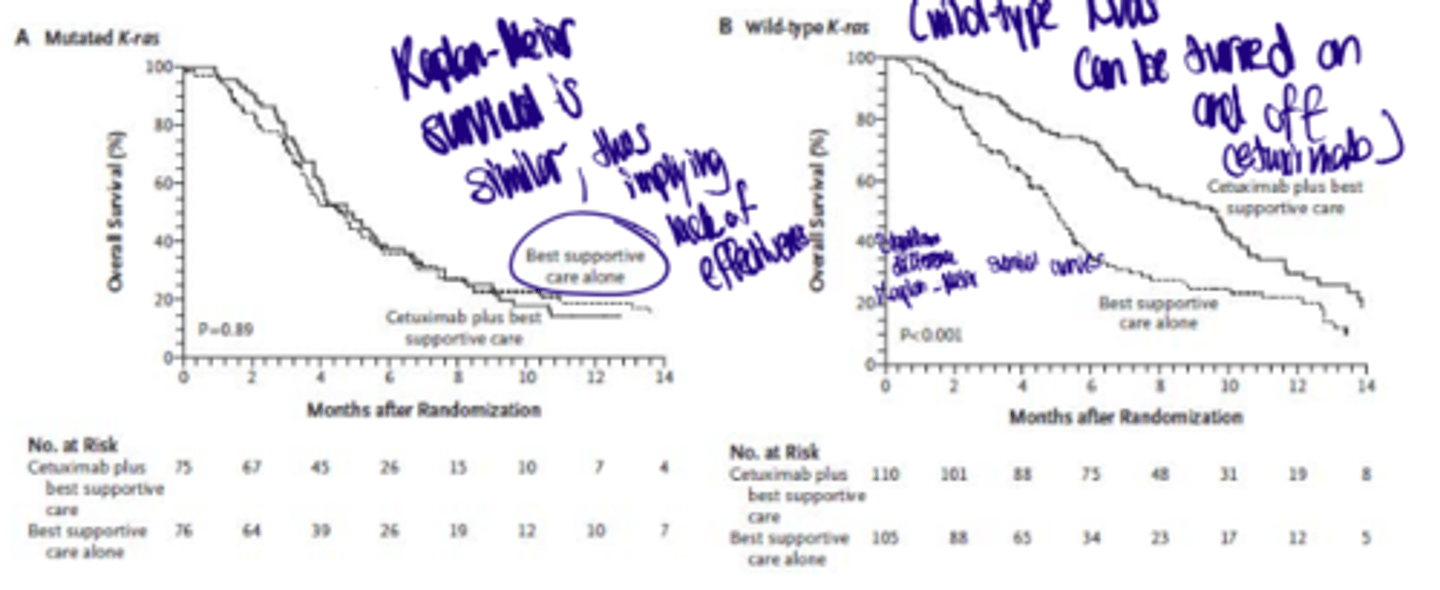
What is the outcome of EGFR-directed rugs in patients with cancers that over-express EGFR BUT harbor a Kras mutation?
Presence of activating Kras mutation predicts a poor response to Cetuximab or Panitumumab in patients with metastatic colorectal cancer
So even though EGFR may be overexpressed, the Kras mutation treats still turns on the transduction signals downstream like PI3K/AKT and MEK/MPAK so it is still resistant and does not work well
The outcome of EGFR-directed rugs in patients with cancers that over-express EGFR BUT harbor a Kras mutation figure
Note: LEFT - Kaplan-Meier survival curve shows those with the mutated Kras have similar outcomes versus best supportive care (i.e., placebo) which means EGFR-directed drug doesn't really have an effect
RIGHT - wild-type Kras there is a significant difference between best-supportive care versus EGFR-directed drugs in the Kaplan-Meier survival curve, implies the EGFR-directed drugs significant impact
HER-2 mediated signaling and targeting of HER2 Receptor: _____________ (___________) is a monoclonal antibody against the extracellular domain of HER2
- Trastuzumab (HERCEPTIN)
When you usually hear about "HER2" it is usually assumed to be the homodimer version
HER-2 mediated signaling and targeting of HER2 Receptor: Trastuzumab (HERCEPTIN) is a monoclonal antibody against the ____________ domain of _________
- extracellular (domain)
- (of) HER2
HER-2 mediated signaling and targeting of HER2 Receptor: Trastuzumab (Herceptin)
Mechanistically, Trastuzumab can lead to...
Blocking dimerization
Activation of ADCC
Endocytosis and receptor degradation
HER-2 mediated signaling and targeting of HER2 Receptor: Trastuzumab (Herceptin)
Mechanistically, Trastuzumab can lead to - blocking _____________
- (blocking) dimerization
HER-2 mediated signaling and targeting of HER2 Receptor: Trastuzumab (Herceptin)
Mechanistically, Trastuzumab can lead to - activation of ___________
- (activation of) ADCC
ADCC
Antibody-dependent cell-mediated cytotoxicity
HER-2 mediated signaling and targeting of HER2 Receptor: Trastuzumab (Herceptin)
Mechanistically, Trastuzumab can lead to - __________ and receptor ___________
- endocytosis
- (receptor) degradation
Every antibody that targets HER2 such as Trastuzumab does ______ ________ the ligand binding domain, because HER2/ErbB2 does not have a ligand binding domain.
Thus, Trastuzumab targets ____________ on the extracellular domain
- not bind (the ligand binding domain, because HER2/ErbB2 does not have a ligand binding domain)
- (targets) dimerization
Mechanisms of resistance towards trastuzumab - steric effects
1. The Trastuzumab binding site is removed by the cancer cell (cancer cells have ability to cleave off extracellular domain, as its not necessary especially without a ligand binding site for HER2)
2. Heterodimerization with HER1, 3, or 4
Mechanisms of resistance towards trastuzumab - steric effects: the Trastuzumab binding site is ____________ by the cancer cell (cancer cells have ability to ________ off extracellular domain, as its not __________ especially __________ a ligand binding site for HER2)
- removed (by the cancer cell)
- cleave (off extracellular domain)
- (not) necessary
- (especially) without (a ligand binding site)
Cancer cell can activate downstream pathways like MAPK and PI3k/AKT instead
Mechanisms of resistance towards trastuzumab - steric effects: heterodimerization with _______, ____ or _______
- (heterodimerization with) HER1
- 3
- (or) 4
Cancer cells can form heterodimers instead of homodimers, since Trastuzumab specifically targets HER2 it is less / half as effective
Mechanisms of resistance towards trastuzumab - steric effects: heterodimerization with HER1, 3, or 4
Cancer cells can form heterodimers instead of ___________, since Trastuzumab _____________ ________ HER2 it is less / half as effective
- (can form heterodimers instead of) homodimers
- specifically targets (HER2)
Less effective than before
Mechanisms of resistance towards trastuzumab - alternative elevations of ______ __________ tyrosine kinases
- (elevations of) other receptor (tyrosine kinases)