Ayache Cell Transport Apr 16
 Call Kai
 Learn
Learn Practice Test
 Spaced Repetition
 Match
Match Flashcards
 Knowt Play
1/58

There's no tags or description
Looks like no tags are added yet.
Name | Mastery | Learn | Test | Matching | Spaced | Call with Kai |
|---|
No analytics yet
Send a link to your students to track their progress
59 Terms
Extracellular fluid and it’s abbreviation
Fluid outside of/between cells. ECL
Extracellular space and it’s abbreviation
Space outside of/between cells. ECS
What does a cell membrane do?
It controls what enters and exits the cell
Fluid mosaic Model
A model of the cell membrane that shows all the parts of the cell membrane.
Selectively permeable (Definition + Example of something that is selectively permeable. Why is it selectively permeable)
Something that allows some molecules in and some molecules out. Cell membrane, because of its structure.
Define all:
Integral protein
Peripheral protein
Glycolipid
Glycoprotein
Type of protein that is embedded in the cell membrane
Type of protein that is not embedded in the cell membrane
Combination of a carbohydrate chain and a lipid (phospholipid)
Combination of a carbohydrate chain and a protein
Type of protein that is embedded in the cell membrane
Type of protein that is not embedded in the cell membrane
Integral protein, Peripheral protein
Combination of a carbohydrate chain and a lipid (phospholipid)
Combination of a carbohydrate chain and a protein
Glycolipid, Glycoprotein
What is ECM?
Extracellular matrix (foundation)
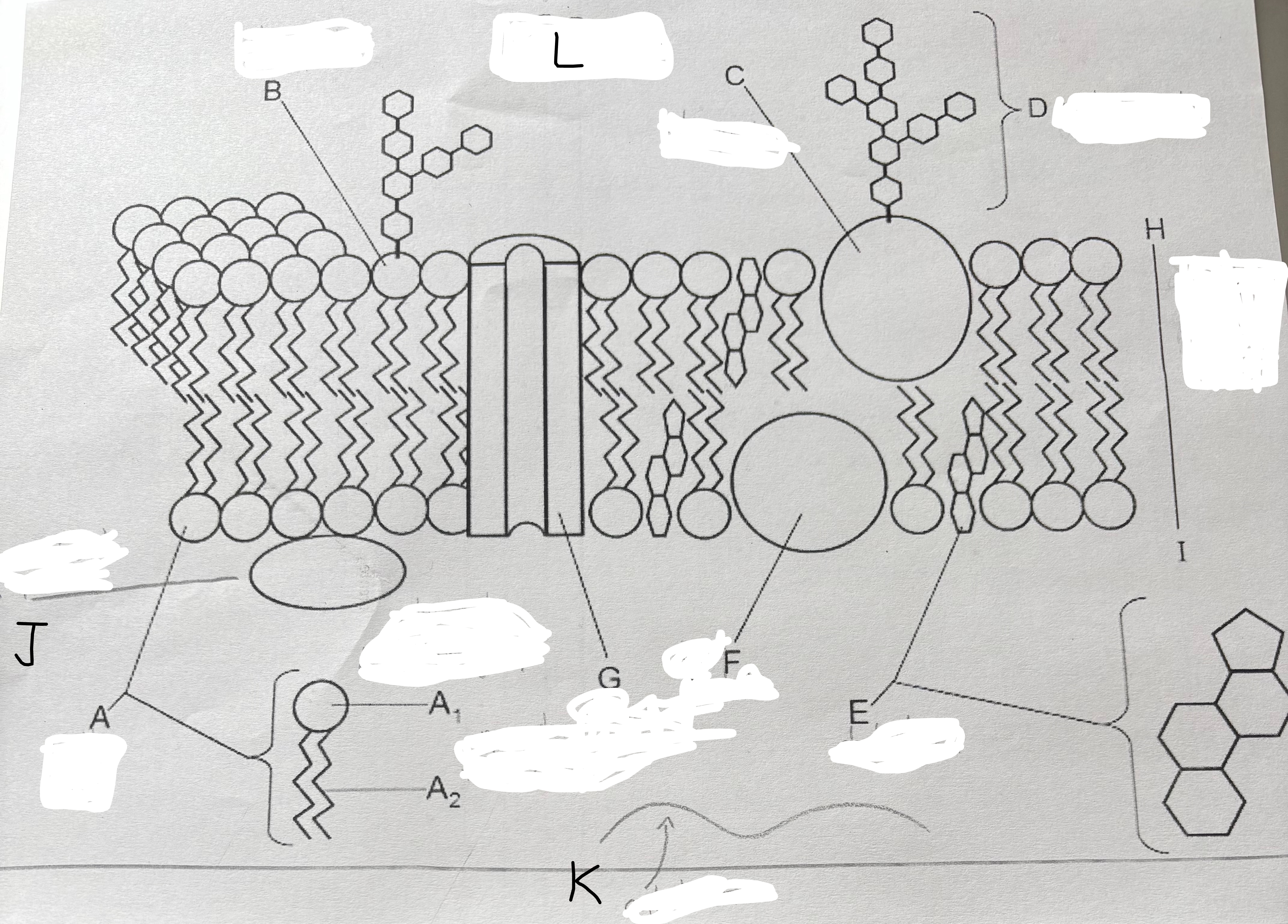
Label the fluid mosaic model of the cell membrane
A1: Phosphate group
A2: Fatty Acid
A: Phosphoplipid (*Assuming that it includes the entire thing, if just the circle, Fatty Acid)
B: Glucolipid
C: Glycoprotein
D: Carbohydrate
E: Cholesterol
F: Integral protein
G: Integral protein
H & I: Phospholipid bilayer
J: Peripheral protein
K: Cytoskeleton
L: Extracellular space
List the 6 types of integral proteins embedded in the cell membrane.
Which of them are transport proteins?
Channel proteins, Carrier proteins, Cell recognition proteins, Receptor proteins, Enzymatic proteins, Junction proteins.
Channel proteins and Carrier proteins
Transport proteins (Definition + 2 examples)
Type of integral protein that transports materials (molecules, macromolecules, and ions) across the cell membrane. Channel protein and carrier protein
Type of integral protein that transports materials (molecules, macromolecules, and ions) across the cell membrane.
Transport protein
Channel protein
Type of transport protein that is almost always open, constantly allows things to pass through, and is specific to a certain ion or molecule. Form of passive transport.
Type of transport protein that is almost always open, constantly allows things to pass through, and is specific to a certain ion or molecule. Form of passive transport.
Channel protein
Carrier protein
Type of transport proteins that changes shape to help molecules pass through the cell membrane. Requires energy to change shape in the form of ATP, active transport.
Type of transport proteins that changes shape to help molecules pass through the cell membrane. Requires energy to change shape in the form of ATP, active transport.
Carrier protein
Diffusion
The process of going from high concentration to low concentration. Going down concentration gradient, no energy is needed.
The process of going from high concentration to low concentration. Going down concentration gradient, no energy is needed.
Diffusion
Going from low concentration to high concentration ____ energy (up concentration gradient)
Going from high concentration to low concentration ____ energy (down concentration gradient)
Need, Does not need
Define and provide 1 example:
Simple diffusion
Facilitated diffusion
Diffusion with no membrane required. Red dye in a jar
Diffusion across cell membrane with a transport protein. Water passing through an aquaporin.
Diffusion with no membrane required. Red dye in a jar
Simple diffusion
Diffusion across cell membrane with a transport protein. Water passing through an aquaporin.
Facilitated diffusion
Active transport (Definition and 3 types)
The movement of molecules that requires some energy (usually ATP) going from low to high concentration (going against the concentration gradient). Protein pump, endocytosis, exocytosis.
The movement of molecules that requires some energy (usually ATP) going from low to high concentration (going against the concentration gradient). Protein pump, endocytosis, exocytosis.
Active transport
Passive transport (definition + 3 types)
The movement of molecules that does not require energy going from high to low concentration (going with the concentration gradient). Diffusion, facilitated diffusion, osmosis.
The movement of molecules that does not require energy going from high to low concentration (going with the concentration gradient). Diffusion, facilitated diffusion, osmosis.
Passive transport
Things that can directly cross/go through the cell membrane. What type of transport is it?
Things that cannot directly cross the cell membrane, and has to use a channel or bulk transport instead. What type of transport is it?
Water, carbon dioxide, oxygen, gasses, small molecules, lipids, and amino acids. Passive transport
Macromolecules. Active transport.
Cellular respiration formula
C6H12O6 + 6O2 —> 6CO2 + 6H2O + energy (stored in ATP)
Bulk transport (Definition, type of transport, explain the process)
Method of letting large macromolecules cross the cell membrane. Type of active transport.
Cell membrane dismantles, vesticles form around the large molecule and transports it into the cell.
Method of letting large macromolecules cross the cell membrane. Type of active transport.
Bulk transport
Endocytosis (definition + 3 types)
Taking bulky material through the cell membrane into the cell by forming vesticles around it. Phagpcytosis, pinocytosis, and receptor medicated cytosis
Taking bulky material through the cell membrane into the cell by forming vesticles around it
Endocytosis
Phagocytosis (definition + 2 example)
Cell eating, forms a vacuole around the molecule and digests the food. Type of endocytosis. Cells digesting starch and White blood cell eating bacteria.
Cell eating, forms a vacuole around the molecule and digests the food. Type of endocytosis
Phagocytosis
Pinocytosis (definition + 1 example)
Cell drinking, forms a vacuole around the molecule and digests small liquids. Type of endocytosis. Cell taking in extracellular fluid
Cell drinking, forms a vacuole around the molecule and digests small liquids. Type of endocytosis.
Pinocytosis
Receptor mediated cytosis (definition, 1 example
Type of endocytosis where a receptor attracts and binds to a material, and the material gets taken inside the cell.