ECSP 4300 & SPED 6120: Assessment of the Young Child
 Call Kai
 Learn
Learn Practice Test
 Spaced Repetition
 Match
Match Flashcards
 Knowt Play
1/38

There's no tags or description
Looks like no tags are added yet.
Name | Mastery | Learn | Test | Matching | Spaced | Call with Kai |
|---|
No analytics yet
Send a link to your students to track their progress
39 Terms
Goal attainment scaling can help us monitor a child’s achievement of particular objectives.
These objectives can be completely personalized.
Portfolio assessment involves the systematic accumulation of a child’s work combined
with a structured system of keeping written records of a child’s performance over time.
For children who might not make sufficient progress to show any change on standardized tests,
goal attainments scaling can offer a quantitative means of documenting progress.
Authentic assessments occur over time,
whereas traditional assessment methods are based upon the assumption that a child can be “assessed” in a few hours
There are three types of portfolios:
the private portfolio, the learning portfolio, and the pass-along portfolio. Each has a distinct function while overlapping with the other in content.
Gelfer and Perkins suggest organizing portfolios into six sections with measures of:
social-emotional growth; academic and literacy growth; cognitive strategies, self-regulation, and independence, including problem solving and decision making; cultural and language factors; motoric competence, including fine and gross motor skills; and teacher and family communication.
“Children enjoy critiquing their own work as they compare early work to items representing their
most recently acquired skills.”
The purpose is assessment and documentation of children’s
knowledge, skills, behavior, and accomplishments over numerous occasions across a variety of classroom settings
Features to authentic performance-based assessments:
not a “snapshot”, integrates a broad range of curricula areas and engages child in process, individualizes, and explores higher-order thinking skills.
The work sampling system is a
curriculum-embedded, criterion-referenced observational on-going assessment system for use in 3-year-olds through 5th grade.
Choice of assessments depends on their usefulness in planning and instruction and gaining meaningful insights into
a child’s authentic behaviors and accomplishments.
Meisels and colleagues argue that by relying on high-stakes standardized group tests as the measure of our success, we set the stage for narrowing of the curriculum, focusing on priorities that lie outside of the classroom
and tolerating other abuses that accompany these tests.
Traditional tests cannot be easily modified to adjust to differences in
learning styles, cultural heritages or language that children display. They do not have a means of encompassing and integrating all parts of the day and areas of curriculum.
Use of assessments based in the actual performance of a child in a natural setting reduces the
dichotomy between teacher and assessment.
Goal attainment scaling
(GAS) begins with the identification of realistic measureable objectives and target completion dates. This process is built into special education services through the IFSP and IEP process. A goal attainment scale is then developed for each of the objectives.
The determination of a child’s progress in his or her educational program can be directly linked to progress toward the achievement of specific goals and objectives defined in an
IFSP or IEP.
We must remember that there is little point in doing assessments in a way that may be of little value or even harmful
to the child.
Individualized portfolio and work sampling systems involve
gathering of actual work samples and other evidence of a child’s performance. These approaches can be time consuming for the teacher particularly in their initial development.
A program that uses transdisciplinary play-based assessment, goal-attainment scales, or work sampling systems for child assessment need a data management system just as much as those that rely on a
comprehensive developmental assessment tool
Creativity becomes more visible when adults try to be more attentive to the cognitive process of children rather than
to the results they achieve in various fields of doing and understanding
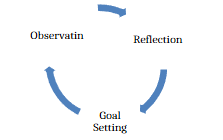
The Assessment Cycle:
observation→Reflection→Goal setting→Observation
Because public education is a public investment,
national standards exist to encourage educators to maximize the benefits of their teaching practice and assessment cycle.
For a society focused on the future
taking time to examine the present is a worthwhile investment.
Engaging in an assessment process with observation (supported with documentation) at the core,
allows us to evaluate young children’s learning more objectively and enlist others in a collaborative, public cycle that incorporates goals settings and reflection.
As teachers and schools are being held increasingly accountable for learning that occurs in classrooms,
is in the best interest of teachers and schools to promote observation practices that inform teachers about their student’ progress as well as their own professional and personal growth
One way to approach observation is to
consider it as a multisensory process, a teacher takes in information using many senses, but primarily looking and listening
Unless a teacher incorporates systematic observation into the daily classroom routine,
observation results will lead to misinterpretation of children’s behavior and ultimately, misleading information that is detrimental to a child’s image
When any observer tries to capture a full, accurate picture of a child
it is impossible to capture every single detail of any given situation.
Different approaches to observing children
require different amounts of time and materials
A useful strategy to minimize the presence and impact of bias is
observing with a colleague from time to time.
“There are checklists that accompany commercial curricula,
as well as checklists that teachers create themselves”
Developmentally appropriate experiences are being replaced with higher expectations and benchmarks that are simply not in line with
young children’s cognitive and physical development
When teachers engage in reflective practice
they use observation to notice children’s learning in the moment, revisit moments of learning through the use of documentation, and plan for the future classroom activity.
When teachers are able to make connections between theory and practice,
they are able to make connections between their observations, educational theory, and new applications.
Analytical reflection expands teachers’ observations and reflections to consider
issues outside of their classroom walls.
Empathy is as important for young children as it is for teachers, so modeling behaviors through the use of documentation helps create a classroom environment that is
respectful to all members of the group.
Documentation provides insights into teaching practices, as a result of recording, analyzing, and sharing observations of young children. During this process, teachers and children are engaged in
active, ongoing reflection that is supported by artifacts (photos, samples of work, etc.), and inspires further inquiry and action.
The three different types of portfolios:
private, pass along, and learning
So often assessment is focused on an end goal or product, without recognizing
the process as valuable