[L15] Retaining wall design
 Call Kai
 Learn
Learn Practice Test
 Spaced Repetition
 Match
Match Flashcards
 Knowt Play
1/23

There's no tags or description
Looks like no tags are added yet.
Name | Mastery | Learn | Test | Matching | Spaced | Call with Kai |
|---|
No analytics yet
Send a link to your students to track their progress
24 Terms
Large scale mass movements
Movements over a large area slope → stability analysis required
Retaining structures may be too expensive to build
Alternative stabilisation methods/monitoring systems may be needed
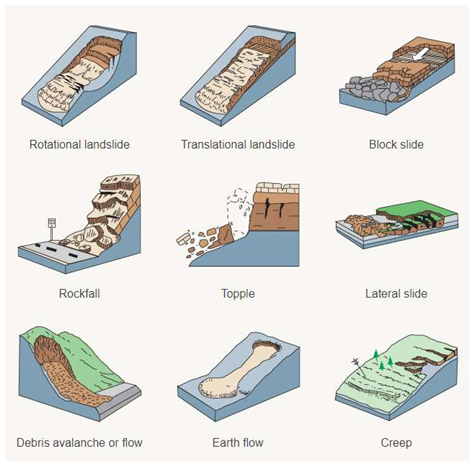
Types of mass movements
Falls
detached from a steep slope, descends mostly through air by free fall, leaping rolling
rapid to extremely rapid movements
Topples
forward rotation about some pivot point under the action of gravity & forces exerted by adjacent units or fluids in cracks
example: clayey gravel sand topples above layer of clean sand
Slide → rotational landslide
shear failure causing slump to more stable configuration
example: clay
Slide → translational landslide
debris can slide in shear or become flow slide
example: soil on top of bedrock
Slide → block slide
translational movement of major part of slip surface (common on larger slides, quick clay)
Lateral spread
shear failure or liquefaction along nearly horizontal soil layers
some parts sink, others left standing higher
Flow
flow side in sand
Tailing
By-product or waste from mineral extraction
Geomaterials = Geotechnical or Mine engineers responsible for their safe disposal
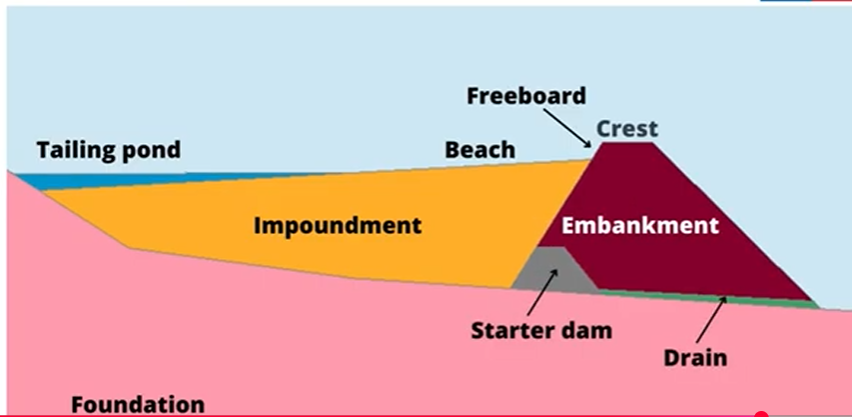
Tailings dam construction
some constructed w/ tailings sand or aggregate material from site
thickened, pasted or filtered deposits depending on w/c
Tailing pond → Impoundment → beach → freeboard → embankment → starter dam → drain → crest foundation
Tailings dam failure (Brumadinho dam)
start with tailings & started dike
new dikes are built on top of solidified mud tailings
dikes built upstream to hold
issues with high water pressure → could potentially breach the dam & produce liquefaction
Small scale mass movements
Mass movement within a small, contained area
Retaining structures can be designed/built to ‘retain’ the collapsed soil
Additional stabilisation methods usually not required
Purposes of structures for small scale mass movements
1) Create temporary space Construction sites, etc.
2) Create permanent space (Underground parking Subway stations, etc.)
3) Retain soil
4) Stabilise slopes or excavations
SLS
Serviceability limit states
1. Excessive deflection towards open space leads to ground loss
2. Damage to existing infrastructure
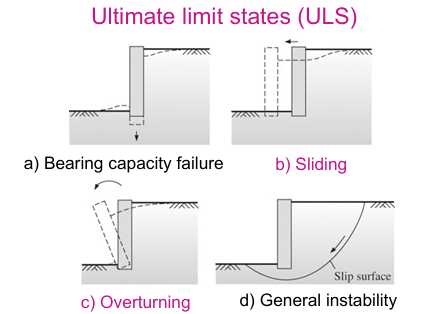
ULS
Ultimate limit states
bearing capacity failure
sliding → most critical
overturning → most critical
general instability
Design goal
avoid limit states
Externally stable retaining structures
Gravity
Cantilever
Tieback
Braced
resistance is developed by external mechanism
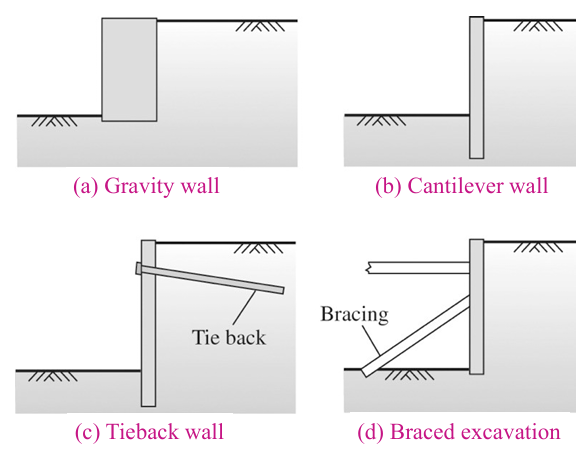
Gravity wall
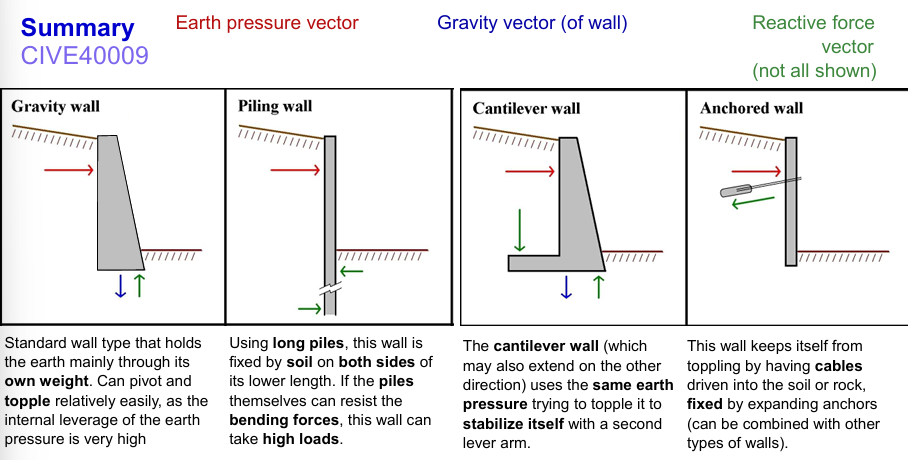
resistance derived almost exclusively from self weight
examples: gabion, pre-fabricated concrete elements
Cantilever wall
examples: secant concrete piles, underground parking garage, steel sheet piles
Tieback
Resistance derived mainly from the tieback interaction with the retained soil
Bracing
Resistance derived from inclusion of additional, stiff bracing elements
Typical excavation sequence in cross-lot excavations
initial V-cut cantilever excavation
strut installation and pre-loading in small trenches in soil berms
V-cut excavation to next level and strut installation
final grade
Summary of forces on different walls
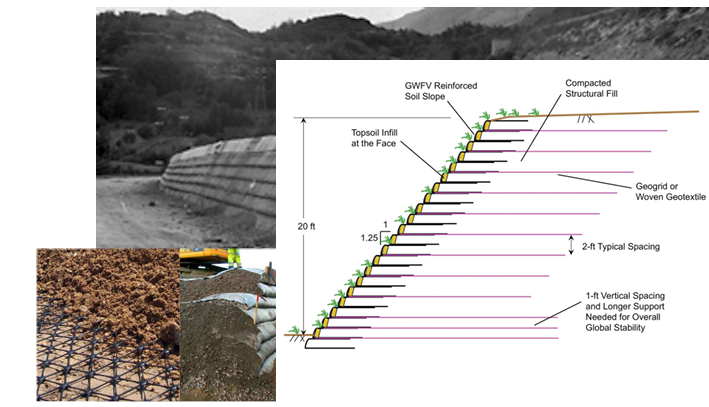
Internally stable retaining structures
Reinforced soil
Soil nails (natural soil)
Geotextiles/geogrids (fill)
Metallic strips (fill)
resistance is developed by internal mechanism
Geotextiles
→ friction & interlocking with soil to develop tensile forces
prevents shear failure
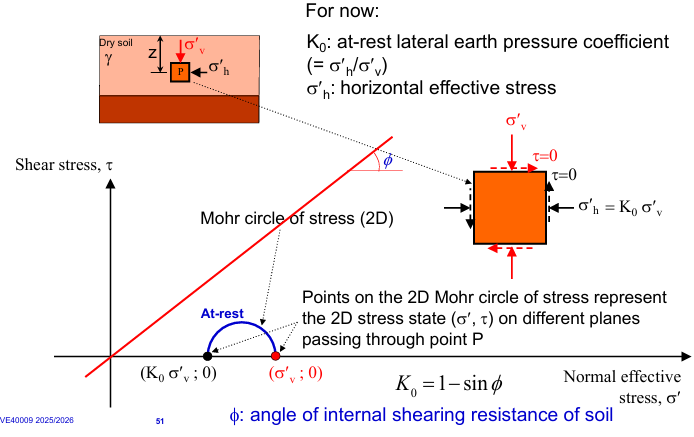
At rest state soil-structure interaction
K0 = at-rest lateral earth pressure coefficient = σ’h/σ’v
σ’h = horizontal effective stress
K0=1-sinΦ
Φ = angle of internal shearing resistance of soil
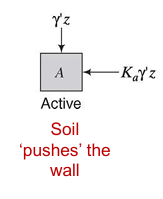
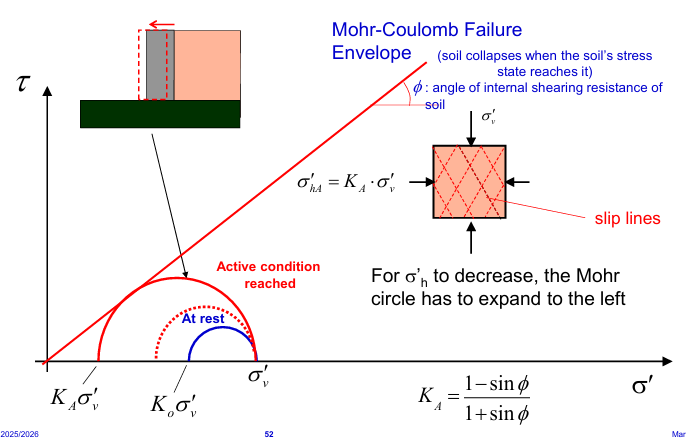
Activate state soil-structure interaction
wall moves away from soil
horizontal stress decreases
Ka=(1-sinΦ)/(1+sinΦ)
Mohr-Coulomb failure envelope → soil collapse when the soil’s stress state reaches it
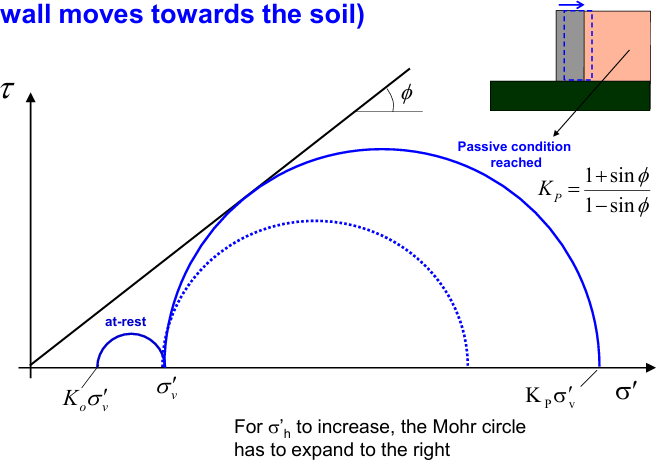
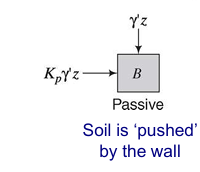
Passive state
wall moves towards the soil
horizontal stress increases
Mohr circle expands to the right
Kp=(1+sinΦ)/(1-sinΦ)
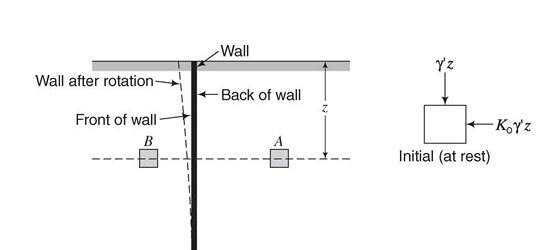
Front of wall
use Kp
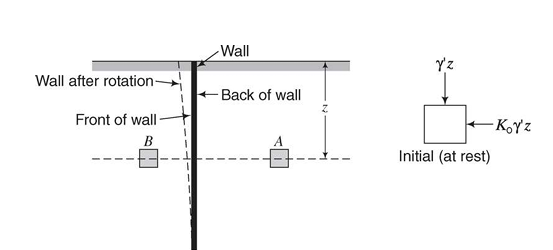
Back of wall
use Ka