Oral Lab- Oral Microbes and UTI diagnosis
 Call Kai
 Learn
Learn Practice Test
 Spaced Repetition
 Match
Match Flashcards
 Knowt Play
1/6

There's no tags or description
Looks like no tags are added yet.
Name | Mastery | Learn | Test | Matching | Spaced | Call with Kai |
|---|
No analytics yet
Send a link to your students to track their progress
7 Terms
Dental plagues
are the most common human-residing biofilm
mostly caused by Streptococcus ssp. (Streptococcus mutans, Streptococcus mitis, etc)
Dental plaques can lead to dental caries (cavities) or periodontal disease
Mitis salivarius media (Selective media for viridans Strep)
Purpose: 1) Selective media for Streptococci, espec. S. mutans, S. mitis and S. salivarius
Rationale: Contains crystal violet and potassium tellurite to inhibit non-Streptococci bacteria
Contains dextrose and sucrose as fermentable carbohydrates, utilized by some species
Interpretation: S. mutans and S. mitis do not utilize sucrose, forming small, flat colonies
S. salivarius utilizes sucrose, forming “gum-drop” colonies
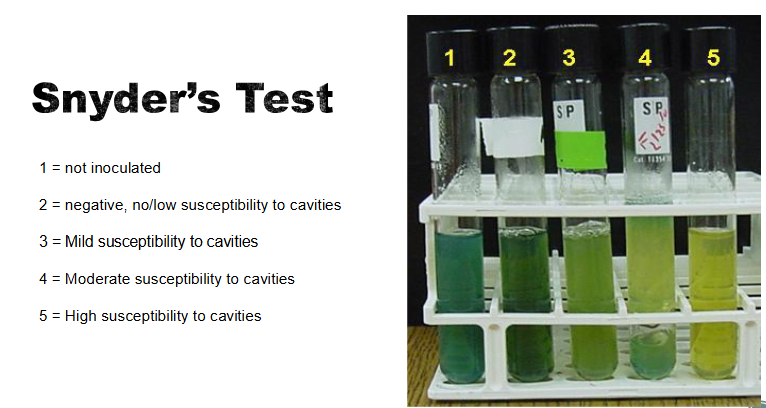
Snyder’s test (identification of Lactobacillus in saliva)
Purpose: 1) Presumptive identification of Lactobacillus in saliva
2) helps determine individual risk of developing dental caries (aka cavities)
(acid production from Lactobacillus erodes tooth enamel, enabling bacterial infection)
Rationale: Contains 2% glucose and bromcresol green dye to detect acid production
Media is at pH = 4.8, which inhibits the growth of non-acidophiles
Interpretation: Color change to yellow is positive, and indicates high susceptibility to cavities
Slight color change (to yellow-green) indicates moderate susceptibility to cavities
Media remaining green is negative
Snyder’s test results
MacConkey Agar
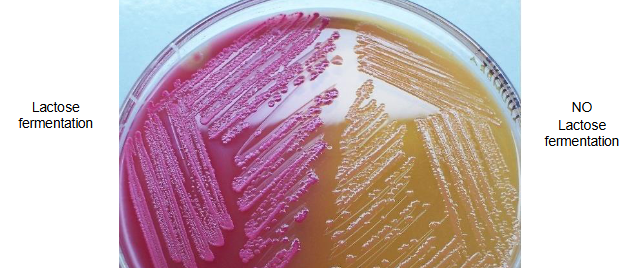
selective and differential media for enteric Bacteria
Contains Crystal Violet and Bile Salts to inhibit the growth of G+ bacteria
Contains neutral-red dye to detect Lactose fermentation (indicates coliforms)
Bacteriuria
is the presence of bacteria in the urine, regardless of whether symptoms are present. It is classified based on the clinical presentation of the patient and the quantitative concentration of bacteria found in a urine culture, measured in colony-forming units per milliliter (CFU/mL)
UTIs
cystitis, urethritis, prostatitis, pyelonephritis