BIOB34 Module 5
 Note
 Call Kai
 Learn
 Practice Test
 Spaced Repetition
 Match
 Flashcards
 Knowt Play
1/100

There's no tags or description
Looks like no tags are added yet.
101 Terms
P50
The partial pressure at which a respiratory pigment is 50% saturated.
Coagulogen
A protein that coagulates to trap bacteria.
Hypoxic Ventilatory Response (HVR)
The behavioral response to lower Po2.
Osmotic Pressure
The pressure needed to offset the movement of pure solute across a semipermeable membrane.
Hydrostatic Pressure
The pressure that fluid physically exerts on its surroundings.
Antidiuretic hormone (ADH)
A peptide hormone involved in regulating water reabsorption in the kidneys.
Direct absorption
A method of nutrient uptake where sugars, amino acids, etc. are absorbed directly by cells.
Endocytosis
A cellular phenomenon where larger food particles are taken in by the cell (engulfing).
Diversity of Respiratory Systems
The variation in respiratory systems across different organisms.
What are different mechanisms involved in gas exchange for larger organism?
Conductive/diffusive and convective steps [Bulk flow steps].
How can respiratory system interface with circulatory system?
Respiratory system have great surface area where diffusion occurs: exchange is with a delivery fluid (blood) and circulation system
What is the closed circulatory system and how does it work?
A circulatory system where the blood is contained within a vascular network.
It relies on the lymphatic system
blood pumped by the heart (deoxygenated) → pulmonary circulartion (interphases with alveolar sacs: picks up O2 + unload CO2) → pulmonary venuos circulation returns blood to the heart (oxygenated: red)
What is the lymphatic system?
In the closed circulatory system, this drains excess fluid from tissues and returns it to the circulatory system (close to the heart).
What is the open circulatory system?
A circulatory system where the circulatory fluid (hemolymph) is not contained within vessels.
What is the tracheal system?
The respiratory system is found in insects, consists of tubes called tracheae.
Circulatory Fluid
The fluid responsible for transporting respiratory gases and other nutrients in the circulatory system.
Red blood cells (RBCs)
Blood cells that contain respiratory pigments and are responsible for oxygen transport.
Hemoglobin (Hb)
The respiratory pigment found in red blood cells that binds and carries oxygen.
Myoglobin
A monomeric respiratory pigment found in muscle tissues that stores and releases oxygen → found widely distributed to our tissues and reversibly bind the O2 in the heme group
Hemocyanin
A respiratory pigment found in some arthropods that contain copper and reversibly binds oxygen → does not contain a heme group and float freely in plasma → many monomer units bound together
Hemerythrin
A respiratory pigment found in some marine invertebrates that contain iron but not a heme group → colourless when deoxygenated but pink-violet when oxygenated
Chlorocruorin
A respiratory pigment found in the plasma of many annelids that exhibits cooperativity in oxygen binding → composed of multiple monomers and abnormal heme group with iron
Effectors of P50
Factors that influence the affinity of respiratory pigments for oxygen, such as temperature, pH, and CO2 levels.
pH and CO2 Binding
The effect of lowering pH and binding of CO2 to hemoglobin in higher concentrations.
Anaerobic Glycolysis
The temporary increase in anaerobic glycolysis in active tissues to buffer ATP levels.
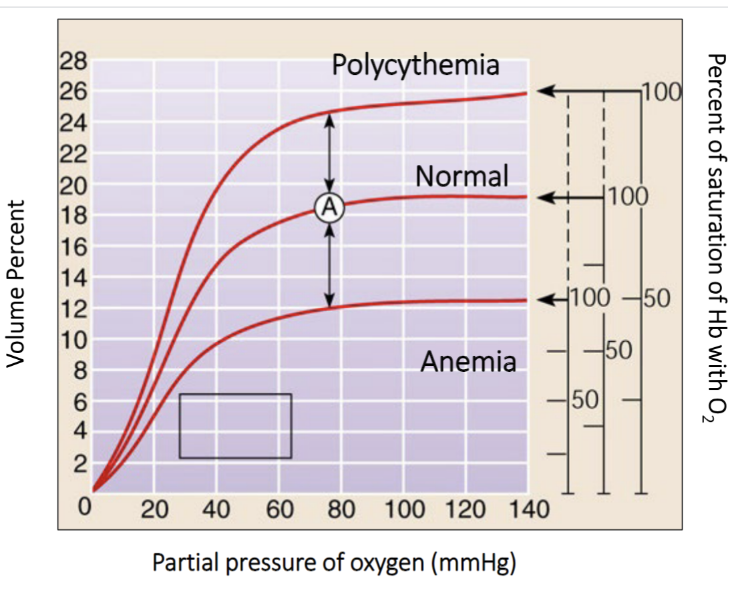
Anemia
A condition characterized by too little red blood cell volume in the blood, often caused by a lack of iron → low O2 carrying capacity & few hemoglobin carrying O2
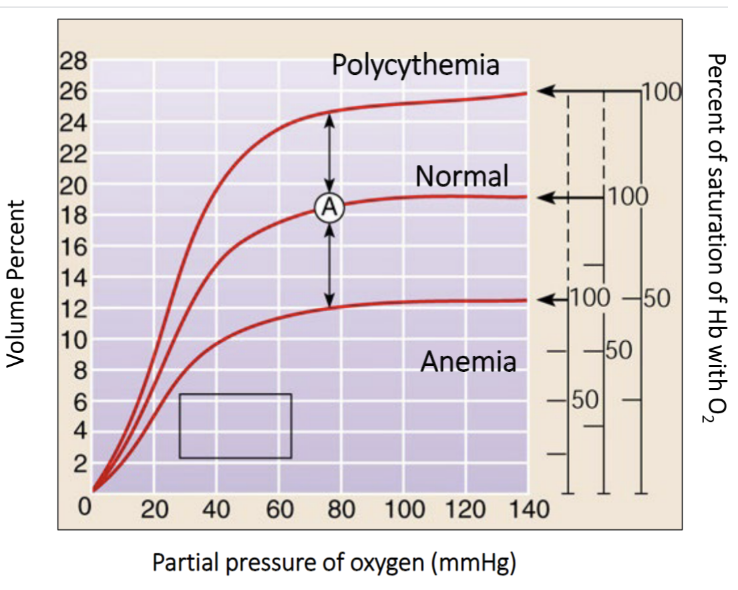
Polycythemia
An increase in red blood cell production, which increases the absolute carrying capacity of blood [can be adaptive or maladaptive] → don’t want too much because packing too many cells can lead to risk of blood clot formation
Bicarbonate Buffer
Bicarbonate's role as a buffer of pH, helping to keep pH relatively stable.
Bohr Shift
The subtle shift in the oxygen-hemoglobin saturation curve due to changes in CO2 and pH levels [ONLY shows pH levels] → as red blood cells encounter a local environment that becomes more acidic, it shifts their O2 binding curve a little bit to the right (right = lower affinity = higher P50 = low pH as it is more acidic)
Carbonic Acid-Bicarbonate System
The process of CO2 combining with water to form carbonic acid, which then dissociates into bicarbonate and a proton.
Venous Blood
Blood returning to the heart with higher levels of CO2 and lower oxygenation.
Arterial Blood
Oxygenated blood with higher oxygen levels and lower CO2 levels.
Hypoxic Ventilatory Response
The increased ventilation in response to lower oxygen levels, leading to hyperventilation.
2,3-DPG [Diphosphoglycerate]
A molecule that increases the release of oxygen from hemoglobin, offsetting the effects of pH changes [the more it binds, the lower the affinity/higher P50]
Erythropoiesis
The formation of red blood cells, stimulated by increased levels of EPO hormone.
Buccal Oscillations
The mechanism of ventilation in fish and amphibians, involving expansion and compression of the buccal cavity.
Axial Musculoskeletal Oscillations
The mechanism of ventilation in reptiles, birds, and mammals, involving expansion and contraction of the rib cage and diaphragm.
Anatomical Dead Space
The volume of non-respiratory portion in the lungs → still air present in lung
Physiological Dead Space
The volume not involved in gas transfer, including less perfused alveoli.
Hypoxic Pulmonary Vasoconstriction (HPV)
The constriction of arterioles in hypoxic areas of the lung to match lung perfusion to pulmonary blood delivery → in hypobaric hypoxia at high elevation, all of the pulmonary circulation gets constricted [increased resistance to flow = increased pressure = pulmonary edema or leakage of more fluid]
Tibetans
People adapted to high elevations, showing blunted HPV response and lower increase in hematocrit.
Concurrent Exchange
The exchange of gases in the same direction (mammals), reducing the diffusion gradient.
Countercurrent Exchange
The exchange of gases in opposite directions (fish), is more efficient due to a larger diffusion gradient.
Crosscurrent Exchange
The exchange of gases in birds, enhancing the rate of blood diffusion → air sacs and ventilation pattern create large flow rate across resp. exchange surface
How would a 4 chambered heart pump?
Pump with an atria & ventricle on the right side directing flow to the lung + atria/ventricle on left side that pumps to systemic circulation
How would lower pressure trip look like?
Shorter trip to pulmonary circulation
What is thick elastic walls in the heart used for?
Acts as a dampener and moderate force of blood pressure → needs greater force/pressure to meet the demand necessary (connective tissues)
What is a thoracic duct in the closed circulatory system?
where the lymphatic system is interfacing with the vascular system → can feed back into circulation
What does it work for the open circulatory system in insects?
Hemolymph is pumped by a muscular heart → goes out through arteries → fluid gets dumped out into general extracellular fluid that bathes tissue of animal
[The blind opening close to the heart can have extracellular fluid leak back into the heart to be pumped again]
How do insect systems (respiratory and circulatory) differ from mammalians?
Separate system for respiratory gases: respiratory and circulatory system are more distinct in operation
How does the tracheal system in the insect “pump”?
Convective movement of air in and out of spericals [opening on the side of the insect]
What are the trachea in terminal portions in aqueous environments?
Need fluid lining since oxygen in the air needs to dissolve into a fluid layer which can diffuse into alveoli → pulmonary capillaries → red blood cells
What are the formed elements of blood for vertebrates?
Red blood cells, platelets and white blood cells
What does “fractionated” mean and what are the three layers for vertebrates?
Spin blood in centrifuge: Plasma (yellow, dissolved nutrients), Buffy coat (platelet on top of white blood cells) & RBCs (red)
What does invertebrate contain for blood that vertebrates do not?
Hemocytes: role in immune response lik WBCs
How does red blood cells differ in invertebrates?
No nucleus
How do platelet differ in invertebrates?
Crucial and allow injured vessels to be temp. clotted to avoid losing blood/blood pressure
What can the heme group between a & b subunits in the hemoglobin subject do?
Gives the system the ability to modify the activity of hemoglobin to pull & push oxygen-holding capacity in protein when appropriate
Oxyhemoglobin
O2 bound to most hemoglobin
Deoxyhemoglobin
Most heme groups are free and O2 are not bound
What are the steps involved in O2 delivery via the circulatory system for vertebrates?
Convection (fluid pump) → Diffusion → Convection (Blood pump) → Diffusion → Tissues
In O2 delivery, what does convection + fluid pump do?
Involves bulk flow of fluid
In O2 delivery, what does convection + blood pump do?
capillary system and pulmonary circulation: muscular pump is used by bulk flow or convection moving fluid around
In O2 delivery, what does the second diffusion do?
The oxygen and CO2 must move between the hemoglobin and plasma in the blood across membrane into the tissues where it makes it way to the mitochondria
What is produced in the mitochondria?
CO2 through decarboxylation
What kind of protein is myoglobin?
Monomeric
What does the mitochondria do in O2 delivery?
Acts as a sink for O2: sucking up and using O2
Is P50 lower or higher for myoglobin compared to hemoglobin and why?
Lower as it takes much lower Po2 in the test tube to get 50% of the myoglobin to be loaded with oxygen
Is the affinity for myoglobin for O2 higher/stronger or lower than affinity of hemoglobin for O2?
Higher → encourages the movement of O2 from the circulation of where hemoglobin is into the tissue where myoglobin is
What is the significance of differing P50 values?
Hemoglobin shows up at tissues (with low PO2) where hemoglobin is happy to give up O2 (as it has high P50) [little oxygemoglobin leftover]
Saturation Effect
Only a number of binding spots on heme groups → when O2 saturation approaches 100%
What type of curve is a myoglobin curve?
Exponential Curve [No cooperativity as not multiple subunits]
What type of curve is a hemoglobin curve?
Sigmoidal Shape [Can exhibit cooperativity]
What causes a conformational change?
Binding of O2, H and CO+ binding to amino acid in protein which can impact affinity or P50
Conformational change
as more O2 binds to more heme groups, the conformation changes and make it easier for O2 to bind to remaining unfilled heme groups
How would a hemocyanin-O2 binding curve look like?
Similar to myoglobin (Exponential) as it has no exhibit cooperativity due to monomer
What happens to P50 if there is lower affinity?
Increases
What factors are changed if there is an increase in P50?
Increase in temperature, decrease in pH, More levels of binding, Increase in CO2
What is ATP and GTP impact on O2?
If ATP levels go up, it signals a good O2 environment and declines in hemoglobin [mitochondria]
Pulmonary circulation
wants blood to load up oxygen on hemoglobin → wants affinity to be strong/high for red blood cells to flow by alveoli sacs to pick up O2 {decrease in HbCO2 formation causes higher affinity}
What impacts for CO2 have by binding to hemoglobin [carbamino hemoglobin]?
Effects by pH & effects by binding itself → both lead to a decrease in affinity and increase in P50 where there is a increase in CO2
Relation between CO2 and pH (and H2O)
CO2 + H2O → (slow) H2CO3 → (Fast) H + HCO3-
What is major form of CO2 in plasma?
Bicarbonate → carbonic acid happy as bicarbonate is weak acid {not enzymatically catalyzed}
Difference between oxygenated and deoxygenated blood matters
CO2 can bind to hemoglobin and reduce the affinity of hemoglobin for O2 → oxygenated hemoglobin is more ikely to kick CO2 off and lose carbomino
What does relative gas partial pressure look like in the lumen of lungs?
Low: O2 = High, Co2 = Low.
High: O2 = Lower, CO2 = Even Lower
What does relative gas partial pressure look like in the lung capillaries?
Low: O2 = Low, Co2 = High
High: O2 = Same, CO2 = Same
What does relative gas partial pressure look like in diffusion gradient?
Low: O2 = High in, Co2 = High out
High: O2 = Lower in, CO2 = Higher in
Oxygen holding in Systemic Circulation
Blood, after picking up O2 easily in pulmonary surfaces, holds onto it tighter in systemic circulation.
Lowering of Co2 Levels in blood does what to pH?
Increase → higher affinity for O2 but no rapidly release of O2 to tissues
Lower P50 for O2 encourages ______ by Hb at lungs, but discourages release at _________
uptake, tissues
Hyperventilation
Increased convective flow → enhance O2 and CO2 exchange
What happens in high elevation?
PO2 = Hyperventilation [Hypoxic Ventilatory Response], Lowering Co2 = Increase in pH, Increase release of 2,3 DPG into circulation, Increased EPO, Erythropoiesis
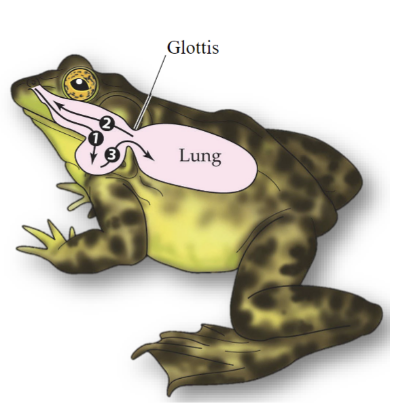
Ventilation in Fish and Amphibians
Floor of mouth is lowered; buccal cavity expanded; air flows through the nares (nostrils) into the bottom of the mouth
Creates negative pressure; pressure gradient for air to move into buccal cavity
Glottis closed
Fish: use water and pushes it out through their gills
Glottis opens; air flows from the lungs across the top of the mouth and out of the nares
Elastic recovery of energy in torso which pushes whatever air that was in the lungs out; exits out in top of buccal cavity
Floor of the mouth is raised; buccal cavity is compressed; air is pumped into the lungs; the glottis closes
Ventilation in Reptiles, birds and mammals
Axial Musculoskeletal Oscillation [Inspiration creates negative pressure in lungs because pleural space cannot expand as it is fluid filled]
Lower lobes: when they contract; causes rib cage to expand → enhances inspiration and exhalation
When the diaphragm contracts, it lowers which pulls on the bottom space defined by ribs → lungs expanding and are deriving low pressure in the lungs (gradient for air to move in)
Ventilation for Tuna
Must be swimming forward all the time; only way to ensure that water is moving past their gills where gas exchange with their pulmonary circulation occurs
Maximum respiratory level
6L in lungs, trachea, etc
Maximym expiratory level
max exhalation
Fick’s Equation
rate of mass diffusion per unit time t
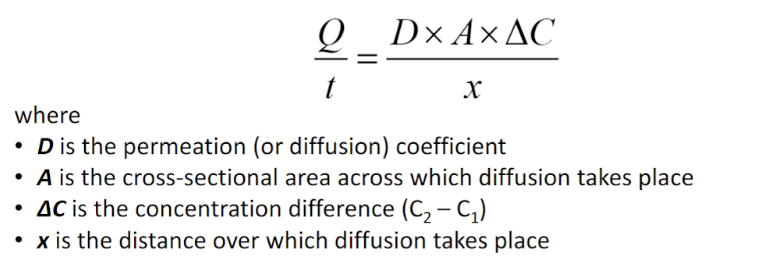
Greater surface area _______ mass diffusion
enhances
Longer diffusion distances ______ mass diffusion
delay