Human Anatomy Chapters 1-2-3
 Call Kai
 Learn
Learn Practice Test
 Spaced Repetition
 Match
Match Flashcards
 Knowt Play
1/54

There's no tags or description
Looks like no tags are added yet.
Name | Mastery | Learn | Test | Matching | Spaced | Call with Kai |
|---|
No analytics yet
Send a link to your students to track their progress
55 Terms
What is Gross Anatomy?
Visible with the unaided eye
What is Microscopic Anatomy?
Examines structures that cannot be observed by unaided eye
What is Cytology?
the study of body cells and their internal structure
What is Histology?
the study of tissues
What is Systemic Anatomy?
By organ system
What is Regional Anatomy?
By area (head and neck)
What is Surface Anatomy?
What can be seen without disturbing tissues
What is Comparative Anatomy?
examines anatomical similarities and differences in different species
What is Embryology?
studies developmental changes from conception to birth
What is Metabolism?
the sum of all chemical reactions that occur within the body
What is Anabolism?
small molecules joined to form larger ones
What is Catabolism?
large molecules broken down into smaller ones
What is Reproduction?
Produce new cells for growth, maintenance, and repair
With sex cells (gametes), can develop into new organisms
What is the Chemical level?
atoms form molecules, which compose macromolecules, which in turn make cell parts (organelles)
What does the Integumentary system do?
Protects body from external environment
Produces vitamin D
Retains water
Regulates body temp
(Hair, skin, nails)
What does the Skeletal system do?
Supports the body
Protects internal organs
Provides leverage for movement
Produces blood cells
Stores calcium salts
(Bones and joints)
What does the Muscular system do?
Produces movement
Controls body openings
Generates heat
(Skeletal muscles)
What does the Nervous system do?
Regulates body functions
Provides sensations via nerve impulses
(Brain, spinal cord, nerves)
What does the Endocrine system do?
Regulates body functions
Hormones
(Pineal gland, hypothalamus, pituitary gland, thyroid gland, thymus gland, adrenal gland, pancreases, testes, ovaries)
What does the Cardiovascular system do?
Pumps and delivers blood
Removes waste form tissues
Transports cells, nutrients, and other substances
(Blood vessels and heart)
What does the Lymphatic system do?
Returns excess tissue fluid to the cardiovascular system
Provides immunity
(Tonsils, lymph nodes, thymus, spleen, lymphatic vessels)
What does the Respiratory system do?
Delivers oxygen to the blood
Removes Carbo dioxide from the body
Maintains acid-base balance of the blood
(Nasal cavity, pharynx, larynx, trachea, lungs)
What does the Urinary system do?
Removes metabolic wastes from the blood
Regulated fluid, electrolyte, and acid-base balance
Stimulates blood cell production
(Kidneys, ureters, urinary bladder, urethra)
What does the Digestive system do?
Digests food
Absorbs nutrients into the blood
Removes food waste
Regulated fluid, electrolyte, and acid-base balance
(Mouth, salivary glands, esophagus, liver, stomach, gallbladder, pancreas, large intestine, small intestine)
What does the Male Reproductive system do?
Produces sperm
Secretes hormones
Sexual function
(Prostate gland, ductus deferens, testis, penis)
What does the Female Reproductive system do?
Produces eggs
Fetal development/ lactation
Secretes hormones
Sex
(Mammary glands, uterine tube, ovary, uterus, vagina)
What is the Coronal (Frontal) plane?
Vertical plane dividing the body into anterior (front) and posterior (back) parts
What is the Transverse (or cross-sectional) plane?
Horizontal plane dividing the body into superior (top) and inferior (bottom) parts
What is the Midsagittal (median) plane?
Vertical plane dividing the body into equal left and right halves
What is the Sagittal plane?
Parallel to midsagittal, but left or right of midsagittal; divides structure into unequal portions
What is Oblique plane?
Passes through structure at an angle
What is the Axial region?
Head, neck, and trunk
Forms the main vertical axis of the body
What is the Appendicular region?
Upper and lower limbs
What is the Posterior aspect?
Completely encased in bone
Subdivided into”
Cranial cavity (endocranium) is formed by bones of the cranium → Houses the brain
Vertebral canal is formed by the bones of the vertebral column → Houses the spinal cord
What is the Ventral cavity?
Larger than posterior cavity
Anteriorly placed in the body
Does not completely encase organs in bone
Subdivisions of are lined with serous membranes
Partitioned into a
Superior thoracic cavity
Inferior abdominopelvic cavity
What is the Parietal serous membrane layer?
lines internal surface of body wall
What is the Visceral serous membrane layer?
covers external surface of organs (viscera)
What is Serous fluid?
Liquid secreted by cells in serous membrane
Acts as lubricant
Reduces friction caused by movement of organs against body wall
What is the Mediastinum?
median space in the thoracic cavity
Contains heart, thymus, esophagus, trachea, and major blood vessels that connect to the heart
What is the Pericardium?
two-layered serous membrane
Parietal pericardium → Outer layer, which forms the sac around the heart
Visceral pericardium → Forms the heart’s external surface
Pericardial cavity → Space between parietal and visceral layers containing serous fluid
What is the Pleura?
two-layered serous membrane associated with lungs
Parietal pleura → Outer layer lines internal surface of thoracic wall
Visceral pleura → Inner layer covers external surface of lungs
Pleural cavity → Space between parietal and visceral layers containing serous fluid
What is the Abdominal cavity?
Superior area
Contains most of the digestive system organs, kidneys, and most of the ureters
What is the Pelvic cavity?
Inferior area, between hip bones
Contains distal part of large intestine, remainder of ureters and urinary bladder, and internal reproductive organs
What is the Peritoneum?
two-layered serous membrane lining the abdominopelvic cavity
Parietal peritoneum → Outer layer, which lines the internal walls of the abdominopelvic cavity
Visceral peritoneum → Inner layer, which covers the external surface of most abdominal and pelvic organs
Peritoneal cavity → Potential space between parietal and visceral layers containing serous fluid
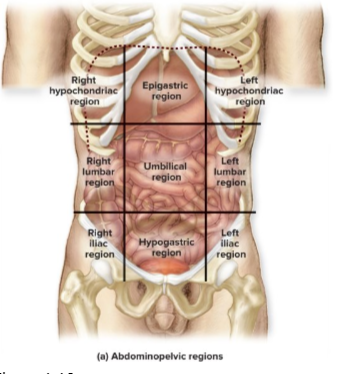
What is the Epigastric region?
Superior to umbilical
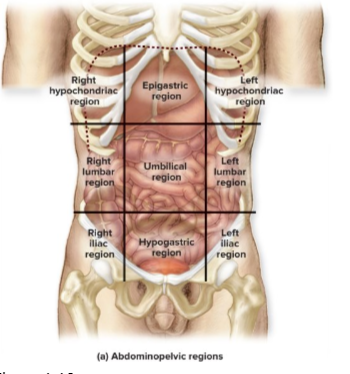
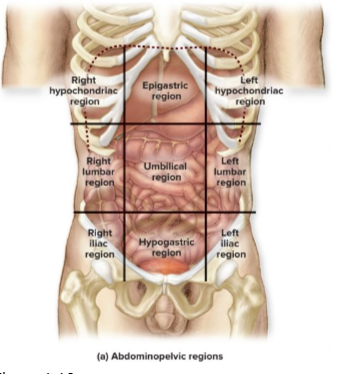
What is the Hypogastric region?
Inferior to the umbilical
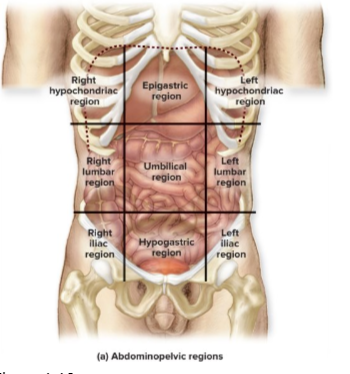
What are the Right and left hypochondriac regions?
Inferior to costal cartilages and lateral to epigastric
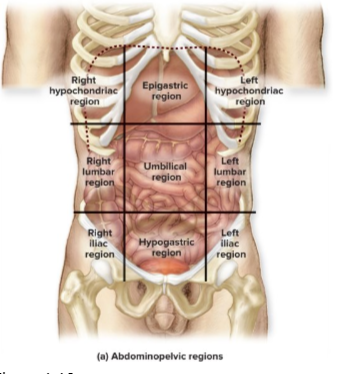
What are the Right and left lumbar regions?
Lateral to umbilical
What are the Right and left iliac regions?
Lateral to hypogastric
What is Homeostasis?
the ability of an organism to maintain consistent internal environment in response to changing internal or external conditions
What are the 3 Components of the Homeostatic systems?
Receptor: detects changes in a variable → Stimulus: change in temp. sensed by skin
Control center: interprets input from receptor and initiates changes through effector → regulation of blood pressure upon rising
Effector: is the structure that brings about changes to alter the stimulus
What is Negative feedback?
Controls most processes in the body
Variable fluctuates within a normal range around a set point
Resulting action is in the opposite direction of the stimulus → temperature regulation
What is Positive feedback?
Occurs much less frequently than negative feedback
Stimulus reinforced to continue moving variable in same direction until a climactic event occurs, then body returns to homeostasis → (Breastfeeding, Blood clotting, and Labor)
What are Characteristics of the Homeostatic system?
Dynamic
Control center is generally nervous system or endocrine system
Regulated through negative feedback
If systems fails, homeostatic imbalance or disease results
What is Diabetes?
homeostatic imbalance
Occurs when homeostatic mechanisms for regulating blood glucose are not functioning normally
Blood glucose fluctuations and high glucose readings