Lecture 14 - MORB Geochemistry
 Call Kai
 Learn
Learn Practice Test
 Spaced Repetition
 Match
Match Flashcards
 Knowt Play
1/59

There's no tags or description
Looks like no tags are added yet.
Name | Mastery | Learn | Test | Matching | Spaced | Call with Kai |
|---|
No analytics yet
Send a link to your students to track their progress
60 Terms
What percentage of volcanism on the Earth is produced by the Mid- Atlantic Ridge?
85%
How long is the Mid-Atlantic Ridge network?
85000 km
Is there a lot, or a little contamination in MORBs?
Minimal contamination, since there is no interaction with the continental crust
When did we discover the MORBs?
1960s to early 1970s because of submersible surveys
What is interesting about ‘black smokers‘? Who discovered them?
They have chemosynthetic life (oxidizes H2S)
discovered by the submersible Alvin in 1979
How do we know what the Oceanic Crust (and upper mantle) look like? (3)
Geophysical studies
Direct sampling
Ophilites
How do Geophysical studies help determine what the upper crust looks? What are the procedures?
Geophysical studies
Changes in Seismic wave velocities (tell us about structure of ocean crust)
Mantle Seismic tomography (temperature differences in crust and mantle system)
How does Direct Sampling help determine what the upper crust looks? What are the procedures?
Direct Sampling
Drilling, dredging, submersibles (with lots of money)
Mantle Xenoliths (samples of ocean crust)
How do Ophilites help determine what the upper crust looks? What sections of the crust are exposed?
Ophilites
uplifted/obducted oceanic crust and upper mantle
Where might a MORB erupt directly at the surface?
Iceland - studied as MORB but also has excess magmatism (plume?)
What is the oldest oceanic crust? (ballpark)
180 Million yrs old
cannot go very far back in time
Define an Ophiolite. What is it composed of?
stratified igneous rock complex
upper basalt member, middle gabbro member, and lower peridotite member
How thick, wide, and long can an Ophiolite sequence be?
some >10km thick, 100 km wide, and 500 km long
What does the ophiolite sequence usually alter into?
serpentinite
What is really important about ophiolites?
Give us a framework for the structure of the crust
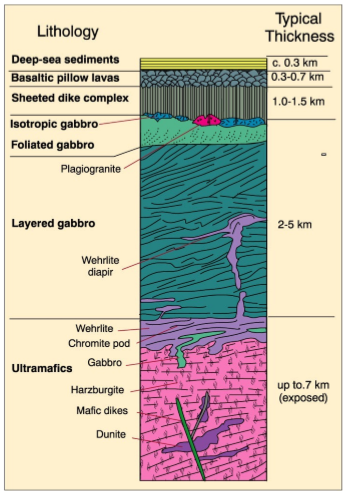
What are some examples of Ophiolites?
Cyprus (inverted topography - higher = more mantle like)
When did the origin of basalt become more known?
1960s, when plate tectonics became more accepted
What was the major factor that allowed us to determine the origin of basalt?
Green and Ringwood experimental petrology (1969)
MORBs were discovered to be partial melts from the mantle
melted peridotites = basalt (basalts must be melts of the mantle)
maybe we can determine what the mantle is made of?
What are the main MORB controls when determining the Mantle chemistry?
Degree of melting - Variations of Temperature in the mantle
Fractional Crystallization - Dependent on phases that crystallize, pressure, and magma composition. (stability of minerals)
Variations in mantle composition - variation in radiogenic isotopes. Not fractionated by melting/crystallization
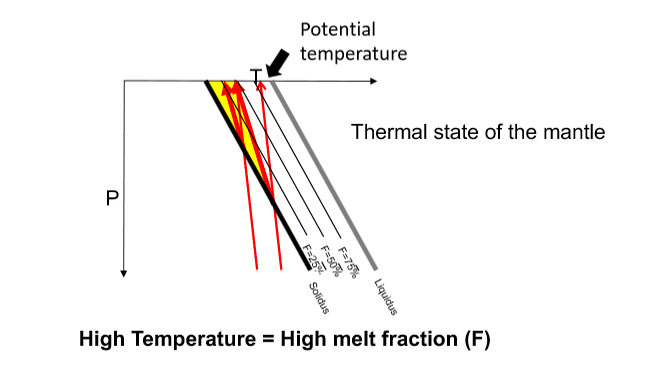
Where does partial melting occur on this diagram?
Between the liquid and the solidus
Mantle is decompressed (moves along adibat), hits solidus and first melt begins to form.
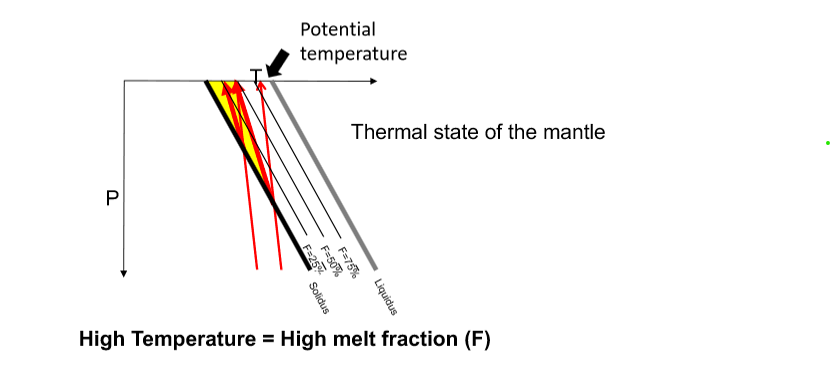
What is a potential temperature?
If we don’t lose heat during decompression = hottest mantle
Represented by the arrow drawn straight up from the pressure
Realistically, there would be some change in temp (barely any change in Temp.) = Adiabat
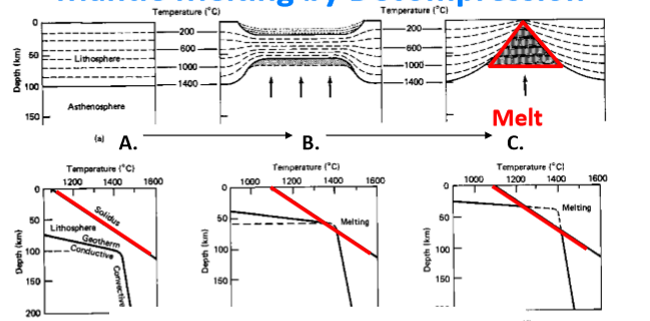
What does this series of images depict? What does the upper portion depict? What does the lower section show?
Upper Portion = the geological structures/environment
Lower Portion = the geotherm of the mantle with respect to the solidus line
Depicts decompression melting during the formation of an MORB and the geotherm’s response to the crustal thinning
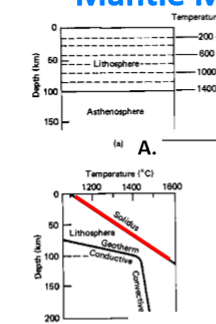
What is the geological environment and geotherm position in this photo?
Stable Lithosphere with a geotherm temperature that is lower then the solidus
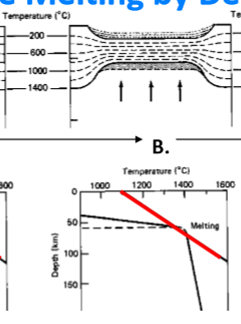
What is the geological environment and geotherm position in this photo?
Lithosphere under extension and thinning. Isotherms are compressed and the asthenosphere moves up.
The solidus remains the same (no additional volatiles), but the position of the geotherm moves towards the solidus
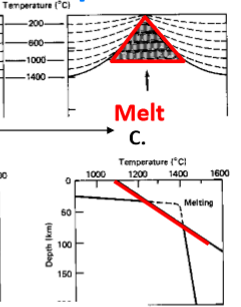
What is the geological environment and geotherm position in this photo?
Continuous spreading (right) yields a triangular regime in which partial melting occurs; this is the case under mid-ocean ridges
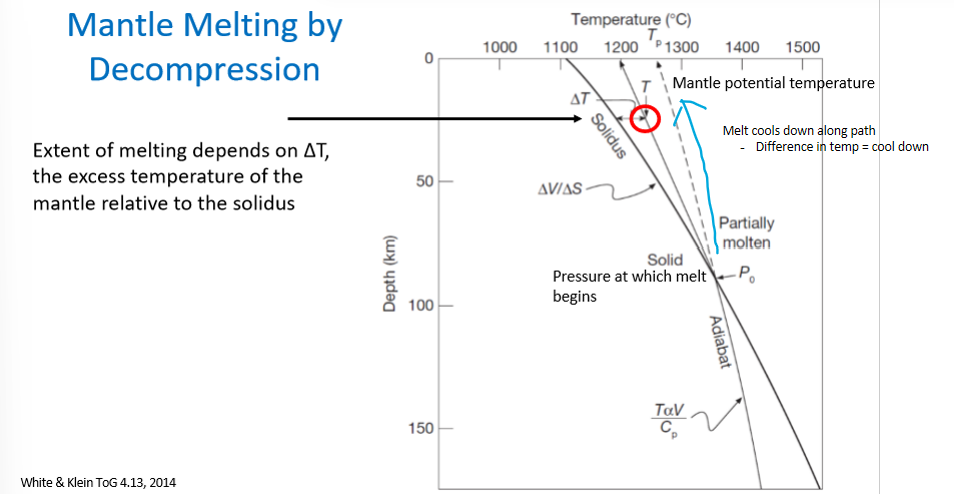
What happens to the temperature when the adiabat reaches the solidus line?
melt losses heat faster than solids = different trajectory in T
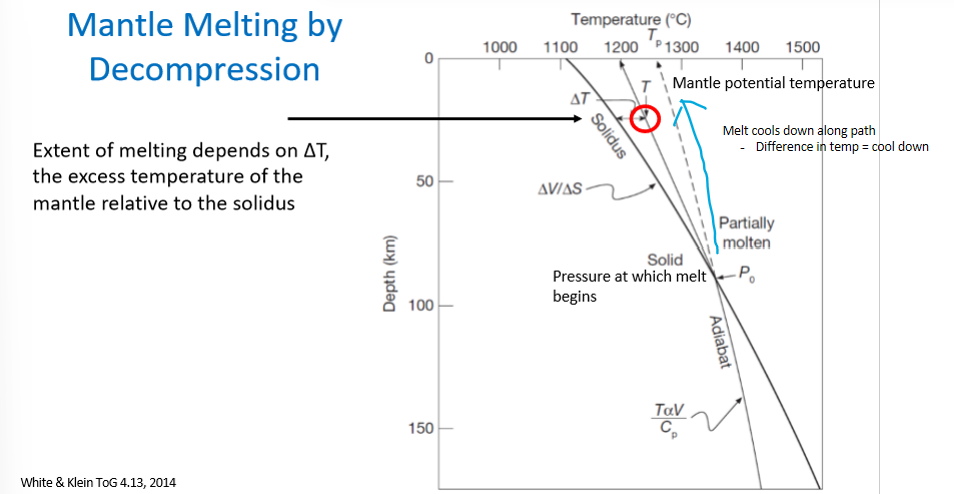
What represents the extent of melting?
Is the difference between the solidus and magma temperature during the eruption
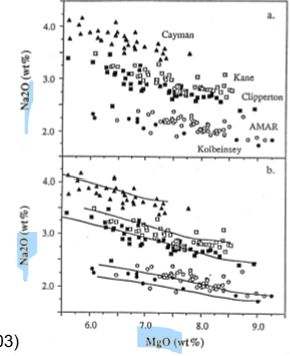
What direction is fractional crystallization (primitive to evolved)? Why?
To the left
MgO starts ~9 wt% (primitive) and is reduced as we evolve/fractionate (though Olivine)
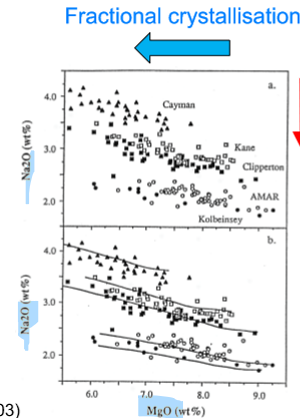
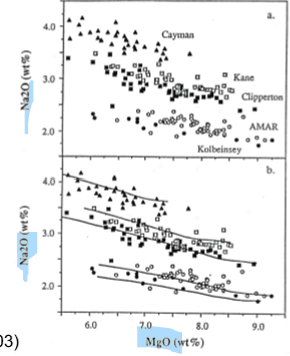
Does Na behave like a compatible or incompatible element?
Na behaves like an incompatible element and becomes more concentrated as the magma evolves.
does not go into minerals as we crystallize
What does sodium (Na) tell us about melt fraction? Why?
As Na decreases, there is more melt (F) in the system
As Na increases, there is less melt (F) in the system
F = melt fraction
Because Na behaves like an incompatible element
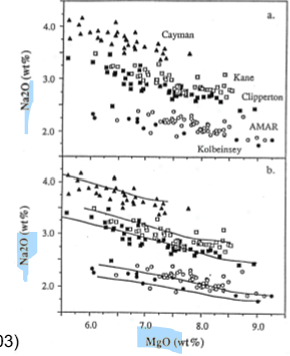
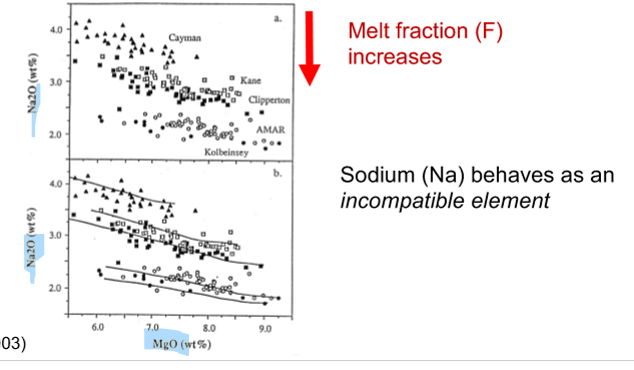
What direction is Melt fractionation? Why?
As you move downwards, melt fraction (F) increases.
Na behaves like an incompatible element and becomes more concentrated as the magma evolves. (less Na = more primitive, more Na = more evolved)
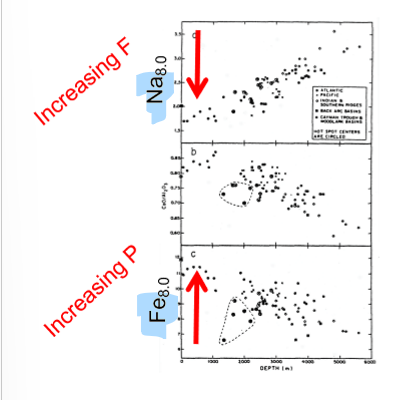
What is the difference between Na and Fe in this figure?
Na is incompatible
Fe is compatible
What makes Iron special?
compatible is Olivine
can switch from 2+ to 3+ = higher iron content at higher pressures (Strange since it is usually incompatible)
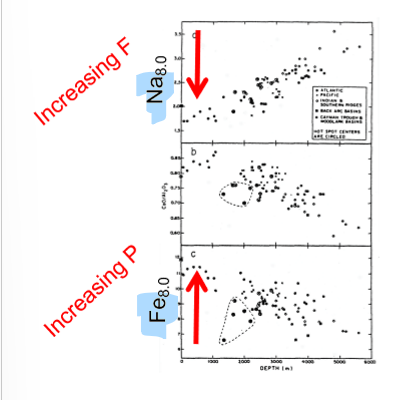
What does the x-axis represent?
The depth between the sea level and the ridge
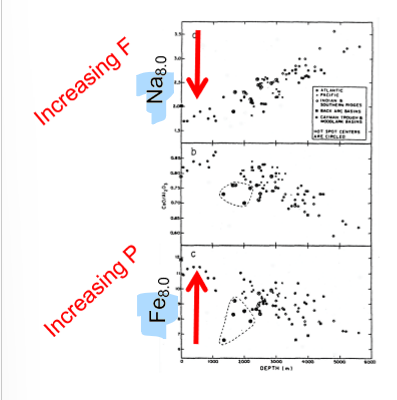
How does Na correlate with the depth to the ridge?
As Na increases, the depth between the sea level and the ridge (“depth to the ridge”) increases
increasing Na = increasing depth
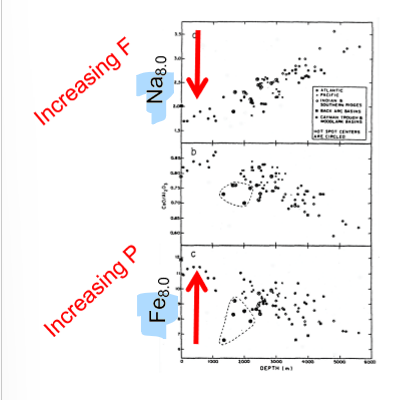
How does Fe correlate with the depth to the ridge?
As Fe increases, the depth between the sea level and the ridge (“depth to the ridge”) decreases. Inverse relationship
increasing Fe = decreasing depth
What doe we need to do to compare global variations in Na and MgO (across suites)?
Draw a straight trend line across the evolving Na-values of the same suite.
Compare the Na-values of two different suites along the same MgO value (usually 8) to minimize the increase in Na you get from progressive fractional crystallization.
What are the main uses for Na and Fe values?
Na = the extent of melting (amount of melt)
Fe = the depth/pressure of melting (distance between ridge and sea-level)
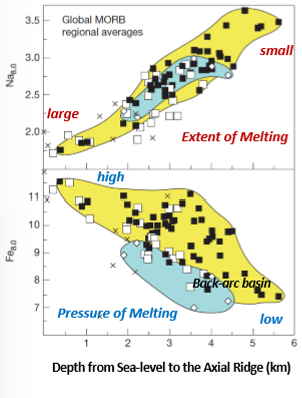
What values of Na and Fe can we use to link major element chemistry to geophysical parameters?
the corrected value of fractional crystallization (with respect to MgO 0.8)
What would a Na vs. Fe plot look like? Attempt to draw. Label the degree of melting (F) and pressures/depths
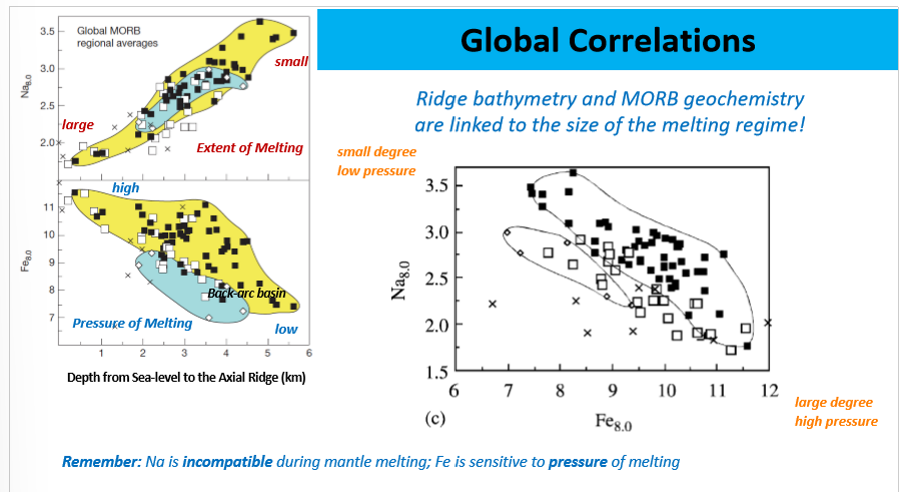
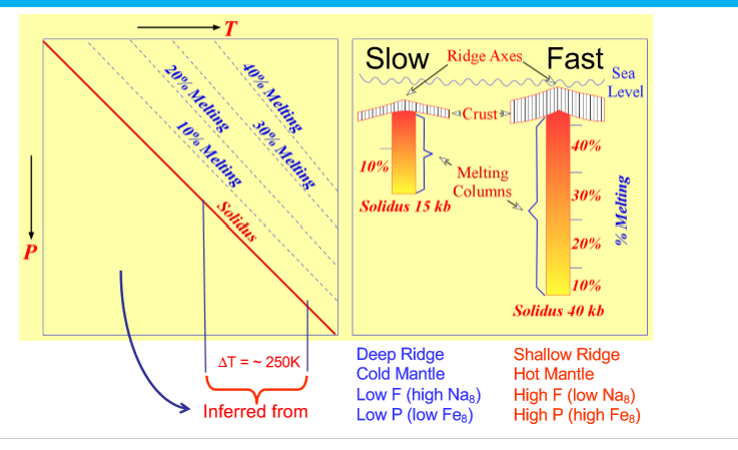
What physical parameter is Na and Fe linked to?
Spreading rates of MORs
What reflects a slow spreading MOR?
Low F = High Na (colder- melting to a smaller degree with a smaller depth of melting)
Low P = Low Fe (smaller mantle column due to less decompression)
What reflects a fast spreading MOR?
High F = Low Na (larger mantle column due to more decompression)
High P = High Fe ()
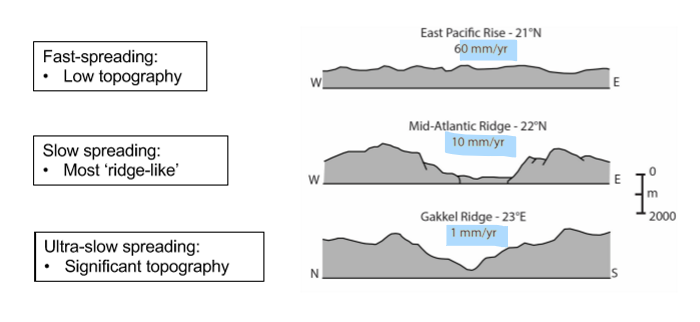
How does topography relate to spreading ridges?
Fast Rate = rise in the middle (smooth)
Slow Rate = low in the middle (rough)
How does the degree of melt change as you get closer to the surface in a mantle column?
The degree of melt increases as you get closer to the surface (more decompression occurs = more past the solidus)
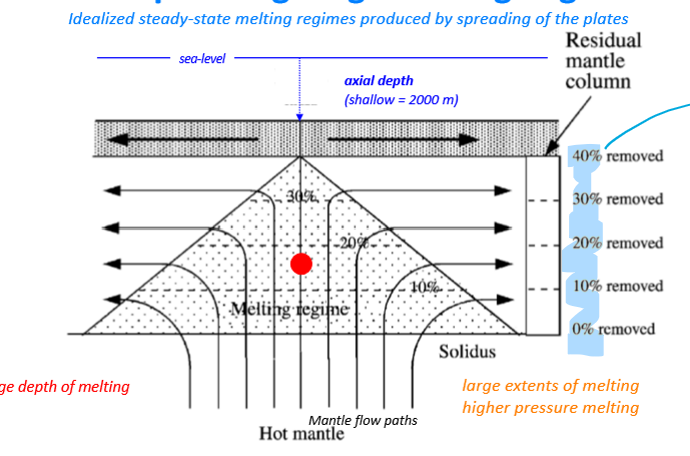
What is the average extent of melting that occurs in a mantle column? Why do we average the melting column?
Average ~ 15% (across the whole melting regime)
To get what F is
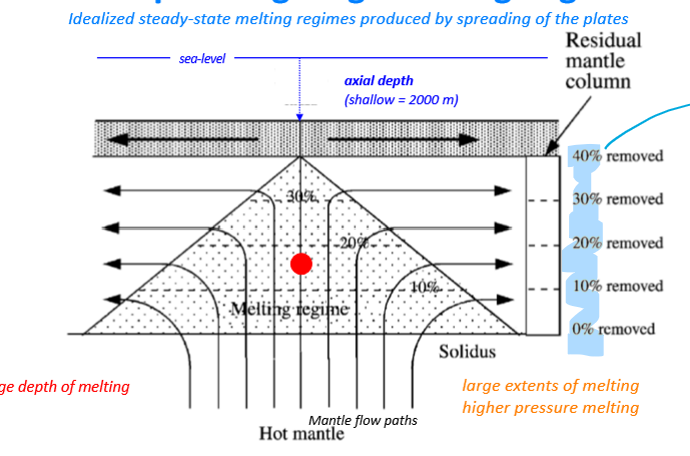
Does a higher mantle T produce more melt or less melt?
more melt
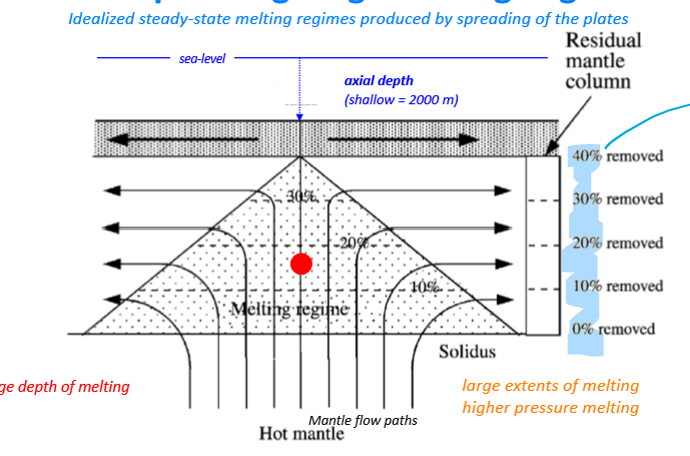
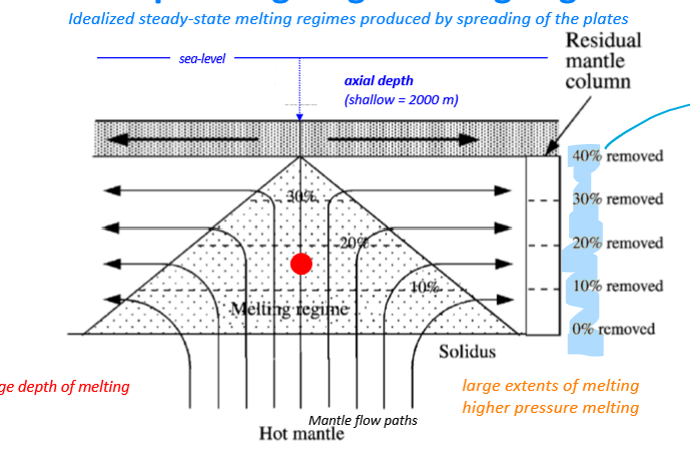
Where does the most partial melting occur, on the ridge axis or off the ridge axis?
On the ridge axis. Note the triangular shape in the mantle
What is BSE
BSE = Bulk Silicate Earth. The undifferentiated Earth
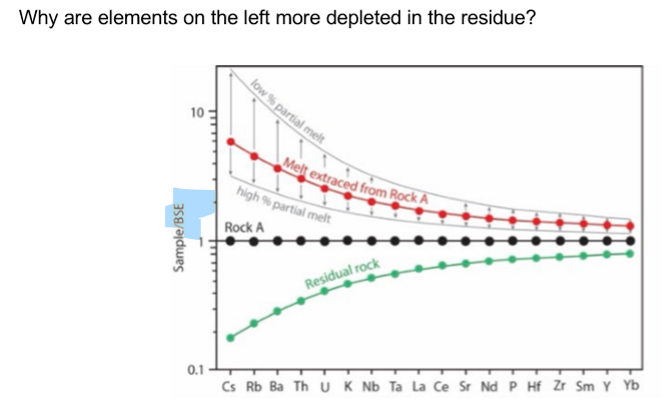
Why are elements on the left more depleted in the residue?
Spider diagrams go from most incompatible to least incompatible
Left = most incompatible; therefore, they will be incorporated into the first melts, but diluted with higher degrees of melt.
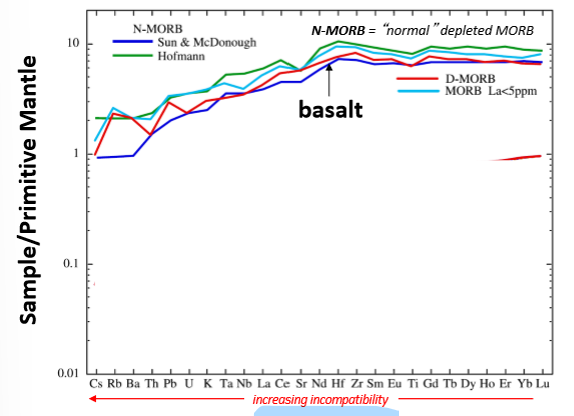
What type of pattern does this represent?
Residual pattern
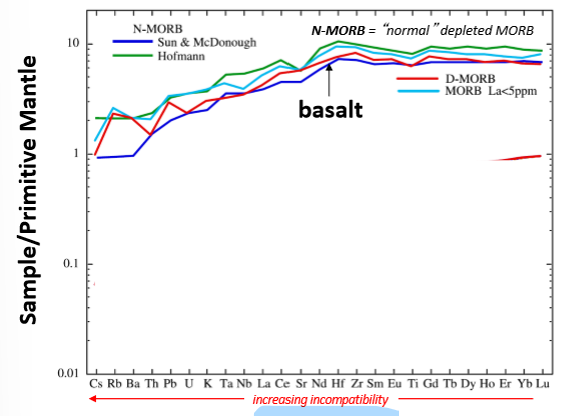
If MORBs are a melt, why does their pattern look like a residue?
*Important to note that it is normalized to a primitive mantle
MORBs are the residue of the primitive mantle after continental separation.
The continental crust leaves a residue that is depleted in incompatible elements
The source was depleted beforehand
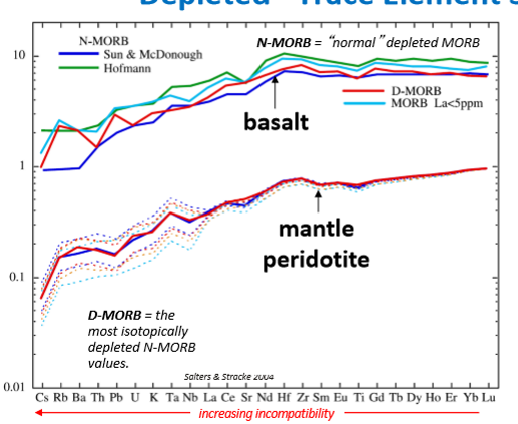
What does the mantle peridotite represent?
The source of the MORBs
Do the initial isotope ratios of MORB samples have to be calculated?
Since they just formed, they just crystallized and locked the signature. - - - The initial is what we measure
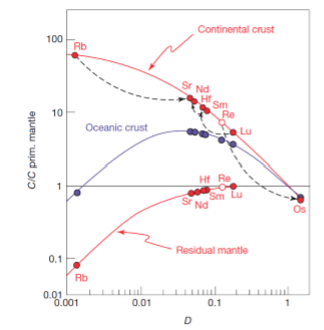
What are the key features of this photo? What is it showing?
Shows the different types of crust compared to the primitive mantle
the extent of fractionation
How do we differentiate the parent from the daughter?
Once depleted in elements, it cannot produce an enriched melt
Are continental crusts enriched or depleted in Rb/Sr ratio and Sm/Nd ratio? How about the oceanic/MORB crust?
Continental Crust:
Enriched Rb/Sr ratio (incompatible)
Depleted Sm/Nd ratio (compatible)
Oceanic/MORB Crust:
Depleted/low Rb/Sr ratio (incompatible)
Enriched/high Sm/Nd ratio (compatible)
b/c of depleted source
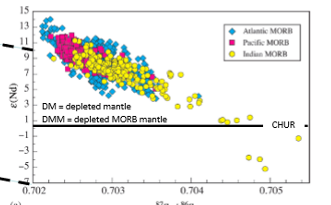
Are MORBs isotopically homogenous?
No. There is a slight variation in MORB isotopes ocean to ocean
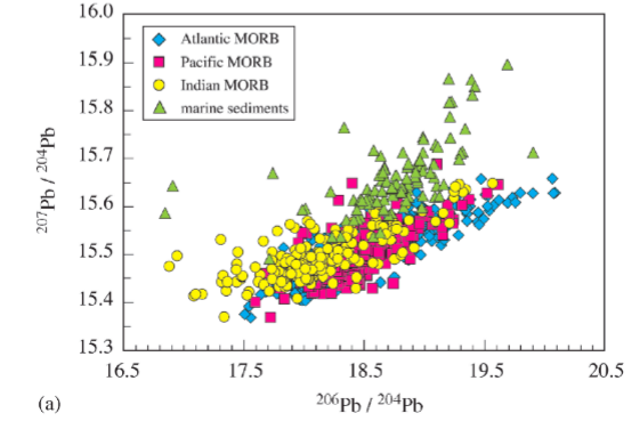
What do the linear relationships represent when plotting 207/204Pb vs. 206/204 Pb? (2 different radiogenic isotopes/ a single stable isotope )
Can either represent isochrons or mixing lines
generally make straight lines (if same age)
MORBs don’t have the same Pb composition everywhere in the ocean
What is the Australian-Atlantic Discordance? What does it represent?
a ridge below Australia, separating the oceans
maps the upper mantle source (distinct and something prevents mixing)
Summarize some things of the MORB geochemistry:
Magma production
Major element uses
trace element trends
isotope composition
isotope composition between oceans
Most important production of magma on Earth
Major elements (Na, Fe) can yield T, P and depth information
MORB trace elements are depleted in incompatible elements
MORB isotopic composition: Higher 143Nd/144Nd and lower Pb ratios and 87Sr/86Sr than other Earth reservoirs (eg. Continental Crust)
MORB isotopic composition is not homogenous (differences between Indian, Pacific, and Atlantic Oceans)