IED Theory Test
 Call Kai
 Learn
Learn Practice Test
 Spaced Repetition
 Match
Match Flashcards
 Knowt Play
1/26

There's no tags or description
Looks like no tags are added yet.
Name | Mastery | Learn | Test | Matching | Spaced | Call with Kai |
|---|
No analytics yet
Send a link to your students to track their progress
27 Terms
Categories of device
Non-explosive anti-personnel devices: e.g. arrow booby traps
Explosive devices: Inflict maximum damage through blast effect. Consists of initiation system, detonator and main explosive charge.
Incendiary devices: Inflict injury/damage by burning. Consists of initiation system, igniter, and incendiary composition.
Explosive and Incendiary devices: Inflict injury/damage through blast + burning effect. Consists of initiation system, detonator, explosive charge and incendiary composition.
IEDs Modes of Activation (MOA)
Delay (Time)
Anti-handling
Ambient
Command
Multi-mode
Neutralization techniques and render safe
Gagging - prevent movement of mechanical device
Separation - separation of chemical substance and detonator from main charge + electrical component
De-arming - replacing safety device + pins (applicable to percussion + non-e firing train)
Freezing - liquid oxygen / nitrogen applied (lower temperature reduces firing potential)
Submerging - submerge IED in oil (stop clock, saturate various explosives/chemical mixture)
Collapsing circuit
Electromagnetic transducer (e.g. relay, reed switch) keeps two contacts apart while electric current is passing through
When energizing current is cut off or becomes insufficient due to battery decay, the contacts will close to complete a separate firing circuit
Dual role of collapsing circuit:
Anti-handling: When any part of the energizing circuit is cut. Terrorists adopts many way to entice the operator into cutting the circuit.
Delay action: Battery drains over time until it can no longer supply sufficient energizing current to hold the contacts apart
Hand entry
Considerations for performing hand entry
Presence of booby traps or secondary devices
Presence of time devices
Moving IED from its original site
Means of gaining access
Best points of entry
Hand Entry - Conditions
Understand design of circuitry
Better chance of success
IED cannot be moved + situation cannot tolerate detonation
Cat A situation
Car bomb - Why is it popular?
It is transport for the terrorist and his bomb
Large quantities of explosive can be carried easily
Cars are not readily suspected
Prevents difficulty in access to the EOD operator because parts of car may be wired to initiate the device
High success rate, and its propaganda effect upon general public
Car bomb - Categories
Anti-personnel: Kill a specific occupant or occupants of a vehicle by explosives. 3lbs of explosives placed anywhere in or under the vehicle could do the job.
Anti-property: Most common type of car bomb encountered, with high NEQ (highest found is 1100lbs).
Car bombs - Types
Known and confirmed car bomb: usually stolen cars parked suspiciously with high possibility of booby-traps.
Vehicles suspect as a result of anonymous information: anonymous information via a telephone call to the police or a press agency. The informant usually gives the make, color, registration number and location.
Vehicles parked in suspicious circumstances: most common incident encountered e.g. vehicle left in a “No Parking Area”. it may also contain suspicious items.
Car Bomb - Tell Tale Signs
Reported missing vehicle
Heavily laden
Signs of tampering
Postal bomb - Types
Explosive: Uses HE/LE to inflict damage by blast effect. Can add nails as frag.
Incendiary: Inflict injury by burning
Explosive + Incendiary: Blast + burning effect → inflict injury + damage to property
Postal Bomb - RSP Considerations
Disposition of the postal bomb
Forensic evidence
Type of material and size of postal bomb
Environment of the incident site
Construction of the circuit
Anti-X-Ray switches
Postal Bomb - RSP Methods
Water disruptor for parcel bombs
Detonating cord method for letter bombs
Postal Bomb - Tell Tale Sign
Excessive postage
Grease stains
Excessive weight
Protruding wires
Holes in envelope/parcel
Rigid envelope
Postal Bomb - Awareness
Strange odor
Hastily written name + address
Wrong postage stamp
Lopsided (excessive weight)
Sender address does not tally with country/postage
Suspicious hole
Excessive tape/string
Oily stain
Protruding wire
Excessive postage
IEDD sequence of event
Tasking
Route planning
Briefing
Check equipment
Movement
Arrival at scene
Establish ECP
Evacuation
Questioning technique
Observe (Remote Recce)
Appreciation of IED situation
It is a systematic thought process designed to examine all relevant factors and produce the most logical solution (which may not necessarily be the selected course of action).
Assessing the maximum possible explosive content
Assessing probable effect on the target
Deciding what assistance could be given by other agencies e.g. advice of EODCC, Fire Brigade
Confirming the category of incident and any restrictions on time or other factors that could affect RSP
Establishing approaches and exit routes
Planning RSP
Bomb warning, bomb scare, false alarm, hoax
Bomb warning - manner in which an incident starts
Bomb scare - after a bomb warning has been investigated and discredited
False alarm - suspected item found but turned out to be innocent or “left without evil intent”
Hoax - item resembling an IED but contains no explosive or malicious substance
Incident categories
Cat A - Immediate danger to life or KINs
Non-Cat A
Soak times
Mandatory in all IEDD incidents
Time to be observed before manual approach (robots can still be sent) can be carried out, except for Cat A incidents
Varied to prevent setting patterns
Primary soak time - minimum time before initial manual approach
Secondary soak time - minimum time between positive action (actions that move the item) and subsequent manual approach
Guiding principles and philosophies
Just use your own understanding.
Radiography - Purpose
Produce a picture of the inside of an object without disturbing its outer covering.
It is useful in deciding:
Is a suspected object/mail an IED or not
Are suspicious objects booby trapper
Are there any suspicious objects in baggage
Hotrod
Bigger variant of pigstick
Can disrupt up to 1 cubic feet in volume
Pigstick
Projects high velocity of water and gas to break circuitry of IED without causing detonation
Employed manually or via ROV
Can disrupt up to 0.5 cubic feet in volume
ROV
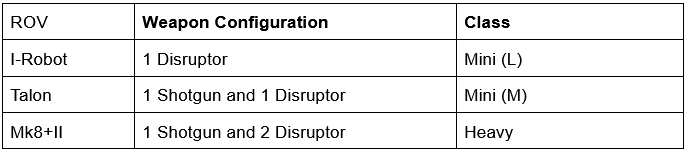
RE12G and RE70 on pipebombs
Use RE12g with a 45 degree angle and 1 slug length (4cm)
Use RE70 1” Barrel with a 45 degree angle and 1 slug length (7cm) aiming approximately 2-3 threads from the start of the screw thread
Evacuation distances
Smaller than suit case: 100m
Suit case or Suicide vest: 200m
Small vehicle bomb: 400m
Large vehicle bomb: 1000m