Paper 2 2026
 Call Kai
 Learn
Learn Practice Test
 Spaced Repetition
 Match
Match Flashcards
 Knowt Play
1/41

There's no tags or description
Looks like no tags are added yet.
Name | Mastery | Learn | Test | Matching | Spaced | Call with Kai |
|---|
No analytics yet
Send a link to your students to track their progress
42 Terms
explain how a resting potential is maintained inside the pacinian corpuscle /2
1.Membrane more permeable to potassium ions and less permeable to sodium ions;
2. Sodium ions actively transported / pumped out and potassium ions in.
describe how the pacinian corpuscle produces a generator potential when stimulated /3
pressure applied deforms the lamellae
lamellae and stretch-mediated Na+ ion channels deform and open, and Na+ ions flow in
depolarisation
After the student had stared at a purple square, he saw a green afterimage.
suggest why /3
red and blue cones stimulated
red and blue stop working
green still working
Cone cells give higher visual acuity than rod cells. Explain how/2
Each cone cell has separate bipolar neurone /separate ganglion cell
(So) no retinal convergence / impulses from each cone kept separate / no summation of impulses;
Exercise causes an increase in heart rate. Describe the role of receptors and of the nervous system in this process 4
Chemoreceptors detect rise in CO2 / H+ / acidity / carbonic acid / fall in pH
send impulses to cardiac centre / medulla;
More impulses to SAN;
By sympathetic
explain the role of chlorophyll in photolysis /3
chlorophyll absorbs light and is oxidised
releases excited electrons
accepts electrons from water, eqm. shifts right
explain how the energy of light is converted into chemical energy in the light-dependent reaction /3
chlorophyll is oxidised
produces excited electrons that travel down electron transport chain
energy released used to make ATP from ADP and Pi
explain why concentration of GP remains constant in a cell /3
GP formed by RuBP + CO2
GP → TP
GP formed at same rate it is used
describe the light dependent reaction /6
Light (energy) excites / raises energy level of electrons in chlorophyll;
Electrons pass down electron transfer chain;
Electrons reduce carriers
Electron transfer chain associated with chloroplast
membranesEnergy released from chain used to ADP + Pi → ATP
Photolysis of water produces O2, electrons and protons - some reduce chlorophyll
NADP reduced by protons and electrons to NADPH
NADPH and ATP enter light independent
suggest three ways to improve validity in a calorimeter experiment /3
using water - high specific heat capacity
leave air space - reduces heat gain
use a stirrer - distributes heat evenly
most of the light falling on producers is not used in photosynthesis. suggest why /4
does not hit chlorophyll
CO2 conc. or temp. limiting factor
wrong wavelength
light reflected
describe how scientists could genetically engineer bacteria to produce a specific enzymes /6
1 Cut gene out of cell, obtain gene with restriction enzymes;
2 Cut DNA using restriction enzyme / plasmid cut with restriction enzyme;
3 Correct reference to sticky ends;
4 Join DNA using ligase / insert gene into vector;
5 Plasmid / named vector transferred to cell;
6 Method of transfer e.g. heat shock;
7 Reference to marker gene;
8 Select bacteria containing new gene
suggest why obtaining DNA fragments with a gene machine is faster than by converting mRNA to cDNA /1
faster gene machine waiting for all the enzyme-catalysed reactions
suggest why phosphorylation of a substrate will enable an enzyme-catalysed reaction to occur /1
substrate more reactive, lower Ea
explain what causes vision using the fovea to be in colour /1
there are three different types of cone cells sensitive to 3 different wavelengths
where are cone cells found and where are rod cells found?
cone cells at the fovea, no rods at fovea
peripheries of retina, only rods
Explain why it takes time for the rod cells to recover their sensitivity to light after moving into darkness /2
rhodopsin has been broken down
time to resynthesise
why might white light be difficult for rhodopsin to absorb?
contains a high proportion of wavelengths of light to which rhodopsin is not sensitive
explain why when an image is focused on the fovea, it is seen in colour /3
colour is detected by cone cells
large number of cones at fovea
three different types of cones, each sensitive to light of a different wavelength
describe how cones allow for images to be seen in detail /3
provides high visual acuity
each cone cell connected to a separate neurone
many separate impulses sent to the brain
explain how rods enable nocturnal organisms to hunt their prey /3
retinal convergence/high sensitivity
three rod cells connected to each neurone
spatial summation allows threshold to be exceeded
give one similarity between taxis and tropisms /1
both are a directional response to a stimulus
Papaya plants reproduce sexually by means of seeds. Papaya plants grown from seeds are very variable in their yield. Explain why /2
meiosis/crossing over
random fertilisation
Explain how genetic fingerprinting allows scientists to identify the father of a particular panda cub /2
all the bands in cub not from mother
must be in father’s genetic fingerprint
explain why PCR was used for DNA fragments before gel electrophoresis /2
only small amounts of DNA obtained
ensures there is enough for genetic fingerprinting
explain why the DNA for each species of shark shows difference in base sequences /2
variations in characteristics and features
caused by mutations
explain why a primer will only bind to the DNA of one species /2
primers bind by complementary base pairing
primer has different DNA sequence to DNA of other species
the length of DNA fragment of each species in is different. explain why this is important in identifying the involved shark species /3
fragments separated by gel electrophoresis
different positions of bands can be identified on the gel plate
shortest fragments move furthest
In conventional DNA fingerprinting, a series of bands is produced on the electrophoresis gel, resembling the rungs of a ladder. When the DNA in this new genetic fingerprinting technique is run in an electrophoresis gel it produces just one of these ‘rungs’.
Explain the reason for the difference in the number of ‘rungs’ produced/2
traditional gel electrophoresis separates many lengths
this method separates one lengths
Explain how DNA could be present on a toothbrush /2
cells present on toothbrush
all cells contain DNA
explain why it takes longer to obtain a genetic fingerprint if the sample is contaminated /1
other DNA must be removed
Explain how meiosis results in this plant producing gametes with these genotypes /2
meiosis separates homologous chromosomes
independent assortment
what is biomass
the mass of living tissue at a specific time in a given area
what is GPP
chemical energy store in plant biomass, in a given area or volume
what is NPP
the chemical store of energy in plant biomass in a given area or volume, after respiratory losses have been taken into account
why is the proteome larger than the genome?
post-translational modification of proteins
alternative splicing (different sections of DNA can be spliced, producing different proteins)
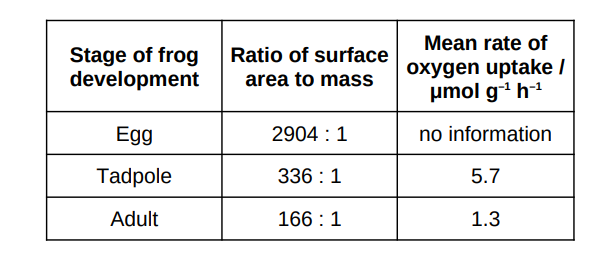
suggest why the scientists were unable to make a conclusion /3
no stats test
no data for egg
cannot compare to tadpole and adult
how does pyruvate enter the matrix in aerobic respiration?
active transport
what is pyruvate converted to in link, and how?
oxidised to acetate
how can lipids be used as a respiratory substrate?
lipids hydrolysed to glycerol and fatty acids
glycerol phosphorylated → triose phosphate, enters glycolysis then krebs
fatty acids → 2C fragment → acetyl coA, goes to krebs
how can proteins be used as a respiratory substrate?
proteins hydrolysed to amino acids, deaminated
3C compounds converted to pyruvate
4C and 5C converted to intermediates in krebs
Suggest the advantage of less blood flow in the mesenteric artery during exercise /3
more blood to respiring muscles
more oxygen available for aerobic respiration
meets increased demand for energy during exercise